Indonesia executes six drug convicts, five of them foreigners

Indonesia executes six drug convicts, five of them foreigners
Widodo has pledged to bring reform to Indonesia

Ban appeals to Indonesia to stop death row executions

Ban appeals to Indonesia to stop death row executions
United Nations Secretary General Ban Ki-moon has pleaded to Indonesia to stop the execution of prisoners on death row for drug crimes. AFP PHOTO

Pope: 'Death penalty represents failure' – no 'humane' way to kill a person

Pope: 'Death penalty represents failure' – no 'humane' way to kill a person
The pope wrote that the principle of legitimate personal defense isn’t adequate justification to execute someone. Photograph: Zuma/Rex

Obama becomes first president to visit US prison (US Justice Systems / Human Rights)

Obama becomes first president to visit US prison   (US Justice Systems / Human Rights)
US President Barack Obama speaks as he tours the El Reno Federal Correctional Institution in El Reno, Oklahoma, July 16, 2015 (AFP Photo/Saul Loeb)

US Death Penalty (Justice Systems / Human Rights)

US Death Penalty (Justice Systems / Human Rights)
Woman who spent 23 years on US death row cleared (Photo: dpa)


.

.
"The Recalibration of Awareness – Apr 20/21, 2012 (Kryon channeled by Lee Carroll) (Subjects: Old Energy, Recalibration Lectures, God / Creator, Religions/Spiritual systems (Catholic Church, Priests/Nun’s, Worship, John Paul Pope, Women in the Church otherwise church will go, Current Pope won’t do it), Middle East, Jews, Governments will change (Internet, Media, Democracies, Dictators, North Korea, Nations voted at once), Integrity (Businesses, Tobacco Companies, Bankers/ Financial Institutes, Pharmaceutical company to collapse), Illuminati (Started in Greece, with Shipping, Financial markets, Stock markets, Pharmaceutical money (fund to build Africa, to develop)), Shift of Human Consciousness, (Old) Souls, Women, Masters to/already come back, Global Unity.... etc.) - (Text version)

… The Shift in Human Nature

You're starting to see integrity change. Awareness recalibrates integrity, and the Human Being who would sit there and take advantage of another Human Being in an old energy would never do it in a new energy. The reason? It will become intuitive, so this is a shift in Human Nature as well, for in the past you have assumed that people take advantage of people first and integrity comes later. That's just ordinary Human nature.

In the past, Human nature expressed within governments worked like this: If you were stronger than the other one, you simply conquered them. If you were strong, it was an invitation to conquer. If you were weak, it was an invitation to be conquered. No one even thought about it. It was the way of things. The bigger you could have your armies, the better they would do when you sent them out to conquer. That's not how you think today. Did you notice?

Any country that thinks this way today will not survive, for humanity has discovered that the world goes far better by putting things together instead of tearing them apart. The new energy puts the weak and strong together in ways that make sense and that have integrity. Take a look at what happened to some of the businesses in this great land (USA). Up to 30 years ago, when you started realizing some of them didn't have integrity, you eliminated them. What happened to the tobacco companies when you realized they were knowingly addicting your children? Today, they still sell their products to less-aware countries, but that will also change.

What did you do a few years ago when you realized that your bankers were actually selling you homes that they knew you couldn't pay for later? They were walking away, smiling greedily, not thinking about the heartbreak that was to follow when a life's dream would be lost. Dear American, you are in a recession. However, this is like when you prune a tree and cut back the branches. When the tree grows back, you've got control and the branches will grow bigger and stronger than they were before, without the greed factor. Then, if you don't like the way it grows back, you'll prune it again! I tell you this because awareness is now in control of big money. It's right before your eyes, what you're doing. But fear often rules. …
Showing posts with label Cruise. Show all posts

Sunday, January 29, 2017

Hoping for a fresh sea breeze aboard a cruise ship? Better hold your nose!

French TV journalists have secretly measured the air quality on a cruise ship. The results are devastating: The air is significantly worse polluted than it would be in thick urban traffic.


Deutsche Welle, 26 January 2017

Cruises are increasingly popular among today's tourists. They offer relaxation with 24-hour service for stressed out office workers.

Forget about searching for the perfect, pristine beach - which most people will never find, anyhow. Instead, just go to the pool on the upper deck, enjoy some tasty drinks and take in breathtaking views of the ocean from high above. For people who need less contemplation, cruises offer theater and show performances, generous meals, bars and shopping opportunities.

That doesn't mean you're in for a boring vacation: Adventure comes as part of the risk free deal. Even frail seniors can now feel like mystic characters such as Long John Silver from Treasure Island or real explorers like Roald Amundsen - be it by cruising the romantic Carribean, visiting savage South Sea islands or admiring polar bears on impenetrable arctic shores. Finally you can do something for your health by going to the ship's gym and getting a good work out.

Tourists want to enjoy themselves - and the fresh sea breeze.

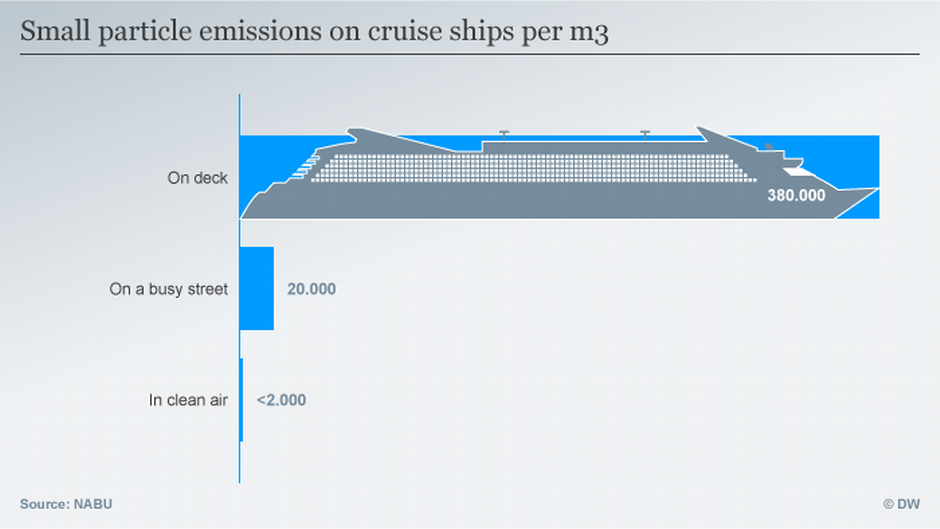
But you better think twice about taking a deep breath. The German Environmental Association "Naturschutzbund Deutschland"(NABU) now warns that it is more likely you inhale polluted air than a fresh breeze. NABU says that it cannot recommend any of the large European cruise ships.

"Pamphlets lead you to believe that there are blue skies and white ships - a dream-like setting," Daniel Rieger, who is in charge of transportation policies at NABU, said. "The truth is that clouds of black soot are emitted from the funnels."

Measuring results are worse than expected

Recent measurements of actual air quality onboard a cruise ship seem to support NABU's view. French TV journalists from broadcaster France 3 conducted covert measurements while on a cruise. They boarded a ship in Marseille for a cruise of the Mediterranean.

Results show that "the shipping companies are exposing their travelers to high concentrations of harmful substances," NABU managing director Leif Miller concluded.

Even environmentalists were surprised by the high concentrations that the journalists detected. Right after leaving Marseille, air pollution was roughly 200 times that of a heavily trafficked urban street.

Besides fine dust and soot, the combustion of marine diesel fuel and heavy oil also set free other harmful substances such as nitrogen oxides and heavy metals.

Former captain and ship broker Helge Grammerstorf, who is the German national director of the Cruise Lines International Association CLIA, defends his industry. He told the daily "Hamburger Abendblatt:" "We don't know these measurements. The claim is completely unsubstantiated."

Grammerstorf argues that the measurements were taken only selectively and that one would need to run a more systematic test to collect data over a longer time period.

Hardly noticeable for passengers

"The passengers can only smell or see the particles before they get mixed up with the ambient air," NABU spokesman Rieger said after the France 3 test results were published.

He argued that it wouldn't take the shipping companies much to change the pollution and to increase comfort. "Even switching from marine diesel fuel or heavy oil to regular road diesel fuel would make a big difference," he said.

In addition, it wouldn't be too hard to install effective exhaust cleaning systems, according to NABU. Such systems have long existed with established standards for trucks and trains.
"The question is whether the industry deliberately looks the other way," Dietmar Oellinger - NABU's transport expert - said.

He suggested that the tests taken by the French journalists were merely an example and could possibly be representative for the entire cruise ship industry.

"The reality is black soot from the chimneys," NABU environmentalists say.

"We should ask how much more proof the industry needs before they finally take action," Oellinger said.

Some cruise lines have pledged to install particle filters, but so far, there are none in use.

Covert measuring only in the harbor

Previously, NABU has only had the opportunity to measure harmful ultra fine dust particles in the air around cruise ships in harbors. They have done so in Hamburg, Venice and the north-eastern German city of Rostock-Warnemünde. The ship owners did not allow the environment agency to take measurements on board, Daniel Rieger said.

The results were devastating nonetheless: In all cases the ships were burning off heavy oil. Four of five ships were not equipped with any exhaust gas cleaning or they were only fulfilling the lowest legal standard for northern Europe - a system that only reduces sulfur oxide emissions.

Technical solutions to reduce particle and nitrogen oxide emissions have long been on the market, though. Therefore, NABU argues, not implementing them is largely due to greed. It would cost money to install the system and furthermore require the companies to use more expensive types of fuel.

Almost as dangerous as asbestos

The German Lung Foundation already recommended several years ago that people with chronic respiratory diseases only stay on certain parts of the deck when on a cruise ship and thus avoide breathing in the ship's exhaust.

The World Health Organization (WHO) has concluded that diesel exhaust is just as carcinogenic as asbestos. The ultrafine particles, which are smaller than 0.1 micrometer can get into the smallest pulmonary alveoli and from there into the blood stream and other organs.

NABU manager Leif Miller argues it's cynical that the cruise ship companies "pay huge sums to improve entertainment and gastronomical services on board, but save as much as they can when it comes to environmental protection."

Meanwhile, in Germany the cruise ship industry is getting ready for the next season: In Warnemünde, Hamburg and Kiel alone, more than two million passengers are expected to board the giants of the seas in 2017.

Related Articles:


Thursday, February 11, 2016

World tourism map redrawn since attacks, epidemics, migrants

Yahoo – AFP, Katia Dolmadjian, 10 February 2016

People react at the site of a shooting attack on the beach in front of the Riu Imperial 
Marhaba Hotel in Port el Kantaoui, on the outskirts of Sousse south of the capital 
Tunis, on June 27, 2015 (AFP Photo/Kenzo Tribouillard)

Paris (AFP) - The world's tourism map is being redrawn at lightning speed as holidaymakers switch preferences prompted by terror attacks, epidemics and migrant crises.

Jihadist attacks on tourists in Tunisia last year and the October 31 crash of a Russian plane which took off from its Egyptian Red Sea resort of Sharm el-Sheikh have devastated the tourism sectors in both countries.

An Egyptian man waits with his camel for
 customers near the pyramids in the southern 
Cairo district of Giza on January 19, 2016
(AFP Photo/Khaled Desouki)
But Muslim countries everywhere are the main losers of the shift in tastes, sector professionals say, as tourists move to destinations they consider safe -- so long as they're also sunny.

Overall, world tourism has never been in better shape. Nearly 1.2 billion people travelled abroad in 2015, an increase of 4.4 percent over the previous year, but the casual observer could be fooled by the sight of deserted North African beaches, once tourist hotspots.

Tunisia, which built its tourism industry on guaranteed sunshine and rock-bottom prices, is the most stunning example of the devastating impact of security fears after murderous attacks targeted foreigners.

Visitor numbers to Tunisia tumbled by two million in 2015, leaving coast resorts empty, hotels idle and the economy in tatters.

Tunisia's tourism sector accounted for almost 10 percent of the nation's economy.

'Muslim countries are suffering'

Turkey is another victim of attack fears. Germany's TUI, the world's biggest tourism group, said Tuesday that it had seen bookings to Turkey drop by 40 percent in the wake of an Islamic State suicide attack in Istanbul.

Turkish media, meanwhile, reported that visitor numbers to the top Turkish resort of Antalya dropped by 17 percent last month, the lowest level for the month of January in a decade.

Some destinations are collateral damage from attack fears, as tourists appear to make little distinction between countries within the Middle East or North Africa, as Jordan has found to its cost.

"There was no attack, but we were affected tremendously by a drop of visitors coming from Europe," Jordan's tourism minister Nayef al-Fayez said recently.

Turkey is another victim of attack fears, with tourism numbers dropping in 
some cases by 40 percent (AFP Photo/Ozan Kose)

"All Muslim countries are suffering to a greater or lesser degree, even those which have been made totally secure, like Oman," said Jean-Francois Rial, chairman of French travel operator Voyageurs du Monde.

"The only exception is Iran, but they've started from scratch," he told AFP, noting that many European agencies have begun offering travel to Iran since Western powers have started dismantling sanctions.

"There is no doubt that the whole Middle East region is today associated with insecurity in the mind of the Western tourist," said Wouter Geerts, analyst at the Euromonitor research company.

"We expect countries such as Greece, Portugal and Spain to largely benefit from the situation, offering similar weather, competitive prices, and security," he said.

The sudden surge in demand is leading to higher prices in these destinations.

"Hotel owners tell clients 'Instead of charging 50 euros per double room, I'm going to charge 55, take it or leave it. If you don't want it, others will'," said Olivier Petit, at the In Extenso firm.

Cuban bottlenecks

Cuba, which already got a boost from the thawing of relations with the United States in late 2014, is now also battling with bottlenecks, with daily arrivals of huge cruise ships in the Havana bay.

Cuba is now also battling with bottlenecks of tourists, with daily arrivals of huge
cruise ships in Havana bay (AFP Photo/Ana Rodriguez)

"I have a group of 250 people arriving this week and I've just heard that I can no longer count on 80 rooms that were booked and paid for in March, all because of over-booking," said Stephane Ferrux, director of French specialist travel agency "Cuba autrement" ("Cuba with a difference").

Tourism numbers in Cuba rose by 17 percent in 2015, "but the country is not ready, they don't have the quality to justify prices that have gone up by half in a year. Everybody wants a piece of the cake," he said.

Haiti's unspoilt beaches are also becoming a magnet for tourists, six years after the country was devastated by an earthquake.

Battalions of tourists have been going to Colombia, Peru, Mexico and Argentina, but Latin American destinations could soon be affected by the spreading Zika crisis, experts say, pointing to the impact on sub-Saharan Africa of Ebola, of Chikungunya in the Carribbean and MERS Coronavirus, or Camel flu, in South Korea.

The migrant crisis has also taken a heavy toll on Greek islands, once a very safe bet for operators, but where masses of refugees have landed, scaring tourists.

"The Greek islands, especially tourism in Kos, have been severely damaged, as holidaymakers feel uneasy about the situation," according to Euromonitor, pointing to data saying that there were 178,000 cancellations of Kos bookings between January and August 2015.

Wednesday, February 4, 2015

Four Countries Reportedly Set to Join List of Visa-Free Travel to Indonesia

Jakarta Globe, Feb 04, 2015

A manta ray swims in the waters of Raja Ampat in eastern Indonesia's remote
Papua province. (AFP Photo)

Jakarta. Indonesia plans to offer visa-free travel to visitors from China, Japan, Russia and South Korea as a tactic to boost tourist numbers, a report said on Wednesday.

Indroyono Soesilo, the coordinating minister for maritime affairs, told Tempo. co that the four countries would join the existing 19 nations whose citizens can enter Indonesia without a visa.

Indonesia recorded 8.8 million foreign tourists in 2013, a 10 percent rise on the 8 million visitors in 2012.

In 2013 there were 747,921 tourists from China, or 8.5 percent of the total.

Indonesia’s neighbors have proved a more attractive place to visit over the years, due to better marketing and infrastructure and fewer visa restrictions. Malaysia recorded 25 million foreign tourists last year, helped in part by offering visa-free travel for 90 days to citizens of many countries.

Indroyono is also keen to provide incentives for foreign cruise vessels to dock in Indonesia. Seven new docks are in the works, the minister said.

“For example, we will give foreign cruises and yachts permission to park at the dock for 6 months,” Indroyono said.

Friday, May 16, 2014

Govt Plans to Open Komodo to Cruise Ships

Jakarta Globe, May 16, 2014

Komodo dragons mating. (Photo via Wikimedia Commons)

Jakarta. East Nusa Tenggara’s provincial tourism agency on Friday said it had appropriated Rp 60 billion ($5.26 million) to build a floating aluminum dock off Komodo that would open the island to cruise ships.

“This year we’ll build a cruise ship dock on Komodo Island,” tourism secretary Wely Rohimone said, as quoted by state-run Antara News Agency. “We’re in the preparation process.”

Wely said the dock would be finished in 2015 and would be built to last for 25 years.  The project, Wely said, would come as part of a broader effort to make Komodo National Park easier to visit.

Komodo and a handful of nearby islands, the only known habitats of the Komodo dragon, are increasingly popular as tourism destinations but remain relatively difficult to access.

The Komodo dragon has been classified by the International Union for the Conservation of Nature as a vulnerable species.

Tuesday, January 17, 2012

First big cruise ship berths at Benoa, Bali

Antara News, Tue, January 17 2012

Related News

Denpasar, Bali (ANTARA News) - Deputy Minister of Tourism and Creative Economy Sapta Nirwandar said a cruise ship named MV Legend of the Seas was the biggest yacht to berth in Benoa Harbor, Bali.

Cruise Ship Photo: MV Legend
of the Seas
"Previously, cruise ships of the same size as the Legend could not berth at any Indonesia port. They could only throw anchor some distance from the coast and transport passengers to the shore by small boats," he said here Monday.

Sapta Nirwandar also said the 264.3-meter-long Legend of the Seas was the biggest cruise ship to berth at an Indonesian port, in this case Benoa, Bali.

Meanwhile, the harbor and dredging director of Bali`s Transportation Office, Kemal Heryandri, said Benoa harbor was ready to receive big ships from overseas.

Kemal Heryandri said coral reefs in the harbor waters had been removed in 2011 to ensure the navigation safety of big ships, even of ships bigger than the MV Legend. Besides, Kemal added, the local government had also dredged the coastal waters up to a depth of 11 meters.

"In 2012, the dredging will reach 12 meters to enable big cruise ships to berth easily and safely," Kemal said.

President Director of PT Indonesia Harbor (Pelindo) III, Djarwo Surjanto, had previously said Benoa would be the first port in Indonesia able to receive the Legend of the Seas.

The cruise ship had 2,300 passengers and a 1,000-strong crew on board when it arrived in Benoa.

"The Legend`s visit will attract world attention because it is the first time for a big cruise ship to berth at an Indonesian port," Djarwo said.

Editor: B Kunto Wibisono

Monday, January 2, 2012

Bali Increasingly a Stop for the World’s Cruise Ships

Jakarta Globe, Made Arya Kencana, January 02, 2012

Bali has increasingly become a stop on the itineraries of cruise ships. Officials,
 and a port official says 2012 promises to be the biggest year yet for the island.
 (JG Photo/J.P. Christo)
      
Related articles

Denpasar. Bali has increasingly become a stop on the itineraries of cruise ships, and a port official says 2012 promises to be the biggest year yet for the island.

Iwan Sabatini, the general manager of Pelabuhan Indonesia III, which manages Benoa Port in southern Bali, said on Monday that 35 cruise ships berthed at the port last year, compared to 27 in 2010 and 15 in 2009.

“That number exceeded our target. We were really happy,” Iwan said.

The target for this year, according to Iwan, is 28 visits. That should not be too difficult to achieve, with Iwan saying 38 cruise ships had already indicated tentative plans to stop at Bali in 2012.

The first of those 38, the Legend of the Sea, a luxury cruise ship operated by Miami-based Royal Caribbean, is scheduled to berth at Benoa this month.

The 264-meter-long ship was scheduled to stop at the port last year but was unable to stop because the water was not deep enough in front of the jetty.

Iwan said they had completed work to deepen the sea to at least nine and a half meters for a width of 150 meters all along the jetty.

Bali is constructing a deep port for cruise ships in Tanah Ampo, in Karangasem district. The project had been halted because of funding problems but the Karangasem district chief, I Wayan Geredeg, said a new agreement signed by the ministries of transportation, people’s welfare, tourism and the creative economy, and maritime affairs and fisheries would allow work to resume soon.

Geredeg said the Tanah Ampo cruise ship terminal would provide another major gateway for tourists to arrive on the island, in addition to Ngurah Rai International Airport.

More than 2.5 million foreigners visited Bali in 2010, and the target for last year was 2.6 million to 2.8 million.

Tuesday, January 4, 2011

RI, Singapore to jointly develop cruise ship tourism

Erwida Maulia, The Jakarta Post, Jakarta | Tue, 01/04/2011

Indonesia and Singapore have agreed to jointly develop cruise ship tourism in the neighbors' latest move to boost bilateral economic ties.

Indonesian Coordinating Minister for the Economy Hatta Rajasa said here on Tuesday that the agreement was reached after a meeting between Singaporean Trade and Industry Minister Lim Hng Kiang at the former’s office in Jakarta.

“Singapore is enjoying a cruise tourism boom and they need areas that the cruises can visit; one of them being Bali. From Bali they can explore eastern Indonesia, which has many potential marine tourist sites,” Hatta said.

He further elaborated that cruise ship tourism was one of six sectors Indonesia and Singapore wished to develop together.

Other targets of bilateral cooperations include civil aviation, manpower, agribusiness, investments, and cooperation in the special economic zones of Batam, Bintan and Karimun; three Indonesian regions bordering with the city state.

On the agribusiness sector, Hatta said the two countries had agreed that Indonesia would increase its vegetable and fruits exports to Singapore by 20 percent each year.

Monday, May 10, 2010

Komodo, Indonesia: Into the dragons' den

Sailing on a schooner around eastern Indonesia, Natalie Paris mixes sunbathing on deck with a spot of island exploration - and a meeting with the carnivorous lizards of Komodo.

Telegraph.co.uk, By Natalie Paris, 11:09AM BST 10 May 2010

While not exactly fire-breathing, these large monitor lizards have an acute sense of smell, large claws and a toxic bite

Indonesia's vast archipelago has always lured adventurers, with tales of stormy straits, desert islands and man-eating dragons. European trading ships sailed here in the 16th century in search of treasures. These days the Spice Islands, now known as Maluku, have fallen off the charts of the average seafarer, but farther south, legends of dragons live on. Here lie remote islands perfect for modern voyages of discovery.

Related Articles


Dirk Bergsma, a latter-day explorer, got his first taste of the country in the Seventies when he caught a lift on a wooden schooner locals used to transport cargo. The journey inspired him to found a tour company, Sea Trek, that organises intrepid but relaxed cruises along the old spice routes. "You can sail to places so incredible you can't believe they still exist," he says.

Nearly two decades after Dirk bought his first schooner, I joined 14 other passengers boarding another on an adventure of our own. We might have had gin-and-tonics, sun loungers and a wonderful crew who rinsed our walking boots for us, but we still felt like adventurers.

Each day would start with some sailing, typically past pods of dolphins and lackadaisical turtles

The double-masted Katharina sails all over the eastern archipelago, including to Maluku, but our voyage was the most accessible that she offers – a 10-day trip east from Bali to the island of Flores and back. This popular itinerary allowed us to make various stops within the Komodo National Park, a diver's haven with sharks and manta rays below the surface, and above it, the island homes of one of the world's most impressive creatures – the Komodo dragon.

While not exactly fire-breathing, these large monitor lizards have an acute sense of smell, large claws and a toxic bite. Although they eat mainly carrion, they prey on deer and water buffalo, and have killed a human as recently as 2009. From Ari, our companionable guide on board the Katharina, I learnt that the dragons eat their dead and are cannibals, forcing their young to live in trees for up to five years to avoid being attacked. Suddenly our planned two-hour hike to spot them seemed less appealing, knowing that they could be anywhere around us – on land, in branches above us, in the sea. That's right. They swim, too.

An encounter with the lizards is certainly the most obvious reason to explore this scattering of volcanic islands, but there are plenty of others. In the couple of days before we went in search of dragons, the boat stopped at Flores ("Flowers"), an island named by the Portuguese that has smoking cones, fertile flanks and forested ridges studded with the tin roofs of villages glinting in the sun.

The winding island road, forever either climbing or falling, is lined with Catholic churches, neat wooden houses and tethered goats, pigs and tawny cows. As our driver negotiated the many switchbacks through the lush interior, old women squatting next to fires of coconut husks smiled up at us through lips stained red by betel-nut juice, and schoolchildren yelled "Hello, mister" at every bend.

We had come inland to see the dramatic crater lakes at the top of Mount Kelimutu, which change colour depending on mineral levels and have, in the past, been a rainbow palate of brown, cream, red, blue and emerald green. Kelimutu's three lakes have a spiritual meaning for locals and represent the afterlife.

The dramatic crater lakes at the top of Mount Kelimutu have, in the past, been a rainbow palate of brown, cream, red, blue and emerald green

At sunrise, two lakes that were brilliant turquoise during my visit were the first to be bathed in light. These are the two that welcome the spirits of the good and the young, and the sun gave them a pinky halo. Yet a chill remained at the third, on the other face of the mountain, supposedly the resting place of evil spirits. This lake was as black as an inkwell and, while it was shrouded in shadows, an air of foreboding was almost tangible.

That feeling returned a few days later on the boat, as we checked our zoom lenses and prepared to set foot on Rinca island, dragon territory. Rinca and neighbouring Komodo, where the dragons also live, have a more arid landscape than Flores. Shoes or flip-flops, I wondered? Apparently the dragons can launch themselves into a sprint as quickly as a small dog. Shoes it was, then. I had just started to weigh up whether it would be safer to stride out with the ranger or stay close to the group when our first group of dragons appeared right in front of us.

Six or seven lay under a ranger's hut, the occasional yellow forked tongue sliding from square jaws. They were just as big as I had imagined. Shutters whirred and we edged nearer. "Careful," one of the rangers said. "Not too close."

For a minute the dragons seemed docile. But then something disturbed the group. In a flash they rose up on haunches encased in folds of scales and darted forward at speed, their thick bodies switching from side to side in a manner that was alarming in something 10 feet long. Deep inside, some innate urge screamed "Run".

I flinched and the ranger laughed. "Don't worry," he said, waving a stick as if idly flapping at a mosquito. "Their noses are really sensitive; they will run away." We had no choice but to believe him and follow him into the woods.

These stocky predators are the largest lizards on earth and are a protected species. There are only about 4,000 of them living in the wild, all found on this cluster of islands. We spotted one with its head close to the ground, camouflaged by the trees. "He is waiting for a monkey," the ranger said. Sure enough, 15 yards along the track we saw a young family of long-tailed macaques skipping along the forest floor.

On the crest of a hill another dragon sat on its hind legs, leaning against a rock and staring down at the bay where the Katharina was docked. Fearing an ambush of the kind recently filmed by the BBC's Life crew – in which dragons had sat mercilessly waiting for a wounded buffalo to die, tongues flicking in anticipation – our group filed back down to the jetty with new purpose.

It was a pleasure to return to the blissfully relaxing routine of the Katharina. Soon I was sitting with my legs over her bow, sea salt in my hair and the waves slapping at my bare soles, watching another uninhabited island slip out of view.

On board were seven air-conditioned, amply appointed cabins, shared by passengers from all over Europe. We ate communal dinners with wine at a large, deck-top dining table and there were sun loungers for optional massages against the backdrop of sublime sunsets. The small lounge and bar downstairs was the perfect nook for nightcaps, and the crew raised handsome maroon sails whenever there was a brisk wind.

Each day would start with some sailing, typically past pods of dolphins and lackadaisical turtles, sheets of ferocious currents and whirlpools. Then, as we travelled slowly back to Bali, we would drop anchor in order to visit island communities on Flores, Sumbawa and Lombok. Some demonstrated how to weave ikat cloth, others how to master the steps of traditional dances.

In Sumbawa we disembarked onto a beach at Wera, where village children ran out to greet us and show us half-built wooden ships positioned like breakers along the black sand. Skilfully made but incomplete, they resembled skeletal Mary Celestes that required years of crafting before they could be blessed and put out to sea.

Sumptuous lunches would be dished up on board before afternoons spent snorkelling or exploring pristine beaches, such as the smudged pink sand at Gili Banta, turquoise bays around Riung and the corals at Gili Lawa.

Afternoons would be spent snorkelling or exploring pristine beaches, such as the turquoise bays around Riung

We came to learn that other passengers had enjoyed previous voyages on the Katharina. At night they swapped stories under the stars of journeys further east, of meeting warrior tribes and sailing through the Alor strait, where "there was nothing but swirling seas". A retired Dutchman told me on our final night: "You should come when we sail to Papua. Now that is truly magnificent."

As we approached the glittering lights of Bali's coastline, I felt every bit the returning explorer, with a successful voyage and encounter with fearsome reptiles under my belt. Even in this day and age, new adventures are always possible at sea.

Explore

(0844 499 0901; www.explore.co.uk) offers 16-night "East Indies Seatrek" tours including a 10-day Bali-Flores-Bali voyage on the Katharina between May and October. The trip includes four nights in a hotel in Bali on a b & b basis and nine nights' full board in ensuite cabins on the schooner: prices from £2,370 with international flights; £1,621 without. Between July and August, places are available for children at £2,478, with adult places costing £2,601, both with flights.

Sea Trek

(0062 361 283358; www.anasia-cruise.com) offers a range of voyages on the Katharina to Indonesian destinations farther afield.

Friday, May 7, 2010

Metro Madness: Riverboat Ranting

Jakarta Globe, Simon Pitchforth, May 07, 2010

The heart of darkness is fully wired these days.

This week, I managed to skip Jakarta’s 21st century heart of darkness and headed into the jungles of Borneo for a few days to do a “Lord Jim.” In Conrad’s novel, Jim, a disgraced young seaman, heads into the jungle in order to live with the Dayaks. So I rocked up to Palangkaraya in central Kalimantan with a bag full of mosquito repellent and amusing hats.

Palangkaraya is a small city that received a lot of attention from Sukarno, who considered making it the Indonesian capital at one point. The nation’s first president got the Russians to build some nice, wide boulevards around town when he was flirting with the red menace and also had a fancy woman shacked up here in a rather tasteless pied-a-terre. Even Sukarno’s successor Suharto, rather hubristically decided to make Indonesia self-sufficient in rice by draining the peat swamps in the huge rainforests and jungles that lie beyond the city to start a huge planting program. Not only did the rice not materialize, due to the peat soil being too acidic for the stuff to grow in, but the release of previously locked-in carbon from the dried out swamps has helped Indonesia reach its current status as the world’s third-largest producer of greenhouse gases. In the words of that intellectual colossus, Homer Simpson, “Doh!”

Along with that, rampant deforestation, slash-and-burn agriculture, forest fires, palm oil plantations and a rapidly dwindling orangutan population have prompted a veritable army of tree-hugging, granola munchers to descend on the area to hold conferences and try to engage rainforest communities in conservation efforts.

However, I wasn’t in town to jam with either Sting, Bono or Bob Geldof. My plan was to ford upstream into the jungle on a pleasant three-day riverboat cruise.

For the past few years, a couple of lovely ladies, Lorna Dowson-Collins and Gaye Thavisin, have run eco-tours from Palangkaraya up into the lush jungles of Borneo. The pair have built a huge cruise boat, which can house groups of up to 10 people, with a spacious top deck on which tourists can recline in comfort and spy on the orangutans at the water’s edge as they muck about and exhibit appalling table manners.

The rivers themselves are quintessential jungle waterways. As calm as mirrors and between 50 and 100 meters in width, they meander through lush protected forests with only the occasional illegal gold mining operation or chainsaw buzzing in the distance to remind one of the dangers that this ancient environment now faces. The tour is an educational one and has previously been enjoyed by various European and Australian parliamentary delegations, as well as the prince of Denmark, who apparently had a whale of a time.

We made a brief stop at an orangutan rehabilitation center and learned that some of these hairy chaps are in a very sad state indeed. Orphaned and suffering from malaria, flu or other ailments, the center nurses them back to health and releases them back into the wild. It’s becoming a losing battle, however, as there are now more orangutans coming in than going out.

The cruise itself is magnificent and takes one through idyllic areas of primary rainforest as yet completely unspoiled by man and his vociferous appetite for destroying things and soiling his nest. Mind you, I was still able to get a mobile phone signal for the entire duration of the trip. The heart of darkness is fully wired these days, you understand.

If you’re up for a cruise like this then take a look at: www.wowborneo.com. An interesting one will be taking place between May 20 and May 23, in fact. If you find the Jakarta Highland Gathering a bit passe then the Isen Mulang Cruise will take you to the traditional Dayak games of the same name. One of the events is a game of soccer played with a burning coconut. Silly sods.

Meanwhile, in terms of saving this ancient environment, consumer choice is perhaps your best weapon. Don’t eat the baso (meatballs) in East Java that locals were recently found making from kidnapped monkeys. Perhaps another thing to avoid would be palm oil, which is apparently present in 10 percent of all supermarket products. Giving up Indonesia’s Blue Band palm margarine shouldn’t be too difficult for Westerners though, seeing as the stuff tastes like clarified goat bile. Mind you, the less we eat of the stuff, the more that can be used as chainsaw lubricant. Anyway, let’s all sit in a circle now and sing, “We shall overcome.”

Simon Pitchforth has lived in Indonesia for well over a decade and is the editor of Jakarta Java Kini magazine.

Wednesday, March 24, 2010

Panamaian yacht to call at Jayapura

Antara News, Wednesday, March 24, 2010 19:56 WIB

Jayapura (ANTARA News) - A yacht flying the Panamanian flag with 300 European tourists on board is scheduled to dock at Jayapura`s Yos Sudarso seaport on Thursday (Mar 25).

This was disclosed by the Jayapura immigration chief Roberth Silitonga here Wednesday.

The luxury boat will call at Jayapura for one day after visiting Papua New Guinea (PNG).

"Many of the passengers planned to enjoy the various tourist objects in Jayapura," the said.

Monday, December 21, 2009

Dutch tourist arrivals in Bali up 22 pct

Antara News, Monday, December 21, 2009 18:12 WIB

Denpasar (ANTARA News) - The number of Dutch tourists visiting Bali in the first ten months of 2009 rose 22.01 percent to 63,622 from the same period last year.

The figure put Dutch in the tenth place as the resort island`s source of foreign tourists, overtaking the US, Head of the Bali Provincial Statistics Office Ida Komang Wisnu said here on Monday.

It was only in the past three months that the European country overtook the US, he said.

The Dutch tourists accounted for 3.21 percent of 1,982,274 foreign tourists visiting Bali in the January-October 2009 period, he said.

Compared to the same period last year, the number of tourist arrivals in Bali in the year ended October 2009 rose 14.22 percent, he said.

The vast majority of the Dutch tourists visited Bali via Ngurah Rai Airport. Only eight of them came to the resort island by cruise liner.

Ida Komang said six of the ten biggest sources of foreign tourists contributed significantly to the total number of tourists visiting Bali over the period. The number of tourists from China rose 65.29 percent, France 51.07 percent, Australia 35.46 percent, Dutch 22.91 percent, Britain 12.36 percent, and Malaysia 9.14 percent.

Meanwhile, the number of tourists from Japan fell 9.12 percent, South Korea 6.11 percent, Taiwan 9.25 percent and Germany 7.20 percent.

Wednesday, March 18, 2009

City welcomes 900 cruise ship tourists for a day

The Jakarta Post, Wed, 03/18/2009 2:34 PM

JAKARTA: The Costa Allegra cruise ship was docked at Tanjung Priok seaport in North Jakarta recently, carrying 900 tourists from Europe and Asia, an official said Tuesday.

The tourists were welcomed by by Betawi Dancers and as well as a Welcome Dance by children from Delima Studio, in Tebet, South Jakarta.

About 400 of the tourists got off the ship to tour the capital, riding 16 buses to the National Monument in Central Jakarta, the Indonesian Miniature Park (TMII) in East Jakarta, the Old Town area in North and West Jakarta and several shopping centers. They were accompanied by 20 guides.

"I hope the tourists get a positive impression of Jakarta and return here," Arie Budhiman, head of the city's tourism agency said, as quoted by beritajakarta.com.

Friday, March 13, 2009

Florida Offered Lombok Tour Package

Friday, 13 March, 2009 | 12:58 WIB 

TEMPO Interactive, Mataram: Leaders of the Association of Indonesia Tours and Travel (ASITA) in West Nusa Tenggara (NTB) plans to offer a tour package to cruise providers at the Seatrade Cruise Shipping Convention in Miami, Florida, USA, March 16-19. 

A cruise only visits Lombok once a year with 1,200 foreign tourists. After this convention, it is expected to visit Lombok 5-6 times a year. 

“We have to be proactive or Lombok will be forgotten,” ASITA's head, Awanadhi Aswinabawa told Tempo, Friday (13/3), who leads NTB delegation in the convention. 

He said that cruises visit Benoa in Bali and Komodo island in East Nusa Tenggara more than Lombok. Komodo island is included as one of the wonderful world heritages. Most cruises end up in Malaysia or Singapore. 

Seatreade Cruise Shipping Convention is the biggest shipping convention in the world. Shipping providers, operators, associations, services, from around the world attend the convention. 

SUPRIYANTHO KHAFID

Wednesday, February 11, 2009

The Rhapsody Docks in Lombok

Wednesday, 11 February, 2009 | 18:44 WIB 

TEMPO Interactive, Mataram:Around 1.200 international tourists sailing on the cruise ship Rhapsody of The Seas will dock in Lombok next Tuesday. They will have a day visit to the handicraft center in Rungkang Jangkuk, Senggigi, and the Putri Mandalika site. 


This will be their first stop in Indonesia before going on to the Komodo Island in East Nusa Tenggara (NTT) and Semarang in Central Java. "This can raise the image of Lombok after the recent security issues and the economic crisis," said West Nusa Tenggara (NTB) Culture and Tourism Office chief, Lalu Gita Ariyadi, meeting with NTB governor Muhammad Zainul Madjdi yesterday. 

SUPRIYANTHO KHAFID

Thursday, January 22, 2009

Benoa all set to welcome cruise ships this year

Wasti Atmodjo, THE JAKARTA POST, DENPASAR | Thu, 01/22/2009 1:49 PM  

Now in the last stages of construction, the Benoa port upgrade, to support turn-around services for cruise ships that meet international standards, should be ready to berth ships soon, state-owned PT Pelabuhan Indonesia (Pelindo) III said. 

"If all parties *including local tourism businesses* are in agreement, we can begin receiving cruise ships into Benoa port this year," 

Pelindo III general manager Bambang Priyanto said after a meeting Monday with Bali's provincial legislative council (DPRD) and the city administration. 

Benoa port has been upgrading its infrastructure since late 2007 to expand its services beyond its longtime role as a cargo and refueling port. 

The government has reportedly been trying to outfit the port with hotels, landscaped gardens, trade centers and other upscale passenger-port facilities. 

The development plans behind Benoa's expansion, which included setting aside two hectares of land at the port, have not been fi nalized. But Pelindo III is apparently not waiting for these facilities to be fully operational before scheduling cruise ships to stay overnight. 

The port's current size - 3.6 kilometers in length and 150 meters in width - should allow ships under 200 meters long to stop over. Only two such cruise ships can berth at a time. 

"Even with this limited capability, we can still make sure the users will be satisfi ed," Bambang said. 

He said starting up the facility would enhance Bali's popularity as a tourist spot, citing the island's strategic location as a bridge between the continent of Asia and Australia. 

The distance between Benoa and Singapore is 1,488 kilometers, from Benoa to Darwin, 1,550. 

"Our position smack dab in the middle makes it one of the best stopoff choices for cruise ships passing through the region," Bambang said.

Related Articles:

BOOK TODAY AND RECEIVE $1,000 OFF + FREE HOTEL NIGHT AT THE RITZ CARLTON SINGAPORE! SEE PROGRAM RATES FOR DETAILS.

Indonesia Aboard the Orion (Pdf)


Bali to finish construction of special tourist port in 2009

Benoa ferry port receives award