Indonesia executes six drug convicts, five of them foreigners

Indonesia executes six drug convicts, five of them foreigners
Widodo has pledged to bring reform to Indonesia

Ban appeals to Indonesia to stop death row executions

Ban appeals to Indonesia to stop death row executions
United Nations Secretary General Ban Ki-moon has pleaded to Indonesia to stop the execution of prisoners on death row for drug crimes. AFP PHOTO

Pope: 'Death penalty represents failure' – no 'humane' way to kill a person

Pope: 'Death penalty represents failure' – no 'humane' way to kill a person
The pope wrote that the principle of legitimate personal defense isn’t adequate justification to execute someone. Photograph: Zuma/Rex

Obama becomes first president to visit US prison (US Justice Systems / Human Rights)

Obama becomes first president to visit US prison   (US Justice Systems / Human Rights)
US President Barack Obama speaks as he tours the El Reno Federal Correctional Institution in El Reno, Oklahoma, July 16, 2015 (AFP Photo/Saul Loeb)

US Death Penalty (Justice Systems / Human Rights)

US Death Penalty (Justice Systems / Human Rights)
Woman who spent 23 years on US death row cleared (Photo: dpa)


.

.
"The Recalibration of Awareness – Apr 20/21, 2012 (Kryon channeled by Lee Carroll) (Subjects: Old Energy, Recalibration Lectures, God / Creator, Religions/Spiritual systems (Catholic Church, Priests/Nun’s, Worship, John Paul Pope, Women in the Church otherwise church will go, Current Pope won’t do it), Middle East, Jews, Governments will change (Internet, Media, Democracies, Dictators, North Korea, Nations voted at once), Integrity (Businesses, Tobacco Companies, Bankers/ Financial Institutes, Pharmaceutical company to collapse), Illuminati (Started in Greece, with Shipping, Financial markets, Stock markets, Pharmaceutical money (fund to build Africa, to develop)), Shift of Human Consciousness, (Old) Souls, Women, Masters to/already come back, Global Unity.... etc.) - (Text version)

… The Shift in Human Nature

You're starting to see integrity change. Awareness recalibrates integrity, and the Human Being who would sit there and take advantage of another Human Being in an old energy would never do it in a new energy. The reason? It will become intuitive, so this is a shift in Human Nature as well, for in the past you have assumed that people take advantage of people first and integrity comes later. That's just ordinary Human nature.

In the past, Human nature expressed within governments worked like this: If you were stronger than the other one, you simply conquered them. If you were strong, it was an invitation to conquer. If you were weak, it was an invitation to be conquered. No one even thought about it. It was the way of things. The bigger you could have your armies, the better they would do when you sent them out to conquer. That's not how you think today. Did you notice?

Any country that thinks this way today will not survive, for humanity has discovered that the world goes far better by putting things together instead of tearing them apart. The new energy puts the weak and strong together in ways that make sense and that have integrity. Take a look at what happened to some of the businesses in this great land (USA). Up to 30 years ago, when you started realizing some of them didn't have integrity, you eliminated them. What happened to the tobacco companies when you realized they were knowingly addicting your children? Today, they still sell their products to less-aware countries, but that will also change.

What did you do a few years ago when you realized that your bankers were actually selling you homes that they knew you couldn't pay for later? They were walking away, smiling greedily, not thinking about the heartbreak that was to follow when a life's dream would be lost. Dear American, you are in a recession. However, this is like when you prune a tree and cut back the branches. When the tree grows back, you've got control and the branches will grow bigger and stronger than they were before, without the greed factor. Then, if you don't like the way it grows back, you'll prune it again! I tell you this because awareness is now in control of big money. It's right before your eyes, what you're doing. But fear often rules. …
Showing posts with label Bikes. Show all posts

Saturday, June 25, 2022

Indonesian designer's wheels behind leaders' bamboo bike bromance

Yahoo – AFP, Marchio GORBIANO, June 24, 2022 

As Indonesian President Joko Widodo led Anthony Albanese around the lush gardens of a presidential palace south of Jakarta earlier this month, he presented the new Australian prime minister with an unusual gift: a bamboo bike. 

The night before, designer Singgih Susilo Kartono learned it would be the Spedagi model he crafts in a small village on the island of Java that the leaders would ride side-by-side in a unique moment of bicycle diplomacy. 

Prime Minister Albanese would tuck his trousers into his socks after the statesmen stripped off their jackets and ties and donned helmets, setting off on the light and environmentally friendly two-wheelers for the symbolic bike ride. 

The 54-year-old designer told AFP the diplomatic gesture was a "special, magical moment" for him after years spent working on the bike. 

"It's not about the bike being bought by Jokowi, but the fact that it was used to welcome PM (Albanese)," he said. 

When not arming world leaders with new bamboo wheels, Kartono is using his sustainable bike craftsmanship to bring jobs to locals and show Indonesian villagers how they can make use of the environment around them.
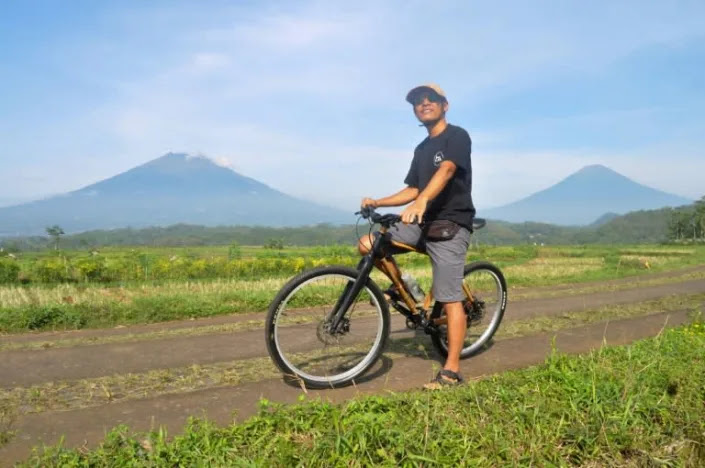

"I train youths here who lack skills. We have a system to train unskilled people until they can create quality products," he said. 

The model, named after the Indonesian words "sepeda" for bicycle and "pagi" for morning, is built by a team of 15 employees at a workshop in Kartono's village in Central Java, where he saddles up for his own bike ride every day. 

Fast-growing bamboo stalks are cut by his team, coated with preservatives, dried, then laminated before being combined with other parts to assemble the sturdy bike frame. 

Pound for pound, bamboo is as strong as steel when used in lightweight structures, studies have shown, with a high tensile strength that makes it a worthy and environmentally friendly substitute. 

A fully assembled Spedagi bamboo bike can take a week of intricate work, fetching up to 15 million rupiah ($1,000), and some have been sold as far away as Japan, company co-founder Tri Wahyuni told AFP. 

Friendship on wheels

The green wheels used by the two leaders were built with more expensive parts, said Kartono, declining to disclose the price of their rides. 

Widodo, famous at home for gifting bikes to ordinary Indonesians, is a Spedagi fan and bought one personally from Kartono in 2015. 

Albanese was similarly beaming about the bike, taking it back to Canberra and saying people would see him on the streets riding what might be "the only bamboo bike" in the Australian capital. 

Both bicycles and bamboo -- affordable and plentiful in Indonesia -- are closely linked with the archipelago nation's lower classes, something that struck a chord with the two leaders from humble backgrounds. 

But while the Kartono creation merged two symbols of Indonesian heritage, it is now tied to a blossoming bromance cultivated in the first weeks of Albanese's premiership. 

"Every time I ride on the bike, I will remember the friendship with President Widodo," he said. 

With his own creation now crossing the Pacific, Kartono said it was seeing bamboo bikes being made where the plant is rarely found -- such as in northern Europe -- that first motivated him to craft his design. 

"When I dug deep into bicycle products online, I found that bamboo bicycles are made in countries that do not have bamboo. That served as a slap for me," said the entrepreneur. 

"Bamboo is everywhere around my house."

Sunday, May 4, 2014

Border city Tumen launches bicycle tours to North Korea

Want China Times, Xinhua 2014-05-04

The first batch of Chinese cyclists ride into North Korea, May 2. (Photo/Xinhua)

A border city in northeastern China has launched bicycle tours to neighboring North Korea.

Thirty-five Chinese tourists joined the first self-drive travel by bicycle from Tumen city in Jilin province to North Korea's Namyang city on Friday, said organizers. The tourists spent three hours across the border.

The bicycle tour, open to tourists from China, is inexpensive and only needs simple procedures, said an official of the Tumen Tourism Bureau. He said the route is expected to attract more tourists to the country.

Excursions by train from Tumen to North Korea's Chilbosan resumed on Wednesday. The tourist train was launched in April 2012, but was later suspended. Tumen also has highway and railway services to North Korea.

Sunday, February 24, 2013

A New Hope for Jakarta's Kota Tua

Jakarta Globe, Lenny Tristia Tambun, February 24, 2013

Building facades in Kota Tua, the historic old city that straddles North
and West Jakarta. (JG Photo/Safir Makki)
              
Related articles

Batavia was once revered as the “Queen of the East.” But this old dame is showing her age.

Jakarta’s old town center, known as Kota Tua, is now a crumbling relic. Many of its heritage buildings are in a critical state of disrepair, some sprouting treetops through their broken roofs, evidence of years of neglect.

A legacy of colonial rule, the old town has been left behind in the new Indonesia. But support is growing for Kota Tua to be revitalized to serve as a tourist attraction and public space to be enjoyed by all.

Last week, Jakarta Governor Joko Widodo announced a new master plan to transform the area into a cultural tourism center. His administration pledged Rp 150 billion ($15.5 million) in 2014 to implement the changes. The Dutch government has also expressed its support of the new plan.

“We are ready to spend a budget of Rp 150 billion to fix this area and make it better. If that is not enough, I will add to the budget,” said Basuki Purnama Tjahaja, Joko’s deputy.

The focus of Joko and Basuki’s plan is to establish a creative public zone, with spaces provided for creative industries such as fashion, food and handicrafts to flourish. At the same time, the pair aims to give the neighborhood a more exclusive feel, by attracting investment from high-end hotels, restaurants and galleries.

Vision for the future

The master plan for Kota Tua aims to return cleanliness, security and order to an area of the city notorious for criminal activity and seedy nightlife.

Basuki said it is this negative image that has scared off investors in hospitality and tourism.

“Kota Tua is too valuable. If it is left to waste away, there will be no community to look after it,” he said. “Even business owners won’t want to invest there because it’s too dirty.”

Basuki and Joko plan to sit down with spatial planning stakeholders and develop an action plan to be implemented starting in 2014.

For 2013, the budget remains at only Rp 12 billion, but with more than 10 times that much in 2014, the administration believes it can make a real change to the area, transforming it into a tourism hub.

In the meantime, the city administration plans to work together with the West Jakarta government to clean up the area from waste left behind by food vendors. There are also plans to improve the condition of Kali Besar, the canal that runs through Kota Tua, with sights on developing water attractions.

Joko aims to replicate his success in Solo as mayor by creating special zones for small traders to operate in.

The food vendors now trading in Taman Fatahillah by night will be allocated 260 places in four distinct trading clusters.

The first cluster will be dedicated to cooked food, and will be located in front of the old post office building. The second cluster will be parked at the other end of the square, near the popular Cafe Batavia, and will be set aside for vendors selling non-food items such as clothes, goods and accessories. Snacks will make up another cluster, while pre-made food and drinks will be sold near the canal.

Traders will be charged Rp 3,000 to Rp 5,000 per day. In return, they will receive a trading spot, equipment and uniforms.

Gathut Dwi Hastoro, the head of the Kota Tua Management Unit, lauded Joko and Basuki’s efforts to restore the historic area. His hope is that the plans for the changes can be consolidated in the coming year, ready to be executed in 2014.

“The biggest share of funds will go to fixing the area around Kali Besar. That area is the most important,” Gathut said. “Those funds can be used to create comfortable sidewalks, bicycle lanes, lighting, sanitation and greenery.”

Challenges past and present

Joko and Basuki are not the first leaders of Jakarta to come up with a master plan for Kota Tua.

Jakarta first began to focus on restoring its urban heritage in the 1970s. At that time, the old Town Hall in Kota Tua’s town square, Taman Fatahillah, was restored to become the Jakarta History Museum. Managing to both preserve the historical building and find a modern usage for it, the restoration work at the time was considered a triumph of town planning.

But in the decades that followed, several plans to revitalize the entire area failed to get up and running as they were tripped up by a tangle of red tape.

Of the 182 heritage buildings in Kota Tua, about 70 percent are privately owned.

The Jakarta government owns 18 percent, while the central government owns 12 percent, including the post office building and Beos station.

State-owned enterprises in 2009 were responsible for 23 unused buildings, among them Indonesian trading company Perusahaan Perdagangan Indonesia with 16 buildings, Bank Mandiri with three buildings, insurance firm Asuransi Jasa Indonesia with two buildings, as well as pharmacology group Kimia Farma and insurance firm Asuransi Jasa Raharja with one building each.

Despite laws stating that owners can be fined Rp 50 million to Rp 5 billion for neglecting their caretaker duties, few have braved the bureaucratic hurdles to obtain permits to restore the buildings.

During his term from 2007 to 2012, Governor Fauzi Bowo managed to install lighting to highlight key attractions in Kota Tua and draw visitors at night. About 2,041 lights were installed around Kota Tua, including at the Jakarta History Museum, the Wayang Museum, the Ceramics Museum, the Beos station and in pedestrian areas.

A total of about Rp 39.7 billion was spent on constructing a pedestrian tunnel at Beos station to connect it to the Kota TransJakarta busway shelter and the Bank Mandiri Museum. The tunnel was also equipped with toilets, air conditioners and small parks.

At the same time, the West Jakarta government established a night food market that aimed to preserve the area’s history while providing an income for the surrounding community.

One plan that went unfinished after the handover to Joko and Basuki was the creation of bicycle lanes, due to begin in October last year.

Robert Tambunan, chairman of the Jakarta Heritage Trust and manager of PPI trading company, hailed the new master plan for the area, saying that the biggest obstacle would be restoring the old buildings.

He asked for a one-stop service to be provided to ease the bureaucratic process of renovating the historic buildings.

With the buildings restored, he said, Kota Tua will spring to life once more.

Monday, November 21, 2011

Bicycles demonstrate Indonesia's new spending power

BBC News, By Karishma Vaswani,  Jakarta, 20 November 2011

Indonesians can now afford to spend more money on their expensive hobbies

It's just past dawn on a Monday morning and the streets of Jakarta are still and quiet.

It is a vast contrast to what this city of 12 million is like during the day, when the roads are packed with cars and motorcycles buzz around the streets.

Only the sounds of the call to prayer, wafting through the suburbs and slums of the capital of the world's most populous Muslim nation, breaks the silence.

In Jakarta, there's no time to breathe. The stresses of work and life are felt deeply by some in the country's middle classes.

But some have found novel ways to unwind.

Adrianka, a digital imaging artist who runs his own successful business in Jakarta, is one such person.

A couple of times a week, the 27-year-old and his friends hit the back streets of Jakarta to relax - by going mountain biking.

He works in the advertising industry and is always rushing to meet deadlines. It's an expensive sport - but he thinks its worth it.

"The first I was shopping for bicycles, I thought even spending $500 was too much," he says as he takes a break from the rigorous morning bike ride. "But then I tried my friends bicycles that cost more - and they felt very comfortable."

"So I kept buying more expensive bikes - because the more they cost, the better they are. When my parents heard how much my bicycles cost they said I was crazy. But my work is very demanding - so I need this hobby to let off some steam."

Posh bikes

Foreign bicycles were rarely seen in Jakarta's shops just over a decade ago.

But now the latest models from Europe and the US are becoming increasingly common.

Most of the bicycles on these roads are relatively inexpensive - but some Indonesians willingly pay up to $5,000 for one.

Jimmy Lie started a series of upmarket stores selling branded bicycles a few years ago, because he recognised a growing trend amongst affluent and aspirational Indonesians.

They were taking to the streets on Sundays, to find some way of working out the stresses of daily life and biking was becoming fashionable.

So Mr Lie capitalised on the new expensive tastes of his consumers and is now in the midst of opening another branch in the city.

Mr Lie says Indonesians these days are far more exposed to what's going in the rest of the world, and want to have access to the same standard of goods they see their counterparts enjoy overseas.

"People nowadays, they get a lot of their information from the internet, or from watching the Tour De France," he says in between serving customers in his busy store.

Growing middle class

Just over a decade ago, it would have been unthinkable for an average Indonesian to spend a few thousand dollars on a bike.

Today though Indonesia's middle classes are far more confident about the future.

Indonesia has one of the fastest growing middle classes in the region - up from 80 million five years ago to 130 million now.

That's more than half of this country's 240 million strong population. 

Not all parts of Jakarta are experiencing a boom
in living standards
And that number is expected to grow - by 2020, many think that Indonesia's middle class will be wealthier than many in Asia.

Indonesia's economy has been one that has managed to continue to grow, despite bumps in the global economic environment.

Largely insulated from the troubles overseas because of strong domestic demand, economists say Indonesia will see growth rates stay stable or possibly even rise next year, at a time when many in the region are cutting their growth forecasts.

All this has meant Indonesian consumers are feeling far more confident about their prospects than ever before.

They consistently rank as some of the most optimistic in Asia about their economic future.

And you can see signs of that all over the streets of Jakarta these days - but especially on Sundays.

The local government has made some Sundays in a month a car-free day - an opportunity for Indonesians to get some fresh air after a busy week at their desks.

Indonesia's next generation has the ability and the desire to spend money on what it wants and not necessarily what it needs.

Not so lucky

But while the future may look bright for some Indonesians, for others not much has changed at all.

In the district of Menteng Dalam, just outside one of the poshest areas in Jakarta, life still moves at a much slower pace.

Tiny shacks are packed densely against one another, and people living in them spill out on to the streets.

The strong economic growth that is so visible just a few kilometres away has yet to touch this part of Jakarta.

Sewi, 62, has lived here for the last two decades.

He has owned his tattered, worn out and old fashioned bicycle for just as long. 

Sewi says he prefers to look after things from the past
Even if he wanted to he wouldn't be able to buy a new one - he just doesn't have that kind of money.

"I've always liked old bicycles like this," he says as he tinkers with his rusty old machine.

"I'm not tempted by newer models. The young generation - they like to change their bicycles all the time and throw the old ones away. But I like to look after things from the past. "

Sewi doesn't understand how some young Indonesians are so eager to spend their hard earned cash.

He's from a generation that still remembers the hard times here. Millions like him have yet to taste the benefits of growth.

Indonesia's future generations need to ride the waves of prosperity for this country's economic rise to be considered a true success.

Tuesday, April 26, 2011

South Jakarta's First Bike Lane to Be Ready Next Month

Jakarta Globe, Dofa Fasila | April 26, 2011

Related articles

South Jakarta will have its first ever bicycle lane by the end of May — though it runs a mere 1.5 kilometers.

South Jakarta Mayor Syahrul Effendi said on Tuesday that a gubernatorial decree would be issued to provide the legal umbrella for the lane, which will run from the Ayodya Park to the Melawai commercial area.

"The physical work for the lane is not yet completed," he said, adding that about 40 percent of the work had already been done.

"It's been a bit slow because we have to work in the evenings so as not to hinder traffic during the day. What is important is that this lane would be inaugurated in May and can be used for cycling."

The mayor said the construction of the Rp 500 million, 1.6-meter wide bike lane was being financed by funds raised by the Indonesian Bicycling Committee.

Syahrul added that they would work to develop more bicycle lanes and try to have them interconnected.

Bike lanes, he said, were part of the city's regional zoning plan for 2010-2030.

The head of the South Jakarta zoning office, Gamal Sinurat, said they were looking at putting bicycle lanes under elevated highways, including under the Antasari-Blok M elevated highway and along the parts of the Eastern Flood Canal that runs through the municipality.

Biking enthusiasts and advocates have long campaigned for the creation of dedicated bicycle lanes in Jakarta. Toto Sugito, chairm an of Jakarta’s Bike to Work (B2W) cycling community, says the administration lacked the political will to make the city friendlier for those not using motor vehicles.

Friday, September 17, 2010

Indonesia’s Best Cyclists Head to Netherlands for Pre-Asiad Training Camp

Jakarta Globe, September 16, 2010

Related articles

Indonesia’s top riders are leaving no stone unturned in their Asian Games preparations, as they travel to the Netherlands to train for the Guangzhou, China, tournament.

Tonton Susanto and Santia Tri Kusuma, the country’s No. 1 cyclists in the men’s and women’s divisions respectively, will lead a five-strong Indonesia team for a training camp in Alkmaar expected to last six weeks or longer.

Completing the team are Ryan Ariehaan Hilmant, Yanthi Fuchiyanti and Wilhelmina Tutuarima. The team is taking a flight to the Netherlands today.

Tonton and Ryan will compete in the men’s road race in the Asian Games, while Santia and Yanthi will take part in the women’s track events.

Wilhelmina, a top junior prospect, joined the Alkmaar-bound team as part of the Indonesian Cycling Union’s (ISSI) youth development program.

Cycling team manager Denny Gumulya said the Netherlands offered the best training setup for the Indonesian national team because it offered good facilities and many opportunities for competition.

“So our cyclists will have a lot of chances to work on their skills, their endurance, everything that’s necessary to get better,” Denny said. “They mustn’t waste this opportunity, that’s all we ask.”

However, the bar will be set higher for Santia, a bronze medalist in the 2002 Asian Games in Korea.

She has shown improvement in the 500-meter time trial event, posting her best time of 36.847 seconds during the Asian Cycling Confederation Track Asia Cup 2010 in Japan, in June.

Santia finished fourth in the competition, as Hong Kong’s Lee Wai Sze clinched the gold with a time of 35.36 seconds.

Santia’s previous best time was 37.907 seconds, which she registered during last year’s Asian Cycling Championship in Tenggarong, East Kalimantan.

Denny said it was important for Santia to continue lowering her time if she hoped for a podium finish at the Asian Games in November.

“ We’re hoping she can get even faster, because we know she’s our biggest hope for a medal in Guangzhou. We believe training in the Netherlands will help her a lot in this regard,” Denny said.

Santia agreed. “I was in the Netherlands to prepare for the 2005 Southeast Asian Games, and it played a big factor as I won the gold medal [in the time trial],” she said.

“I participated in a number of competitions there and got the opportunity to practice with some really good cyclists. That helped me to improve, and hopefully it will pay dividends for me again.” 

Ami Afriatni

Thursday, July 1, 2010

Keep rolling

The Jakarta Post | Thu, 07/01/2010 5:28 PM


Keep rolling:
Old bicycle enthusiasts line up with their bicycles wearing matching costumes before joining a parade held to celebrate Medan City's 420th anniversary in downtown Medan, North Sumatra, on Thursday.

Thursday, January 21, 2010

Joy ride

The Jakarta Post, Thu, 01/21/2010 9:11 PM


US Ambassador to Indonesia Cameron R. Hume rides a pedicab with the statue of US President Barack Obama as its passenger during the his visit to Yogyakarta on Thursday. (JP/Tarko Sudiarno)

Saturday, January 16, 2010

East Flood Canal to have bicycle tracks

The Jakarta Post, Jakarta | Sat, 01/16/2010 8:46 PM

A resident cycles past a project site of the East Flood Canal in Pondok Kopi, East Jakarta. A Muslim praying house, or musholla, still stands despite ongoing construction. JP/J. Adiguna (25 Feb. 2009)

The East Flood Canal is soon to emerge as the most popular and safest place for bikers to ride in Jakarta.

Pitoyo Subandrio, head of Ciliwung-Cisadane Flood Bureau at the Ministry of Public Works, said Saturday a bicycle track would be built along each side of the canal, which stretches between Kebon Nanas in East Jakarta and Marunda Beach in North Jakarta.

The left track between Kebon Nanas and Marunda covers 23 kilometers, while the opposite track covers 22 kilometers.

“We are planting trees along the tracks to make them convenient to bikers. I believe the canal will be the most popular route,” Pitoyo was quoted by kompas.com.

The government will build barb wire fences along the canal to keep people from dumping garbage into the flood control facility.

Thursday, January 7, 2010

Take a Spin Back Through Time

Jakarta Globe, Tasa Nugraza Barley

Old bicycles are the vehicles of choice for this Jakarta-based community.
(Photo courtesy of Komunitas Ontel Batavia)

Because of Jakarta’s endless traffic and thick pollution, activities that take you out into the great outdoors aren’t very common.

Despite this, a group of people are still trying to enjoy the city their own way — by riding their bicycles.

And they are not doing this on just any bicycle. Members of Komunitas Ontel Batavia (Batavia Bicycle Community) prefer riding antique bikes. The group derives its name, ontel , from the Javanese word for bicycle.

“It feels so peaceful to be on my bicycle and just ride slowly,” said 28-year-old Fahmi Saimima, who works at a bank in Jakarta.

Established on Aug. 17, 2005, the group now has about 700 members.

Fahmi, who is the group’s public relations officer, said he first fell in love with old bicycles in 1996 when he inherited one that used to belong to his grandfather.

To his surprise, the bicycle was still in good condition. When he rode it, he felt a connection with the bike.

“I would say that it was love at first sight,” Fahmi said, adding that being on a bike is a unique experience.

Fahmi, who lives in Kalibata, South Jakarta, said he takes the main roads when he rides. He enjoys being on his bike so much that the traffic and pollution don’t bother him.

As his appreciation of old bicycles grew, he decided to give his grandfather’s bicycle to his brother and bought three others.

One is a 1942 English Burgers brand bicycle. Another is an English bicycle made by Phillips in 1950. The third one is a Dutch Teha bicycle from 1930.

Altogether, the three bicycles cost him Rp 10 million ($1,100).

According to Fahmi, bicycles that are considered “old” by the group’s standards are the ones that were made before 1960. Most of these are European bicycles, with a few that were made in China.

Fahmi said, however, that he prefers the European models.

“It’s the prestige,” he said.

Heru Pramono, 34, who works in TV, joined Komunitas Ontel Batavia in 2006, just after purchasing his first antique bicycle.

He found the group’s blog online and joined in order to spend time and swap stories with people who shared the same hobby.

He now has four bicycles, which in total cost him about Rp 4 million. His latest addition is a French model.

Heru said most Jakartans were unfamiliar with the idea of people riding bikes as a hobby.

He said people often gave him strange looks when they saw him cycling, partly because bicycles — especially the ones he rides — are seen as old-fashioned. But Heru said that the stares don’t bother him and can’t detract from the enjoyment he derives from his recreation.

Unlike today’s well-equipped modern bicycles, old bicycles can generally only reach a maximum speed of 20 kilometers per hour.

But to Heru, that’s what makes it so enjoyable. “For me it’s the perfect relaxation,” he said.

Searching for antique bicycles takes members of Komunitas Ontel Batavia all around Java.

Heru said that many of his friends regularly go to cities like Bandung, Yogyakarta, Semarang and Surabaya in search of bicycles.

“Old bicycles are usually sold at traditional markets [in those places] at low prices,” Heru said.

Members of the community have lots of stories about their quests to find old bicycles, too.

Heru said one of his friends saved up to buy a particular Dutch bicycle from the 1920s. Unable to find the model he was looking for, he instead spent the money on his wedding.

To his surprise, his father in-law gave him the exact bicycle that he had been searching for as a wedding gift.

Members of Komunitas Ontel gather every Sunday at the Hotel Indonesia traffic circle, on Jalan Thamrin, at 7 a.m.

After riding their bicycles from home, they sit together and talk.

Sometimes, they go to museums together and occasionally arrange group rides in the city.

“We also exchange tips and tricks related to maintaining our bicycles,” Fahmi said.

“Everyone can join the community for free as long as they share the same passion for old bicycles.”

Komunitas Ontel Batavia
Jalan Cipinang Timur Raya No. 48 Rawamangun, East Jakarta, 13240
021 4788 2340
sepeda.wordpress.com
herupram@gmail.com

Related Article:

Fixed gear bicycling -- no brakes, no stopping, no fear

S. Jakarta’s cycle lane plan affects several streets


Saturday, December 19, 2009

Two-day Kemang Festival kicks off

Indah Setiawati, THE JAKARTA POST, JAKARTA | Sun, 12/20/2009 2:26 PM

The fifth Kemang Festival kicked off Saturday with more than 1,000 visitors swarming Jl. Kemang Raya in South Jakarta.

The two-day festival runs from 9 a.m. to 10 p.m. and features more than 300 booths displaying clothes, antiques, accessories, food and beverages. Also on offer are musical performances, drum bands, street magic and firework shows.

Andina Sabri, the event coordinator, said she was grateful that Kitapoenya Production, which began the event, managed to stage the festival despite criticisms by some Kemang residents.

"We find it harder to hold the festival each year because we always face objections from residents. They don't like the noise and the traffic jams," she told The Jakarta Post on Saturday.

She said the festival almost didn't happen, but a series of meetings with representatives of the residents to assure them the community would benefit from the annual event finally facilitated proceedings.

"We assured them they would be able to showcase their products because we provided them with free booths," she said.

She said the organizers also provided a special stage dedicated to traditional Betawi performances, including tanjidor (traditional music), ondel ondel (giant effigies) and traditional dances.

She said the festival, usually held in July, was moved to December because of the presidential election.

First time visitors Antonio and his friend Dicky, who live in Mampang, South Jakarta, said they accidentally stumbled upon the festival while driving around to find a hang out for the weekend.

"I highly recommend people spend time here this weekend. I find the food bazaar the most appealing because we can try various dishes," Antonio said while lining up to buy gudeg (a traditional dish from Yogyakarta).

Dicky said the festival had a distinctly Betawi air as they could find a number of vendors selling kerak telor (rice omelet).

"It feels like the PRJ," Antonio said, referring to the Jakarta Fair, held annually to mark the city's anniversary.

Traffic heading to Jl. Kemang Raya was heavily congested in the evening. Businesses located close to the festival allowed cars and motorcycles to park on their premises.

Sirojudin, a taxi driver, said he had been avoiding the street since the afternoon and chose an alternative route via Jl. Antasari.

"My previous passenger was a foreigner. He told me he lived in Kemang, but preferred to stay the night in a hotel to avoid the traffic because he was heading to the airport tomorrow," he said.

The festival area stretches from the McDonald's intersection to the Papillon Boutique t-junction.

Related Article:

Residents objected to Kemang Festival: Organizer


Saturday, December 5, 2009

Dancing in the streets for the good old days

Indah Setiawati, The Jakarta Post, Jakarta | Sat, 12/05/2009 10:05 PM

The rain Saturday did not dampen the spirits of Menteng residents, who turned out in droves for the first-ever celebration of the elite historical area.

Semarak Menteng, a two-day festival organized by Sahabat Menteng and the Central Jakarta Municipality, featured a bazaar, Brazilian martial art form Capoeira, dancing, including breakdance, and a photo exhibition depicting the old and new Menteng.

For many senior citizens who lived in Menteng in their youth, the event was an opportunity for a reunion. At the reunion, former residents shared memories of Menteng as a friendly neighborhood.

“Menteng has changed,” resident Bandji Asaari, 64, told The Jakarta Post. “It used to be Menteng. Now it is Benteng [a fort].”

He said during his childhood, houses in Menteng were not surrounded by high walls and gates. Rather, the beautiful architecture of houses was visible.

“When children passed these beautiful houses, they were inspired to have the same,” he said.

Bandji said he mostly missed having warm, friendly neighbors, saying the current situation greatly differed from the past when residents knew each other.

The bazaar continues on Sunday and a parade of Betawi, India and Japanese culture, kung fu, a percussion band and decorative bicycles.

There will also be presentation of Menteng Senior Awards for residents who have made a contribution to the country, including Emil Salim and Rosihan Anwar.

Thursday, April 2, 2009

Fifteen countries to join Tour of Singkarak cycling race

The Jakarta Post, Jakarta | Thu, 04/02/2009 4:06 PM

Fifteen countries have so far expressed commitment to participate in the Tour of Singkarak 2009 cycling race to be held in West Sumatra April 29 to May 3, 2009.

Culture and tourism ministry's director general Sapta Nirwandar said in Jakarta on Thursday that the countries include New Zealand, Japan, Thailand, Taiwan, the Philippines, Malaysia, Iran, Australia, Kazakhstan, Uzbekistan, Russia, and Qatar.

"Around 85 percent of the construction works of new routes for the cycling race has been completed," he said as quoted by Antara state news agency.

Participants of the Tour of Singkarak will cover a total distance of 459 km and compete for a total prize of US$60,000.

The race route is to consist of four segments: Padang-Bukittinggi segment (92.3 km), Bukittinggi-Sawahlunto segment (85.1 km), Sawahlunto-Danau Singkarak segment (90.2 km), and Lake Singkarak- lake Kembar - Lake Singkarak segment (188 km).

The cycling race, which is aimed at promoting tourism in West Sumatra Province, will be accompanied by music concerts, a food festival, and a fun bike event.

West Sumatra Province was visited by a total of 1.4 million tourists, including about 100,000 foreigners, last year, he said.

The province has set a target of receiving at least 1.5 million tourists in 2009.

Wednesday, March 25, 2009

Indonesia to host inaugural Tour de Singkarak this year

Agnes Winarti, The Jakarta Post, Jakarta | Wed, 03/25/2009 1:56 PM

This year, for the first time, Indonesia will host the US$60,000 Tour de Singkarak in West Sumatra, from April 28 to May 4.

The Tour de Singkarak will consist of four stages: a 4-kilometer first stage team time trial in the West Sumatra capital, Padang; a 92-km second stage from Padang to Bukittinggi; a third stage comprising an 85-km leg from Bukittinggi to Sawahlunto and then a 93-km leg from Sawahlunto to Singkarak Lake; and a 188-km fourth stage from Singkarak Lake to Kembar Lake.

"Fifteen countries have confirmed their entrance in the Tour de Singkarak," Indonesian Cycling Association (ISSI) deputy chairman Sofyan Ruzian said on Monday.

Foreign countries that have confirmed competitors are Qatar, New Zealand, Iran, Japan, the Netherlands, Taiwan, Thailand, Philippines, Malaysia, Australia and Switzerland.

"These countries will confirm names of their athletes before the end of this month," said Sofyan, adding that there would be more than 80 international cyclists taking part.

Japan and Malaysia will have two teams representing each. Indonesia will have 10, spearheaded by national star cyclists Kaswanto, Angga Fredli, Tonton Susanto, Ryan Ariehaan, Samai and Yudho Sasongko.

"Most of them, except Yudho Sasongko, are cyclists specializing in long-distance rides," ISSI development chief Wahyudi Hidayat said.

Tonton of Team Dodol Picnic Garut, for example, was the Asia division winner of the 2002 Tour de Langkawi tournament, Malaysia. Meanwhile, Ryan was a gold snatcher in the road race at the 2007 SEA Games, and Samai won gold in the 2005 SEA Games.

When asked about the national team's target in the championship, Wahyudi said "We do not want to set our targets too high, but we hope our cyclists will be of the same standard as cyclists from other Asian and Southeast Asian countries."

The Tour de Singkarak event is being organized by ISSI, in cooperation with the Culture and Tourism Ministry - which is aiming to promote the Visit Indonesia 2009 program through the event.

Sunday, March 1, 2009

Thousands of cyclists mark Yogyakarta attack

Slamet Susanto, The Jakarta Post, Yogyakarta | Sun, 03/01/2009 7:39 PM 
 

 Pedal power: Cyclists in Yogyakarta on Sunday take part in the 60th anniversary commemorations of a March 1, 1949 strike against the Dutch military that was controlling the city. Thousands of cyclists rode around Yogyakarta as part of the event. JP/Slamet Susanto
 

Thousands of cyclists rode around Yogyakarta to mark the 60th anniversary of the Indonesian military’s March 1, 1949 attack on Dutch forces occupying Yogyakarta. 

The cyclists, from more than 200 cycling clubs, gathered at the main Post Office in downtown Yogyakarta. Cyclists also packed Jl. Malioboro, Yogyakarta’s tourist road and main thoroughfare, which was closed to other vehicles on Sunday. 

The gathering was also attended by Yogyakarta mayor Herry Zudiano, who presided over the 60th anniversary ceremony. 

Herry said he supported the promotion and use of bicycles in Yogyakarta, and that riding bicycles would serve as a small contribution to reducing global warming. 

“This also shows that the celebration of this March 1 attack belongs to everyone,” he said.

Yogyakarta administration would continue to promote the use of bicycles in the city to reduce traffic jams and pollution, he said. 

To support biking activities, Herry added, his administration was currently planning to build around 34 new bicycle lanes around Yogyakarta.