Indonesia executes six drug convicts, five of them foreigners

Indonesia executes six drug convicts, five of them foreigners
Widodo has pledged to bring reform to Indonesia

Ban appeals to Indonesia to stop death row executions

Ban appeals to Indonesia to stop death row executions
United Nations Secretary General Ban Ki-moon has pleaded to Indonesia to stop the execution of prisoners on death row for drug crimes. AFP PHOTO

Pope: 'Death penalty represents failure' – no 'humane' way to kill a person

Pope: 'Death penalty represents failure' – no 'humane' way to kill a person
The pope wrote that the principle of legitimate personal defense isn’t adequate justification to execute someone. Photograph: Zuma/Rex

Obama becomes first president to visit US prison (US Justice Systems / Human Rights)

Obama becomes first president to visit US prison   (US Justice Systems / Human Rights)
US President Barack Obama speaks as he tours the El Reno Federal Correctional Institution in El Reno, Oklahoma, July 16, 2015 (AFP Photo/Saul Loeb)

US Death Penalty (Justice Systems / Human Rights)

US Death Penalty (Justice Systems / Human Rights)
Woman who spent 23 years on US death row cleared (Photo: dpa)


.

.
"The Recalibration of Awareness – Apr 20/21, 2012 (Kryon channeled by Lee Carroll) (Subjects: Old Energy, Recalibration Lectures, God / Creator, Religions/Spiritual systems (Catholic Church, Priests/Nun’s, Worship, John Paul Pope, Women in the Church otherwise church will go, Current Pope won’t do it), Middle East, Jews, Governments will change (Internet, Media, Democracies, Dictators, North Korea, Nations voted at once), Integrity (Businesses, Tobacco Companies, Bankers/ Financial Institutes, Pharmaceutical company to collapse), Illuminati (Started in Greece, with Shipping, Financial markets, Stock markets, Pharmaceutical money (fund to build Africa, to develop)), Shift of Human Consciousness, (Old) Souls, Women, Masters to/already come back, Global Unity.... etc.) - (Text version)

… The Shift in Human Nature

You're starting to see integrity change. Awareness recalibrates integrity, and the Human Being who would sit there and take advantage of another Human Being in an old energy would never do it in a new energy. The reason? It will become intuitive, so this is a shift in Human Nature as well, for in the past you have assumed that people take advantage of people first and integrity comes later. That's just ordinary Human nature.

In the past, Human nature expressed within governments worked like this: If you were stronger than the other one, you simply conquered them. If you were strong, it was an invitation to conquer. If you were weak, it was an invitation to be conquered. No one even thought about it. It was the way of things. The bigger you could have your armies, the better they would do when you sent them out to conquer. That's not how you think today. Did you notice?

Any country that thinks this way today will not survive, for humanity has discovered that the world goes far better by putting things together instead of tearing them apart. The new energy puts the weak and strong together in ways that make sense and that have integrity. Take a look at what happened to some of the businesses in this great land (USA). Up to 30 years ago, when you started realizing some of them didn't have integrity, you eliminated them. What happened to the tobacco companies when you realized they were knowingly addicting your children? Today, they still sell their products to less-aware countries, but that will also change.

What did you do a few years ago when you realized that your bankers were actually selling you homes that they knew you couldn't pay for later? They were walking away, smiling greedily, not thinking about the heartbreak that was to follow when a life's dream would be lost. Dear American, you are in a recession. However, this is like when you prune a tree and cut back the branches. When the tree grows back, you've got control and the branches will grow bigger and stronger than they were before, without the greed factor. Then, if you don't like the way it grows back, you'll prune it again! I tell you this because awareness is now in control of big money. It's right before your eyes, what you're doing. But fear often rules. …
Showing posts with label Health-Safety-Environment (HSE). Show all posts

Wednesday, August 5, 2020

Aboriginal group blocks access to Australia's Uluru over virus fears

France24 – AFP , 4 August 2020

Tourists gather to watch the sunset at Uluru in 2019 Saeed KHAN AFP/File

Sydney (AFP) - Indigenous residents forced the closure of Australia's famed Uluru national park Tuesday, after blocking tourists from accessing the sacred site amid fears over the spread of coronavirus.

About 30 members of the local community physically blocked dozens of tourists arriving from virus-hit eastern Australia from accessing the park entrance, said Glenn Irvine, manager of Mutitjulu Community Aboriginal Corporation, which handles local community issues.

Locals said they were blindsided by the arrival of 43 tourists on a flight from Brisbane, Queensland and decided to take action.

"We were of the understanding that the flight was cancelled," Irvine told AFP.

"We asked for the national park to be closed," he added. When that did not happen, "members of the community gathered at the park gate".

After crisis talks with local authorities Tuesday, the park remained closed.

Uluru-Kata Tjuta National Park said in a statement: "We have the utmost respect for Uluru-Kata Tjuta's traditional owners and are continuing to work in good faith with them and all other parties to keep Mutitjulu residents safe."

More than 395,000 people visited the park in the 12 months to June 2019, according to Parks Australia.

Irvine said there was now tacit agreement that the tourists -- who remained nearby -- would be tested for the virus and no more groups would come from COVID-19 "hotspots".

Queensland has recorded just over 1,000 cases of the virus since the pandemic began and new cases have been relatively rare.

But even in areas where tourism is a mainstay of the local economy, many Aboriginal groups are fearful that any outbreak could badly hit remote Outback communities.

Travel to the Northern Territory, including Uluru -- once known as Ayer's Rock -- has been severely restricted since the pandemic began.

Those measures were recently eased, but visitors from Australia's COVID-19 hotpots are still required to quarantine for 14 days.

Brisbane is currently included on that list.

Overseas travellers remain banned from entering Australia except for some very closely prescribed cases.

Australia recorded 453 new cases Tuesday, taking the total to 18,728 with 10,787 recoveries. The death toll is now 232, after 11 more fatalities.

Thursday, February 13, 2020

Bat for sale at Indonesia's wildlife market despite virus warning

Yahoo – AFP, February 12, 2020

Scientists are debating how the novel coronavirus, which has killed more than
1,100 people in China and spread to dozens of countries around the world,
was transmitted to humans (AFP Photo/Ronny Adolof Buol)

Bats, rats and snakes are still being sold at an Indonesian market known for its wildlife offerings, despite a government request to take them off the menu over fears of a link to the deadly coronavirus.

Vendors at the Tomohon Extreme Meat market on Sulawesi island say business is booming and curious tourists keep arriving to check out exotic fare that enrages animal rights activists.

But scientists are debating how the new virus, which has killed more than 1,100 people in China and spread to dozens of countries around the world, was transmitted to humans.

A wildlife market in Wuhan, the epicentre of the virus, is thought to be ground zero and there is suspicion it could have originated in bats.

The possible link wasn't on many radar screens at the Indonesian market, however.

Vendors at the Tomohon Extreme Meat market on Sulawesi island say
business is booming (AFP Photo/Ronny Adolof Buol)

Its grubby stalls feature a dizzying array of animals including giant snakes, rats impaled on sticks and charred dogs with their hair seared off by blowtorches -- a gory scene described by some critics as "like walking through hell".

Bat seller Stenly Timbuleng says he's still moving his fare for as much as 60,000 rupiah ($4.40) a kilogram to buyers in the area, where bats are a speciality in local cuisine.

"I'm selling between 40 and 60 kilograms every day," the 45-year-old told AFP.

"The virus hasn't affected sales. My customers still keep coming."

Restaurateur Lince Rengkuan -- who serves bats including their heads and wings stewed in coconut milk and spices -- says the secret is preparation.

"If you don't cook the bat well then of course it can be dangerous," she said.

Stalls at the Tomohon Extreme Meat market on Sulawesi island feature
a dizzying array of animals (AFP Photo/Ronny Adolof Buol)

"We cook it thoroughly and so far the number of customers hasn't gone down at all."

This despite a request from the local government and the health agency to take bats and other wildlife out of circulation -- a call that has been all but ignored.

"We're also urging people not to consume meat from animals suspected to be carriers of a fatal disease," said Ruddy Lengkong, head of the area's government trade and industry agency.

Indonesia has not yet reported a confirmed case of the virus.

In the capital Jakarta, vendors selling skinned snakes and cobra blood on a recent Saturday night didn't have any trouble finding takers.

"It's good for you, sir," said one vendor of his slithering fare.

"Cures and prevents all diseases."

Friday, April 19, 2019

Holiday island mourns after bus crash kills 29 German tourists

Yahoo – AFP, Jerome Pin, April 18, 2019

The bus plunged down a 10-metre slope with around 50 people on board
(AFP Photo/STRINGER)

Caniço (Portugal) (AFP) - Portugal and Germany mourned on Thursday after 29 German tourists died when their bus tumbled down a slope and crashed into a house on the tourist island of Madeira.

Drone footage showed the mangled wreckage lying against a building on a hillside near the town of Canico, the vehicle's roof partially crushed and front window smashed.

Rescue workers attended to injured passengers on the grass where the bus rested nearby, some of them bearing bloodied head bandages and blood-stained clothes.

A woman who survived the accident said on the TVI television channel that the bus crashed after hitting a wall.

"It happened just after the bus started, one minute or a few seconds later. People were flying through the windows," said the woman, who was not named.

"Some people were crying for help and we could immediately see some people were dead," said her husband, who also survived the crash. "Help arrived very fast."

Rescue workers helped survivors at the crash site (AFP Photo/RUI SILVA)

Local authorities said most of the dead were aged in their 40s and 50s. Twelve men and 17 women were among the victims, an official at the Nelio Mendonca hospital, Tomasia Alves, told reporters.

They were among the more than one million tourists who visit the Atlantic islands off the coast of Morocco each year, attracted by their subtropical climate and rugged volcanic terrain.

"It is with sadness and dismay that I think of our compatriots and all the other people affected by the terrible bus accident in Madeira," German Chancellor Angela Merkel said in a statement.

"My sincere condolences go above all to those families that have lost loved ones in this tragedy," she added, thanking the Portuguese emergency services for their efforts.

The bus was only five years old and has been recently inspected, officials 
said (AFP Photo/RUI SILVA)

Investigation launched

Witnesses and officials said the 50-odd tourists had left their hotel on their way to the regional capital Funchal for dinner when the bus crashed on Wednesday.

Local media said two Portuguese nationals survived the crash: the driver and a tour guide.

Prosecutors have opened a probe. The vice-president of the regional government Pedro Calado said it was "premature" to attribute the cause of the accident.

He said the bus was five years old and had been recently inspected.

German Foreign Minister Heiko Maas said he would travel to Madeira on Thursday with a team of doctors and psychologists to "speak personally with those affected".

The injured were "in a state of shock, with memories of terrible images. An injured woman said she had lost her partner," Ilse Everlien Berardo, the pastor at the German Evangelical church in Madeira, told Germany's RTL network.

Wellwishers left flowers for the victims (AFP Photo/MIGUEL RIOPA)

Frankfurt-based tour operator Trendtours said 51 of its customers were involved in the accident. Another company, Schauinsland, said it also had two customers in the crash.

The companies sent their condolences to victims' families and said they were sending teams to Madeira to offer support.

Trendtour said the bus had been hired by a local operator and crashed off the road "for a reason still unknown".

Makeshift morgue

A makeshift morgue has been set up at the airport in Funchal, local media reports said. Medical teams will be flown in from Lisbon to carry out autopsies.

German holidaymakers were the second largest group after British tourists to visit Madeira in 2017, according to Madeira's tourism office.

Madeira lies in the Atlantic off the coast of Morocco (AFP 
Photo/Maria-Cecilia REZENDE)

Known as the Pearl of the Atlantic and the Floating Garden, Madeira is home to just 270,000 inhabitants.

The Portuguese government decreed three days of national mourning.

"I express the sorrow and solidarity of all the Portuguese people in this tragic moment, and especially for the families of the victims who I have been told were all German," President Marcelo Rebelo de Sousa told Portuguese television.

Alves said the hospital hoped to begin returning victims' bodies to their families by Saturday.

The last serious bus accident in Madeira occurred in December 2005, killing five Italian tourists in Sao Vicente.

Tuesday, March 26, 2019

No quiet rules at Indonesia's flyover library

Yahoo – AFP, Harry PEARL, 25 March 2019

Despite its unlikely location, the Taman Baca Masyarakat Kolong open-air reading
 park has been a hit due to a shortage of public libraries where kids from this
area can read books outside school

Singing and laughter briefly drown out the roar of cars under a Jakarta flyover, where an unlikely library for kids is thriving despite choking fumes -- and opposition from menacing gangsters.

There's no quiet rule at this open-air reading park wedged between two lanes of traffic just outside Indonesia's capital, a city of some 30 million that is notorious for having some of the world's worst traffic jams.

Despite its unlikely location, the Taman Baca Masyarakat Kolong has been a hit. A shortage of public libraries means it's one of the few places where kids from this area can read books outside school.

"We wanted to bring books closer to the community," Devina Febrianti, a library coordinator, told AFP as car horns blared accompanied by choking exhaust fumes.

Several years ago, the flyover in suburb Ciputat, part of Jakarta's greater metropolitan area, was strewn with rubbish and roamed by intimidating street thugs, Febrianti said.

But armed with books and paint, local organisations set about transforming its down-and-out reputation.

Artists painted murals on the walls, installed planter boxes and a futsal pitch, and a library with several dozen books was built on site.

Still, it wasn't met with universal acclaim when it opened for business in 2016.

"In the beginning not everyone was supportive when we came with books because there were already other residents here," Febrianti said.

"We asked for forgiveness first from the gangsters who were here and then the 'angkot' drivers," she added, referring to cheap and ubiquitous minivans that provide public transport.

Winning over parents afraid that their children would be kidnapped or hit by a car was no mean feat, either.

'Smell, rubbish, loud noises'

But eventually, parents -- and even the street gangs -- warmed to the idea.

Today, it's not uncommon to see up to 70 kids attending after-school sessions, where they read stories with teachers, get help with homework, or sing and dance on concrete covered with green Astroturf.

Bookshelves are stuffed with hand-me-down kids books and some other less likely titles such as "Accounting" and "Glossary of Marketing Terms".

Emilia Clara, an 11-year-old student, said she liked reading stories, especially fairytales, with friends.

"It makes me happy and it's exciting," she told AFP in a brief interview, before rushing back to join the other kids.

And it has won over parents like Salmih Usia, a 41-year-old mother of two.

"This is a great place for learning, creating and playing," she said.

Free reading gardens, known as Taman Bacaan, have existed in various forms across Indonesia for several decades.

They're often run by NGOs or volunteer associations funded by public and private sector contributions.

Some 80 reading parks have been established this part of the sprawling capital, although there is only one located right below a flyover, Febrianti said.

In Hong Kong, a small outdoor library that doubled as a children's playground was set up under a flyover in the bustling city as part of research into how to better use community spaces, according to a report in the South China Morning Post last year.

Back in Indonesia, library volunteers admit the street-side location poses some potential health problems because of the fumes from traffic and the subsequent impact on air quality.

"But so far there haven't been any complaints about the smell, rubbish or loud noises," Febrianti said, adding: "We use a sound system, which is quite helpful for us to overcome the (noise) problem."


Sunday, January 29, 2017

Hoping for a fresh sea breeze aboard a cruise ship? Better hold your nose!

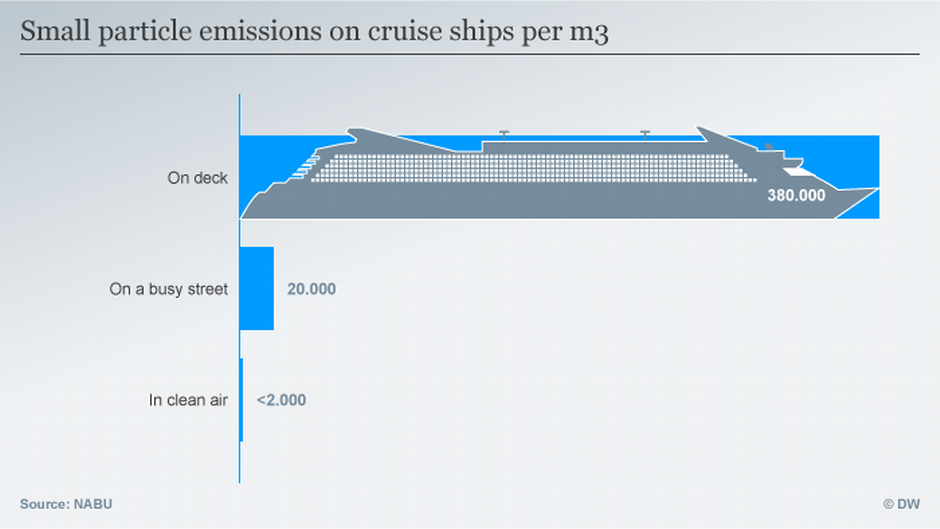
French TV journalists have secretly measured the air quality on a cruise ship. The results are devastating: The air is significantly worse polluted than it would be in thick urban traffic.


Deutsche Welle, 26 January 2017

Cruises are increasingly popular among today's tourists. They offer relaxation with 24-hour service for stressed out office workers.

Forget about searching for the perfect, pristine beach - which most people will never find, anyhow. Instead, just go to the pool on the upper deck, enjoy some tasty drinks and take in breathtaking views of the ocean from high above. For people who need less contemplation, cruises offer theater and show performances, generous meals, bars and shopping opportunities.

That doesn't mean you're in for a boring vacation: Adventure comes as part of the risk free deal. Even frail seniors can now feel like mystic characters such as Long John Silver from Treasure Island or real explorers like Roald Amundsen - be it by cruising the romantic Carribean, visiting savage South Sea islands or admiring polar bears on impenetrable arctic shores. Finally you can do something for your health by going to the ship's gym and getting a good work out.

Tourists want to enjoy themselves - and the fresh sea breeze.

But you better think twice about taking a deep breath. The German Environmental Association "Naturschutzbund Deutschland"(NABU) now warns that it is more likely you inhale polluted air than a fresh breeze. NABU says that it cannot recommend any of the large European cruise ships.

"Pamphlets lead you to believe that there are blue skies and white ships - a dream-like setting," Daniel Rieger, who is in charge of transportation policies at NABU, said. "The truth is that clouds of black soot are emitted from the funnels."

Measuring results are worse than expected

Recent measurements of actual air quality onboard a cruise ship seem to support NABU's view. French TV journalists from broadcaster France 3 conducted covert measurements while on a cruise. They boarded a ship in Marseille for a cruise of the Mediterranean.

Results show that "the shipping companies are exposing their travelers to high concentrations of harmful substances," NABU managing director Leif Miller concluded.

Even environmentalists were surprised by the high concentrations that the journalists detected. Right after leaving Marseille, air pollution was roughly 200 times that of a heavily trafficked urban street.

Besides fine dust and soot, the combustion of marine diesel fuel and heavy oil also set free other harmful substances such as nitrogen oxides and heavy metals.


Former captain and ship broker Helge Grammerstorf, who is the German national director of the Cruise Lines International Association CLIA, defends his industry. He told the daily "Hamburger Abendblatt:" "We don't know these measurements. The claim is completely unsubstantiated."

Grammerstorf argues that the measurements were taken only selectively and that one would need to run a more systematic test to collect data over a longer time period.

Hardly noticeable for passengers

"The passengers can only smell or see the particles before they get mixed up with the ambient air," NABU spokesman Rieger said after the France 3 test results were published.

He argued that it wouldn't take the shipping companies much to change the pollution and to increase comfort. "Even switching from marine diesel fuel or heavy oil to regular road diesel fuel would make a big difference," he said.

In addition, it wouldn't be too hard to install effective exhaust cleaning systems, according to NABU. Such systems have long existed with established standards for trucks and trains.
"The question is whether the industry deliberately looks the other way," Dietmar Oellinger - NABU's transport expert - said.

He suggested that the tests taken by the French journalists were merely an example and could possibly be representative for the entire cruise ship industry.

"The reality is black soot from the chimneys," NABU environmentalists say.

"We should ask how much more proof the industry needs before they finally take action," Oellinger said.

Some cruise lines have pledged to install particle filters, but so far, there are none in use.

Covert measuring only in the harbor

Previously, NABU has only had the opportunity to measure harmful ultra fine dust particles in the air around cruise ships in harbors. They have done so in Hamburg, Venice and the north-eastern German city of Rostock-Warnemünde. The ship owners did not allow the environment agency to take measurements on board, Daniel Rieger said.

The results were devastating nonetheless: In all cases the ships were burning off heavy oil. Four of five ships were not equipped with any exhaust gas cleaning or they were only fulfilling the lowest legal standard for northern Europe - a system that only reduces sulfur oxide emissions.

Technical solutions to reduce particle and nitrogen oxide emissions have long been on the market, though. Therefore, NABU argues, not implementing them is largely due to greed. It would cost money to install the system and furthermore require the companies to use more expensive types of fuel.

Almost as dangerous as asbestos

The German Lung Foundation already recommended several years ago that people with chronic respiratory diseases only stay on certain parts of the deck when on a cruise ship and thus avoide breathing in the ship's exhaust.

The World Health Organization (WHO) has concluded that diesel exhaust is just as carcinogenic as asbestos. The ultrafine particles, which are smaller than 0.1 micrometer can get into the smallest pulmonary alveoli and from there into the blood stream and other organs.

NABU manager Leif Miller argues it's cynical that the cruise ship companies "pay huge sums to improve entertainment and gastronomical services on board, but save as much as they can when it comes to environmental protection."

Meanwhile, in Germany the cruise ship industry is getting ready for the next season: In Warnemünde, Hamburg and Kiel alone, more than two million passengers are expected to board the giants of the seas in 2017.

Related Articles:


Sunday, October 4, 2015

First Iran hajj dead flown home nine days after stampede

Yahoo – AFP, Arthur Macmillan, 3 Oct 2015

The Iranian honour guard carries the caskets of Iranian pilgrims, killed in a stampede
 at the annual hajj, during a repatriation ceremony on their arrival on October 3,
2015 in Tehran (AFP Photo/Atta Kenare)

Tehran (AFP) - The first bodies of Iranians killed in a stampede at the hajj arrived home from Saudi Arabia Saturday after a controversial nine-day delay and questions over the final death toll.

President Hassan Rouhani and other top officials laid white flowers on coffins at a sombre ceremony in Tehran for the 104 pilgrims -- among 464 Iranians declared dead in the September 24 crush.

Iran has accused Saudi Arabia of incompetence in its handling of safety at the hajj, further souring relations already strained by the civil war in Syria and conflict in Yemen.

Iranian officials pray over the caskets 
of Iranian pilgrims killed in the hajj 
stampede as the bodies arrived in Tehran
 on October 3, 2015 (AFP Photo/Atta 
Kenare)
"If it were proved that some (authorities) were guilty in this accident, we will not forgive," Rouhani said as the bodies emerged in red caskets from a cargo plane at Mehrabad Airport in Tehran.

The president was accompanied by the heads of Iran's judiciary and parliament as well as the chief of staff of supreme leader Ayatollah Ali Khamenei's office.

"Our language in this accident was one of brotherhood and respect and the language of diplomacy was used when necessary," Rouhani said. "If needed, the language of authority will also be used."

Iran has been deeply critical of the slow pace at which the Saudi authorities have identified the dead.

More bodies were expected to be flown home later on Saturday but Iran's health minister said not all of the Iranian dead had yet been found and many were thought to be lying unidentified in sealed containers.

"We hope with Saudi cooperation, we can find the bodies of these victims which might be among the corpses from other countries," Hassan Hashemi told the official IRNA news agency.

Iranian families face a further delay in receiving their loved ones for burial as DNA testing has been deemed necessary.

"The ID tags on the coffins do not match the victims' identities and the existing lists in Mehrabad Airport," the ISNA news agency cited an unnamed official as saying.

Memorial ceremonies on Sunday

The tragedy will be marked with memorial ceremonies in Tehran and in provincial capitals on Sunday.

Iranian President Hassan Rouhani (C) 
attended a repatriation ceremony for the
 pilgrims who were among at least 464 
Iranians killed in the hajj stampede on 
September 24, 2015 (AFP Photo/
Atta Kenare)
Khamenei, Iran's supreme guide, demanded on Wednesday that Saudi Arabia apologise to the bereaved and to the world's Muslims

"The slightest disrespect towards tens of thousands of Iranian pilgrims in Mecca and Medina and not fulfilling their obligation to transfer holy bodies will have Iran's tough and fierce reaction," he said.

Rouhani called for a fact-finding commission into the disaster as all Islamic countries deserved to know the cause.

Saudi authorities have yet to provide a breakdown of the nationalities of the 769 pilgrims they say died, but many countries have provided their own individual tolls.

Tallies of the dead from foreign officials and media from 24 countries put the dead at 1,036, well in excess of the Saudi figure.

With many more pilgrims still listed as missing, Iranian officials say the real death toll is between 2,000 and 4,000, and many of the dead have yet to be identified.

It took a week before Iran was able to confirm 464 of its nationals had died as officials spent days scouring Saudi hospitals for the missing without success.

It is the highest confirmed death toll among foreign nationalities by far. Egypt has 126 dead and 110 missing, and Indonesia has 91 dead.

While Iran has been vocal, official reaction elsewhere in the Muslim world has been more restrained, although survivors and bereaved families have criticised safety measures in place at the hajj.

Tuesday, February 3, 2015

1 Dead, 1 Missing in Bogor Rafting Accident

Jakarta Globe, Vento Saudale, Feb 02, 2015

The river Ciliwung in Bogor district, seen in a March 2013 file photo.
(JG Photo/Vento Saudale)

Bogor. A rafting accident on a West Java river on Sunday killed one person while another remained missing on Monday.

The incident happened on the Cianteun river in Karekel village, in the Leuwiliang subdistrict of Bogor, on Sunday afternoon when a group of eight people were rafting along the river.

The head of the Bogor Disaster Mitigation Agency (BPBD)’s emergency and logistic division, Budi Aksomo, said that six raft passengers survived the ordeal. Several agencies, including the police and the military, were working together to find Yuaningsih, the missing passenger, while the body of  Handoyo, the dead victim, has been returned to his home in Bogor.

“One victim is still missing,” Budi said on Sunday evening. “We’re temporarily halting the search effort but it will be resumed tomorrow.”

Local police have been questioning witnesses about the incident to find out what went wrong. But Leuwiliang Police Chief Adj. Comr. Asep Triono said that the incident shouldn’t have happened.

“Operators of water activities should know that the water levels rise when it rains,” Asep said.

Indonesia is currently experiencing the peak of its rainy season.