Indonesia executes six drug convicts, five of them foreigners

Indonesia executes six drug convicts, five of them foreigners
Widodo has pledged to bring reform to Indonesia

Ban appeals to Indonesia to stop death row executions

Ban appeals to Indonesia to stop death row executions
United Nations Secretary General Ban Ki-moon has pleaded to Indonesia to stop the execution of prisoners on death row for drug crimes. AFP PHOTO

Pope: 'Death penalty represents failure' – no 'humane' way to kill a person

Pope: 'Death penalty represents failure' – no 'humane' way to kill a person
The pope wrote that the principle of legitimate personal defense isn’t adequate justification to execute someone. Photograph: Zuma/Rex

Obama becomes first president to visit US prison (US Justice Systems / Human Rights)

Obama becomes first president to visit US prison   (US Justice Systems / Human Rights)
US President Barack Obama speaks as he tours the El Reno Federal Correctional Institution in El Reno, Oklahoma, July 16, 2015 (AFP Photo/Saul Loeb)

US Death Penalty (Justice Systems / Human Rights)

US Death Penalty (Justice Systems / Human Rights)
Woman who spent 23 years on US death row cleared (Photo: dpa)


.

.
"The Recalibration of Awareness – Apr 20/21, 2012 (Kryon channeled by Lee Carroll) (Subjects: Old Energy, Recalibration Lectures, God / Creator, Religions/Spiritual systems (Catholic Church, Priests/Nun’s, Worship, John Paul Pope, Women in the Church otherwise church will go, Current Pope won’t do it), Middle East, Jews, Governments will change (Internet, Media, Democracies, Dictators, North Korea, Nations voted at once), Integrity (Businesses, Tobacco Companies, Bankers/ Financial Institutes, Pharmaceutical company to collapse), Illuminati (Started in Greece, with Shipping, Financial markets, Stock markets, Pharmaceutical money (fund to build Africa, to develop)), Shift of Human Consciousness, (Old) Souls, Women, Masters to/already come back, Global Unity.... etc.) - (Text version)

… The Shift in Human Nature

You're starting to see integrity change. Awareness recalibrates integrity, and the Human Being who would sit there and take advantage of another Human Being in an old energy would never do it in a new energy. The reason? It will become intuitive, so this is a shift in Human Nature as well, for in the past you have assumed that people take advantage of people first and integrity comes later. That's just ordinary Human nature.

In the past, Human nature expressed within governments worked like this: If you were stronger than the other one, you simply conquered them. If you were strong, it was an invitation to conquer. If you were weak, it was an invitation to be conquered. No one even thought about it. It was the way of things. The bigger you could have your armies, the better they would do when you sent them out to conquer. That's not how you think today. Did you notice?

Any country that thinks this way today will not survive, for humanity has discovered that the world goes far better by putting things together instead of tearing them apart. The new energy puts the weak and strong together in ways that make sense and that have integrity. Take a look at what happened to some of the businesses in this great land (USA). Up to 30 years ago, when you started realizing some of them didn't have integrity, you eliminated them. What happened to the tobacco companies when you realized they were knowingly addicting your children? Today, they still sell their products to less-aware countries, but that will also change.

What did you do a few years ago when you realized that your bankers were actually selling you homes that they knew you couldn't pay for later? They were walking away, smiling greedily, not thinking about the heartbreak that was to follow when a life's dream would be lost. Dear American, you are in a recession. However, this is like when you prune a tree and cut back the branches. When the tree grows back, you've got control and the branches will grow bigger and stronger than they were before, without the greed factor. Then, if you don't like the way it grows back, you'll prune it again! I tell you this because awareness is now in control of big money. It's right before your eyes, what you're doing. But fear often rules. …
Showing posts with label VOC. Show all posts

Tuesday, March 11, 2014

Jakarta Is Going Back to Its Roots With Old Town Fiesta

Jakarta Globe, Sylviana Hamdani, Mar 11, 2014

This weekend sees Jakarta’s historic Kota Tua play host to Fiesta Fatahillah.
(AFP Photo/Romeo Gacad)

Jakarta. Indonesia’s capital may be one of the liveliest cities of Southeast Asia, yet when it comes to having fun and stepping out of the house for the day, the city has very little to offer other than shopping malls and restaurants. This weekend, however, Jakartans are encouraged to visit the Old Town or Kota Tua to enjoy Fiesta Fatahillah, a vibrant art, culture, and culinary festival running from Thursday through Sunday. The first event of its kind, it will also mark the start of ambitious plans made by Jakarta’s provincial government to revamp the city’s historical Old Town.

History

“At last, everything falls into place,” said Arie Budhiman, head of Jakarta’s tourism and culture office. “After decades of planning, we’re now going to revitalize the heart of the city, the Kota Tua section.”

Kota Tua, which encompasses about 1.3 square kilometers across parts of North and West Jakarta, was the onset of the sprawling metropolis that Jakarta is now. It was in this area that Jan Pieterszoon Coen, governor general of the Dutch East Indies, established the headquarters of the Dutch East India Company (VOC) in the early 1600s.

Thanks to the Sunda Kelapa Harbor, which was the biggest in Southeast Asia at that time, trade and business activities in Batavia (Jakarta’s old name) grew rapidly and this part of the town soon became a very busy. Sailors and traders from many different parts of the world lived in this part of the town.

At the end of the 17th century, malaria, dysentery and cholera plagues hit the area, killing hundreds of people. Survivors evacuated and abandoned all forts, offices, mansions and warehouses in Kota Tua. Thus, the area became dingy, run-down and finally neglected.

In 1972, Jakarta’s visionary governor, Ali Sadikin, established Kota Tua as a cultural and heritage center and started an ambitious plan to renovate and restore its old buildings.

“But somehow, the plan was never executed,” Jakarta’s senior historian, Martono Yuwono said.

All of Ali Sadikin successors expressed intentions to breathe life back into the site, yet their plans also fell through.

“But this is now the era of Jakarta Baru [New Jakarta] under Pak Jokowi [Governor Joko Widodo] and Ahok [Deputy Governor Basuki Tjahaja Purnama],” Arie said. “They both have great concerns about this heritage area and are truly committed to seeing it revitalized.”

Under Jokowi and Ahok’s care, the provincial government founded the Jakarta Endowment for Arts and Heritage (Jeforah) a non-profit consortium, which consists of two government-owned companies, nine private companies, artists, architects, historians and many other experts, in early 2014.

The group’s members came together out of concern for the Old Town, vowing to carry out a revitalization project.

Meanwhile, the city also established the Jakarta Old Town Revitalization Corporation (Jotrc) to carry out the ambitious plans under Jeforah’s guidance and supervision.

A large number of stakeholders have invested their time, effort, and funds into the undertaking.

“The government owns just 4 percent of the buildings in the Kota Tua area,” said Lin Che Wei, chairman of Jotrc.

“About 40 percent are owned by private companies and the rest of its buildings are personally owned.”

With the consortium, Lin hopes to encourage all stakeholders in Kota Tua to work together in renovating and revitalizing the area.

The Fiesta Fatahillah festival is the group’s first endeavor toward reanimating Jakarta’s beloved historical site.

The four-day festival, opened by governor Joko Widodo, launched ambitious plans
 to revitalize an area steeped in history but suffering from decades of neglect.
(AFP Photo/Romeo Gacad)

Fiesta Fatahillah

The festival will be opened by the Jakarta Governor in Taman Fatahillah (Fatahillah Park), in front of the Jakarta History Museum on Thursday at 6 p.m.

The opening ceremony will be followed by a video-mapping presentation by Sembilan Matahari, a creative studio based in Bandung, offering a visual concept of the new Kota Tua upon the project’s completion. The studio presented a similar video in the exact same spot on the exact same day four years ago.

“I believe it’s no coincidence,” said Adi Panuntun, founder and creative head of Sembilan Matahari. “When the provincial government asked us to present another video-mapping on the exact same day and location, it means that the universe supports this project.”

Adi refused to divulge details of the video, only adding: “The video depicts water as a source of inspiration for revitalizing the Old Town.”

The four-day festival will also feature 55 vendors of the best local cuisines in Jakarta, all of which were selected by food critic and writer Laksmi Pamuntjak.

“We treat food as art in this festival,” Lin Che Wei said. “Everything is carefully curated by experts.”

In addition, contemporary creations by 47 renowned Indonesian artists will be displayed in Galleria Fatahillah, a new art space on the second floor of the Fatahillah Post Office.

Senior art collectors Dr. Oei Hong Djien and Heri Pemad Art Management selected the pieces showcased in the exhibition, including an installation called “Taxi Lover” by Angki Purbandono and a sculpture by Dolorosa Sinaga. Bandung-based visual artist Tisna Sanjaya will present a performance art action painting during the opening night by using asphalt, mud and paints on a large canvas.

The exhibit will run through Sept. 13 to “give maximum exposure to these artists and boost their careers,” Oei said.

Despite the festivities, Jeforah members realize much still needs to be done.

“We don’t aim to wow the public with a series of spectacular events in the festival,” said senior poet, writer and social activist, Goenawan Mohamad, who chairs the consortium’s advisory board. “We realize that we still have a long way to go [in revitalizing the Old Town]. We just want to let the people know that something positive is being done.”
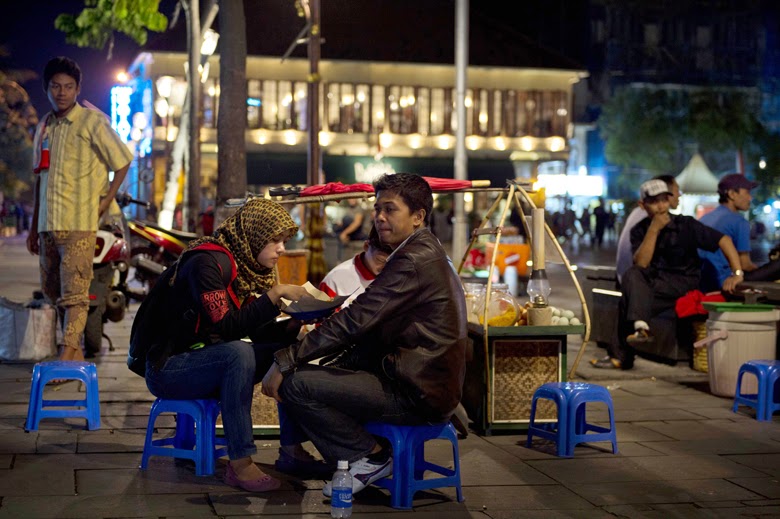
Pedestrians enjoy street food in Jakarta’s Kota Tua. (AFP Photo/Romeo Gacad)

Revitalization plan

The Fiesta Fatahillah will also mark the opening of a Visitor’s Center on the ground floor of the Fatahillah Post Office.

“The visitor’s center will provide anyone who is interested with detailed information regarding the project,” Lin Che Wei said.

A very important part of the revitalization plan is to convert the Kota Tua area into a special trade and business center.

“Economic activities are needed to sustain this area,” Lin Che Wei said. “However, every utilization and development plan is subject to the approval of [Jeforah’s] advisory board.”

These activities will involve art and culture, education, lifestyle (food, fashion and entertainment), MICE (meeting, incentive, convention, exhibition), creative industries and finance.

“The advisory board guarantees there will be no gentrification and no change to the old buildings,” Goenawan said.

Instead, owners of Kota Tua’s colonial buildings will be encouraged to renovate.

“The provincial government will enact new regulations for building owners,” Arie of Jakarta Tourism said.

Under the new regulations, owners who neglect their property will be given a large penalty, while those who agree to renovate and maintain their structures will enjoy significant discounts on land and building taxes.

“Those who cannot afford to renovate their old buildings, may send their proposals to us,” Arie said.

“The governor has agreed to contribute a portion of Jakarta’s development budget to renovate some of these historical buildings.”

Jeforah and Jotrc aim to renovate 85 colonial structures in the area within the first five years of the project.

On the opening night of the festival, the Indonesia Port Corporation (Pelindo) will also sign an agreement with Jeforah and Jotrc to revitalize the 33-hectare area of the historic Sunda Kelapa Harbor.

“Everything is already on track,” Arie said. “With the right people on our team, I’m optimistic the plan will be executed properly.”

The government is also working on a traffic master plan to alleviate the heavy traffic jams in this area and planning to build more sidewalks for tourists.

“This is our starting point,” Lin Che Wei said. “With the commitment and participation of all stakeholders, I’m positive that Kota Tua can once again be a wonderful place to live, work and play.”

A revitalized Kota Tua can play an important role in promoting Jakarta as a destination offering more than just malls and traffic gridlock.

Fiesta Fatahillah
March 13 to 16
5 p.m. to 10.30 p.m.
Related Article:


Tuesday, November 22, 2011

Slowly but Surely, Dutch Are Coming to Terms With the Colonial Past

Jakarta Globe, Bastiaan Scherpen, November 21, 2011

The controversial panel on the late 19th-century royal vehicle shows
colonial subjects presenting gifts to their Dutch rulers. (AP Photo)

Related articles

After a brief controversy, a ruthless former governor-general of the Dutch East India Company is back on his pedestal in his Holland birthplace. Literally, that is.

The statue of Jan Pieterszoon Coen (1587-1629) in the city of Hoorn, North Holland province, was accidentally hit by a vehicle during construction works in August. Despite calls to use the opportunity to replace the effigy with one of a less controversial figure than the man nicknamed the Butcher of Banda, the Hoorn City Council in late September decided to restore the monument. It was placed back on Oct. 19.

But the dispute over the statue of Coen doesn’t stand alone.

Together with a similar debate about a royal vehicle and a recent lawsuit over a massacre by Dutch soldiers in a West Java village, it shows that 66 years after Indonesia declared its independence from the Netherlands, the former colonial power is finally, and slowly, coming to terms with the legacy of its often-brutal rule in the archipelago.

Controversial Carriage

Henk Schulte Nordholt, head of research at the Royal Netherlands Institute of Southeast Asian and Caribbean Studies (KITLV), says the Dutch are gradually starting to realize that it cannot erase its colonial past.

“It will be with us in various postcolonial manifestations,” he told the Jakarta Globe in an e-mail exchange, citing migrants, food and memories as examples.

Yet this growing awareness also leads to criticism of long-accepted practices. Dutch lawmakers and rights activists recently called for a panel depicting a controversial scene to be removed from a ceremonial vehicle owned by the royal family.

The controversial panel on the late 19th-century royal
vehicle shows colonial subjects presenting gifts
to their Dutch rulers. (AP Photo)
On the horse-pulled Gouden Koets (Golden Carriage), colonial subjects — including Javanese people — are shown apparently presenting gifts to their Dutch rulers. The vehicle was a gift for then-Queen Wilhelmina by the citizens of Amsterdam in 1898. It is still used every year to transport the Dutch monarch ahead of a speech from the throne.

According to Harry van Bommel from the Socialist Party and Mariko Peters from the Green-Left party, the panel is reminiscent of a “gruesome period in Dutch history.” In September, they urged Queen Beatrix to remove the disputed panel, which is called Hulde der Kolonien ( Tribute of the Colonies).

Prime Minister Mark Rutte, who is accountable for the royal family’s actions, spoke of the request as “bizarre.”

“Rewriting history by destroying the Golden Carriage, that’s not something I would support,” Rutte, who holds a history degree, told a press conference.

Frans Grijzenhout, a professor of art history from the University of Amsterdam (UvA), said the carriage is a historical artifact that has full right to its integrity.

“It is no use to infringe on that and remove parts from it as a consequence of new insights into the position of the Dutch in the former colonies,” he said. “No matter how valuable these insights may be.”

Rewriting History

Both in Indonesia and in the Netherlands, there is a need for a holistic approach to the colonial past, said another expert, Bambang Purwanto.

“Like it or not, Indonesia and the Netherlands for a long time shared their history. To deny this is tantamount to fooling ourselves,” said Bambang, a history professor from Yogyakarta’s Gadjah Mada University.

Grijzenhout believes it would be a good idea to reconsider the way the colonial past is represented in the Netherlands, citing the Monument Indie-Nederland (Indies-Netherlands Monument) in Amsterdam as a good example.

Unveiled in 1935, that monument was meant to honor Gen. J.B. van Heutsz (1851-1924), a commander of the Royal Netherlands East Indies Army (KNIL) and governor-general.

In 2004, the local government decided to change the monument into a memorial for all aspects of Indonesia-Netherlands relations during the colonial period. All references to Van Heutsz, who had gained particular notoriety after brutally countering resistance in Aceh, were removed.

Rawagede Ruling

In another case that highlighted violent aspects of Dutch colonial rule, a court in The Hague in September ordered the Netherlands to pay damages to relatives of victims of the 1947 Rawagede massacre. The landmark ruling was hailed in Indonesia.

By some accounts, over 400 were killed in December 1947, when Dutch soldiers tried to force people in Rawagede to give up the location an Indonesian soldier.

Schulte Nordholt, who is also a professor at Amsterdam’s VU University, thinks it is strange that the Netherlands is still prosecuting former Dutch members of the German-led SS during the Second World War while at the same time trying to “cover up crimes committed in Indonesia.”

“Apart from Rawagede there are the killings by Raymond Westerling in South Sulawesi, with 3,000 victims,” Schulte Nordholt said. “The Dutch government was deeply involved in a cover-up of this case and protected Westerling,” a move described by the historian as “nothing less than a bloody shame.”

Westerling led a vicious counterinsurgency operation in Sulawesi in 1946-47. He was never prosecuted in the Netherlands, nor extradited to Indonesia.

But monetary compensation might not be a cure-all solution.

“What would our reaction be if the children and grandchildren of people murdered in the Bersiap period would take their case to court?” Bambang said, referring to the chaotic early days of the Indonesian Revolution, during which many people of Indo-European descent, and others, were killed. “The same applies to East Timor: don’t think that we are a nation without flaws and sins.”

Bambang said a statement of apology would be preferable to money. “The true lesson from history should be that such crimes against humanity should never happen again,” he added.

Back on a Pedestal

The Netherlands has never formally apologized for cases like Rawagede or other atrocities.

Under Coen’s command, in 1621, thousands of residents of the Banda Islands were massacred in an effort to monopolize the spice trade in the area.

The statue of the Hoorn native was made in 1887 to commemorate his 300th birthday. A month before it was damaged this year, the City Council of Hoorn, after being petitioned to do so by citizens, decided to alter the text accompanying the statue. The information should also reflect the violent side of Coen’s actions in Asia, officials said at the time.

Today, the statue is still accompanied by its old plaque, with a Dutch text providing basic information about the man who founded Batavia, present-day Jakarta.

But Hoorn is working on a more complete text, both in Dutch and in English. In a draft version released last week, Coen is described not only as a “visionary administrator,” but also as the architect of “aggressive policies.”

Bambang, who also holds the Leiden University chair in the history of Dutch-Indonesia relations, believes that replacing the controversial statue would have been a mistake.

“Taking away the statue of Coen would mean to deny the reality of the shared Dutch-Indonesian history,” he said. “History brings not only good things, but also misery, and all of that must be represented.”

The UvA’s Grijzenhout also said Hoorn had made the right call. “It is never a good idea to do away with the past, and much better to comment on it,” he said.

Coming to terms with colonial history clearly is a work in process on both sides of the old fence.

“We look at it from different perspectives,” Schulte Nordholt said. “But in my cooperation with Indonesian colleagues, as we try to define together new common research themes, we increasingly feel that the colonial past is our common history, which should not be marginalized or silenced.”

Sunday, December 6, 2009

Unearthing Indonesia’s forgotten heritage

Dian Kuswandini, The Jakarta Post, Jakarta | Fri, 12/04/2009 1:32 PM | Culture

Past attraction: Visitors stand in front of photos from the ongoing “Forts in Java and Sumatra: Trade Conflicts and Territorial Fights” exhibition at the National Museum (JP/J. Adiguna)

They might look like little more than old bricks and ruins, but these fortifications are the silent witnesses to the country’s centuries-old journey to independence.

Long forgotten and neglected, the forts have lost their attraction today as many of us seem to regard them merely as old constructions with little function.

Perhaps that’s true — that they can’t really function anymore — but it’s the stories embedded within their bricks that actually make them precious.

Among the stories are ones that take us back to the Java and Sumatra of 300 years ago, where fortifications were at the heart of trade conflicts and territorial fights.

These periods saw how the functions of most fortifications shifted from just trading posts equipped with storehouses, offices and residences, into bases of defense and territorial expansion.

The shift in functionality was proof of the growing power of the Dutch East India Company (VOC), which maintained strategic posts in Java and Sumatra.

Urgently seeking to secure its assets, expand its territory and maintain its domination, the VOC built more fortifications, including in Bandung, West Java, in the wake of the First World War. All have a significant place in history for Indonesians, as the fortifications are the unspoken witnesses of their struggles against the Dutch in gaining independence.

“We can actually learn a lot about our history from the fortifications,” says Nadia Purwestri, research coordinator for the Center for Architecture Documentation (PDA).

“[However] we never realized this because we weren’t aware of their existence in the first place.”

So the PDA and its Dutch counterpart, Paaschier Architects and Consultant (PAC), wish to raise the people’s consciousness with the ongoing exhibition on Indonesia’s fortifications at the National Museum.

Titled “Forts in Java and Sumatra: Trade Conflicts and Territorial Fights”, the exhibition contains the comprehensive documentation on fortifications on both islands, capturing our attention as we find out that Indonesia has hundreds of such bygone splendors.

“We want to make these fortifications as part of the country’s history through this exhibition,” Nadia says.

“Most people today have no idea they can find fortifications in their surroundings.”

In particular Jakartans, she adds, who don’t know there are ruins of forts in North Jakarta’s Old Town.

The team defines fortifications as defense structures that come in various types, including stockades, blockhouses, bunkers, pillboxes, city walls, defense caves and military base camps.

(JP/J. Adiguna)

In addition, Nadia goes on, there are also traditional fortifications such as moats and land piles. The fortifications, she says, include those built by the Dutch, British, Spanish and Portuguese.

The PDA and the PAC are holding the exhibition as part of their project to document fortifications across the country — identifying their types, conditions and damage.

“The project is also set to provide the government, in this case the Culture and Tourism Ministry, with a database for the preservation of fortifications,” Nadia says of the project that began in 2007.

This exhibition is the second since last year that highlights fortifications in the eastern part of Indonesia: Maluku, North Maluku, West Papua and Papua.

Next year, Nadia says, a third exhibition will be held to showcase the team’s documentation of fortifications in Kalimantan, Sulawesi, Nusa Tenggara and Bali.

“Our project is in three stages,” she says.

“In the first stage, we are documenting fortifications in the eastern part of Indonesia, the second in the western part, and the third in the central part.”

For the first stage, Nadia’s team recorded 141 fortifications, while they found 177 in the second stage in Java and Sumatra. The third stage is still underway.

“We found hundreds of fortifications, but the ones we’ve showcased in the exhibitions are the special ones,” Nadia says.

This means, she points out, the fortifications must meet certain criteria. “We pick those that are already famous in our history.”

Nadia then cites the magnificent Marlborough Fort in Bengkulu, South Sumatra, and Vanderburg Fort in Yogyakarta as among those highlighted this time around.

The second type of fortification chosen are those with unique or unusual structures, either pentagonal or round, she adds.

“The Martello Fort on Bidadari Island [in Jakarta’s Thousand Islands] is an example of that round shape. It’s interesting for people to know about it, right?” Nadia says, adding forts that are in good condition also fit the team’s criteria for the exhibition.

The team also highlighted fortifications that are still in use today, either as prisons, amusement hubs or offices.

“We wish to find out whether other fortifications might have similar prospects for being developed,” Nadia says.

“As we know, most of these fortifications are located in the middle of growing areas or big cities, so they’re threatened by development.”

Therefore, as Nadia points out, efforts must be made to use the fortifications, either as tourism sites or as commercial buildings, just so they can be around us just that little bit longer, as precious heritage to remind us of the country’s journey to independence.

Forts in Java and Sumatra: Trade Conflicts and Territorial Fights

Runs through Dec. 10 at Galeri Kaca, National Museum
Jl. Merdeka Barat No. 12
Central Jakarta
Tuesday to Sunday from 9 a.m. to 2 p.m.

Related Articles:

Pusat Dokumentasi Arsitektur-Indonesia - PDA Website (Indonesian Center for Architecture Documentation)

Documenting Culture Heritage Project - PAC architects and consultants

Map of Forts in Indonesia


Sunday, November 15, 2009

Struyswijk powered Salemba in 16th century

BERITAJAKARTA.COM — 11/15/2009 7:49:00 PM

At that time, Salemba was called as Struyswijk

The Netherlands came into Jakarta in early 16th century. At that time, Salemba was called as Struyswijk. It was taken from the name of the landowner, Abraham Struys. Struys was a VOC official who opened swamp to be a wide plantation. He took his gardeners and farmers from the native Indonesian with small salary.

History told that Abraham Struys always wanted to be respected. Therefore, he named his land as `Struyswijk` or a Struys’s wide land. Its borders were in Utan Kayu, Matraman to Rawamangun.

When he passed away, Abraham Struys inherited his land to Anna Struys, his daughter. Ever since, the land was lessened. Joan van Hoorn, Anna’s husband sold it to Domine Kiezenga also the Netherlands.

The remaining Struys’s land is now Salemba.

And then in Struyswijk, there were built some residential areas. People told, Governor General Daendels in 1808 built a big road there. It was named Daendels Street.

The street was built to connect Mesteer Cornelis (Jatinegara), Senen and Batavia New City (a Daendels’s city) in Weltevreden (Gambir).

Netherland Govt. built a college which is now called as UI (University of Indonesia). Behind the campus there was CBZ, which was a medical practice place for medical students of UI. Now, CBZ is Tjipto Mangunkusumo Hospital.

In Salemba, the Netherlands also built a prison for them, the Indonesian strugglers who wanted to fight against Dutch colonial.

Wahab, a resident of Jl. Kenari, Salemba told beritajakarta.com that Salemba Street was a witness of the war between English troops and the Netherlands troops in seizing Batavia. “English troops won it,” Wahab said, Saturday (11/14).

Translator: ajeng

Monday, November 9, 2009

National heroes

The Jakarta Post, Mon, 11/09/2009 3:46 PM


President Susilo Bambang Yudhoyono congratulates the heirs of national heroes in Central Jakarta on Monday as part of the commemoration of National Heroes Day which is celebrated tomorrow. (Antara/Widodo S. Jusuf)

Related Articles:

The national heroes list is comprised of 144 people who fought for the country during the Dutch and Japanese colonial period (Photo: Afriadi Mikmal, JG)

A Day To Honor Indonesian Heroes


Raden Mas Soerachmen spent his youth hunting down traitors in Indonesia’s independence movement. (Photo: Armando Siahaan, JG)

Hero, Hunter, Soldier, Spy


Saturday, November 7, 2009

Old hearse in Museum Prasasti

BERITAJAKARTA.COM — 11/6/2009 5:48:28 PM

Cemetery is identical with spooky atmosphere. But that typical is different with the old cemetery in Jl Tanahabang I, Central Jakarta. It has been aged for 4 centuries. It saves many priceless art objects. It is Museum Taman Prasasti, people nearby call it as Kebonjahe Kober cemetery.

There are three little angel statues complete the main gate. The cemetery is maintained nicely. It is beautiful although spooky.

In the auditorium there are 16 giant ancient inscriptions made by black steel and also some others inscriptions.

At the left side of the cemetery, there is an old hearse in a gazebo. Not many people know about it.

It has 6 meters length. It was made by a black teak and glass wall on its sides and back. It is tidily saved at the museum. It still looks strong.

Allegedly, it was functioned as the carrier for the Netherlands’ body from a boat in Krukut River. It was used only for the Netherlands. Native Indonesian could not use it.

The coffin of Indonesia’s first president, Soekarno and Indonesia’s first Vice President Muhammad Hatta are also placed there. VOC officials’ gravestone is also there, for example Olivia Marianne Raffles’s gravestone. She was a wife of VOC Governor General, Thomas Stamford Raffles who passed away in 1816, and Netherland and England figures A.V. Michelle and Dr. H.F. Roll (founding of medical school at the era of Dutch colonialism) and Capt. Jas (his grave is believed by the people to give fertility, security, prosperous and happiness).

The cemetery is divided into 10 blocks and it has almost 1,500 collections. Most of the gravestones were written in the year around 1800 to 1900.

At that time, there were only VOC officials who could be buried there. But time to time, common people could also be buried there, with an expensive cost.

Museum Taman Prasasti name was established in 1977. Previously, people knew it as Kebonjahe Kober. Because of city development, the previous wide of it around 5.5 hectares, it is now shrinking into only 1.3 hectares.

Translator: ajeng

Saturday, March 14, 2009

Onrust Island struggles for survival, recognition

Agnes Winarti, The Jakarta Post, JAKARTA | Sat, 03/14/2009 1:32 PM 


 So new yet so fragile: Parts of Onrust’s new dike the administration built in 2002 and 2003, are already cracked and damaged. (JP/Agnes Winarti)
 

Despite the city administration declaring Onrust Island a protected historical site almost four decades ago, the majority of the island’s visitors are fishermen, rather than people interested in the site’s history.   

“I have been fishing here since 1991. My father used to bring me here,” said Barouk, a resident of Tanah Abang, Central Jakarta, who was camping near the remains of a Dutch fort in Kelor Island. The less than one-hectare island is about one kilometer away from Onrust.

Onrust, once a bustling Dutch shipyard and port, is located in the Thousand Islands.

‘The water is calm here,” he said. “I could catch up to four kilograms of squids and fish every day.”

In 1972, Jakarta governor Ali Sadikin declared Onrust a protected historical site. In 2002, the administration made Onrust and its three neighboring islands - Bidadari, Kelor and Cipir – an archaeological park, because of the artifacts and ruins that were discovered there.

During the 17th and 18th centuries, Onrust - believed to be one of the largest shipyards in Southeast Asia - and its three neighboring islands, were key strategic posts the Dutch East India Company (VOC) used to defend Batavia, now Jakarta.

While a section of Bidadari Island is now a resort catering for up to 50 visitors a day, Onrust, Kelor and Cipir islands have remained under the tourists’ radar.

“Many of our visitors come to fish rather than visit historical sites,” Mahdi Effendi, head of the city tourism and culture agency’s Onrust Archaeology Park division told The Jakarta Post recently.

Last year, Onrust welcomed 15,000 visitors. 

“The figures were much better than last year’s, when we only recorded 8,000 visitors,” said Mahdi.


 Fishermen and the sea: Two men stand on a wave breaker near Onrust island, in the Thousand Islands, fishing baronang (Siganus lineatus). Most visitors to Onrust, once a Dutch port, are fishermen rather than visitors touring historical sites. (JP/Agnes Winarti)

Most of the fishermen visiting the islands only pay half of the entrance ticket price, or Rp 2,000. Some end up not paying anything as there are no officers attending the entrance of Onrust’s archeological park. 

“We do not have any boats available to ferry visitors between our islands and Jakarta, let alone officers to monitor visitors entering the park,” said site officer Purwo Lesono.

The administration used to provide a boat that could carry up to 16 people, but this service came to an end after the boat was badly damaged.

As a result, renting a fisherman’s boat at North Jakarta’s Muara Kamal fish auction market has become the most affordable option for both employees and visitors going to the island. Visitors can also rent a more expensive boat from Marina dock in Ancol and Muara Angke fish market.

It takes 20 minutes to travel the 14 kilometers distance between Muara Kamal and Onrust, while Onrust is only one to two kilometers away from the other islands.

“A regular shuttle service to Onrust and its neighboring islands is urgently required. It is the most basic thing we must provide visitors,” said Purwo.

This year, Onrust is hoping to attract 20,000 visitors.   

Bad weather also prevents visitors from accessing the islands.

“During the rainy season, Jakarta waters are quite rough and daunting for people sailing to the islands,” Mahdi said.   

Onrust’s size has shrunk as a result of erosion, from its original 12 hectares to 7.5 hectares in 2002. In that year, the administration built a dike around the island, made out of concrete. About 30 percent of the dike is now damaged.  


Last fort: A visitor takes a picture of the ruins of an old Dutch fort in Kelor Island, located two kilometers away from Onrust. The fort was once used as a surveillance post to store gunpowder. (JP/Agnes Winarti)

The Dutch had to rebuild their Onrust Island naval bases several times, after repeated attacks by the British fleets. In 1883, a tidal wave - caused by the eruption of the Krakatoa Volcano in the Sunda Strait - destroyed the last Dutch navy base in the island. When the construction of Tanjung Priok port began, Onrust was deserted.

During the 19th century, Onrust was used as a sanatorium for people suffering from tuberculosis. Afterwards, the island was used by haj pilgrims heading to and returning from Mecca. The barracks, which could hold up to 3,500 pilgrims, used to occupy two-thirds of the island.

Before Governor Ali Sadikin declared Onrust a protected historical site, there were many thefts, from artifacts to old building ruins, including roofs, bricks and woods. As of today, only a handful of ruins remain.


Mary’s tomb: A visitor takes a picture of the tombstone belonging to Maria Van Veldeslyk, who died in 1693. Maria Van Veldeslyk and Anna Adriana Duran’s tombstones are the only Dutch tombs left intact in Onrust. The rest have been damaged throughout the years. (JP/Agnes Winarti)

Sights of interest in Onrust include an unattended graveyard, a run-down prison building that has been newly renovated, a new hospital serving as a museum showcasing pictures, artifacts and a miniature reproduction of what the island used to look like.

Remains of the Dutch dike can also been seen along the shores of Onrust. There are similar remains in Bidadari Island and a dilapidated Martello tower as well as a crumbling fort in Kelor Island.

“I have read the history of Onrust Island. I’ve seen the pictures in books. They are beautiful. I would have never guessed its historical site had been so neglected,” said Ken Paramita, a 19-year-old history student at the University of Indonesia, while she noticed the damaged tombs in the island’s graveyard.

“Wild plants and trash should be regularly removed from the sites,” said Ken.

Mahdi said that the amount of garbage coming from Jakarta’s mainland was a problem too. Some fishermen added that when annual floods hit Jakarta, disused sofas, cupboards and beds wash up on the islands’ shores.

Rangga, an archaeology student visiting Onrust, said better services should be provided to visitors, such as tour guides and comprehensive literature on the island’s history.

“In that way, visitors can get a better idea of what living on this island was like many years ago,” said Rangga.  

Site officer Purwo said his office is still looking into how to showcase the island’s history, given the small amount of historical buildings left.

“We are currently focusing on how to better attract visitors to Onrust. Hopefully, we will come up with a solution at the end of this year,” Purwo said.   

This year, the administration allocated Rp 1 billion to the Onrust Archaeology Park, of which Rp 500 million went toward marketing, Rp 300 million toward maintenance, Rp 36 million toward renovations and the rest toward other operational expenses.    
 

Cost and transportation alternatives to Onrust Island: 

  1. Most affordable: rent a fisherman’s boat in Muara Kamal fish auction, North Jakarta. The boat does a round trip from Muara - stopping in Kamal, Onrust, Kelor, Cipir and Bidadari - and costs Rp 300,000 to Rp 400,000. The boat can take up to 30 passengers. Onrust is 15 to 20 minutes from Muara Kamal. To get to Muara Kamal: Take the Harmoni-Kalideres busway to Rawa Buaya. Jump on an ojek to Muara Kamal auction fish (Rp 10,000) or catch a red minibus in Kota. Look for the D06 going from Kota to Kamal and Kapuk and get off at Muara Kamal auction fish.    

  2. Rent a boat from the Muara Angke fish market. A round trip will cost Rp 6 million and can take up to 60 passengers. Onrust is about 20 minutes from Muara Angke.

  3. Rent a ferry boat from Ancol Marina. A four-hour round trip will cost Rp 15 million and can take up to 70 passengers.  Onrust is about 45 minutes from Ancol Marina. 

  4. Catch a boat from Bidadari. The Bidadari round trip - which stops in Onrust, Cipir, and Kelor - takes 2 hours and costs Rp 250,000 per passenger, with a minimum of five passengers and a maximum of 30. Entrance ticket to Bidadari cost Rp 25,000.

Related Article: