Indonesia executes six drug convicts, five of them foreigners

Indonesia executes six drug convicts, five of them foreigners
Widodo has pledged to bring reform to Indonesia

Ban appeals to Indonesia to stop death row executions

Ban appeals to Indonesia to stop death row executions
United Nations Secretary General Ban Ki-moon has pleaded to Indonesia to stop the execution of prisoners on death row for drug crimes. AFP PHOTO

Pope: 'Death penalty represents failure' – no 'humane' way to kill a person

Pope: 'Death penalty represents failure' – no 'humane' way to kill a person
The pope wrote that the principle of legitimate personal defense isn’t adequate justification to execute someone. Photograph: Zuma/Rex

Obama becomes first president to visit US prison (US Justice Systems / Human Rights)

Obama becomes first president to visit US prison   (US Justice Systems / Human Rights)
US President Barack Obama speaks as he tours the El Reno Federal Correctional Institution in El Reno, Oklahoma, July 16, 2015 (AFP Photo/Saul Loeb)

US Death Penalty (Justice Systems / Human Rights)

US Death Penalty (Justice Systems / Human Rights)
Woman who spent 23 years on US death row cleared (Photo: dpa)


.

.
"The Recalibration of Awareness – Apr 20/21, 2012 (Kryon channeled by Lee Carroll) (Subjects: Old Energy, Recalibration Lectures, God / Creator, Religions/Spiritual systems (Catholic Church, Priests/Nun’s, Worship, John Paul Pope, Women in the Church otherwise church will go, Current Pope won’t do it), Middle East, Jews, Governments will change (Internet, Media, Democracies, Dictators, North Korea, Nations voted at once), Integrity (Businesses, Tobacco Companies, Bankers/ Financial Institutes, Pharmaceutical company to collapse), Illuminati (Started in Greece, with Shipping, Financial markets, Stock markets, Pharmaceutical money (fund to build Africa, to develop)), Shift of Human Consciousness, (Old) Souls, Women, Masters to/already come back, Global Unity.... etc.) - (Text version)

“… The Shift in Human Nature

You're starting to see integrity change. Awareness recalibrates integrity, and the Human Being who would sit there and take advantage of another Human Being in an old energy would never do it in a new energy. The reason? It will become intuitive, so this is a shift in Human Nature as well, for in the past you have assumed that people take advantage of people first and integrity comes later. That's just ordinary Human nature.

In the past, Human nature expressed within governments worked like this: If you were stronger than the other one, you simply conquered them. If you were strong, it was an invitation to conquer. If you were weak, it was an invitation to be conquered. No one even thought about it. It was the way of things. The bigger you could have your armies, the better they would do when you sent them out to conquer. That's not how you think today. Did you notice?

Any country that thinks this way today will not survive, for humanity has discovered that the world goes far better by putting things together instead of tearing them apart. The new energy puts the weak and strong together in ways that make sense and that have integrity. Take a look at what happened to some of the businesses in this great land (USA). Up to 30 years ago, when you started realizing some of them didn't have integrity, you eliminated them. What happened to the tobacco companies when you realized they were knowingly addicting your children? Today, they still sell their products to less-aware countries, but that will also change.

What did you do a few years ago when you realized that your bankers were actually selling you homes that they knew you couldn't pay for later? They were walking away, smiling greedily, not thinking about the heartbreak that was to follow when a life's dream would be lost. Dear American, you are in a recession. However, this is like when you prune a tree and cut back the branches. When the tree grows back, you've got control and the branches will grow bigger and stronger than they were before, without the greed factor. Then, if you don't like the way it grows back, you'll prune it again! I tell you this because awareness is now in control of big money. It's right before your eyes, what you're doing. But fear often rules. …”

Saturday, April 1, 2017

Children of Indonesian men executed by Dutch demand damages

DutchNews, March 31, 2017

More than 500 children of men executed in Indonesia during the independence war of 1946 to 1949 are preparing damages claims against the Dutch state, the AD said on Friday. 

Lawyer Liesbeth Zegveld has sent a list of 520 names to the defence and foreign affairs ministries, urging the state to settle their claims out of court, the paper said. 

She wants the government to agree to give the children damages the same rights as the widows of the men killed. They are able to make an uncontested claim for damages, outside the courts. 

The state, however, has said it wants to wait until the outcome of a test case brought by the children of men executed in southern Sulawesi. A lower court ruled in 2015 that they are entitled to compensation like their mothers. 

The Dutch military interventions in Indonesia, or Dutch Indies as it was known then, followed the proclamation of the independent Republic of Indonesia in 1945 and lasted until the country formally gained independence in 1949 after a bloody struggle. 

At the end of 2011, the Netherlands finally formally apologised for the massacre of hundreds of men and boys in the Javanese village of Rawagede in 1947. 

Last year, the Dutch government agreed to set up a major inquiry into the structural use of violence in Indonesia.

Related Article:


Friday, March 3, 2017

Indonesia, Saudi sign deals as King Salman starts landmark visit

Yahoo – AFP, Dessy Sagita, March 1, 2017

Saudi Arabia's King Salman bin Abdul Aziz (L) held talks with Indonesian
President Joko Widodo (R) in Bogor, West Java, on March 1, 2017

Indonesia and Saudi Arabia Wednesday signed agreements in areas ranging from trade to aviation as the kingdom's monarch visited the world's most populous Muslim-majority country for the first time in almost half a century.

King Salman was treated to an elaborate official welcome as he arrived in Jakarta, his latest stop on an Asian tour seeking investment opportunities, at the head of a 1,000-strong delegation including princes and ministers.

After disembarking from his plane, he was met by President Joko Widodo before travelling past cheering crowds in pouring rain to a presidential palace at Bogor south of Jakarta, where he was greeted by a marching band, a mounted honour guard and a 21-gun salute.

Almost 460 tons of equipment have been flown in for the visit, including limousines and escalators.

Preparations have been elaborate. Naked statues at the Bogor palace were covered up before Salman's arrival. Some 150 chefs have reportedly been hired to cook for the king's party and a VIP toilet has been constructed at a mosque he will visit.

Widodo hailed the "historic" visit, adding: "As the country with the biggest Muslim population in the world, Indonesia will always have a special bond with Saudi Arabia."

The leaders oversaw the signing of 11 cooperation memoranda following Wednesday's talks at the Bogor palace. Apart from trade and aviation, they included agreements on boosting cooperation in science, health and fighting crime.

Indonesia's President Joko Widodo (centre L) welcomes Saudi Arabia's King 
Salman bin Abdul Aziz (centre R) at Halim airport in Jakarta on March 1, 2017

Jakarta and Riyadh also inked an agreement that builds on an existing $6 billion deal between state-owned energy firms Aramco and Pertamina to expand an Indonesian oil refinery.

Salman, 81, said he hoped the visit would "contribute to the improvement of the bilateral relationship between our two countries".

The visit -- the first by a Saudi Arabian king to Indonesia for 47 years -- is one of the highlights of a rare Saudi royal tour of Asia, a region seeking investment as the world's biggest oil exporter tries to diversify its economy.

After the three-day visit to Jakarta, Salman and his entourage will head to the Hindu-majority resort island of Bali for a holiday, where they will reportedly stay in five luxury hotels.

On Thursday the king is due to give a speech to parliament and visit a major Jakarta mosque. He is also due to meet leaders of some of Indonesia's major Muslim organisations during the trip.

Salman began his three-week Asian tour in Malaysia earlier this week and is also set to visit Japan, China and the Maldives.


Related Articles:

Saudi monarch turns selfie king on Asia tour


Wednesday, February 22, 2017

Indonesian foreign minister: 'Trying to create a culture of tolerance'

Concerns abound in recent times about the threats posed by radicalization and terrorism to Indonesian society. The country's foreign minister spoke to DW about how the government is tackling these issues.

Deutsche Welle, 20 February 2017


DW: There are growing concerns about increasing radicalization in Indonesia. How vulnerable is the country to this threat?

Retno Lestari Priansari Marsudi: Let me start by saying that radicalization is not a problem limited to any particular country. The threats of radicalism and terrorism are faced by almost every nation worldwide. We discussed them during the G20 meeting and also ways to improve and coordinate counter-terrorism measures.

Terrorism is one of the most challenging threats to world peace. In 2015, for example, outfits affiliated to IS [the so-called Islamic State terror group] were responsible for carrying out attacks in 28 countries. That figure was twice the number of attacks in 2014. Over the past 16 years, 93 nations have experienced terror attacks, resulting in some 32,000 deaths. I, therefore, would like to stress that no country is immune to terrorism.

What measures are being put in place by Indonesia to deal with these threats?

I think Indonesia is a good example for how to cope with such threats. We have the biggest Muslim population of any other country in the world, and at the same time our community is very heterogeneous. We are therefore trying to create a culture of tolerance.

Since the birth of Indonesia as a country, we Indonesians know we have different ethnicities and multiple religions, but we all want to have one country - Indonesia. So a culture of tolerance is always there. However, as evidenced by almost all countries, Indonesia has also faced radicalization and the threat of terrorism. But Indonesia has so far been able to cope with the situation.

Whereas most countries focus on hard power to counter radicalism and terrorism, Indonesia has laid emphasis on a soft power approach, and it's working very well.

How do you think the fears surrounding radicalism would impact Indonesia's economic development prospects?

I don't think international investors are worried at all about the threat of radicalization in Indonesia, as everybody is aware that this kind of danger exists everywhere. Regarding foreign investment, the president of Indonesia has always stressed his commitment to make the nation's economy more open and competitive. This is reflected in the government's initiatives over the past year, when we introduced 14 economic reform packages. With these measures, we do hope to draw in more foreign investment into our fast-expanding economy.

Again, we are striving to make our economy more open and competitive and this should attract greater foreign investment into the country.

Many are calling on Indonesia to step up its efforts to help tackle the Rohingya crisis. How do you envisage the Indonesian government's response to the problem?

To start with, Myanmar is an ASEAN [Association of Southeast Asian Nations] country, like Indonesia. If something happens in Myanmar, it will surely affect the rest of the region. So there are only two options here: either help Myanmar resolve the problem or don't help.

Indonesia, for its part, has decided to actively and constructively engage with Myanmar. We understand the problem there, which created a humanitarian crisis and a security concern in Rakhine state. We continue to convey our concerns to the Myanmar government and stress on the need to create an environment that is conducive for peace in Rakhine.   

Retno Lestari Priansari Marsudi:
 'Indonesia has decided to actively and
 constructively engage with Myanmar' 
on the Rohingya issue
We have also communicated with Myanmar on the importance of protecting and respecting the human rights of all communities, including the Muslim communities. We also underline the significance of inclusive economic development, particularly in Rakhine state.

This way, we convey our views, concerns and criticisms to our counterparts in the Myanmar government, while offering our assistance at the same time.

Furthermore, I have discussed the issue of Rohingyas with many stakeholders, including Kofi Annan. I have visited Myanmar three times, traveled to Dhaka and paid a visit to the refugee camps in Cox's Bazar.

I want to underscore that we would like to not only help Myanmar in addressing the immediate issues in Rakhine state, but also provide more medium- and long-term assistance for the country's development.

Retno Lestari Priansari Marsudi is currently serving as Indonesia's foreign minister.

The interview was conducted by Vidi Legowo-Zipperer during the recent G20 foreign ministers summit in Bonn, Germany.

Sunday, February 19, 2017

Philippine Church in 'show of force' against drug killings

Yahoo – AFP, Ayee Macaraig, February 18, 2017

More than 6,000 people have died in the seven months since President
Rodrigo Duterte ordered an unprecedented war on drugs, which has drawn
global criticism for alleged human rights abuses (AFP Photo/NOEL CELIS)

Manila (AFP) - Thousands of Catholic faithful gathered in the Philippine capital on Saturday for a "show of force" in the biggest rally yet to stop extrajudicial killings in President Rodrigo Duterte's drug war.

More than 6,000 people have died since Duterte took office seven months ago and ordered an unprecedented crime war that has drawn global criticism for alleged human rights abuses, but is popular with many in the mainly Catholic country.

Members of one of the nation's oldest and most powerful institutions chanted prayers and sang hymns as they marched to condemn a "spreading culture of violence".

"We have to stand up. Somehow this is already a show of force by the faithful that they don't like these extrajudicial killings," Manila bishop Broderick Pabillo told AFP before addressing the crowd.

"I am alarmed and angry at what's happening because this is something that is regressive. It does not show our humanity."

Duterte, 71, has attacked the Church as "the most hypocritical institution" for speaking out against a campaign that he says would save generations of Filipinos from the drug menace.

About eight in 10 Filipinos are Catholic, making the former Spanish colony of more than 100 million people Asia's bastion of Christianity.

The Church helped lead the revolution that toppled dictator Ferdinand Marcos in 1986 and a 2001 uprising against then-president Joseph Estrada that saw him ousted over corruption charges.

Thousands of Catholics gather at a dawn rally in a "show of force" against alleged
 extrajudicial killings in Philippine President Rodrigo Duterte's drug war in Manila on 
February 18, 2017 (AFP Photo/NOEL CELIS)

It had initially declined to voice opposition publicly to Duterte's drug war but, as the death toll of mostly poor people mounted, it began late last year to call for the killings to end.

Saturday's event, called the "Walk for Life", gathered 20,000 people, according to the organisers. Manila police estimated the crowd at 10,000.

The rally also opposed Duterte's push to restore the death penalty, his top legislative priority as part of his crime war.

'Tears and fears'

"It is obvious that there is a spreading culture of violence. It is saddening to see, sometimes it drives me to tears how violent words seem so natural and ordinary," said Manila Cardinal Luis Tagle, the country's highest-ranking Church official.

"In your surroundings, in your neighbourhood, there are so many lives that must be saved. They will not be saved by mere discussion."

The Catholic Bishops' Conference of the Philippines had called on the faithful to gather at the Quirino Grandstand, where Duterte held a huge pre-election rally, from 4:30am.

"Why dawn? It's because it is during these hours that we find bodies on the streets or near trash cans. Dawn, which is supposed to be the hour of a new start, is becoming an hour of tears and fears," Archbishop Socrates Villegas, president of the bishops' conference, told the crowd.

Villegas this month issued the Church's strongest statement against the drug war, warning against a "reign of terror" in poor communities.

Officers investigate the killing of two alleged robbers in a gun fight with police
in Manila (AFP Photo/NOEL CELIS)

Among those who attended Saturday's event was Senator Leila de Lima, a former human rights commissioner and one of Duterte's most vocal opponents.

The government on Friday filed charges against her for allegedly running a drug trafficking ring using criminals in the country's largest prison when she was justice secretary in the previous administration.

De Lima, who has repeatedly insisted the charges against her are trumped up to silence her and intimidate other Duterte critics, said she attended Saturday's event as a show of solidarity.

"For as long as I can, I will continue to fight. They cannot silence me," De Lima, who is expecting to be arrested in the coming days, told AFP.

Bone cancer survivor Lucy Castillo, 56, turned up in a wheelchair along with dozens of other people with disabilities.

"When I was in so much pain, I could have taken my life but I did not. Only God can take it," she told AFP.

"I was diagnosed 40 years ago but I was given a chance to live. I want to give these drug addicts another chance."

Saturday, February 18, 2017

Dick Bruna, who created Miffy the rabbit, dies at the age of 89

DutchNews, February 17, 2017

Japanese Miffy fans pose by her statue in Utrecht. Foto: Erik van ‘t Woud /
Hollandse Hoogte 

Dick Bruna, the Utrecht artist behind the globally successful Miffy the rabbit children’s books, has died at the age of 89. 

Bruna died peacefully in his sleep, his publisher said on Friday. He had not been seen in public for several years and brought out the last book about Miffy in 2011. 

Bruna wrote and illustrated 124 books as well as designing posters and other book covers plus work for charities as diverse as Unicef and World Aids Day. 

Books about Miffy, known as Nijntije in Dutch, were translated into over 50 languages and Bruna sold some 85 million books during his life, news agency ANP said. The first was published in 1955.

The artist also had his own museum, the Dick Bruna Huis, in Utrecht. Marja Kerkhof, director of Bruna’s publisher Mercis, told broadcaster NOS: ‘I had such an enormous admiration for his work that representing his business interests was easy. It is an honour to introduce his work to adults and children all over the world.’

Sunday, January 29, 2017

KLM refuses seven passengers following Trump’s Muslim country ban

DutchNews, January 28, 2017

Dutch airline KLM has refused to fly at least seven passengers to the US after president Donald Trump closed the country’s borders to refugees and visa holders from a list of banned Muslim-majority countries. 

All the people who were refused permission to fly had a visa for the US, KLM told broadcaster NOS. Two had tickets to fly from Amsterdam’s Schiphol airport. The other five were flying from different destinations and had planned to change planes at Schiphol, NOS said. 

KLM said it had no alternative but to refuse to allow them to fly because they would not be allowed into the US. The airline said it and would pay for them to return to the starting point of their journey. 

Trump on Friday introduced an immediate entry ban for everyone from Iran, Iraq, Somalia, Sudan, Syria, Libya and Yemen to last three months. The ban appears also to apply to people with a green card – a permanent residency permit. 

The KLM spokesman told website Nu.nl there would be more clarity about who could and could not fly in the coming days. 

More on the impact of the ban
Related Articles:

This google document shows lists Senators alphabetically, noting whether they have opposed or remained silent to the ban, any link or public statement about it and the dates of their next re-election. - New

Trump ban leads Dutch to halt talks with the US on clearance at Schiphol - New
Dutch prime minister regrets and rejects Trump’s Muslim country entry ban
Leaders, groups and businesses react to US immigration ban


Portrait of Anne Frank at age 12, sitting at her desk at the Montessori school
in Amsterdam. (Courtesy Anne Frank House, Amsterdam)


"The New Human P1" - Sep 19-20, 2015 (Kryon Channelling by Lee Carroll)
"Return of the Masters" - Apr 11-12, 2015 (Kryon Channelling by Lee Carroll)


".... The Wild Card of 2016

Remember: No emotion now. You have come from another planet and you’re looking at the end of 2016 – and there is the election. Understand without bias.

So for 2016, let’s do the numerology. You add the numbers and get nine. Nine is completion in simple numerology, and when you see a nine it often means the completion of something. Often it is of a time cycle, an energy or the completion of a paradigm. But it’s very strong.

The nines are stronger than many of the other numerological aspects and you feel them. The president-elect (at this writing) is a strong wild card. He is scheduled to become the 45th president. What a coincidence! Forty-five is a nine. A nine and a nine together are more than significant. They tell a story about what is happening. I will tell you something else. This story is not finished yet and there is more coming. You don’t know what you don’t know, so don’t make up your mind in advance about any outcomes. You’re from another planet, remember? There’s no emotion, no bias, no politics and nothing to judge. Look at it for what it is.

A big stick has just been inserted into what is normal and it’s going to be turned. As the big stick turns, other things will respond that never would have responded otherwise. I wish to tell you, dear one, old soul, relax with upcoming wild cards. They do what they do on purpose so that you will have a better civilization in the future. Sometimes they show you what won’t work, and sometimes they change paradigms that would have never changed otherwise. But what you have now is a profound wild card. That is the message.

It’s so common for you to respond certain ways when you are invested in the process. The knee-jerk reaction is expected or you wouldn’t be a Human. However, for this lesson, you’re from another planet and you’re looking down and you’re seeing it. Pretend.

Isn’t that interesting about a nine and a nine together? It means that truly the end of something is here. Perhaps it’s the end of the old way things were done? Perhaps it’s a shake-up of the system so it can correct itself? Don’t dare make up your mind where it’s going, because it’s not finished yet. However, wait a moment. Did you also realize that 2017 is a “one” year? Not only is the energy one of completion with a double nine, but it moves into “a new beginning” (the definition of a one in numerology).

I have more to tell you about numerology, and also something that will be clearer about this whole situation. I will give this to you in the next channelling.

Can you relax in the face of uncertainty when it’s your own country? Can you relax in the face of not knowing what’s next? When you’re so involved, can you disengage from either side of the fray? That is the test of a Lightworker.

There’s something else coming. Dear ones, this is beautiful. No matter what you think and no matter what your reaction is to this channelling, what is happening is correct for your time and needed for your immediate future. I will speak of this later. The beauty is when you step away and see how grand it is, that Spirit cares enough that it would allow a big stick to occur that would stir your complacency at this time. The real reason? The shift is here.

How do you feel? I want you to relax and smile at what the shift has brought you. For those of you who felt all the “shift talk” was nonsense, this may be your wake-up call. It’s real. Here it comes.

This is the message of the day. I am Kryon, in love with humanity, and for good reason.

And so it is.

KRYON


"The Timing of the Great Shift" – Mar 21, 2009 (Kryon channelled by Lee Carroll) - (Text version)

“… Human Nature is Changing

There's a new concept afoot, a change in Human nature. We've spoken about this before. How many of you studied European history? And in school, did your mind fill up with all of the dates you had to memorize? Who conquered whom and when? Over and over and over, every single country had their turn conquering another country. Borders moved constantly. As far back as you want to go, that's what Humans did. They separated, gathered, and conquered. But as little as 50 years ago, it all stopped.

We've said this before. Fifty years ago, a seed, an idea, was planted at the end of World War II. "Let's put these European countries together," they said. "Let's even drop the borders and eventually give them one currency." Do this and they'll never war again, they predicted, for countries with common economic sources don't go to war! And that's exactly what's happened. Did it work? It's fairly fresh, but their money is threatening to take over the strength of your money, did you notice? It's worth more than yours. They still struggle to make it work and balance it. But then again, you do the same in the United States, always fine tuning the unity.

South America is considering the same thing right now. The seeds are being planted in Brazil. Within a generation, they would love to see the borders dropped and one currency. Can they do it? Perhaps. Perhaps it will take longer. Why do it? Because they see the European Union with the strongest currency on Earth. We've said this before. Here is a prediction: Perhaps not in your time, but there'll come a day when there are only five currencies in the world, because continents will start understanding that unification creates peace and prosperity. Separation creates chaos. What a concept. …”


"The Recalibration of Awareness – Apr 20/21, 2012 (Kryon channeled by Lee Carroll) (Subjects: Old Energy, Recalibration Lectures, God / Creator, Religions/Spiritual systems  (Catholic Church, Priests/Nun’s, Worship, John Paul Pope, Women in the Church otherwise church will go, Current Pope won’t do it),  Middle East, Jews, Governments will change (Internet, Media, Democracies, Dictators, North Korea, Nations voted at once), Integrity (Businesses, Tobacco Companies, Bankers/ Financial Institutes, Pharmaceutical company to collapse),  Illuminati (Started in Greece, with Shipping, Financial markets, Stock markets, Pharmaceutical money (fund to build Africa, to develop)), Shift of Human Consciousness, (Old) Souls, Women, Masters to/already come back, Global Unity.... etc.) - (Text version)

“.   New Tolerance

Look for a softening of finger pointing and an awakening of new tolerance. There will remain many systems for different cultures, as traditions and history are important to sustaining the integrity of culture. So there are many in the Middle East who would follow the prophet and they will continue, but with an increase of awareness. It will be the increase of awareness of what the prophet really wanted all along - unity and tolerance. The angel in the cave instructed him to "unify the tribes and give them the God of Israel." You're going to start seeing a softening of intolerance and the beginning of a new way of being.

Eventually, this will create an acknowledgement that says, "You may not believe the way we believe, but we honor you and your God. We honor our prophet and we will love you according to his teachings. We don't have to agree in order to love." How would you like that? The earth is not going to turn into one belief system. It never will, for Humans don't do that. There must be variety, and there must be the beauty of cultural differences. But the systems will slowly update themselves with increased awareness of the truth of a new kind of balance. So that's the first thing. Watch for these changes, dear ones. ...."

Hoping for a fresh sea breeze aboard a cruise ship? Better hold your nose!

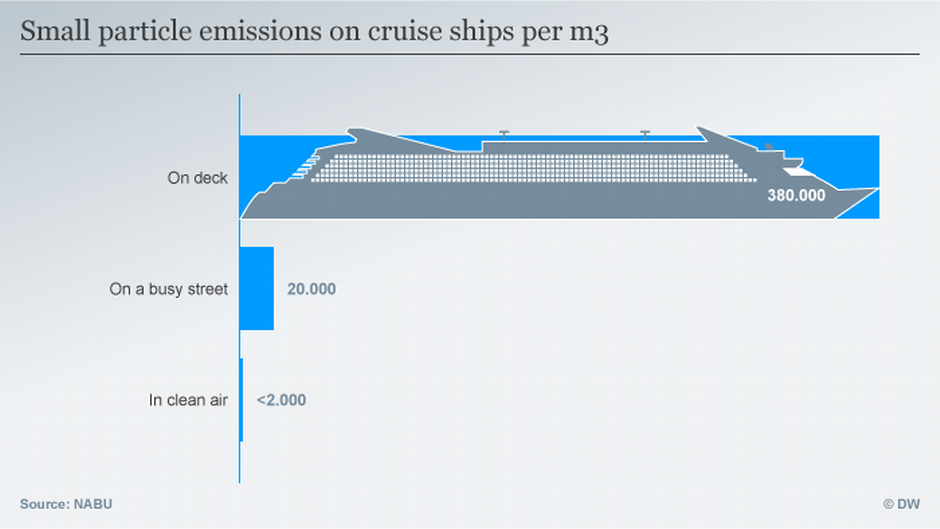
French TV journalists have secretly measured the air quality on a cruise ship. The results are devastating: The air is significantly worse polluted than it would be in thick urban traffic.


Deutsche Welle, 26 January 2017

Cruises are increasingly popular among today's tourists. They offer relaxation with 24-hour service for stressed out office workers.

Forget about searching for the perfect, pristine beach - which most people will never find, anyhow. Instead, just go to the pool on the upper deck, enjoy some tasty drinks and take in breathtaking views of the ocean from high above. For people who need less contemplation, cruises offer theater and show performances, generous meals, bars and shopping opportunities.

That doesn't mean you're in for a boring vacation: Adventure comes as part of the risk free deal. Even frail seniors can now feel like mystic characters such as Long John Silver from Treasure Island or real explorers like Roald Amundsen - be it by cruising the romantic Carribean, visiting savage South Sea islands or admiring polar bears on impenetrable arctic shores. Finally you can do something for your health by going to the ship's gym and getting a good work out.

Tourists want to enjoy themselves - and the fresh sea breeze.

But you better think twice about taking a deep breath. The German Environmental Association "Naturschutzbund Deutschland"(NABU) now warns that it is more likely you inhale polluted air than a fresh breeze. NABU says that it cannot recommend any of the large European cruise ships.

"Pamphlets lead you to believe that there are blue skies and white ships - a dream-like setting," Daniel Rieger, who is in charge of transportation policies at NABU, said. "The truth is that clouds of black soot are emitted from the funnels."

Measuring results are worse than expected

Recent measurements of actual air quality onboard a cruise ship seem to support NABU's view. French TV journalists from broadcaster France 3 conducted covert measurements while on a cruise. They boarded a ship in Marseille for a cruise of the Mediterranean.

Results show that "the shipping companies are exposing their travelers to high concentrations of harmful substances," NABU managing director Leif Miller concluded.

Even environmentalists were surprised by the high concentrations that the journalists detected. Right after leaving Marseille, air pollution was roughly 200 times that of a heavily trafficked urban street.

Besides fine dust and soot, the combustion of marine diesel fuel and heavy oil also set free other harmful substances such as nitrogen oxides and heavy metals.


Former captain and ship broker Helge Grammerstorf, who is the German national director of the Cruise Lines International Association CLIA, defends his industry. He told the daily "Hamburger Abendblatt:" "We don't know these measurements. The claim is completely unsubstantiated."

Grammerstorf argues that the measurements were taken only selectively and that one would need to run a more systematic test to collect data over a longer time period.

Hardly noticeable for passengers

"The passengers can only smell or see the particles before they get mixed up with the ambient air," NABU spokesman Rieger said after the France 3 test results were published.

He argued that it wouldn't take the shipping companies much to change the pollution and to increase comfort. "Even switching from marine diesel fuel or heavy oil to regular road diesel fuel would make a big difference," he said.

In addition, it wouldn't be too hard to install effective exhaust cleaning systems, according to NABU. Such systems have long existed with established standards for trucks and trains.
"The question is whether the industry deliberately looks the other way," Dietmar Oellinger - NABU's transport expert - said.

He suggested that the tests taken by the French journalists were merely an example and could possibly be representative for the entire cruise ship industry.

"The reality is black soot from the chimneys," NABU environmentalists say.

"We should ask how much more proof the industry needs before they finally take action," Oellinger said.

Some cruise lines have pledged to install particle filters, but so far, there are none in use.

Covert measuring only in the harbor

Previously, NABU has only had the opportunity to measure harmful ultra fine dust particles in the air around cruise ships in harbors. They have done so in Hamburg, Venice and the north-eastern German city of Rostock-Warnemünde. The ship owners did not allow the environment agency to take measurements on board, Daniel Rieger said.

The results were devastating nonetheless: In all cases the ships were burning off heavy oil. Four of five ships were not equipped with any exhaust gas cleaning or they were only fulfilling the lowest legal standard for northern Europe - a system that only reduces sulfur oxide emissions.

Technical solutions to reduce particle and nitrogen oxide emissions have long been on the market, though. Therefore, NABU argues, not implementing them is largely due to greed. It would cost money to install the system and furthermore require the companies to use more expensive types of fuel.

Almost as dangerous as asbestos

The German Lung Foundation already recommended several years ago that people with chronic respiratory diseases only stay on certain parts of the deck when on a cruise ship and thus avoide breathing in the ship's exhaust.

The World Health Organization (WHO) has concluded that diesel exhaust is just as carcinogenic as asbestos. The ultrafine particles, which are smaller than 0.1 micrometer can get into the smallest pulmonary alveoli and from there into the blood stream and other organs.

NABU manager Leif Miller argues it's cynical that the cruise ship companies "pay huge sums to improve entertainment and gastronomical services on board, but save as much as they can when it comes to environmental protection."

Meanwhile, in Germany the cruise ship industry is getting ready for the next season: In Warnemünde, Hamburg and Kiel alone, more than two million passengers are expected to board the giants of the seas in 2017.

Related Articles:


Friday, January 13, 2017

'This time is different': Istanbul tourism reels after attacks

Yahoo – AFP, Fulya Ozerkan, January 12, 2017

The number of foreign tourists visiting Istanbul,dropped to 9.2 million in 2016,
a 26-percent decline on the previous year (AFP Photo/Ozan Kose)

Istanbul (AFP) - Yavuz Indere has worked as a hotel receptionist in Istanbul for nearly half a century, witnessing coups, unrest and economic crises.

But as a string of terror attacks erodes the backbone of Turkey's key tourism sector, Indere admits he has never seen anything like this in the city.

"I've been doing this job for 45 years, obviously I've had tough years, but this time it was different," he told AFP at his tiny hotel in the historic Sultanahmet area, the scene of a deadly attack on January 12 last year that rocked the tourism industry.

Exactly a year on from the bombing blamed on Islamic State (IS) jihadists which killed 12 German tourists in the heart of the city, many hotels are suffering, and some have closed their doors for good.

"The heart of the problem is that terrorist attacks do not stop. People who go to visit a country want a guarantee ... I understand them, it is a human reflex," Indere said.

That attack was followed by a slew of strikes blamed on IS and Kurdish militants that killed hundreds in Turkey in 2016, capped by the gunning down of 39 revellers at Istanbul's glamourous Reina nightclub by a suspected jihadist on New Year's night.

'Lost my dear travellers'

There were no official ceremonies to mark the Sultanahmet bombing and the anniversary was barely mentioned on Turkish television.

But Sibel Satiroglu, the tourist guide who was with the Germans that day, laid single red carnations on each spot where a body had fallen in a lonely and personal act of remembrance.

"It is a year today since I lost my dear people and travellers. Faced with their pain, in their absence, I pay my respects," she told AFP

"I curse those who have done this, planned this, produced this. Those I lost, I love them all, I love them and they will always live with me," she said as she sobbed with grief.

The number of foreign tourists visiting Istanbul, with its historic mosques and Ottoman palaces, dropped to 9.2 million in 2016, a 26-percent decline on the previous year, tourism ministry statistics show.

Istanbul: a year of attacks (AFP Photo)

Tourists can still be spotted on Sultanahmet -- home to sights including the Blue Mosque and Hagia Sofia -- but there is no sign of the crowds that once thronged the area and souvenir sellers look forlornly at their stalls.

The Sultanahmet attack was followed by another one on the busy Istiklal shopping street last March, which left three Israelis and an Iranian dead.

A gun and bomb attack on the city's Ataturk airport in June slaughtered 47 people, including 19 foreigners.

Then on July 15, a failed coup attempt left dozens dead in Istanbul alone while a December double bombing near the Besiktas football stadium claimed by Kurdish militants killed 46 people.

"The airport was attacked, Sultanahmet was attacked, then Taksim was attacked, and finally the Reina (nightclub), which for me is an attack on the heart of tourism," said Cetin Gurcun, secretary general of the Association of Turkish Travel Agencies (TURSAB).

The country as a whole has paid a steep price: while 42 million people visited Turkey in 2015, some 12 million fewer travelled there in 2016, Gurcun said.

"In foreign currency terms, revenues amounted to 31.6 billion dollars in 2015, and we had a fall of almost 10 billion dollars in 2016," he added.

In 2015 tourism accounted for 4.4 percent of Turkey's gross domestic product (GDP), according to the latest figures available.

'Can't let terrorists win'

Adding to the tensions, the search continues for an IS-claimed jihadist who rampaged through the Reina nightclub in the early hours of 2017, shooting revellers, including Arab and European tourists, before escaping.

"It does worry me but you know, if you do not come, then you let the terrorists win," said John Plas, a tourist from the Netherlands.

Security measures have been heightened in the wake of the attacks, with heavily armed police patrolling streets.

Tourist guide Umran Aslan said it helped make her feel safer: "They're trying to protect us. I feel better when I see police everywhere".

But she admitted it was unlikely to reassure tourists. "it's so sad, because I love my job".