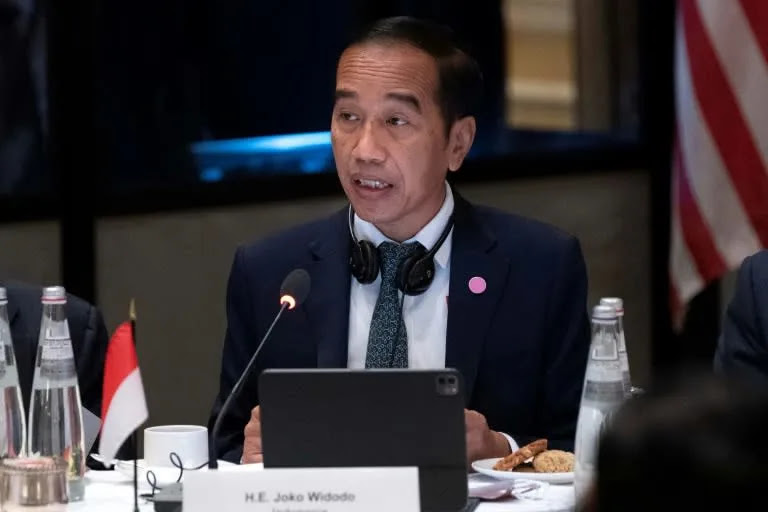
Indonesia executes six drug convicts, five of them foreigners

Indonesia executes six drug convicts, five of them foreigners
Widodo has pledged to bring reform to Indonesia

Ban appeals to Indonesia to stop death row executions

Ban appeals to Indonesia to stop death row executions
United Nations Secretary General Ban Ki-moon has pleaded to Indonesia to stop the execution of prisoners on death row for drug crimes. AFP PHOTO

Pope: 'Death penalty represents failure' – no 'humane' way to kill a person

Pope: 'Death penalty represents failure' – no 'humane' way to kill a person
The pope wrote that the principle of legitimate personal defense isn’t adequate justification to execute someone. Photograph: Zuma/Rex

Obama becomes first president to visit US prison (US Justice Systems / Human Rights)

Obama becomes first president to visit US prison   (US Justice Systems / Human Rights)
US President Barack Obama speaks as he tours the El Reno Federal Correctional Institution in El Reno, Oklahoma, July 16, 2015 (AFP Photo/Saul Loeb)

US Death Penalty (Justice Systems / Human Rights)

US Death Penalty (Justice Systems / Human Rights)
Woman who spent 23 years on US death row cleared (Photo: dpa)


.

.
"The Recalibration of Awareness – Apr 20/21, 2012 (Kryon channeled by Lee Carroll) (Subjects: Old Energy, Recalibration Lectures, God / Creator, Religions/Spiritual systems (Catholic Church, Priests/Nun’s, Worship, John Paul Pope, Women in the Church otherwise church will go, Current Pope won’t do it), Middle East, Jews, Governments will change (Internet, Media, Democracies, Dictators, North Korea, Nations voted at once), Integrity (Businesses, Tobacco Companies, Bankers/ Financial Institutes, Pharmaceutical company to collapse), Illuminati (Started in Greece, with Shipping, Financial markets, Stock markets, Pharmaceutical money (fund to build Africa, to develop)), Shift of Human Consciousness, (Old) Souls, Women, Masters to/already come back, Global Unity.... etc.) - (Text version)

… The Shift in Human Nature

You're starting to see integrity change. Awareness recalibrates integrity, and the Human Being who would sit there and take advantage of another Human Being in an old energy would never do it in a new energy. The reason? It will become intuitive, so this is a shift in Human Nature as well, for in the past you have assumed that people take advantage of people first and integrity comes later. That's just ordinary Human nature.

In the past, Human nature expressed within governments worked like this: If you were stronger than the other one, you simply conquered them. If you were strong, it was an invitation to conquer. If you were weak, it was an invitation to be conquered. No one even thought about it. It was the way of things. The bigger you could have your armies, the better they would do when you sent them out to conquer. That's not how you think today. Did you notice?

Any country that thinks this way today will not survive, for humanity has discovered that the world goes far better by putting things together instead of tearing them apart. The new energy puts the weak and strong together in ways that make sense and that have integrity. Take a look at what happened to some of the businesses in this great land (USA). Up to 30 years ago, when you started realizing some of them didn't have integrity, you eliminated them. What happened to the tobacco companies when you realized they were knowingly addicting your children? Today, they still sell their products to less-aware countries, but that will also change.

What did you do a few years ago when you realized that your bankers were actually selling you homes that they knew you couldn't pay for later? They were walking away, smiling greedily, not thinking about the heartbreak that was to follow when a life's dream would be lost. Dear American, you are in a recession. However, this is like when you prune a tree and cut back the branches. When the tree grows back, you've got control and the branches will grow bigger and stronger than they were before, without the greed factor. Then, if you don't like the way it grows back, you'll prune it again! I tell you this because awareness is now in control of big money. It's right before your eyes, what you're doing. But fear often rules. …
Showing posts with label Bali. Show all posts

Monday, June 27, 2022

Indonesian president to meet Zelensky and Putin to urge peace talks

Yahoo – AFP, 26 June 2022 


Indonesian President and G20 chairman Joko Widodo set off on Sunday to Europe where he said he plans to visit Russia and Ukraine and meet with the countries' leaders to urge peace talks. 

Widodo departed for Germany to attend as a guest for the G7 summit from June 26 to 27, and he will then go to the Ukraine capital Kyiv to meet President Volodymyr Zelensky. 

"The mission is to ask... President Zelensky to open a dialogue forum for peace, to build peace because the war has to be stopped," he told a press conference in Jakarta. 

The two leaders will also discuss the food supply chain "that needs to be reactivated" soon, Widodo said. From Kyiv, Widodo is scheduled to visit Moscow and meet with Russia's Vladimir Putin. 

The visit to Moscow is planned for June 30, Indonesian authorities said earlier. 

"With the same mission, I will ask President Putin to open a dialogue and to immediately have a ceasefire and to stop the war," he said. Earlier in April Widodo announced he had called Zelensky and invited him to join world leaders at G20 Summit in Bali in November 2022 as a guest. 

Indonesia holds the rotating presidency of the G20 this year and has been pressured by Western countries, led by the United States, to exclude Russia from the meeting. 

Widodo, however, did not rescind the invitation to Russia and said that Putin has expressed his intention to attend the November summit. 

Indonesia, like most major emerging economies, has tried to maintain a neutral position and has called for a peaceful resolution to the months-long conflict. 

Widodo refused to send weapons to Ukraine in response to a request from Zelensky, instead offering humanitarian aid. 

After concluding the European visit, Widodo will head to the United Arab Emirates before returning to Indonesia.

Friday, August 7, 2020

Bali sea turtles set free after poacher arrests

Yahoo – AFP, 5 August 2020

Rescuers released two dozen green sea turtles on Kuta beach near Denpasar
in Bali after police arrested seven alleged poachers

Around two dozen green turtles were released back to the wild in Bali on Wednesday after the endangered creatures were rescued from poachers on the Indonesian holiday island.

Marine officials carefully guided the giant reptiles as they thrashed their flippers in the sand to propel themselves toward the water.

The turtles were among 36 seized after a raid last month that saw the arrest of several suspected traffickers -- who could face five years behind bars if convicted under Indonesia's wildlife protection laws.

The turtles are taken from a truck to Kuta beach near Denpasar in Bali for release

"Hopefully these 25 turtles will survive so that they can lay their eggs again," said Bali conservation agency chief Agus Budi Santosa, adding that 11 others rescued at the time would be freed later.

The turtles, which can grow to more than a metre (three feet) in length and weigh upwards of 300 kilograms (700 pounds), are under threat due to poaching and habitat destruction.

Their eggs are considered a delicacy and they are also slaughtered for their meat, skin and shells.

Tuesday, July 7, 2020

Bali eyes September re-opening for foreign tourists

MSN – AFP, 6 July 2020

Bali says foreign tourists will be allowed to return by September as the Indonesian holiday island scrambles to repair its crippled vacation sector -- even as coronavirus cases mount.

A Balinese woman masked against coronavirus has her temperature taken
before a Hindu ceremony at Jagatnatha temple in Denpasar. The Indonesian
island hopes to re-open to tourists in September 

The island will re-open beaches, temples and other tourism spots for domestic visitors by the end of July, the governor said Sunday, and welcome foreign holidaymakers from September 11.

It was not immediately clear if vacationers from all countries would be allowed to visit, or if restrictions would be put in place on their arrival.

"We must continue to make the best efforts to handle Covid-19, while at the same time we must begin to carry out activities for the sake of community life," said Bali Governor Wayan Koster.

The volume of flights to and from Bali plummeted during the global pandemic, leaving hotels empty and restaurants struggling to survive.

The island was relatively unaffected in the early days of the epidemic, but cases have jumped in recent weeks.

As of Monday, Bali reported 1,900 confirmed infections, with 23 deaths. Indonesia, the world's fourth most-populous nation, has posted 65,000 cases and 3,241 deaths.

The real toll is widely believed to be much higher, however, with experts attributing the low figures to limited testing.

Thursday, June 25, 2020

Bali boots Syrian yogi over virus violations

Yahoo – AFP, June 24, 2020

Syrian yoga instructor Wissam Barakeh was paraded by Indonesian immigration
officials after being detained for breaking coronavirus restrictions in Bali (AFP Photo/
SONNY TUMBELAKA)

Gianyar (Indonesia) (AFP) - A Syrian yogi will be kicked out of Bali for holding a crowded gathering that violated the Indonesian holiday island's coronavirus restrictions, a justice official said Wednesday.

House of Om, a holistic retreat in Bali's cultural hub of Ubud, found itself in a hot water after a video went viral showing at least sixty foreign yoga enthusiasts crammed together at a gathering last week.

Few of the cross-legged participants wore masks or kept a distance from each other, sparking widespread anger in Bali where coronavirus infections have been on the rise.

On Wednesday, the island's immigration department said it would deport retreat co-founder Wissam Barakeh, 45, to his native Syria for breaking rules that prohibit gatherings of more than two dozen people.

"(He) didn't try to cancel the event even after the number of participants exceeded what's allowed by the government," said Jamaruli Manihuruk, the head of Bali's justice and legal office.

"Holding this during the pandemic is dangerous," he added.

Barakeh, in Bali on a temporary visa, is now being held at an immigration centre until plans to return him to his war-torn homeland are sorted out, Manihuruk said.

The volume of flights to and from Bali has plummeted in the midst of the global pandemic, crippling the island's key tourism sector.

As of Tuesday, Bali has reported 1,158 confirmed coronavirus infections, with nine deaths.

Wednesday, January 23, 2019

Indonesia reviewing early release for Bali bombing-linked cleric

Yahoo – AFP, Dessy SAGITA, 22 January 2019

Indonesian cleric Abu Bakar Bashir was convicted for 15 years in 2011 for
helping fund a paramilitary group

Plans to free a radical cleric linked to the deadly Bali bombings are under review, Indonesia has said, after the surprise decision drew sharp criticism.

Abu Bakar Bashir, once synonymous with militant Islam in Indonesia, was tied to a terror network behind the 2002 attacks that killed more than 200 people, mostly foreign tourists.

Last week, Indonesian president Joko Widodo said he had given the green light for the early release of Bashir -- believed to have been a key figure in militant group Jemaah Islamiyah (JI).

Widodo said the 80-year-old preacher was "old and sick".

The plan was slammed both at home and abroad, with objections across Indonesian social media and from Australian leader Scott Morrison, who warned that Bashir was still a threat.

Dozens of Australians were killed in the Bali attacks.

In an apparent backtrack on Monday, Indonesia's Chief Security Minister Wiranto said the president had ordered a "thorough and comprehensive study" of Bashir's release from prison.

"We can't act hastily or spontaneously," the minister told reporters.

He did not say when a final decision would be made.

On Tuesday, Widodo said Bashir must agree to pledge his loyalty to the state in order to win parole -- something the cleric has previously said he would not do.

"This is parole -- not an absolute release. These conditions must be fulfilled," the president told reporters.

Indonesian forces patrol the perimeter of Gunung Sindur prison in Bogor 
where radical cleric Abu Bakar Bashiris jailed

Bashir was sentenced to 15 years in jail in 2011 for helping fund a paramilitary group training in the conservative Islamic province of Aceh.

The firebrand preacher was previously jailed over the Bali bombings but that conviction was quashed on appeal. He has repeatedly denied involvement in terror attacks.

Bashir's lawyer Achmad Michdan questioned the apparent official change of heart.

"We have no problem with (the review) but people might wonder why would they announce it in the first place," Michdan told AFP.

Widodo had cited "humanitarian reasons" for agreeing to the release of the elderly preacher, sparking a torrent of criticism on Indonesian social media.

"This whole story is stupid beyond belief," one Twitter user wrote.

Bashir "murdered hundreds of people. They don't get to be with their families, but he does?"

'Politically deaf'

Analysts questioned the timing of the original announcement, just months before Widodo -- better known by his nickname Jokowi -- seeks re-election to lead the world's biggest Muslim-majority nation.

While Indonesia has long been praised for its moderate practice of religion, the political influence of Islamist hardliners has grown in recent years with some viewing Bashir as a hero.

"Why did Jokowi choose to act now, when it was inevitable that he would be accused of trying to score political points?" said Sidney Jones at the Jakarta-based Institute for Policy Analysis of Conflict.

"It makes the president seem either Machiavellian enough to do anything in exchange for a few votes, or so politically deaf and blind that he had no idea of the consequences."

The 2002 bombings prompted Jakarta to beef up counter-terror co-operation with the US and Australia.

"We have been very clear about the need to ensure that, as part of our joint counter-terrorism efforts... that Abu Bakar Bashir would not be in any position... to influence or incite anything," Australia's Morrison was quoted as saying.

Al-Qaeda-linked JI was founded by a handful of exiled Indonesian militants in Malaysia in the 1980s, and grew to include cells across Southeast Asia.

As well as the 2002 Bali bombings, the radical group was blamed for a 2003 car bomb at the JW Marriott hotel in Jakarta and a suicide car bomb the following year outside the Australian embassy.

Several militants convicted over their involvement in the Bali bombings have been executed while two others, including Malaysian Noordin Mohammed Top, were killed in police raids in 2009 and 2010.

Saturday, September 29, 2018

Abused Hong Kong maid Erwiana 'rises again'

Yahoo - AFP, Agus Purwanto, 28 September 2018

Erwiana now works on behalf of migrant workers

She was once the face of abused maids in Hong Kong -- imprisoned, starved and beaten so badly she lost control of her bodily functions.

But four years after her horrific ordeal made global headlines, Indonesian Erwiana Sulistyaningsih is a university graduate and fighting for the rights of domestic helpers in the southern Chinese city and beyond.

Erwiana completed a degree in economics this month -- the culmination of a dream that brought her to Hong Kong in 2013 before her life was turned upside down.

"Before I went to Hong Kong, I had been dreaming I could make enough money to study," the 27-year-old told AFP from her home in Indonesia's cultural capital Yogyakarta.

"After the incident, I thought I might have to give up on that dream."

Erwiana's employer Law Wan-tung was jailed after pictures of her extensive injuries went viral in 2014.

Widespread media coverage of Erwiana's torture had one unexpected benefit -- she was offered scholarships to study.

"I'm happy but it's bittersweet because even though I graduated university there are still many migrant workers who are persecuted and treated badly," she said.

She chose economics partly to understand "why so many people in this world have to migrate" for work.

"People should be able to live peacefully in their own country without having to work abroad unprotected," she said.

Erwiana plans to take that message to demonstrations outside the annual meetings of the International Monetary Fund and World Bank in Bali next month.

Erwiana's horrific ordeal made global headlines

She now works on behalf of migrant workers, including pushing for the release of former Filipina maid Mary Jane Veloso who is on death row in Indonesia for drug smuggling.

Most domestic workers in Hong Kong are from poor communities in Indonesia and the Philippines and are vulnerable to abuse by employers and employment agencies.

Migrants from both countries have also suffered injury -- or worse -- in the Middle East and other parts of the world.

In February, the death of a Filipina maid in Kuwait, whose body was found this year stuffed in a freezer, sparked outrage in the Philippines.

Also this year, Indonesian domestic helper Adelina Sau died in hospital after being rescued from her employer's house in Malaysia's Penang state, with wounds covering her body. Her boss was charged with murder.

It is these stories that prompted Erwiana to fight for workers' rights, and never give up on herself even when she doubted her chances.

"I never imagined I'd be here -- I almost gave up," she said.

"I was so sick, I was a failed migrant worker and my injuries were all over the media.

"But because my family and fellow migrant worker friends gave me strength, I finally had the spirit to rise again."


Erwiana Sulistyaningsih arrives at the Wanchai Law Courts to begin giving
 evidence against her former employer who is accused of abuse and torture, in
Hong Kong on Monday. (AFP Photo/Isaac Lawrence)

Related Article:


Tuesday, August 7, 2018

More than 2,000 tourists evacuated after Indonesia quake kills 98

Yahoo – AFP, Kiki Siregar, August 6, 2018

The Lombok quake has already killed 91 people with fears the toll could rise
(AFP Photo/ADEK BERRY)

Mataram (Indonesia) (AFP) - Indonesia Monday sent rescuers fanning out across the holiday island of Lombok and evacuated more than 2,000 tourists after a powerful earthquake killed at least 98 people and damaged thousands of buildings.

The shallow 6.9-magnitude quake sparked terror among tourists and locals alike, coming just a week after another deadly tremor surged through Lombok and killed 17 people.

Rescuers on Monday searched for survivors in the rubble of houses, mosques and schools destroyed in the latest disaster on Sunday evening.

National disaster agency spokesman Sutopo Purwo Nugroho said there were fears a number of people were trapped in the ruins of a collapsed mosque in the northern village of Lading-Lading. Footage he posted on Twitter showed the large concrete mosque had pancaked.

A lack of heavy equipment and shattered roads were hampering efforts to reach survivors in the mountainous north and east of the island, which had been hardest hit.

Najmul Akhyar, the head of North Lombok district, estimated that 80 percent of that region was damaged by the quake.

"We expect the number of fatalities to keep rising," Nugroho said. "All victims who died are Indonesians."

He said up to 20,000 people may have had to quit their homes on Lombok and paramedics, food and medication were badly needed.

The spokesman said search and rescue teams also rescued between 2,000 and 2,700 tourists from the Gili Islands, three tiny, coral-fringed tropical islands a few kilometres off the northwest coast of Lombok.

Authorities initially said 1,200 people were stuck on the islands but scaled up the figure early in the evening. Some tourists chose to stay behind.

Footage posted online by Nugroho showed hundreds crowded onto powder-white beaches desperately awaiting transport off the normally paradise Gilis.

"We cannot evacuate all of them all at once because we don't have enough capacity on the boats," Muhammad Faozal, the head of the tourism agency in West Nusa Tenggara province, told AFP, adding two navy vessels were on their way.

"It's understandable they want to leave the Gilis, they are panicking."

By early afternoon, hundreds of weary tourists had arrived with their baggage at Bangsal harbour, the main link between Lombok and the Gilis.

Margret Helgadottir, a holidaymaker from Iceland, described people screaming as the roof of her hotel on one of the islands collapsed.

"We just froze: thankfully we were outside," she told AFP tearfully from a harbour in Lombok to where she had been evacuated. "Everything went black, it was terrible."

Seven Indonesian holidaymakers died on the largest of the three islands, Gili Trawangan, while another local woman died on nearby Bali.

Foreign tourists were among those injured on Lombok and the nearby Gili 
islands (AFP Photo/ADEK BERRY)

Night of aftershocks

But it was Lombok which bore the brunt of Sunday evening's quake.

The shallow tremor sent thousands of residents and tourists scrambling outdoors, where many spent the night as strong aftershocks including one of 5.3-magnitude rattled the island.

The quake knocked out power in many areas and parts of Lombok remained without electricity on Monday.

Hundreds of bloodied and bandaged victims were treated outside damaged hospitals in the main city of Mataram and other hard-hit areas.

Patients lay on beds under wards set up in tents, surrounded by drip stands and monitors, as doctors in blue scrubs attended to them.

Anguished relatives were huddled around loved ones in front of the main clinic in Mataram, as medical staff struggled to cope with hundreds of patients. Many were yet to be attended to despite spending the night out in the open.

"I feel restless sleeping in a tent, I can't be at peace," Nurhayati told AFP outside one hospital where she had brought her sick 70-year-old mother.

"What we really need now are paramedics, we are short-staffed. We also need medications," Supriadi, a spokesman for Mataram general hospital, told AFP.

Singapore's Home Affairs Minister K. Shanmugam, who was in Lombok for a security conference when the earthquake struck, described on Facebook how his hotel room on the 10th floor shook violently.

"Walls cracked, it was quite impossible to stand up," he said.

Bali's international airport suffered damage to its terminal but the runway was unaffected and operations had returned to normal. Disaster agency officials said. Lombok airport was also operating.

Indonesia, one of the world's most disaster-prone nations, straddles the so-called Pacific "Ring of Fire", where tectonic plates collide and many of the world's volcanic eruptions and earthquakes occur.

In 2014, a devastating tsunami triggered by a magnitude 9.3 undersea earthquake off the coast of Sumatra in western Indonesia killed 220,000 people in countries around the Indian Ocean, including 168,000 in Indonesia.


Thursday, April 12, 2018

Trouble in Paradise: Tourism surge lashes Southeast Asia's beaches

Yahoo – AFP, Lillian SUWANRUMPHA with Joe FREEMAN in Bangkok and AFP bureaus,  April 11, 2018

Thailand received 35 million tourists last year, of whom nearly 10 million hailed
from China, according to official data (AFP Photo/Lillian SUWANRUMPHA)

Hordes of tourists clamber across the white sand with selfie sticks as Thai park rangers wade into turquoise waters to direct boats charging into the cliff-ringed cove.

Made famous by the 2000 movie "The Beach" starring Leonardo DiCaprio, Maya Bay on the western Thai island of Koh Phi Phi Ley is now a case study in the ruinous costs of runaway tourism, swamped by up to 4,000 daily visitors.

"There is too many people here, it's bad," lamented Saad Lazrak, a 61-year-old from Morocco, as crowds around him swallowed the stretch of sand encircled by an amphitheatre of limestone cliffs.

Across the region, Southeast Asia's once-pristine beaches are reeling from decades of unchecked tourism as governments scramble to confront trash-filled waters and environmental degradation without puncturing a key economic driver.

Thailand's Maya Bay will be off limits for four months from June to September, officials announced last month, in a bid to save its ravaged coral reefs.

In the Philippines, President Rodrigo Duterte ordered this month the Boracay beach resort closed to tourists for up to six months from April 26, describing the destination as a "cesspool" tainted by sewage dumped directly into the sea.

Indonesian officials, meanwhile, declared a "garbage emergency" last year swamping a six-kilometre stretch of coast along the island of Bali.

The island's grim coastal pollution was highlighted in March by British diver Rich Horner's viral video of swimming through a sea of trash swirling off shore.

"Plastic bags, more plastic bags, plastic, plastic, so much plastic!" Horner said in a Facebook post that has been viewed more than a million times.

Thailand's Maya Bay will be off limits for four months from June to September 
in a bid to save its ravaged coral reefs (AFP Photo/Lillian SUWANRUMPHA)

Breathing space

Conservationists and governments are worried about the health of coral reefs, which are in a dire state globally due to climate change and rising sea temperatures.

When exposed to warmer waters, they shed the algae that dazzle the eye and are vital to marine eco-systems, leaving the corals diseased or bone-white in a process called bleaching.

Environmental stress, including pollution, human contact and exposure to plastics that comes with mass tourism are also major threats to reefs that are part of the draw for snorkellers and scuba-divers.

"Tourism has a series of detrimental effects on coral health," said Eike Schoenig, a Thailand-based marine biologist at the Center for Oceanic Research and Education.

Countries in Southeast Asia are looking to stem the threats without cutting off the cash flow of a regional tourism boom, led by China, the top source market for travellers to the region.

Thailand received 35 million tourists last year, of whom nearly 10 million hailed from China, according to official data.

But what is good for business can be bad for beaches.

Songtam Suksawang, Thailand's National Park Office Director, told AFP he personally inspected the beach at Maya Bay and said it "must definitely be (temporarily) closed" in order to rehabilitate it.

He said authorities are discussing new rules once the shut-down is lifted, such as restrictions on the number of daily visitors, better regulation of boats and a higher entrance fee.

Made famous by the 2000 movie 'The Beach' starring Leonardo DiCaprio, Maya Bay
 on the western Thai island of Koh Phi Phi Ley is now a case study in the ruinous 
costs of runaway tourism (AFP Photo/Lillian SUWANRUMPHA)

Tourism costs

Thailand is also conducting studies on six other marine parks, while the Philippines is weighing action on other top destinations buckling under mass tourism.

But governments are wary of curtailing an industry that creates jobs and buoys economies.

Spending on travel and tourism contributed nearly $136 billion to the region's GDP in 2017, a figure forecast to rise to $144 billion this year, according to the World Travel & Tourism Council.

The cost of the closures is already being felt in the Philippines, where hundreds of Boracay hotels and tour companies are facing steep losses from cancelled rooms, flights and other bookings.

But some countries are not taking such dramatic steps.

In Indonesia, the tourism ministry said there were no plans to close Bali or any other holiday destination in the archipelago, although it acknowledged that pockets of the tropical paradise were under strain from heavy tourism.

"Shut down Bali? I don't think we will need to do that yet," said ministry spokesman Guntur Sakti. "Bali is the centre of Indonesian tourism."

In fact, Indonesia has identified 10 other destinations where it is trying to boost visitors and replicate Bali's success, including neighbouring island Lombok and Lake Toba in Sumatra.

Experts are also sceptical that short shut-downs will have lasting effects.

Fire dancers perform for tourists on the southern Thai island of Koh Phi Phi, which
is swamped by up to 4,000 daily visitors (AFP Photo/Lillian SUWANRUMPHA)

"Bottom line is that temporarily closing the beach is probably not the optimal solution to these problems. It only take a day for a bunch of incompetent snorkellers to trash a small reef," said Andrew Baird from the ARC Centre of Excellence for Coral Reef Studies in Australia.

In Thailand, the government hopes to draw people to lesser known beaches.

"We are working very hard to spread people out, not to go to one condensed area," said Thon Thamrongnawasawat, a marine expert working with the parks and tourism authorities.

Travellers to Maya Bay might like the idea.

"It's very touristy. There wasn't a patch of sand that didn't have people laying down on it, taking photos," Oliver Black, a 22-year-old tourist, said of his afternoon at the destination.

As for his thoughts on the looming closure?

"It would not really upset me if I wasn't able to go to (back to) Maya beach," he told AFP.
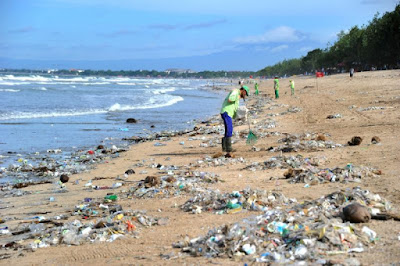
The Indonesian holiday island has become an embarrassing poster child for the
country's trash problem (AFP Photo/SONNY TUMBELAKA)

Sunday, March 11, 2018

Dutch packaging industry has two years to solve plastic bottle problem

DutchNews, March 10, 2018


The Dutch government has given the packaging industry until 2021 to boost the recycling of small plastic bottles or face the introduction of a deposit system. 

‘Litter is bad for the environment and the public mood,’ junior environment minister Stientje van Veldhoven said in a briefing for MPs about the plans. ‘We’ve all seen the pictures, the roadside full of litter, the Bali beach covered in bottles, animals full of plastic in the oceans. It has to stop.’ 

The industry must ensure 90% of throwaway plastic bottles are recycled and that the number of plastic bottles in litter is cut by 70% to 90% to avoid the introduction of deposits of 10 to 15 cents on plastic bottles. 

The results of the industry’s efforts will be assessed in autumn 2020. If the target has not been met, deposits will be introduced on small bottles from January 1, 2021, the minister said. 

Almost 200 Dutch local authorities and other organisations have now signed up to a campaign aimed at bringing in deposits on cans and small plastic bottles. 

The Statiegeldalliantie was launched in November with 21 organisations, including the North Sea foundation and aims to persuade Dutch and Belgian governments to widen the use of deposits. 

In 2015, the Dutch government tore up an agreement with the packaging industry to end the current system of deposits on plastic bottles. The industry argued there would be major cost advantages if deposits were scrapped but the cost savings, in a report commissioned by the industry, were later shown to be exaggerated.

The Indonesian holiday island has become an embarrassing poster child for the
country's trash problem (AFP Photo/SONNY TUMBELAKA)

Related Article:


Friday, December 29, 2017

Bali declares 'garbage emergency' amid sea of waste

Yahoo – AFP, Bagus SARAGIH, December 28, 2017

The Indonesian holiday island has become an embarrassing poster child for the
country's trash problem (AFP Photo/SONNY TUMBELAKA)

Kuta (Indonesia) (AFP) - Bali's palm-fringed Kuta beach has long been a favourite with tourists seeking sun and surf, but nowadays its golden shoreline is disappearing under a mountain of garbage.

Plastic straws and food packaging are strewn between sunbathers, while surfers bobbing behind the waves dodge waste flushed out from rivers or brought in by swirling currents.

"When I want to swim, it is not really nice. I see a lot of garbage here every day, every time," Austrian traveler Vanessa Moonshine explains.

"It's always coming from the ocean. It's really horrible," she adds.

Often dubbed a paradise on earth, the Indonesian holiday island has become an embarrassing poster child for the country's trash problem.

The archipelago of more than 17,000 islands is the world's second biggest contributor to marine debris after China, and a colossal 1.29 million metric tons is estimated to be produced annually by Indonesia.

The waves of plastic flooding into rivers and oceans have been causing problems for years -- clogging waterways in cities, increasing the risk of floods, and injuring or killing marine animals who ingest or become trapped by plastic packaging.

Officials in Bali have declared a "garbage emergency" across a stretch of coast that 
includes Jimbaran, Kuta and Seminyak beaches (AFP Photo/SONNY TUMBELAKA)

The problem has grown so bad that officials in Bali last month declared a "garbage emergency" across a six-kilometre (3.7-mile) stretch of coast that included popular beaches Jimbaran, Kuta and Seminyak.

Officials deployed 700 cleaners and 35 trucks to remove roughly 100 tons of debris each day to a nearby landfill.

"People with green uniform were collecting the garbage to move it away but the next day I saw the same situation," said German Claus Dignas, who claimed he saw more garbage with each visit to the island.

"No one wants to sit on nice beach chairs and facing all this rubbish," he added.

Bali's rubbish problem is at its worst during the annual monsoon season, when strong winds push marine flotsam onto the beach and swollen rivers wash rubbish from riverbanks to the coast, according to Putu Eka Merthawan from the local environment agency.

"This garbage does not come from people living in Kuta and nearby areas," he told AFP.

"It would be suicidal if Kuta people were doing it."

War on waste

Some 72 kilometres from Kuta, Mount Agung has been threatening to erupt for two months, prompting tourists to cancel visits and displacing tens of thousands of villagers living within a 10 kilometre-radius of the volcano's crater.

Indonesia is the world's second biggest contributor to marine debris after 
China (AFP Photo/SONNY TUMBELAKA)

But the island's waste problem is no less of a threat, said I Gede Hendrawan, an environmental oceanography researcher from Bali's Udayana University.

"Garbage is aesthetically disturbing to tourists, but plastic waste issue is way more serious," he told AFP.

"Microplastics can contaminate fish which, if eaten by humans, could cause health problems including cancer."

Indonesia is one of nearly 40 countries that are part of UN Environment's Clean Seas campaign, which aims to halt the tide of plastic trash polluting the oceans.

As part of its commitment, the government has pledged to reduce marine plastic waste by 70 percent by 2025.

It plans to boost recycling services, curb the use of plastic bags, launch cleanup campaigns and raise public awareness.

Still, the scale of the problem facing Indonesia is huge, due to its population of more than 250 million and poor waste processing infrastructure.

Hendrawan, who says both locals and tourists are responsible for the island's rubbish problem, urged authorities to invest more resources to tackle the problem.

"The Bali government should spare more budget to raise people's awareness to take care of local rivers, not to dump waste," he said.

"The central government should boost the campaign to reduce use of plastic packaging and ban free plastic bags at convenient stores."