Indonesia executes six drug convicts, five of them foreigners

Indonesia executes six drug convicts, five of them foreigners
Widodo has pledged to bring reform to Indonesia

Ban appeals to Indonesia to stop death row executions

Ban appeals to Indonesia to stop death row executions
United Nations Secretary General Ban Ki-moon has pleaded to Indonesia to stop the execution of prisoners on death row for drug crimes. AFP PHOTO

Pope: 'Death penalty represents failure' – no 'humane' way to kill a person

Pope: 'Death penalty represents failure' – no 'humane' way to kill a person
The pope wrote that the principle of legitimate personal defense isn’t adequate justification to execute someone. Photograph: Zuma/Rex

Obama becomes first president to visit US prison (US Justice Systems / Human Rights)

Obama becomes first president to visit US prison   (US Justice Systems / Human Rights)
US President Barack Obama speaks as he tours the El Reno Federal Correctional Institution in El Reno, Oklahoma, July 16, 2015 (AFP Photo/Saul Loeb)

US Death Penalty (Justice Systems / Human Rights)

US Death Penalty (Justice Systems / Human Rights)
Woman who spent 23 years on US death row cleared (Photo: dpa)


.

.
"The Recalibration of Awareness – Apr 20/21, 2012 (Kryon channeled by Lee Carroll) (Subjects: Old Energy, Recalibration Lectures, God / Creator, Religions/Spiritual systems (Catholic Church, Priests/Nun’s, Worship, John Paul Pope, Women in the Church otherwise church will go, Current Pope won’t do it), Middle East, Jews, Governments will change (Internet, Media, Democracies, Dictators, North Korea, Nations voted at once), Integrity (Businesses, Tobacco Companies, Bankers/ Financial Institutes, Pharmaceutical company to collapse), Illuminati (Started in Greece, with Shipping, Financial markets, Stock markets, Pharmaceutical money (fund to build Africa, to develop)), Shift of Human Consciousness, (Old) Souls, Women, Masters to/already come back, Global Unity.... etc.) - (Text version)

… The Shift in Human Nature

You're starting to see integrity change. Awareness recalibrates integrity, and the Human Being who would sit there and take advantage of another Human Being in an old energy would never do it in a new energy. The reason? It will become intuitive, so this is a shift in Human Nature as well, for in the past you have assumed that people take advantage of people first and integrity comes later. That's just ordinary Human nature.

In the past, Human nature expressed within governments worked like this: If you were stronger than the other one, you simply conquered them. If you were strong, it was an invitation to conquer. If you were weak, it was an invitation to be conquered. No one even thought about it. It was the way of things. The bigger you could have your armies, the better they would do when you sent them out to conquer. That's not how you think today. Did you notice?

Any country that thinks this way today will not survive, for humanity has discovered that the world goes far better by putting things together instead of tearing them apart. The new energy puts the weak and strong together in ways that make sense and that have integrity. Take a look at what happened to some of the businesses in this great land (USA). Up to 30 years ago, when you started realizing some of them didn't have integrity, you eliminated them. What happened to the tobacco companies when you realized they were knowingly addicting your children? Today, they still sell their products to less-aware countries, but that will also change.

What did you do a few years ago when you realized that your bankers were actually selling you homes that they knew you couldn't pay for later? They were walking away, smiling greedily, not thinking about the heartbreak that was to follow when a life's dream would be lost. Dear American, you are in a recession. However, this is like when you prune a tree and cut back the branches. When the tree grows back, you've got control and the branches will grow bigger and stronger than they were before, without the greed factor. Then, if you don't like the way it grows back, you'll prune it again! I tell you this because awareness is now in control of big money. It's right before your eyes, what you're doing. But fear often rules. …
Showing posts with label Environment. Show all posts

Thursday, January 2, 2020

Palau bans 'reef-toxic' sunscreen

Yahoo – AFP, Bernadette Carreon, January 1, 2020

Reefs all over the world are being affected by the toxins in sunscreens (AFP Photo/
DONALD MIRALLE)

Koror (Palau) (AFP) - Palau's pioneering ban on "reef-toxic" sunscreens took effect Wednesday as the tiny Pacific island nation introduced strict environmental measures that also include one of the world's largest marine sanctuaries.

"We have to live and respect the environment because the environment is the nest of life, and without it nobody in Palau can survive," President Tommy Remengesau told AFP as the new laws took effect.

Palau, which lies in the western Pacific about halfway between Australia and Japan, is renowned for its marine life and is regarded as one of the world's best diving destinations, but the government is concerned its popularity is coming at a cost.

Remengesau said there was scientific evidence that the chemicals found in most sunscreens were toxic to corals, even in minute doses.

With Palau's popular dive sites regularly packed with tourists there were concerns a build-up of these chemicals would irreparably harm the reefs.

From New Year's day, any reef-toxic sunscreen imported or sold in Palau will be confiscated and the owner will be fined US$1,000.

"When science tells us that a practice is damaging to coral reefs, to fish populations, or to the ocean itself, our people take note and our visitors do too," Remengesau said.

Map locating Palau. The tiny Pacific island nation's pioneering ban on 
"reef-toxic" sunscreens took effect on New Year's Day (AFP Photo/Gal ROMA)

"Toxic sunscreen chemicals have been found throughout Palau's critical habitats, and in the tissues of our most famous creatures.

"We don't mind being the first nation to ban these chemicals, and we will do our part to spread the word. With better education and awareness, more jurisdictions will have the confidence to take this necessary action.

"The science is clear, and once that message has spread, we will be the first of many."

Along with the sunscreen ban, Palau’s much-touted marine sanctuary came into effect on January 1, closing 80 percent of its exclusive economic zone (EEZ) to fishing and other marine activities including mining and shark finning.

"It is a very ambitious and worthy goal for Palau's future," Remengesau said. The marine sanctuary prohibits commercial fishing in about 500,000 square kilometres (190,000 square miles) of ocean.

The legislation also requires most foreign fleets working in the limited fishing area to land their catch in Palau and then pay an export tax.

Environment Minister Umiich Sengebau said the law ensures Palau has first rights to purchase fish caught in the area to satisfy the local demand before exports are allowed.

Remengesau said the ban was needed to "let the ocean heal" after years of mass commercial fishing in the Pacific that has seen stocks of some species such as bluefin tuna fall to critical levels.

It follows Palau's establishment of the world's first shark sanctuary in 2009 to prevent finning -- a practice that sees fish have their fins hacked off before they are thrown back into the sea to die.

Tuesday, August 6, 2019

Indonesian man walking in reverse to save forests

Yahoo – AFP, August 5, 2019

Medi Bastoni walks 20 to 30 kilometres backwards every day under the scorching sun,
with a rear-view mirror attached to his backpack to avoid bumping into objects (AFP
Photo/Medi BASTONI)

Jakarta (AFP) - An Indonesian man is walking 700 kilometres (435 miles) from his home on a volcano in East Java to Jakarta in the hope of drawing attention to the archipelago's quickly shrinking forests -- and he is doing it backwards.

Medi Bastoni, a 43-year-old father of four, set out on his arduous, in-reverse journey in mid-July, with the goal of reaching the capital by August 16, a day before the Southeast Asian nation's independence day anniversary.

"Of course I'm exhausted, but I'm willing to do this to fight for the next generation," Bastoni told AFP.

"(My home) is losing all of its trees so I have to do something. I can take the pain and fatigue."

Walking backwards is a siganl to Indonesians to reflect on the past and remember 
how national heroes fought for the good of the country (AFP Photo/Medi BASTONI)

When he arrives, Bastoni said he hopes to meet with president Joko Widodo and highlight deforestation across the archipelago including at his home on Mt. Wilis, a dormant volcano.

Indonesia suffers from one of the high rates of deforestation in the world, according to Greenpeace.

Bastoni walks 20 to 30 kilometres backwards every day under the scorching sun, with a rear-view mirror attached to his backpack to avoid bumping into objects.

Along the way, supporters cheer him on, offer him meals or a place to stay overnight. But Bastoni always leaves at dawn to stay on schedule.

Walking backwards is meant as a siganl to Indonesians to reflect on the past and remember how national heroes fought for the good of the country, he said.

Friday, February 22, 2019

Indonesians clean up the beach one sandal at a time

Yahoo – AFP, February 21, 2019

The yearly campaign kicked into action after rubbish was getting trapped in the
fishing nets of locals (AFP Photo/PERDIANSYAH)

Hundreds of people sifted through a vast wasteland of rubbish strewn across a beach in Indonesia on Thursday, underscoring the Southeast Asian archipelago's mammoth marine waste problem

Some 200 students, military personnel and locals scoured a beach on the southern tip of Sumatra island, picking up rubbish as they waded through heaps of plastic, discarded flip flops and other debris.

In just over three hours, the group collected an eye-watering 30 tonnes of rubbish from the coast in Lampung province.

The yearly campaign first kicked into action in 2010 after huge amounts of rubbish were getting trapped in the fishing nets of locals who made their living off the sea.

Most of the detritus had flowed in from the provincial capital.

Other rubbish clearing campaigns have popped up across Indonesia, the world's second biggest contributor to marine debris after China.

In holiday hotspot Bali, the problem has become so bad that officials declared a "garbage emergency" two years ago after a stretch of coast was swamped with rubbish.

Last year, a sperm whale was found dead in a marine park off Sulawesi island with 115 plastic cups and 25 plastic bags in its stomach.

The archipelago of some 17,000 islands has pledged to reduce marine plastic waste by 70 percent by 2025.


Saturday, December 1, 2018

Paradise regained? Sharks return to Thai bay popularised by 'The Beach'

Yahoo – AFP, November 30, 2018

Authorities shut the area to the public to let Maya Bay recover (AFP Photo/Handout)

Bangkok (AFP) - Thai conservationists have welcomed footage of reef sharks gliding through the azure waters of Maya Bay as a "positive sign" of recovery six months after the closure of a tourist hot-spot made famous by the movie "The Beach".

The bay, circled by dramatic limestone cliffs on Ko Phi Phi Ley island, was made famous by the 2000 film starring Leonardo DiCaprio.

But the movie prompted hordes of tourists to sweep in on a daily of flotilla of motor boats, damaging the coral ecosystem and eroding the once pristine white sand beach.

Authorities shut the park temporarily to the public in June but later extended the closure indefinitely to let the bay recover.

On Friday park officials shared video of dozens of blacktip reef sharks serenely swimming close to the beach -- images unimaginable just weeks ago as tourists jostled for selfies on the white sand.

"Come and count sharks!" the National Park, Wildlife and Plant Conservation Department said in a Facebook post.

"It's a good sign that Maya Bay has changed and that change is positive," the post added.

A Thai marine biologist prominent in the campaign to close Maya Bay hailed the shark video as "beyond imagination, unbelievable".

The 2000 movie 'The Beach' prompted hordes of tourists to visit, damaging the 
coral ecosystem and eroding the once pristine white sand beach (AFP Photo/
Lillian SUWANRUMPHA)

"How do I feel? Tearful," Thon Thamrongnawasawat said in a Faceboook post.

"At the beginning I never thought (the rehabilitation) would be as good as this in only six months."

Authorities have not said if, or when, the bay will open.

"The reef will take a longer time to recover," an official from the National Park, Wildlife and Plant Conservation Department said requesting anonymity.

Thailand's idyllic beaches are under increasing strain from huge numbers of tourists and accompanying development in remote and fragile ecosystems.

The country drew around 35 million visitors last year.

Many flock to the town of Krabi where boat trips carried visitors to nearby islands replete with opportunities for snorkelling and selfies -- among them Maya Bay.

Wednesday, October 4, 2017

First global pact backing indigenous land rights launched

MSN – AFP, Marlowe HOOD, 3 October 2017

Provided by AFP Brazilian natives demonstrate in front of the Planalto Palace in
Brasilia, during the National Mobilization Week to protest and demand their rights, in 2015

Native peoples struggling to retain or regain stewardship of forests that sustained them for countless generations may finally have backing from an organisation with both swag and sway.

The International Land and Forest Tenure Facility -- the first and only global institution dedicated to securing the land rights of indigenous communities worldwide -- was formally launched in Stockholm on Tuesday.

Funded by Sweden, Norway and the Ford Foundation, a major US philanthropy, the Tenure Facility has already provided grants and guidance for pilot projects in Peru, Mali, and Indonesia, helping local communities leverage rarely enforced laws to protect their land and resources.

Disputes over land rights in tropical forests teeming with exploitable resources -- from hard woods to precious stones to oil -- can quickly escalate into deadly conflict, and local peoples more often than not wind up on the losing end.

More than 200 environmental campaigners, nearly half from indigenous tribes, were murdered around the world in 2016 alone, according to watchdog NGO Global Witness.

Restoring some measure of control to the original inhabitants of forests appropriated by corrupt governments or extraction industries has also proven an effective bulkhead against global warming, according to a 2014 global survey by the US-based World Resources Institute, a think tank.

In Brazil, for example, deforestation in indigenous community forests from 2000 to 2012 was less than 1 percent, compared with 7 percent outside those areas.

'Unrelenting conflicts'

Provided by AFP Representatives of indigenous communities and activists protest
in front of the Chinese Embassy in Lima, Peru, on September 22, 2017, to support the
Achuar, Kichwa and Quechua Amazonic tribes affected by oil industry activities on their
ancestral lands


Tropical vegetation soaks up planet-warming CO2 emitted by the burning of fossil fuels.

Destroying these forests outright not only reduces the area available to absorb carbon dioxide, it also releases CO2 into the atmosphere, accounting in recent decades -- along with agriculture and livestock -- for more than a fifth of global greenhouse gas emissions.

"We see climate change and inequality as two of the greatest existential threats facing the planet," said Ford Foundation president Darren Walker.

"Creating mechanisms that allow indigenous peoples and local communities to gain tenure over their land or forests is a way to tackle both these problems," he told AFP ahead of a conference keyed to the launch.

Walker has pledged five million dollars, and expects -- based on other grants in the pipeline -- the facility to have 100 million within a year.

The project aims over the span of a decade to boost forestland properly titled to indigenous peoples by 40 million hectares, an area twice the size of Spain.

Such efforts, they calculate, would prevent deforestation of one million hectares and the release of 500 million tonnes of CO2, more than the annual emissions of Britain or Brazil.

"The Tenure Facility provides a powerful solution to save the world's forests from the ground up," said Carin Jamtin, director general of the Swedish International Development Cooperation Agency, a key funder.

Corruption and abuses

More than two billion people live on and manage half the world's land area in customary or traditional systems, yet indigenous communities have formal legal ownership of only 10 percent.

And even where they do have title, corruption and abuses have led to protracted conflicts with local and national governments, companies and migrant workers.

Native populations can even run afoul of major green initiatives to fight climate change or stem biodiversity loss.

A controversial UN-backed programme, for example, known as REDD+ -- Reducing Emissions from Deforestation and Degradation -- creates incentives to keep forests intact, paid for by rich nations or companies seeking to offset pollution under carbon trading schemes.

But the projects that REDD+ finances can push aside the needs and rights of indigenous peoples who are often most directly affected by the changes set in motion, critics say.

A peer-reviewed 2013 study -- one of the few to examine the impacts on local communities -- concluded that less than half of 50-odd projects in Africa, Latin America and Asia did anything to alleviate the poverty of forest-dependent peoples.

But many did enhance their land tenure rights, they concluded.

Related Article:


Sunday, January 29, 2017

Hoping for a fresh sea breeze aboard a cruise ship? Better hold your nose!

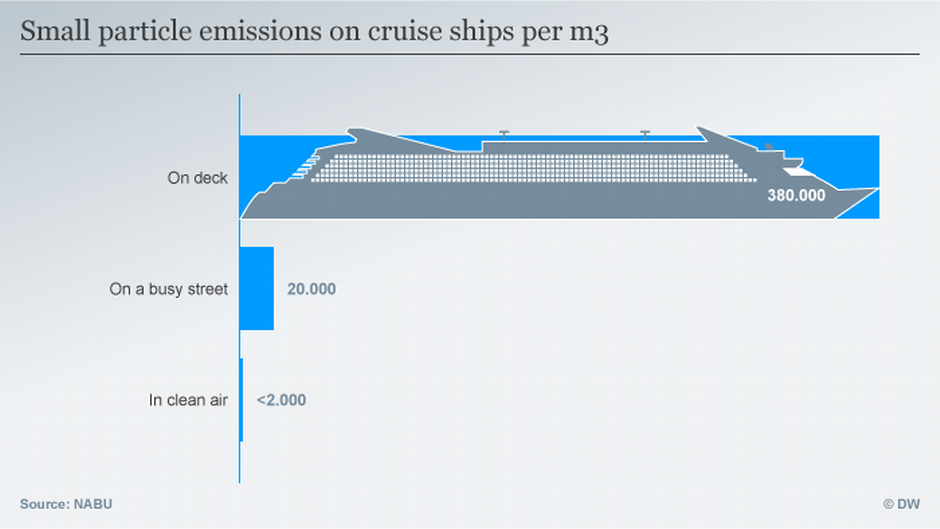
French TV journalists have secretly measured the air quality on a cruise ship. The results are devastating: The air is significantly worse polluted than it would be in thick urban traffic.


Deutsche Welle, 26 January 2017

Cruises are increasingly popular among today's tourists. They offer relaxation with 24-hour service for stressed out office workers.

Forget about searching for the perfect, pristine beach - which most people will never find, anyhow. Instead, just go to the pool on the upper deck, enjoy some tasty drinks and take in breathtaking views of the ocean from high above. For people who need less contemplation, cruises offer theater and show performances, generous meals, bars and shopping opportunities.

That doesn't mean you're in for a boring vacation: Adventure comes as part of the risk free deal. Even frail seniors can now feel like mystic characters such as Long John Silver from Treasure Island or real explorers like Roald Amundsen - be it by cruising the romantic Carribean, visiting savage South Sea islands or admiring polar bears on impenetrable arctic shores. Finally you can do something for your health by going to the ship's gym and getting a good work out.

Tourists want to enjoy themselves - and the fresh sea breeze.

But you better think twice about taking a deep breath. The German Environmental Association "Naturschutzbund Deutschland"(NABU) now warns that it is more likely you inhale polluted air than a fresh breeze. NABU says that it cannot recommend any of the large European cruise ships.

"Pamphlets lead you to believe that there are blue skies and white ships - a dream-like setting," Daniel Rieger, who is in charge of transportation policies at NABU, said. "The truth is that clouds of black soot are emitted from the funnels."

Measuring results are worse than expected

Recent measurements of actual air quality onboard a cruise ship seem to support NABU's view. French TV journalists from broadcaster France 3 conducted covert measurements while on a cruise. They boarded a ship in Marseille for a cruise of the Mediterranean.

Results show that "the shipping companies are exposing their travelers to high concentrations of harmful substances," NABU managing director Leif Miller concluded.

Even environmentalists were surprised by the high concentrations that the journalists detected. Right after leaving Marseille, air pollution was roughly 200 times that of a heavily trafficked urban street.

Besides fine dust and soot, the combustion of marine diesel fuel and heavy oil also set free other harmful substances such as nitrogen oxides and heavy metals.


Former captain and ship broker Helge Grammerstorf, who is the German national director of the Cruise Lines International Association CLIA, defends his industry. He told the daily "Hamburger Abendblatt:" "We don't know these measurements. The claim is completely unsubstantiated."

Grammerstorf argues that the measurements were taken only selectively and that one would need to run a more systematic test to collect data over a longer time period.

Hardly noticeable for passengers

"The passengers can only smell or see the particles before they get mixed up with the ambient air," NABU spokesman Rieger said after the France 3 test results were published.

He argued that it wouldn't take the shipping companies much to change the pollution and to increase comfort. "Even switching from marine diesel fuel or heavy oil to regular road diesel fuel would make a big difference," he said.

In addition, it wouldn't be too hard to install effective exhaust cleaning systems, according to NABU. Such systems have long existed with established standards for trucks and trains.
"The question is whether the industry deliberately looks the other way," Dietmar Oellinger - NABU's transport expert - said.

He suggested that the tests taken by the French journalists were merely an example and could possibly be representative for the entire cruise ship industry.

"The reality is black soot from the chimneys," NABU environmentalists say.

"We should ask how much more proof the industry needs before they finally take action," Oellinger said.

Some cruise lines have pledged to install particle filters, but so far, there are none in use.

Covert measuring only in the harbor

Previously, NABU has only had the opportunity to measure harmful ultra fine dust particles in the air around cruise ships in harbors. They have done so in Hamburg, Venice and the north-eastern German city of Rostock-Warnemünde. The ship owners did not allow the environment agency to take measurements on board, Daniel Rieger said.

The results were devastating nonetheless: In all cases the ships were burning off heavy oil. Four of five ships were not equipped with any exhaust gas cleaning or they were only fulfilling the lowest legal standard for northern Europe - a system that only reduces sulfur oxide emissions.

Technical solutions to reduce particle and nitrogen oxide emissions have long been on the market, though. Therefore, NABU argues, not implementing them is largely due to greed. It would cost money to install the system and furthermore require the companies to use more expensive types of fuel.

Almost as dangerous as asbestos

The German Lung Foundation already recommended several years ago that people with chronic respiratory diseases only stay on certain parts of the deck when on a cruise ship and thus avoide breathing in the ship's exhaust.

The World Health Organization (WHO) has concluded that diesel exhaust is just as carcinogenic as asbestos. The ultrafine particles, which are smaller than 0.1 micrometer can get into the smallest pulmonary alveoli and from there into the blood stream and other organs.

NABU manager Leif Miller argues it's cynical that the cruise ship companies "pay huge sums to improve entertainment and gastronomical services on board, but save as much as they can when it comes to environmental protection."

Meanwhile, in Germany the cruise ship industry is getting ready for the next season: In Warnemünde, Hamburg and Kiel alone, more than two million passengers are expected to board the giants of the seas in 2017.

Related Articles:


Sunday, November 6, 2016

Verdict for Leuser Ecosystem to Fall on Nov. 8

Jakarta Globe, Ratri M. Siniwi, November 04, 2016

The Mount Leuser National Park. (Photo courtesy of World Conservation Society)

Jakarta. The fate of the Leuser Ecosystem will be revealed on Tuesday (08/11) with judges set to deliver their verdict in a case launched by Aceh citizens.

The lawsuit was filed on Jan. 21 by Acehnese community leaders against the Minister of Home Affairs, the Aceh Governor and the Aceh local government for excluding the Leuser Ecosystem from the Aceh Spatial Plan 2013-2033.

By excluding the Leuser Ecosystem, the Aceh local government will open arms to more mining, logging and palm oil plantations, dismissing the ecosystem’s National Strategic Area status and its Unesco World Heritage Site status for Mount Leuser National Park.

“The Leuser Ecosystem is a legacy from my parents, and if I don’t take care of it, it’s like I’m betraying my next generation,” Aman Jarum, a plaintiff in the suit and a member of the Aceh Citizen Lawsuit Movement (GeRAM), said on Thursday (03/11).

As the ecosystem is the province’s water catchment area, it plays an essential role as the water source for millions of people in Sumatra. Due to the hard impacts of climate change, losing water source would mean a gamble on the future of livelihoods around the world.

“Climate change is going to turn water into gold; [water is] going to be more valuable,” said former environment minister Emil Salam.

As the expert witness for GeRAM, he said in court that destroying the area will also mean destroying the homes of Sumatra’s endemic wildlife.

“Leuser is one of the 25 ecosystems in the world with a unique biodiversity and serves as home for 7,500 Sumatran orangutans, 700 Sumatran elephants and 250 Sumatran tigers,” said Emil.

According to Friends of the Earth Indonesia (WALHI), there are 53 companies benefiting from the Leuser Ecosystem.

Most are palm oil plantations, followed by timber, and pulp and paper companies.

“We are not just putting Leuser at stake, but also other ecosystems in Indonesia — what would happen to them?” the former minister stated.

Wednesday, April 13, 2016

Travel firms to brief holidaymakers on their trip’s environmental footprint

DutchNews, April 12, 2016

A Fokker 70 takes off from Schiphol
airport. Photo jvanderwolf via
Depositphotos
Dutch travel firms are to start informing holidaymakers how much environmental damage their trip is doing by listing ‘holiday footprints’ in brochures and on websites, travel sector organisation ANVR says in Tuesday’s Volkskrant

‘We aim to eventually allow consumers to calculate their own holiday footprint via an app or website,’ ANVR spokesman Gerben Hardeman told the paper. ‘We are still a long way off that. But we are now working with a group of travel firms to determine how we can best inform consumers about what we know already.’ 

By helping consumers to realise the impact of their holiday on the environment, holidaymakers can ‘make a responsible choice’, he said. 

Currently, airline passengers can pay extra to offset the cost to the climate of their journey. The amounts vary from €10 to €100, depending on the way the potential damage is calculated by different airlines. 

The system used by the ANVR has been developed by researchers at several hbo colleges and 10 travel firms. It is based on confidential information from airline manufacturers, airlines themselves and the hotel website Booking.com.

Thursday, February 25, 2016

Belated win for coastal protection in Spain

Environmentalists have won a decade-long battle to halt construction of a mega-hotel in one of Spain's largest coastal protected areas. However, the conflict between tourism and conservation is far from over.

Deutsche Welle, 24 February 2016

El Algarrobico has been for a decade one of the most controversial buildings in Spain

It was a clear win for environmentalists when Spain's highest court ruled the construction of a mega-hotel 'illegal'.

Just 14 meters away from El Algarrobico, a pristine beach of Cabo de Gata in southern Spain, the hotel - with its 21 floors and 411 bedrooms - stands vacant.

Its construction in the province of Almeria was dubbed one of Spain's biggest environmental scandals.

The Spanish Supreme Court recently declared the area environmentally protected and has banned construction. Environmentalists have hailed the decision a great success. But, the victory may have come a bit late.

A decade of confusion

"The countdown for the demolition of the Algarrobico's hotel has finally started," said Andalusian environment minister José Fiscal.

His triumphant announcement comes after years of backtracking and legal ambiguity with many locals holding the regional government responsible for the whole fiasco.

It all began in the 1980s, when construction of the hotel was first licensed. Then, the coastal area was not protected. But by the time construction began in 2003, that had changed and building was prohibited.

The hotel is located in a protected area within the natural park, Cabo de Gata

It wasn’t until 2006 that a local court first ordered an immediate halt to building. But the national environment ministry and the regional government of Andalusia failed to react to the ruling.

Then in 2012, the high court of Andalusia declared the hotel illegal and called for its demolition. But two years later, the court reversed its decision. The hotel was legal and building free to restart.

Now, 10 years after works were halted, Spain's Supreme Court has finally given the green light for its demolition.

The price of the victory

Tearing down the huge edifice will cost an estimated 7 million euros. The national and local government are to split the bill.

There is also the outstanding question of compensation for the hotel’s owners – who are demanding around 70 million euros.

Locals feel they too have lost out financially.

While environmental groups have long fought the hotel, it has always had majority support in the area – mainly for economic reasons.

"Once it was already constructed, it would have been best to make use of it," said Salvador Hernández, mayor of the nearby village of Carboneras.

Hernández argues the hotel would have brought much needed jobs to the village. "Instead, the people – through taxes – will pay for its demolition, and the consequences," he told DW.

Hernández believes the local community has emerged the biggest loser from a debacle that put Carboneras on the map for all the wrong reasons.

"Our village may be outstanding for many reasons, but our image has been destroyed by this scandal," he lamented.

The natural park Cabo de Gata is the largest coastal protected area in Andalusia

An uncertain future

And the construction that has loomed over Algarrobico for more than a decade will not disappear overnight.

The demolition is expected to produce around 60,000 cubic meters of waste, of which at least 40,000 cubic meters must removed and dumped. The remainder is to be used in the area’s recovery

Greenpeace at least sees an upside to this logistical challenge.

"The demolition work would bring around 400 new jobs," said Pilar Marcos, head of Greenpeace Spain’s coastal campaign.

"98% of the materials could be recycled. Moreover, it represents a new opportunity for sustainable tourism."

What the beach will look like once the process is over remains an open question. Whether it will be restored to its natural state – or become the site for new tourism services has yet to be decided.

Massive tourism is visible all along the Spanish coast

Tourism threatens conservation

According to WWF, tourism is one of the main causes for biodiversity loss in the Mediterranean region. Sea beds, coastal landscapes and marine dynamics are all at risk.

Spain is one of the world’s best-loved tourist destinations. In 2014, it was ranked third in the world for numbers of foreign tourists by the United Nations Tourism Organization.

But threats to environment from tourism are a problem the world over, with Mexico, China, Ecuador, Indonesia and Nepal just a few of countries where vacationers put the landscapes they come to enjoy at risk.

Tuesday, October 20, 2015

West Papua Declares Itself 'First Conservation Province' in Indonesia, World

Jakarta Globe, Robert Isidorus, October 19, 2015

West Papua, a region famous for having a rich marine ecosystem and diverse
 flora and fauna, has declared itself as Indonesia's and the world's 'first
conservation province.' (Photo courtesy of Burufly).

Jayapura, Papua. West Papua has declared itself as the world's "first conservation province" in a signed declaration on Monday, in an bid to formally dedicate its efforts to conservation purposes.

The signing of a declaration by West Papua governor Abraham Ataruri took place at the gubernatorial office in the provincial capital of Manokwari, and was attended by Home Affairs Minister Tjahjo Kumolo and West Papua district heads.

The West Papua governor admits to being the brainchild of the idea, which is intended on protecting and managing the province's natural resources in a collective effort by its residents.

“This declaration [of transforming West Papua into a conservation site] will help us maintain and manage our natural resources wisely and continuously so that [...] the future generation can enjoy them,” Abraham said.

In order to support West Papua's to function as a conservation province, the local government has created a working group (Pokja), members of which include the People's Assembly of West Papua, the West Papua legislative council, Papua State University, and international NGOs such as WWF Indonesia, Conservation International (CI) and The Nature Conservancy (TNC).

Together, they are in the process of preparing regional bills (Ranperdasus) to govern the conservation site.

West Papua is world famous for its rich marine ecosystem and diverse flora and fauna.


The Fullerton Hotel is blanketed in thick haze, in Singapore, on September 24,
2015 (AFP Photo/Roslan Rahman)

Related Articles:


Saturday, June 6, 2015

Bali Top of the Class for Sustainable Innovation and Education

Jakarta Globe, Nadia Bintoro, Jun 05, 2015

Two days of conference panels, hands-on workshops and
project showcases, eco change-makers gathered to showcase
 their practical solutions to Bali’s most urgent environmental
issues. (Photo courtesy of Green School Bali)

Ubud, Bali. Last sunny weekend at the Green School, Sibang Kaja, Ubud, positive vibes wafted thick in the air among students and adults alike during the “Sustainable Solutions: From the Ground up” event. Two days of conference meetings, hands-on workshops and project showcases, the event gathered Bali’s eco change-makers to demonstrate their practical solutions to the island’s most urgent environmental issues.

Co-hosted by the Green School and the United Nations Office for REDD+ Coordination in Indonesia (Unorcid), The “Sustainable Solutions: From the Ground Up,” was held over the last weekend in May and was jam packed with 500 enthusiastic participants including 120 students from the local school.

In addition to raising awareness of existing environmental problems, the event presented the practical solutions to sustainable lifestyle through actions. “Sustainable Development: from the Ground Up” sought to empower individuals by providing a forum for meaningful, engaging discussions and by offering practical, simple daily solutions for living a more environmentally conscious and sustainable life.

The event activities consisted of segments focusing on food, energy and waste management, all aiming to inspire and empower individuals who are ready to take on the challenge of living sustainably.

The Speaker Series highlights a diverse line-up of local and global stakeholders keen on providing solutions to the challenges which come with sustainable development, while the workshops provide a more practical and easy way to reducing the carbon footprint.

In the Solutions Showcase, held in the bamboo architectures which characterizes the Green School, a plethora of vendors presented their eco-products and services. The area filled with curious visitors. Their endless questions drilled the hosts for information on practical ways to implement sustainable lifestyle from the various booths displaying environmental projects, initiatives and educational programs led by local NGOs and youths.

Among them was Biowear which presented an alternative-to-plastic disposable product ranges, including the Eco Bag, the biodegradable, compostable and recyclable bioplastic bags made from cassava roots. The visitors were left in awe upon discovering that the eco-plastic bag is dissolvable in hot air and is harmless if consumed by animals. It is estimated that more than one million sea creatures die every day from plastic entanglement and mistakenly eating plastic bags seen as food.

While in the next-door vestibule in Meranggi Bale, kids from the local schools were attentively glued to their mobile phones to try the new mobile app “Cash for Trash” during the “Sampah punya Harga” (“Trash has value”) workshop. A winner of “Start-up Weekend,” a competition held in Ubud’s creative hub Hubud last November, the “Cash for Trash” app is a mobile app aiming to tackle the problem of inadequate waste management system in Bali through the use of popular technology. Olivier Pouillon and Febri, from the “Cash for Trash” team, led the crowd of expecting participants in downloading the app .

Currently only available for Android phones, “Cash for Trash” is designed to connect users with a pemulung (scavenger) to pick up their recyclable trash at home. Using similar geo-mapping technology employed by other pick-up services Gojek or Uber Taxi, with the “Crash for Trash” app, the user can pinpoint the location and search for the closest pemulung to arrange pick up.

“At first, we developed this app to target the students, because as we know they’re the heavy mobile phone users in Indonesia, but now we see the potential to launch this app to the wider public,” said “Cash for Trash” founder Pouillon. “In giving price to the trash and inform people on the possibility of selling this trash, we want to change the paradigm attached to rubbish, so people will think that throwing rubbish means throwing money so they’d rather sell it through Cash for Trash and recycle.”

The app does not only provide practical solutions for Bali, but also aims to offer inspiration on a global scale. Nilam is one participant who came all the way from Maldives to seek practical solutions to tackle the nation’s mounting trash problem.

“The Maldives is just like Bali, it’s an island nation, so I came today to pick up some ideas on how Bali [solves] environmental problems. And upon learning all these great practical ideas, I’m eager to see which options we can implement in Maldives.”

The solutions on offer were also welcomed by local participants. Made Wangsean, co-founder of Wirausaha Bali, an organization focusing on promoting the welfare of marginalized Balinese communities, commented: “I really appreciate that Green School organized this kind of activity and invited us to get involved. Especially, because many of our projects are focused on sustainable environmental programs for the local communities. We hope that this kind of activity can happen regularly and integrate more locals to find sustainable solutions together.”

Continuing in the spirit of environmentalism, the visitors  then moved to the school’s main hall in Sangkep to engage in the panel talk “New Life for Trash,” attended by Ahmad Djuhara from Djuhara + Djuhara architect firm, Pouillon, Melati and Isabel Wijsen from Bye Bye Plastic Bag campaign, and Herni Hastutie from PPLH Bali.

Each panel member presented their eco-initiatives across various fields to give new meaning and value to trash. Djuhara, a prominent architect based in Jakarta, showcased his projects of designing houses entirely made from left-over and used building materials. His designs are not only unique but solid proof that living sustainably does not need to be expensive.

But to solve today’s pressing environmental issues, you need to get your hands dirty. And dirty it was, as the kids tried to make compost while learning about permaculture from the Kul Kul Farm, held in Green School’s very own vegetable garden. Children as young as 3 years old happily molded soil around beetroot seedlings before planting them.

With laughter echoing around the garden and faces smeared with dirt, the children truly learned about a sustainable lifestyle.

Satya Tripathi, director and executive head of Unorcid, said: “Indonesia’s young people are a powerful force for engendering the changes in values and practices that we need to see in order to achieve sustainable development. Our generation has the responsibility of doing what we can to steer humanity in the right direction, and to provide young people with the tools they need to accelerate along this pathway.”

The Green School aims to assist REDD+ & UNORCID’s initiative to educate one million Green Youth Ambassadors across Indonesia by 2017, putting them at the frontier of green education in Indonesia.

UN Secretary General Ban Ki-moon greets young students in Sibang Kaja,
Bali on Aug. 28, 2014. (Photo courtesy of Green School Bali)