Indonesia executes six drug convicts, five of them foreigners

Indonesia executes six drug convicts, five of them foreigners
Widodo has pledged to bring reform to Indonesia

Ban appeals to Indonesia to stop death row executions

Ban appeals to Indonesia to stop death row executions
United Nations Secretary General Ban Ki-moon has pleaded to Indonesia to stop the execution of prisoners on death row for drug crimes. AFP PHOTO

Pope: 'Death penalty represents failure' – no 'humane' way to kill a person

Pope: 'Death penalty represents failure' – no 'humane' way to kill a person
The pope wrote that the principle of legitimate personal defense isn’t adequate justification to execute someone. Photograph: Zuma/Rex

Obama becomes first president to visit US prison (US Justice Systems / Human Rights)

Obama becomes first president to visit US prison   (US Justice Systems / Human Rights)
US President Barack Obama speaks as he tours the El Reno Federal Correctional Institution in El Reno, Oklahoma, July 16, 2015 (AFP Photo/Saul Loeb)

US Death Penalty (Justice Systems / Human Rights)

US Death Penalty (Justice Systems / Human Rights)
Woman who spent 23 years on US death row cleared (Photo: dpa)


.

.
"The Recalibration of Awareness – Apr 20/21, 2012 (Kryon channeled by Lee Carroll) (Subjects: Old Energy, Recalibration Lectures, God / Creator, Religions/Spiritual systems (Catholic Church, Priests/Nun’s, Worship, John Paul Pope, Women in the Church otherwise church will go, Current Pope won’t do it), Middle East, Jews, Governments will change (Internet, Media, Democracies, Dictators, North Korea, Nations voted at once), Integrity (Businesses, Tobacco Companies, Bankers/ Financial Institutes, Pharmaceutical company to collapse), Illuminati (Started in Greece, with Shipping, Financial markets, Stock markets, Pharmaceutical money (fund to build Africa, to develop)), Shift of Human Consciousness, (Old) Souls, Women, Masters to/already come back, Global Unity.... etc.) - (Text version)

… The Shift in Human Nature

You're starting to see integrity change. Awareness recalibrates integrity, and the Human Being who would sit there and take advantage of another Human Being in an old energy would never do it in a new energy. The reason? It will become intuitive, so this is a shift in Human Nature as well, for in the past you have assumed that people take advantage of people first and integrity comes later. That's just ordinary Human nature.

In the past, Human nature expressed within governments worked like this: If you were stronger than the other one, you simply conquered them. If you were strong, it was an invitation to conquer. If you were weak, it was an invitation to be conquered. No one even thought about it. It was the way of things. The bigger you could have your armies, the better they would do when you sent them out to conquer. That's not how you think today. Did you notice?

Any country that thinks this way today will not survive, for humanity has discovered that the world goes far better by putting things together instead of tearing them apart. The new energy puts the weak and strong together in ways that make sense and that have integrity. Take a look at what happened to some of the businesses in this great land (USA). Up to 30 years ago, when you started realizing some of them didn't have integrity, you eliminated them. What happened to the tobacco companies when you realized they were knowingly addicting your children? Today, they still sell their products to less-aware countries, but that will also change.

What did you do a few years ago when you realized that your bankers were actually selling you homes that they knew you couldn't pay for later? They were walking away, smiling greedily, not thinking about the heartbreak that was to follow when a life's dream would be lost. Dear American, you are in a recession. However, this is like when you prune a tree and cut back the branches. When the tree grows back, you've got control and the branches will grow bigger and stronger than they were before, without the greed factor. Then, if you don't like the way it grows back, you'll prune it again! I tell you this because awareness is now in control of big money. It's right before your eyes, what you're doing. But fear often rules. …
Showing posts with label Transport. Show all posts

Friday, April 19, 2019

Holiday island mourns after bus crash kills 29 German tourists

Yahoo – AFP, Jerome Pin, April 18, 2019

The bus plunged down a 10-metre slope with around 50 people on board
(AFP Photo/STRINGER)

Caniço (Portugal) (AFP) - Portugal and Germany mourned on Thursday after 29 German tourists died when their bus tumbled down a slope and crashed into a house on the tourist island of Madeira.

Drone footage showed the mangled wreckage lying against a building on a hillside near the town of Canico, the vehicle's roof partially crushed and front window smashed.

Rescue workers attended to injured passengers on the grass where the bus rested nearby, some of them bearing bloodied head bandages and blood-stained clothes.

A woman who survived the accident said on the TVI television channel that the bus crashed after hitting a wall.

"It happened just after the bus started, one minute or a few seconds later. People were flying through the windows," said the woman, who was not named.

"Some people were crying for help and we could immediately see some people were dead," said her husband, who also survived the crash. "Help arrived very fast."

Rescue workers helped survivors at the crash site (AFP Photo/RUI SILVA)

Local authorities said most of the dead were aged in their 40s and 50s. Twelve men and 17 women were among the victims, an official at the Nelio Mendonca hospital, Tomasia Alves, told reporters.

They were among the more than one million tourists who visit the Atlantic islands off the coast of Morocco each year, attracted by their subtropical climate and rugged volcanic terrain.

"It is with sadness and dismay that I think of our compatriots and all the other people affected by the terrible bus accident in Madeira," German Chancellor Angela Merkel said in a statement.

"My sincere condolences go above all to those families that have lost loved ones in this tragedy," she added, thanking the Portuguese emergency services for their efforts.

The bus was only five years old and has been recently inspected, officials 
said (AFP Photo/RUI SILVA)

Investigation launched

Witnesses and officials said the 50-odd tourists had left their hotel on their way to the regional capital Funchal for dinner when the bus crashed on Wednesday.

Local media said two Portuguese nationals survived the crash: the driver and a tour guide.

Prosecutors have opened a probe. The vice-president of the regional government Pedro Calado said it was "premature" to attribute the cause of the accident.

He said the bus was five years old and had been recently inspected.

German Foreign Minister Heiko Maas said he would travel to Madeira on Thursday with a team of doctors and psychologists to "speak personally with those affected".

The injured were "in a state of shock, with memories of terrible images. An injured woman said she had lost her partner," Ilse Everlien Berardo, the pastor at the German Evangelical church in Madeira, told Germany's RTL network.

Wellwishers left flowers for the victims (AFP Photo/MIGUEL RIOPA)

Frankfurt-based tour operator Trendtours said 51 of its customers were involved in the accident. Another company, Schauinsland, said it also had two customers in the crash.

The companies sent their condolences to victims' families and said they were sending teams to Madeira to offer support.

Trendtour said the bus had been hired by a local operator and crashed off the road "for a reason still unknown".

Makeshift morgue

A makeshift morgue has been set up at the airport in Funchal, local media reports said. Medical teams will be flown in from Lisbon to carry out autopsies.

German holidaymakers were the second largest group after British tourists to visit Madeira in 2017, according to Madeira's tourism office.

Madeira lies in the Atlantic off the coast of Morocco (AFP 
Photo/Maria-Cecilia REZENDE)

Known as the Pearl of the Atlantic and the Floating Garden, Madeira is home to just 270,000 inhabitants.

The Portuguese government decreed three days of national mourning.

"I express the sorrow and solidarity of all the Portuguese people in this tragic moment, and especially for the families of the victims who I have been told were all German," President Marcelo Rebelo de Sousa told Portuguese television.

Alves said the hospital hoped to begin returning victims' bodies to their families by Saturday.

The last serious bus accident in Madeira occurred in December 2005, killing five Italian tourists in Sao Vicente.

Monday, March 26, 2018

Ride-hailing apps run Indonesian tuk-tuks off road

Yahoo - AFP, Mackenzie Smith, March 25, 2018

Ride-hailing apps like the Grab motorcyle-taxi seen here are denting the fortunes
of traditional three-wheeled bajaj taxis in Indonesia (AFP Photo/BAY ISMOYO)

Auto-rickshaw driver Zainuddin used to make decent money navigating Jakarta's congested roads and narrow alleyways.

But now US-based Uber, Google-backed Go-Jek and Singapore's Grab are locked in a race for ride-hailing app supremacy in Southeast Asia's biggest economy, denting the fortunes of traditional three-wheeled bajaj taxis that once ruled Indonesia's roads.

"Our income has fallen between 70 and 80 percent since ride-hailing apps came on the scene," said Zainuddin, who like many Indonesians goes by one name.

There were some 14,000 bajaj on Indonesia's roads by 2015, according to the latest official figures.

By contrast, Go-Jek alone claims 900,000 drivers and some 15 million weekly active users. It launched in 2010.

Google and Singapore's sovereign wealth fund Temasek have announced investments in Go-Jek, which has been valued at as much as $5 billion although it's little known outside Asia.

Southeast Asia's ride-hailing market more than doubled in two years to some $5 billion in 2017 and it's expected to reach $20 billion by 2025, with Indonesia set to account for some 40 percent of it, according to research done by Google and Temasek.

Go-Jek, which also reportedly won funding from Chinese internet giant Tencent, has said it is mulling an initial public offering as it looks to grow in Indonesia and beyond.

That could inflate its army of motorcycle taxis, private cars and other services -- from massage and house cleaning to grocery shopping and package deliveries -- all available at users' fingertips.

Dragging behind its regional rivals, Uber is reportedly selling parts of its Southeast Asian operations to rival Grab in exchange for a stake in the Singaporean company.

No more haggling

The ride-hailing trio offer fixed-price rides that take haggling out of the equation, a welcome change for former bajaj customer Tetty Iskandar.

"I haven't taken a bajaj in years," said the 35-year-old housewife, who used to ride the three-wheelers to go grocery shopping.

"You had to bargain with the drivers to get cheap fares. And you would already have done bargaining a lot in the market. Sometimes I felt so tired and just wanted to get home."

The vast archipelago of some 260 million people has a relatively low per-capita car ownership rate.

For some, sitting in a tuk-tuk as it teeters and rumbles over Jakarta's roads offers
a connection to an older way of life (AFP Photo/BAY ISMOYO)

And vehicle owners often choose to leave their ride at home, opting instead for a fixed-price motorcycle that can zip through Jakarta's epic traffic congestion -- at a bargain-basement prices.

That is threatening bajaj -- not to mention regular cabs and ubiquitous motorbike taxis known as ojek -- which arrived in Indonesia during the 1970s.

The motorised rickshaw quickly made inroads under its namesake company, which hailed from India.

The name bajaj is now inked into Jakarta's lexicon after supplanting traditional bicycle taxis.

A distinctive blue model of the vehicle is still a common sight and while pollution-spewing older models are outlawed, some still ply the narrow alleyways of Indonesia's sprawling capital.

Government efforts to reduce traffic snarls by reintroducing bicycle taxis could further chip away at the market share of bajaj, which cannot operate on highways and certain busy streets.

'Nostalgic feeling'

Still, bajaj backers point out that the little tuk-tuks are safer than motorcycles which have higher injury and fatality rates.

"They are still a very useful means of transport when you have to go through small alleys and roads in Jakarta," said Danang Parikesit, president of the think tank Indonesia Transportation Society.

For some, sitting in a tuk-tuk as it teeters and rumbles over Jakarta's roads offers a connection to an older way of life.

"Riding bajaj has a unique sensation, a nostalgic feeling," said faithful customer Budiyanto.

In central Jakarta, bajaj line a curb, their drivers smoking or sleeping as swarms of motorbike drivers sporting Go-Jek or Grab windbreakers zip by on their way to collect customers.

Even if they wanted to switch to ride-hailing apps, it's too late for some older drivers.

"I cannot shift to an app-based motorcycle taxi because of my age," said driver Sutardi.

"Companies require that their drivers not be over 60."

Despite the threat of technology, some insist bajaj have a future, especially among customers who don't want to get soaked on the back of a motorbike or while waiting for a hired car during the months-long rainy season.

"Customers don't like to get wet," tuk-tuk driver Zainuddin said.

"It's not good for people when the rain comes, but bajaj drivers will be happy."


Wednesday, December 27, 2017

Soekarno-Hatta Airport Launches Sky Train

Jakarta Globe, December 26, 2017

The sky train at Soekarno-Hatta International Airport operates 20 hours
a day, from 4 a.m. to midnight. (Antara Photo/Muhammad Iqbal)
 

Jakarta. State-owned airport operator Angkasa Pura II launched the inter-terminal sky train, known as Kalayang, at Soekarno-Hatta International Airport on Tuesday (26/12).

The sky train will be operating 20 hours a day, from 4 a.m. to midnight, in line with the airport's operational hours.

Angkasa Pura II president director Muhammad Awaluddin said the sky train reflects the company's efforts in providing comfort to passengers and innovating the airport's services.

"We hope that with this new facility Soekarno-Hatta International Airport will become one of the best airports in the world and will be among the best airports on [airline ranking site] Skytrax," he said.

The train is now available at Terminal 1, Terminal 2 and Terminal 3.

"We plan to connect the sky train to Terminal 4 in the future, and to the sky hub commercial area," Awaluddin said.

A rail link to the airport from Sudirman Baru Station in Central Jakarta will also open on Tuesday. Tickets will be sold at a discounted price of Rp. 30,000 ($ 2.21). On Jan. 2 the fare will increase to Rp. 70,000.

The airport train will stop at the Duri and Batu Ceper stations before reaching the airport. Soon the link will be extended to Manggarai Station in South Jakarta.


Wednesday, July 6, 2016

'Mosque-mobile' makes praying easier in gridlocked Jakarta

Yahoo – AFP, Kiki Siregar, 5 Jul 2016

Men offering prayers at a "mobile mosque" outside a sports complex in 
Jakarta (AFP Photo/Adek Berry)

As the call to prayer rang out across the Indonesian capital, Sutikno faced a dilemma -- the devout Muslim needed to set off through Jakarta's notorious traffic to pick up his wife but did not want to miss out on worshipping.

However for him and others juggling the demands of hectic, 21st century life and piety in the crowded capital of the world's most populous Muslim-majority country, a solution has just pulled up.

The "mosque-mobile" started cruising through Jakarta in June as the Islamic holy month of Ramadan drew to a close, aiming to ensure Muslims did not miss out on prayers by setting up in busy places, such as near festivals and sports events.

Sutikno, a middle-aged office worker who like many Indonesians goes by one name, came across the van parked between a sports stadium and shopping malls, and it proved a godsend.

"I was supposed to go to a mosque that is quite far away but then I saw this one," he told AFP.

"I just parked my car and performed my prayers here. I can save time and go and pick up my wife faster."

The green and white van has been specially adapted to become a mobile place of worship. At prayer time, the sides of the vehicle open up and a small stage is extended, from which the imam preaches.

The "mosque-mobile" started cruising through Jakarta in June as the Islamic
holy month of Ramadan drew to a close (AFP Photo/Adek Berry)

Prayer rugs are rolled out in front of the van, with space for up to 100 people, and a handful can worship inside the vehicle. It also provides special robes for women and a tank of water for the faithful to ritually cleanse themselves before praying.

The mosque started operating in Jakarta with a team of four in the final week of Ramadan, a month of fasting and piety, but plans to continue afterwards.

The van offers its services between 3:00 pm (0800 GMT) and 7:00 pm (1100 GMT) for two prayer sessions, at a time traffic is bad as millions flood out of downtown areas and head back to satellite cities. Muslims are supposed to pray five times a day.

During Ramadan, the crew running the Jakarta "mosque-mobile" also serve snacks to people stuck in gridlock when it is time to break their fast.

Overcrowded, traffic-choked cities

The van is run by the Archipelago Mosque Foundation, an organisation that sets up and maintains mosques, with funding provided by Adira Sharia, a group that provides Islamic-compliant financing for motor vehicles.

"We were concerned that there was a lack of places of worship at crowded spots such as music concerts, festivals and football games. Sometimes people intend to pray, but because there are no facilities, they skip it," said Hamzah Fatdri, director of the mosque foundation.

The Jakarta mosque-on-wheels has hit the streets after the foundation launched a mobile place of worship in the city of Bandung, southeast of the capital on the main island of Java.

The Bandung mosque proved a success, offering prayer sessions at 50 different locations in its first year of operation, and the foundation hopes the van in the capital -- which is slightly larger than the Bandung model -- can do even better.

The mobile mosque started operating in Jakarta with a team of four in the final 
week of Ramadan, but plans to continue afterwards (AFP Photo/Adek Berry)

Indonesia is already home to some 800,000 mosques, including a large number in Jakarta and other major cities.

But with many people stuck in gridlock at prayer time -- particularly during Ramadan -- and ad hoc festivals and sports events typically failing to provide facilities for praying, the foundation believes the "mobile-mosque" will be a great help.

It is the latest innovation to offer relief to residents of Indonesia's booming but overcrowded, traffic-choked cities, where hundreds of new vehicles are hitting the roads every day as the middle class rapidly expands due to strong economic growth.

Motorbike taxi-hailing apps that whisk passengers quickly through the gridlock have been a chief beneficiary, and have expanded their businesses into other areas such as food delivery and courier services.

Still, some worshippers were not immediately taken by the mosque-on-wheels.

"Maybe because this was a new experience, I felt a bit awkward and embarrassed to pray in an open, public space," student Mahtashal Harbi said after worshipping for the first time at the Jakarta van.


Friday, May 27, 2016

Jakarta Gets Kota Tua Repainted for Free, Plus Four Public Buses

The Jakarta administration has signed an agreement on Wednesday (25/05) with
 a Dutch multinational company for the repainting of Kota Tua in North Jakarta
and several other public buildings and structures in the city. (Antara Photo/Aprillio Akbar)

Jakarta. The Jakarta administration has signed an agreement on Wednesday (25/05) with a Dutch multinational company for the repainting of Kota Tua in North Jakarta and several other public buildings and structures in the city.

Jakarta regional secretary Saefullah signed the agreement with Jun de Dios, president director of AkzoNobel, the company that produces the Dulux brand of paints.

The painting process will be divided into two phases, with the first involving the Jakarta History Museum, the Museum of Fine Arts and Ceramics and the Kota Intan Bridge in Kota Tua. The three structures will be painted in a livelier color and 50 trash cans made from the empty paint cans will be placed around the historic area.

The second phase will involve repainting of the Maritime Museum in Sunda Kelapa, North Jakarta, and the Wayang Museum, also in Kota Tua. This phase will be expanded to other parts of the capital and it will include the repainting of bus shelters, pedestrian bridges, overpasses and underpasses in lively colors.

"We are happy to see the program proceed, as it will maintain the historical buildings, which are essential factors in preserving a cultural heritage," de Dios said after the signing.

The Jakarta administration has also received four double-decker buses from the company.

"I am the most expensive model in Jakarta. For wearing a Dulux shirt and a hat, I get paid four buses and Kota Tua's revitalization," Governor Basuki Tjahaja Purnama, better known as Ahok, said jokingly during Wednesday's ceremony.

"You can have me wear these [clothing items] for a week, but then you must give me seven buses," he added.

Thursday, December 31, 2015

Indonesia's Muslim women hail female-only motorbike taxis

Yahoo – AFP, Olivia Rondonuwu, December 30, 2015

Several motorbike taxi services with women drivers entered the Indonesian
 market in 2015 after years of growing piety in the country (AFP Photo/Bay Ismoyo)

Female motorbike taxi drivers in headscarves zig-zag through heavy traffic in the Indonesian capital Jakarta, the latest two-wheeled transport service for women making a dent in the male-dominated world of ride-hailing apps in the Muslim nation.

A flurry of new motorbike taxi options have in the past year appeared in the metropolis of 10 million, led by popular service Go-Jek, giving Indonesia's growing middle class a greater choice of transport to get through some of the world's worst traffic jams.

The services -- many inspired by ride-sharing app Uber and accessible on smartphones -- are a challenge to traditional motorbike taxis in Indonesia, known as "ojeks", which are ubiquitous but have drawn criticism with their dishevelled, dangerous drivers and unpredictable pricing.

Several services with women drivers entered the market in 2015 after years of growing piety in Indonesia, which has the world's biggest Muslim population, and amid heightened safety concerns following reports of attacks on women by male motorbike taxi drivers.

They are in part designed with religious sensitivities in mind, as an increasing number of Muslim women wear headscarves and follow strict interpretations of Islam that forbid close contact with the opposite sex, except between married couples.

"The need for transportation for women is huge, especially in big cities where rates of crime and sexual harassment are very high," Evilita Adriani, co-founder of motorbike taxi company Ojek Syari, told AFP.

Only Muslim drivers

Popularly known by its nickname "Ojesy", it is the service that aims most clearly at devout female passengers, requiring its drivers to be Muslim women wearing headscarves and loose-fitting clothes.

Ojesy drivers can currently only be hailed by a phone call or through mobile messaging service WhatsApp, but the service is also developing an app that was being tested out this month.

The service, which began in Indonesia's second-biggest city Surabaya in March before expanding across the main island of Java, only accepts female passengers or children.

"I feel more comfortable sharing a ride with a fellow Muslim woman," said Nurlaila, a Surabaya housewife who goes by one name.

She uses the service to take her children to school -- a common practice in the country where whole families often travel squashed together on a motorbike.

"Thank God for Ojesy."

The company says business is booming -- after starting in March with Adriani as its only driver, it now has 350 drivers.

Other motorbike taxi companies vying for a stake in the female market include app-based service LadyJek, whose drivers dress in pink jackets and helmets, and Sister-Ojek, a start-up that began operations earlier this year with capital of just $100.

Indonesia stands out for the number of motorbike taxi services aimed at women that it boasts, with female drivers relatively rare in many developing nations where the mode of transport is popular.

But they do exist in some other countries, including in Liberia where a group of female drivers, sick of being robbed, took to the wheel, reportedly donning pink helmets and jackets and calling themselves "The Pink Panthers".

The trend for motorbike taxi-hailing services started in earnest last year with Go-Jek in Jakarta, a general service for anyone wishing to order a motorbike ride, which was quickly followed by others such as GrabBike and Blu-jek.

Tough security measures

The women-only services are slightly more expensive than others, but insist they have better security measures.

Calls have been growing for heightened security after reports of women being stalked and harassed by male motorbike taxi drivers, while the rape of a young woman in India by an Uber driver last year also added to safety concerns about ride-hailing services.

LadyJek drivers can activate a loud alarm if they are attacked or feel threatened, while Ojesy and Sister-Ojek only operate between sunrise and sunset.

However the services are unlikely to overtake major competitors like Go-Jek as many women in Indonesia, where the majority practise a moderate form of Islam, have few qualms about taking a motorbike taxi driven by a man.

The services also try to make themselves attractive to drivers, with Ojesy allowing Muslim housewives and university students to work part-time.

Sunday, March 29, 2015

ASEAN has pivotal role in Beijing's regional integration plans

Want China Times, Staff Reporter 2015-03-29

Xi Jinping, right, meets President Joko Widodo of Indonesia at the Great
Hall of the People in Beijing, March 26. (Photo/Xinhua)

The 2015 Boao Forum for Asia, currently underway in China's southern island province of Hainan under the theme "Asia's New Future: Towards a Community of Common Destiny," has revealed a good deal about China's continuing role in forming this community and the basis on which it can be established, according to Duowei News, an outlet run by overseas Chinese.

The sub-forums held at the forum laid out China's blueprint for the community, according to the website.

There have been six main topics of discussion at this year's forum, including macroeconomic policy, regional cooperation, industrial transformation, political security and social welfare, with 77 formal discussion sessions. There has also been much talk of China's Asia Infrastructure Investment Bank (AIIB) initiative, as well as the New Silk Road Economic Belt, the 21st Century Maritime Silk Road plans, East Asian economic integration and the much touted "new normal" for China's economy.

This year's Boao Forum has coincided with the end of the two sessions in China–the annual meetings of the National People's Congress and the Chinese People's Political Consultative Conference–and the deadline for application to be a founding member of the AIIB on March 31. China has taken advantage of this convenient timing to discuss these concepts at length. In the middle of all the discussion centered on China however, the forum also played host to a discussion session entitled "ASEAN Community: A New Starting Point for Integration" at which foreign minister Wang Yi gave a speech. This has led many to speculate on Beijing's reasons for lending such importance to this session.

Quiet changes at the Boao Forum

That China was willing to give the floor to this session, during such a high-profile diplomatic event for the country, suggests that ASEAN integration is key to China's interests in the region and to its own trade initiatives.

Asia accounts for 60% of the world's population and according to an estimate by the Asian Development Bank, by 2050, Asia will make up 51% of the global GDP. However, it is not yet clear how regional integration will play out through this time frame. In recent decades Asia has witnessed unprecedented economic growth, increased regional trade and direct investment as well as economic and social exchanges between countries. This is not just on the economic front, but also in terms of security, in dealing with terrorism and pirates. Political and military cooperation is also starting to make headway, according to Duowei.

Compared with Europe, Africa or South America, however, Asia has traditionally been held back by geographical issues, which have prevented institutionalized cooperation, with only informal meetings between leaders and ministerial-level summits. There is also a need for an effective negotiation mechanism in Asia. Beijing clearly hopes that its new initiatives can resolve this.

At the national level, the ten countries that make up ASEAN have undergone different paths of political, cultural and economic development, but as an organization, they make up a collective of 600 million people, linked by river ways as well as maritime and overland routes, stretching through Eurasia to the Pacific. This is of strategic importance for China's planned "Belt and Road" initiative, as ASEAN countries serve as the gateway to the 21st Century Maritime Silk Road. ASEAN countries were also among the earliest initiators of economic integration in Asia, setting out first from preferential trade conditions, to free trade agreements, until they eventually formed an economic community.

This is not the first time Beijing has dedicated a platform to talks between ASEAN countries. Beijing sees ASEAN as a testing ground for its ambitions to implement its strategic entry into Eurasia and so has played a key role in facilitating integration within the organization. From 1991 onward, after then foreign minister Qian Qichen visited the 24th ASEAN leaders' summit as a guest at the invite of host country Malaysia, China's cooperative relationship with the organization began in earnest. This led to regional economic cooperation initiatives surrounding the Mekong river and the Gulf of Tonkin and China subsequently played a role in facilitating negotiations over the ASEAN Regional Comprehensive Economic Partnership (RCEP) and its predecessor.

President Xi Jinping invited the Indonesian president, Joko Widodo, on a state visit on the eve of the forum from March 25-28. On March 26 the two leaders issued a joint statement announcing that they would strengthen the strategic partnership between their countries. The joint statement also reaffirmed Beijing's support for ASEAN's role in regional integration as well as for the ASEAN+3 mechanism - talks between ASEAN countries, South Korea, China and Japan. As Indonesia is often perceived as the major driver behind ASEAN, the move is likely another sign of the importance Beijing is placing on the organization.

The idea of a "Community of Destiny" was first mentioned in a report from the 18th CPC National Congress in November 2012. The concept also featured in Xi's speech at the 2013 Boao Forum, held in April of that year. Xi also mentioned the concept while meeting with Laotian president Choummaly Sayasone in August of 2013 and in a speech at the Indonesian congress in September of the same year. On each occasion he stressed the importance of ASEAN to this community of destiny.


Li Keqiang, right, meets Joko Widodo at the Great Hall of the
People in Beijing, March 27. (Photo/Xinhua)

Related Article:


Tuesday, December 9, 2014

Jokowi: Papua Railway Development to Start in 2015

Jakarta Globe, Ezra Sihite, Dec 08, 2014

A railroad under construction in East Jakarta on Dec. 3, 2014. (Antara
Photo/Irene Renata)

Jakarta. The government will start building a railroad network in Papua next year, President Joko Widodo promised on Monday.

“The railway development in Papua will start next year. We want the provincial development agency to support us so the development can start as soon as possible,” Joko said on Monday during a teleconference with district heads and governors from Papua and Maluku, both in the east of the country. “We want the railways to reach higher areas in Papua.”

A preliminary study is set to be concluded in six months and building can start immediately afterward, the president said, adding that old railways in Biak that are no longer in use will also be reactivated from next year.

Besides railways, Joko wants to revamp the roads in the outlying parts of the country as well.

“We want the railway development to start immediately,” he said. “It’s time the eastern part of Indonesia receives more attention from the central government. We want to start developing together, maintain the unity [of the nation], and manage our border areas.”

Monday, April 14, 2014

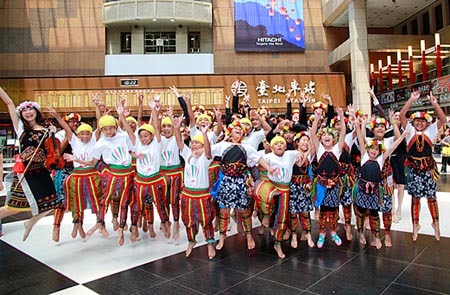
Indigenous children surprise travelers to Taiwan with flash mob

Want China Times, CNA 2014-04-14

Flash mob performers pose for photos at Taipei Main Station. (Photo/Hotel Royal)

A flash mob organized by members of one of Taiwan's indigenous tribes surprised travelers at Taipei Railway Station on Sunday with traditional songs and dances and the traditional costumes they wore.

Many spectators were touched by the angel-like voices of the members of the flash mob, all Puyuma children.

"They made me tear up within five seconds after they started," one passenger at the station told reporters from Public Television Service.

Asked about what they sang, a member of the flash mob said the songs extolled the beauty of their land in Taitung County in southeastern Taiwan and the return of brave Puyuma warriors from battles they won.

The performance was in fact part of a charity program initiated by the Hotel Royal Chihpen in Taitung to help indigenous children residing in remote mountainous parts of the county live their dreams.

Most members of the flash mob, comprised of a dancing troupe and a choir, had never been outside Taitung due to their secluded living environment, the organizer of the show said.

With assistance from the Taitung County Tourism Bureau and Uni Air, the indigenous children took their first-ever flight to Taipei to show urban dwellers in Taipei the beauty of Taitung through song and dance, the organizer said.

The Puyama, one of 14 indigenous tribes in Taiwan, reside mainly in Taitung County.

Tuesday, February 25, 2014

Double-Decker Tour Buses Launched Today

Jakarta Globe, Lenny Tristia Tambun, February 24, 2014

The capital’s free tourist buses began service on Feb. 24. (AFP Photo)

Jakarta. “Hopefully everything will work out as planned,” was how the head of the Jakarta Tourism Agency introduced five new yellow-and-purple tour buses that began ferrying tourists around the capital on Monday.

“As promised, we are operating the double-decker buses on Feb. 24,” Jakarta Tourism and Culture Agency chief Arie Budhiman said on Monday. “From our week-long evaluation, bus drivers and crew members have done a pretty good job.”

The buses are scheduled to operate — free of charge — from 9 a.m. to 9 p.m. six days a week, with a later service beginning at midday on Sunday. The bus will not use the city’s busway lane.

The first five buses will ply a trial route through the very center of the city, starting from the Hotel Indonesia traffic circle before heading past the National Monument to the Istiqlal mosque, and continuing on to the State Palace and City Hall before returning back to Hotel Indonesia.

Andriyanto, a resident of Central Jakarta, claimed on Monday that he had waited for more than one hour for a bus to arrive.

“My wife and I, along with our child, wanted to try the tourism bus today. We found out that the buses would start operating today from TV,” he said at the Hotel Indonesia bus stop on Monday.

In the end, Andriyanto hailed a cab.

Captive audience

The government plans to roll out another 15 buses onto an expanded tour of the capital, for tourists to absorb the Dutch colonial surroundings of Kota Tua in the city’s north as well as the sights and sounds of Blok M in South Jakarta.

Arie said the first five buses were slated to accommodate up to 3,000 passengers per day. Each bus would make around 10 round trips daily, with a capacity of around 60 passengers, he said.

The city has sought to emphasize that it will focus on passenger safety and will not allow overcrowding. It remains to be seen whether the city will be able to ward off opportunistic commuters seeking a free ride home through the new service.

The city government has partnered with the Indonesian tourist board and the Historia Community to provide a historical precis of the sites along the bus routes.

“Our buses are equipped with GPS and the audio systems can also be computerized,” Arie said. “Later on, we will use an automatic audio system [that will provide information] based on the [buses’] positions.”

The Jakarta Tourism Agency officially counted 2.29 million tourist visits last year, an eight percent increase on the 2012 figure of 2.1 million.

The Jakarta administration spent Rp 17 billion ($1.4 million) to purchase the fleet of buses from China. It plans to expand the program to include as many as 20 buses in the near future.

The city administration so far this year received a total of 656 buses from China, mostly for an expansion of the Integrated City Busway (BKTB) program. However, less than a month into their use, 10 BKTB buses and five TransJakarta buses were found to be unfit for use, prompting an investigation into alleged corruption in the city’s procurement process.

Related Article:


Tuesday, January 14, 2014

Jakarta to Offer Free Bus Tours of Capital’s Historic Sites

Jakarta Globe, Lenny Tristia Tambun, January 14, 2014

Five new double-decker buses arrive at Tanjung Priok port in North Jakarta
on Jan. 13, 2014. (JG Photo/Lenny Tristia Tambun)

The Jakarta Tourism Agency welcomed the arrival of five double-decker tour buses Monday night as the capital, long listed as a sight best left unseen on a visit to Indonesia, began an aggressive push to double the number of foreign tourists visiting the city.

“We thank God that Jakarta will finally have city tour buses,” tourism head Arie Budhiman said as the buses arrived at Tanjung Priok port in North Jakarta. “We hope with the double-decker tour buses that Jakarta will have a different thing to offer than other towns [in Indonesia]. Hopefully Jakarta will become more attractive and draw more visitors.”

Jakarta logged 2.3 million foreign tourists last year, an 8 percent increase over 2012′s figures, but still short of Governor Joko Widodo’s five-million tourist goal. The capital’s administration spent Rp 17 billion ($1.4 million) to purchase the fleet of buses from China. It plans to expand the fleet to include as many as 20 buses in the near future.

“With the support of the governor, who is very tourism conscious, I’m optimistic that the target [of five million visitors] can be reached in three to five years,” Arie said.

The tour buses will offer visitors a free ride through the capital, stopping at sights like the Hotel Indonesia roundabout, Kota Tua, in North Jakarta, and the Blok M shopping hub, in South Jakarta. Each air-conditioned bus can hold 60 passengers and includes television screens that will be used to show a tourism video.

Bus service will begin a trial run on Thursday, with full service going into effect by the end early February at the latest, Arie said.

Jakarta may feature a rich colonial history, but the capital’s congestion and pollution, combined with poor maintenance of its museums and historical sites has done little to help its appeal to foreign tourists. The popular guidebook company “Lonely Planet” describes the capital as “a hard city to love. One of the world’s greatest megalopolises, its grey, relentlessly urban sprawl spreads for tens of kilometers across a flood-prone plain with barely a park to break the concrete monotony.”

The guidebook later lists several sites, including Kota Tua and Taman Ismail Marzuki, as popular locations, calling the city an “essential” stop for travelers looking to experience all Indonesia has to offer.

Monday, November 21, 2011

Bicycles demonstrate Indonesia's new spending power

BBC News, By Karishma Vaswani,  Jakarta, 20 November 2011

Indonesians can now afford to spend more money on their expensive hobbies

It's just past dawn on a Monday morning and the streets of Jakarta are still and quiet.

It is a vast contrast to what this city of 12 million is like during the day, when the roads are packed with cars and motorcycles buzz around the streets.

Only the sounds of the call to prayer, wafting through the suburbs and slums of the capital of the world's most populous Muslim nation, breaks the silence.

In Jakarta, there's no time to breathe. The stresses of work and life are felt deeply by some in the country's middle classes.

But some have found novel ways to unwind.

Adrianka, a digital imaging artist who runs his own successful business in Jakarta, is one such person.

A couple of times a week, the 27-year-old and his friends hit the back streets of Jakarta to relax - by going mountain biking.

He works in the advertising industry and is always rushing to meet deadlines. It's an expensive sport - but he thinks its worth it.

"The first I was shopping for bicycles, I thought even spending $500 was too much," he says as he takes a break from the rigorous morning bike ride. "But then I tried my friends bicycles that cost more - and they felt very comfortable."

"So I kept buying more expensive bikes - because the more they cost, the better they are. When my parents heard how much my bicycles cost they said I was crazy. But my work is very demanding - so I need this hobby to let off some steam."

Posh bikes

Foreign bicycles were rarely seen in Jakarta's shops just over a decade ago.

But now the latest models from Europe and the US are becoming increasingly common.

Most of the bicycles on these roads are relatively inexpensive - but some Indonesians willingly pay up to $5,000 for one.

Jimmy Lie started a series of upmarket stores selling branded bicycles a few years ago, because he recognised a growing trend amongst affluent and aspirational Indonesians.

They were taking to the streets on Sundays, to find some way of working out the stresses of daily life and biking was becoming fashionable.

So Mr Lie capitalised on the new expensive tastes of his consumers and is now in the midst of opening another branch in the city.

Mr Lie says Indonesians these days are far more exposed to what's going in the rest of the world, and want to have access to the same standard of goods they see their counterparts enjoy overseas.

"People nowadays, they get a lot of their information from the internet, or from watching the Tour De France," he says in between serving customers in his busy store.

Growing middle class

Just over a decade ago, it would have been unthinkable for an average Indonesian to spend a few thousand dollars on a bike.

Today though Indonesia's middle classes are far more confident about the future.

Indonesia has one of the fastest growing middle classes in the region - up from 80 million five years ago to 130 million now.

That's more than half of this country's 240 million strong population. 

Not all parts of Jakarta are experiencing a boom
in living standards
And that number is expected to grow - by 2020, many think that Indonesia's middle class will be wealthier than many in Asia.

Indonesia's economy has been one that has managed to continue to grow, despite bumps in the global economic environment.

Largely insulated from the troubles overseas because of strong domestic demand, economists say Indonesia will see growth rates stay stable or possibly even rise next year, at a time when many in the region are cutting their growth forecasts.

All this has meant Indonesian consumers are feeling far more confident about their prospects than ever before.

They consistently rank as some of the most optimistic in Asia about their economic future.

And you can see signs of that all over the streets of Jakarta these days - but especially on Sundays.

The local government has made some Sundays in a month a car-free day - an opportunity for Indonesians to get some fresh air after a busy week at their desks.

Indonesia's next generation has the ability and the desire to spend money on what it wants and not necessarily what it needs.

Not so lucky

But while the future may look bright for some Indonesians, for others not much has changed at all.

In the district of Menteng Dalam, just outside one of the poshest areas in Jakarta, life still moves at a much slower pace.

Tiny shacks are packed densely against one another, and people living in them spill out on to the streets.

The strong economic growth that is so visible just a few kilometres away has yet to touch this part of Jakarta.

Sewi, 62, has lived here for the last two decades.

He has owned his tattered, worn out and old fashioned bicycle for just as long. 

Sewi says he prefers to look after things from the past
Even if he wanted to he wouldn't be able to buy a new one - he just doesn't have that kind of money.

"I've always liked old bicycles like this," he says as he tinkers with his rusty old machine.

"I'm not tempted by newer models. The young generation - they like to change their bicycles all the time and throw the old ones away. But I like to look after things from the past. "

Sewi doesn't understand how some young Indonesians are so eager to spend their hard earned cash.

He's from a generation that still remembers the hard times here. Millions like him have yet to taste the benefits of growth.

Indonesia's future generations need to ride the waves of prosperity for this country's economic rise to be considered a true success.