Indonesia executes six drug convicts, five of them foreigners

Indonesia executes six drug convicts, five of them foreigners
Widodo has pledged to bring reform to Indonesia

Ban appeals to Indonesia to stop death row executions

Ban appeals to Indonesia to stop death row executions
United Nations Secretary General Ban Ki-moon has pleaded to Indonesia to stop the execution of prisoners on death row for drug crimes. AFP PHOTO

Pope: 'Death penalty represents failure' – no 'humane' way to kill a person

Pope: 'Death penalty represents failure' – no 'humane' way to kill a person
The pope wrote that the principle of legitimate personal defense isn’t adequate justification to execute someone. Photograph: Zuma/Rex

Obama becomes first president to visit US prison (US Justice Systems / Human Rights)

Obama becomes first president to visit US prison   (US Justice Systems / Human Rights)
US President Barack Obama speaks as he tours the El Reno Federal Correctional Institution in El Reno, Oklahoma, July 16, 2015 (AFP Photo/Saul Loeb)

US Death Penalty (Justice Systems / Human Rights)

US Death Penalty (Justice Systems / Human Rights)
Woman who spent 23 years on US death row cleared (Photo: dpa)


.

.
"The Recalibration of Awareness – Apr 20/21, 2012 (Kryon channeled by Lee Carroll) (Subjects: Old Energy, Recalibration Lectures, God / Creator, Religions/Spiritual systems (Catholic Church, Priests/Nun’s, Worship, John Paul Pope, Women in the Church otherwise church will go, Current Pope won’t do it), Middle East, Jews, Governments will change (Internet, Media, Democracies, Dictators, North Korea, Nations voted at once), Integrity (Businesses, Tobacco Companies, Bankers/ Financial Institutes, Pharmaceutical company to collapse), Illuminati (Started in Greece, with Shipping, Financial markets, Stock markets, Pharmaceutical money (fund to build Africa, to develop)), Shift of Human Consciousness, (Old) Souls, Women, Masters to/already come back, Global Unity.... etc.) - (Text version)

… The Shift in Human Nature

You're starting to see integrity change. Awareness recalibrates integrity, and the Human Being who would sit there and take advantage of another Human Being in an old energy would never do it in a new energy. The reason? It will become intuitive, so this is a shift in Human Nature as well, for in the past you have assumed that people take advantage of people first and integrity comes later. That's just ordinary Human nature.

In the past, Human nature expressed within governments worked like this: If you were stronger than the other one, you simply conquered them. If you were strong, it was an invitation to conquer. If you were weak, it was an invitation to be conquered. No one even thought about it. It was the way of things. The bigger you could have your armies, the better they would do when you sent them out to conquer. That's not how you think today. Did you notice?

Any country that thinks this way today will not survive, for humanity has discovered that the world goes far better by putting things together instead of tearing them apart. The new energy puts the weak and strong together in ways that make sense and that have integrity. Take a look at what happened to some of the businesses in this great land (USA). Up to 30 years ago, when you started realizing some of them didn't have integrity, you eliminated them. What happened to the tobacco companies when you realized they were knowingly addicting your children? Today, they still sell their products to less-aware countries, but that will also change.

What did you do a few years ago when you realized that your bankers were actually selling you homes that they knew you couldn't pay for later? They were walking away, smiling greedily, not thinking about the heartbreak that was to follow when a life's dream would be lost. Dear American, you are in a recession. However, this is like when you prune a tree and cut back the branches. When the tree grows back, you've got control and the branches will grow bigger and stronger than they were before, without the greed factor. Then, if you don't like the way it grows back, you'll prune it again! I tell you this because awareness is now in control of big money. It's right before your eyes, what you're doing. But fear often rules. …
Showing posts with label Old City. Show all posts

Friday, May 27, 2016

Jakarta Gets Kota Tua Repainted for Free, Plus Four Public Buses

The Jakarta administration has signed an agreement on Wednesday (25/05) with
 a Dutch multinational company for the repainting of Kota Tua in North Jakarta
and several other public buildings and structures in the city. (Antara Photo/Aprillio Akbar)

Jakarta. The Jakarta administration has signed an agreement on Wednesday (25/05) with a Dutch multinational company for the repainting of Kota Tua in North Jakarta and several other public buildings and structures in the city.

Jakarta regional secretary Saefullah signed the agreement with Jun de Dios, president director of AkzoNobel, the company that produces the Dulux brand of paints.

The painting process will be divided into two phases, with the first involving the Jakarta History Museum, the Museum of Fine Arts and Ceramics and the Kota Intan Bridge in Kota Tua. The three structures will be painted in a livelier color and 50 trash cans made from the empty paint cans will be placed around the historic area.

The second phase will involve repainting of the Maritime Museum in Sunda Kelapa, North Jakarta, and the Wayang Museum, also in Kota Tua. This phase will be expanded to other parts of the capital and it will include the repainting of bus shelters, pedestrian bridges, overpasses and underpasses in lively colors.

"We are happy to see the program proceed, as it will maintain the historical buildings, which are essential factors in preserving a cultural heritage," de Dios said after the signing.

The Jakarta administration has also received four double-decker buses from the company.

"I am the most expensive model in Jakarta. For wearing a Dulux shirt and a hat, I get paid four buses and Kota Tua's revitalization," Governor Basuki Tjahaja Purnama, better known as Ahok, said jokingly during Wednesday's ceremony.

"You can have me wear these [clothing items] for a week, but then you must give me seven buses," he added.

Saturday, February 20, 2016

Kipling to Jinnah: Mumbai's crumbling colonial homes

Yahoo – AFP, Peter Hutchison, 19 February 2016

The "Kipling Bungalow" is one of several mansions in Mumbai, once associated 
with famous residents but now in ruin (AFP Photo/Indranil Mukherjee)

Mumbai (AFP) - Hidden behind a blanket of trees at the back of a university in Mumbai lies the dilapidated, but once grand, former home of writer Rudyard Kipling.

Fallen branches, discarded chairs and even empty whisky bottles surround the 19th-century building, while bird droppings mar a bust of Kipling, author of such beloved novels as "The Jungle Book" and "Kim".

"The bungalow is in very bad condition and needs desperate help," the college's principal, Rajiv Mishra, tells AFP.

"We feel cheated that such a beautiful monument has been neglected," he adds, pointing to a rotting wooden post, precariously supporting the historic property in south Mumbai.

The "Kipling Bungalow", as locals affectionately call it, is one of several mansions in the teeming Indian city, once associated with famous residents but now in ruin.

Nearby stands the former colonial home of Lord Harris, an ex-governor of then-named Bombay, widely credited with making cricket the most popular sport in India.

The 147-year-old Esplanade Mansion, formerly the resplendent Watson's Hotel, 
and frequented and written about by Mark Twain, is now a ramshackle shadow 
of its former glory (AFP Photo/Indranil Muherjee)

The gothic building housed school classrooms until four years ago, when pupils were moved out because the crumbling structure had become too weak and hazardous.

A few kilometres away in plush Malabar Hill sits the previously imposing residence of Mohammad Ali Jinnah, the founder of Pakistan and its first governor-general.

The stately home hosted critical talks between Jinnah and India's first prime minister Jawaharlal Nehru on partition of the subcontinent, but today its downtrodden appearance belies its historical significance.

Red tape

Heritage campaigners lament the demise of such buildings, blaming red tape and claiming politicians and developers are more concerned with constructing sparkly new luxury towers than preserving Mumbai's architectural history.

"The Kipling Bungalow is just a very sad reflection of bureaucratic hurdles... creating the death of a historic building," renowned architect Abha Narain Lambah, who specialises in conservation, told AFP.

An Indian mason stands on scaffolding at the under-renovation Lord Harris
Higher Secondary Marathi School in Mumbai (AFP Photo/Indranil Mukherjee)

The wood and stone structure, its green paint peeling, is situated on the grounds of an art school, whose first principal was John Lockwood Kipling, Rudyard's father.

Built in 1882, 17 years after Rudyard was born, the house was home to Lockwood Kipling and subsequent deans until the early 2000s, by which time it had sunk into such disrepair that it was rendered uninhabitable.

"We feel that Lockwood must have had Rudyard stay here and write so we call it the 'Kipling Bungalow'," explains Mishra, who wants the Maharashtra state government to restore it without delay.

He says officials plan to turn the building into a gallery exhibiting students' work and that of decorated artists, and have issued a tender for the contract.

The building has been caught in a tug-of-war between the college and the government for years over what its restoration should look like, but Mishra hopes renovations will finally start in around six months.

Maharashtra culture and education minister Vinod Tawde failed to respond to repeated AFP requests for comment on the issue.

Built in 1882, 17 years after Rudyard Kipling was born, the house was home to his 
father John Lockwood Kipling and subsequent deans until the early 2000s, by which
 time it had sunk into such disrepair that it was rendered uninhabitable (AFP Photo/
Indranil Mukherjee)

A short walk away, work has already begun on the former Mumbai residence of batsman and acclaimed cricket administrator George Harris, who was governor of the city from 1890-1895.

Harris captained England and during his tenure on the subcontinent "did much to lay down foundations for the expansion of the game in India", according to Cricinfo website.

A Mumbai inter-schools cricket tournament called the Harris Shield is testament to his legacy, but his former home was allowed to come close to collapse before long overdue maintenance work started.

The three-storey mansion, part of a public school, was out of use for three years until renovation began in June, and presently stands gutted, surrounded by bamboo scaffolding.

"It was basically falling apart and became too dangerous to be inside," the school's principal, Mohan Bhogade, told AFP.

Jinnah dispute

In arty Kala Ghoda district, a 147-year-old mansion, formerly the resplendent Watson's Hotel, frequented and written about by Mark Twain, is a ramshackle shadow of its former glory.

A bust of author Rudyard Kipling pictured at
the Kipling Bunglow -- the author's birthplace
-- inside the campus of the J.J. School of Art
in Mumbai  (AFP Photo/Indranil Mukherjee)
Now called Esplanade Mansion, it shows no signs of being restored despite ten years having passed since it was placed on a global list of endangered monuments by the New York-based World Monuments Fund.

Watson's, completed in 1869, is believed to be India's oldest caste-iron building and was the hotel of choice for colonialists and visiting dignatories during the British Raj.

Accoring to legend, the hotel went into decline after Indian industrialist Jamsetji Tata built Mumbai's iconic Taj Mahal Palace because he was denied entry to Watson's, which had a "Europeans-only" policy.

Today the crumbling structure houses a medley of dark cubbyhole offices. A lack of funds and arguments between tenants and city authorities have been cited as contributing to its descent into ruin.

"The idea of heritage has just evaporated," says Naresh Fernandes, author of "City Adrift: A Short Biography of Bombay".

Students gather under the porch at the Kipling Bunglow -- the birthplace of author 
Rudyard Kipling -- at the J.J. School of Art in Mumbai (AFP Photo/Indranil Mukherjee)

AFP contacted a number of officials at the Brihanmumbai Municipal Corporation, regarding the Watson's Hotel and the Harris building, but none were available for comment.

Jinnah's house has been embroiled in a long-running legal dispute over ownership between his daughter, India and Pakistan. It lies empty in thick forest behind a padlocked gate.

Lambah doesn't believe the buildings owe their dilapidation to any sort of colonial antipathy, citing well-maintained British-era relics like the Bombay High Court and the former Victoria Terminus train station.

"It's just sheer neglect and bureaucracy," she says.

Monday, June 15, 2015

Indonesia Formally Waives Visa Requirements for 45 Countries


Visitors at Fatahillah square, the heart of Jakarta's old town known locally
known as Kota Tua. (AFP photo/ Romeo Gacad)

Jakarta. The Indonesian government this week finally formalized a visa-free travel regulation that was announced months ago for citizens from 45 countries, in a bid to boost tourism and improve relations with those countries.

President Joko Widodo signed the presidential regulation on visa-free travel for tourists on Tuesday.

“Visa-free travel is offered to citizens of several countries and special administrative regions in consideration of the importance of reciprocity and benefits,” Indonesia’s Cabinet Secretariat website quoted from the regulation, in a post published on Friday. “Those citizens are allowed to stay for 30 days but the visit permit can’t be extended or changed to other stay permits.”


Citizens from the member states of the Association of Southeast Asian Nations as well as from several other states could already travel to the country visa-free, but the complete list of visa-free states and territories is now:

Singapore, Thailand, Myanmar, Brunei, Malaysia, Cambodia, Vietnam, Laos, Philippines, Chile, Morocco, Peru, Ecuador, Hong Kong, Macau, China, Russia, South Korea, Japan, United States, Canada, New Zealand, Mexico, United Kingdom, Germany, France, the Netherlands, Italy, Spain, Switzerland, Belgium, Sweden, Austria, Denmark, Norway, Finland, Poland, Hungary, Czech Republic, Qatar, United Arab Emirates, Kuwait, Bahrain, Oman, and South Africa.

Australians, the third-largest group of foreign visitors after Singaporeans and Malaysians according to the latest available Central Statistics Agency (BPS) data, will still need a visa to enter the country, although tourists can buy one on arrival.

The five international airports through which citizens of the 45 countries and territories can enter Indonesia visa-free are Soekarno-Hatta in Jakarta, Ngurah Rai in Bali, Kuala Namu in Medan, Juanda in Surabaya and Hang Nadim in Batam.

Sri Bintan and Tanjung Uban seaports in Bintan Island and Sekupang and Batam Center ports in Batam will also provide the facility.

Wednesday, October 8, 2014

Jakarta to Speed Up Kota Tua Revitalization for 2018 Asian Games

Jakarta Globe, Lenny Tristia Tambun, Oct 08, 2014

Visitors at Fatahillah square, the heart of the old town known locally known
as Kota Tua. (AFP photo/ Romeo Gacad)

Jakarta.  Revitalization of Jakarta’s historic town center Kota Tua will be fast tracked in order to be ready for the 2018 Asian Games, the company charged with organizing the renovation said on Wednesday.

Lin Che Wei, the CEO of Jakarta Old Town Revitalization Corporation, a consortium handling the revitalization, said the company had obtained consent from some building owners and had already started working on the project.

“The revitalization of Kota Tua has started. We are optimistic it will be completed within a relatively short time so that when we host the 2018 Asian Games, Kota Tua is a selling point for the tourism sector,” Lin said in Jakarta on Wednesday.

Indonesia was approved to host the Asian Games (Asiad) last month after Vietnam said in April that it could no longer afford to stage them.

Already Lin said he had requested that the Jakarta City Council (DPRD) help regulate street vendors in the area.

“Hawkers will still be allowed, but only those who are registered,” Lin said, “this needs to be done so they won’t get bigger in numbers and are still orderly.”

Kota Tua, once revered as the “Queen of the East”, is now a crumbling relic and many of its heritage buildings are in a critical state of disrepair.

The DPRD has pushed for revitalization of the area in the hope it will become a tourist attraction, and this year it gave property owners a two-year deadline to restore buildings or face severe sanctions.

Of the 134 colonial-era buildings in Kota Tua, only five of them — including the Jakarta History Museum — are owned by the Jakarta Government.

Sarwo Handayani, Jakarta’s deputy for spatial planning and environmental protection, said acting governor Basuki Tjahaja Purnama had contacted owners, including a number of state-owned enterprises.

Head of Jakarta Tourism Agency Arief Budhiman said the revitalization would not change the authentic design of the buildings. Restoration would adjust the function of the buildings by adding more facilities, such as parking lots and parks, he said.

“The design will stay the same because those buildings are the city’s heritage,” Arief said.

Other prominent buildings such as Gedung Cipta and Kerta Niaga would be renovated in 2015.

“These historical buildings will be returned to their original facade, however, there will many new activities inside. One of them is aimed to facilitate the hawkers,” Arie said.

Tuesday, March 11, 2014

Jakarta Is Going Back to Its Roots With Old Town Fiesta

Jakarta Globe, Sylviana Hamdani, Mar 11, 2014

This weekend sees Jakarta’s historic Kota Tua play host to Fiesta Fatahillah.
(AFP Photo/Romeo Gacad)

Jakarta. Indonesia’s capital may be one of the liveliest cities of Southeast Asia, yet when it comes to having fun and stepping out of the house for the day, the city has very little to offer other than shopping malls and restaurants. This weekend, however, Jakartans are encouraged to visit the Old Town or Kota Tua to enjoy Fiesta Fatahillah, a vibrant art, culture, and culinary festival running from Thursday through Sunday. The first event of its kind, it will also mark the start of ambitious plans made by Jakarta’s provincial government to revamp the city’s historical Old Town.

History

“At last, everything falls into place,” said Arie Budhiman, head of Jakarta’s tourism and culture office. “After decades of planning, we’re now going to revitalize the heart of the city, the Kota Tua section.”

Kota Tua, which encompasses about 1.3 square kilometers across parts of North and West Jakarta, was the onset of the sprawling metropolis that Jakarta is now. It was in this area that Jan Pieterszoon Coen, governor general of the Dutch East Indies, established the headquarters of the Dutch East India Company (VOC) in the early 1600s.

Thanks to the Sunda Kelapa Harbor, which was the biggest in Southeast Asia at that time, trade and business activities in Batavia (Jakarta’s old name) grew rapidly and this part of the town soon became a very busy. Sailors and traders from many different parts of the world lived in this part of the town.

At the end of the 17th century, malaria, dysentery and cholera plagues hit the area, killing hundreds of people. Survivors evacuated and abandoned all forts, offices, mansions and warehouses in Kota Tua. Thus, the area became dingy, run-down and finally neglected.

In 1972, Jakarta’s visionary governor, Ali Sadikin, established Kota Tua as a cultural and heritage center and started an ambitious plan to renovate and restore its old buildings.

“But somehow, the plan was never executed,” Jakarta’s senior historian, Martono Yuwono said.

All of Ali Sadikin successors expressed intentions to breathe life back into the site, yet their plans also fell through.

“But this is now the era of Jakarta Baru [New Jakarta] under Pak Jokowi [Governor Joko Widodo] and Ahok [Deputy Governor Basuki Tjahaja Purnama],” Arie said. “They both have great concerns about this heritage area and are truly committed to seeing it revitalized.”

Under Jokowi and Ahok’s care, the provincial government founded the Jakarta Endowment for Arts and Heritage (Jeforah) a non-profit consortium, which consists of two government-owned companies, nine private companies, artists, architects, historians and many other experts, in early 2014.

The group’s members came together out of concern for the Old Town, vowing to carry out a revitalization project.

Meanwhile, the city also established the Jakarta Old Town Revitalization Corporation (Jotrc) to carry out the ambitious plans under Jeforah’s guidance and supervision.

A large number of stakeholders have invested their time, effort, and funds into the undertaking.

“The government owns just 4 percent of the buildings in the Kota Tua area,” said Lin Che Wei, chairman of Jotrc.

“About 40 percent are owned by private companies and the rest of its buildings are personally owned.”

With the consortium, Lin hopes to encourage all stakeholders in Kota Tua to work together in renovating and revitalizing the area.

The Fiesta Fatahillah festival is the group’s first endeavor toward reanimating Jakarta’s beloved historical site.

The four-day festival, opened by governor Joko Widodo, launched ambitious plans
 to revitalize an area steeped in history but suffering from decades of neglect.
(AFP Photo/Romeo Gacad)

Fiesta Fatahillah

The festival will be opened by the Jakarta Governor in Taman Fatahillah (Fatahillah Park), in front of the Jakarta History Museum on Thursday at 6 p.m.

The opening ceremony will be followed by a video-mapping presentation by Sembilan Matahari, a creative studio based in Bandung, offering a visual concept of the new Kota Tua upon the project’s completion. The studio presented a similar video in the exact same spot on the exact same day four years ago.

“I believe it’s no coincidence,” said Adi Panuntun, founder and creative head of Sembilan Matahari. “When the provincial government asked us to present another video-mapping on the exact same day and location, it means that the universe supports this project.”

Adi refused to divulge details of the video, only adding: “The video depicts water as a source of inspiration for revitalizing the Old Town.”

The four-day festival will also feature 55 vendors of the best local cuisines in Jakarta, all of which were selected by food critic and writer Laksmi Pamuntjak.

“We treat food as art in this festival,” Lin Che Wei said. “Everything is carefully curated by experts.”

In addition, contemporary creations by 47 renowned Indonesian artists will be displayed in Galleria Fatahillah, a new art space on the second floor of the Fatahillah Post Office.

Senior art collectors Dr. Oei Hong Djien and Heri Pemad Art Management selected the pieces showcased in the exhibition, including an installation called “Taxi Lover” by Angki Purbandono and a sculpture by Dolorosa Sinaga. Bandung-based visual artist Tisna Sanjaya will present a performance art action painting during the opening night by using asphalt, mud and paints on a large canvas.

The exhibit will run through Sept. 13 to “give maximum exposure to these artists and boost their careers,” Oei said.

Despite the festivities, Jeforah members realize much still needs to be done.

“We don’t aim to wow the public with a series of spectacular events in the festival,” said senior poet, writer and social activist, Goenawan Mohamad, who chairs the consortium’s advisory board. “We realize that we still have a long way to go [in revitalizing the Old Town]. We just want to let the people know that something positive is being done.”
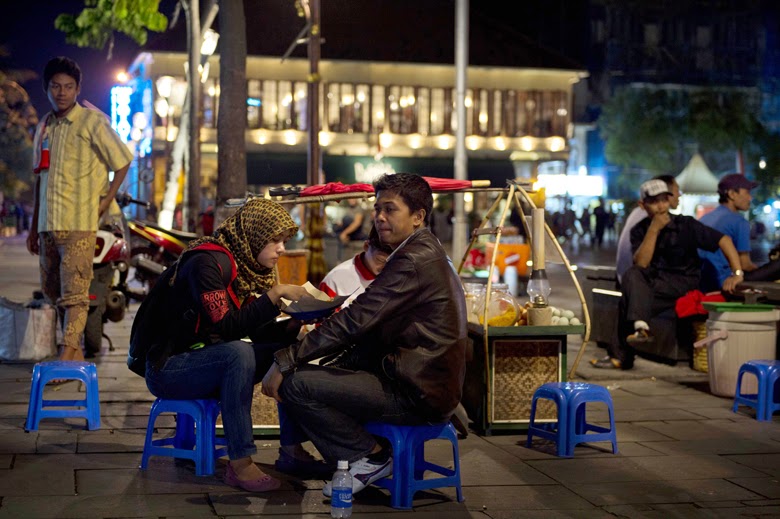
Pedestrians enjoy street food in Jakarta’s Kota Tua. (AFP Photo/Romeo Gacad)

Revitalization plan

The Fiesta Fatahillah will also mark the opening of a Visitor’s Center on the ground floor of the Fatahillah Post Office.

“The visitor’s center will provide anyone who is interested with detailed information regarding the project,” Lin Che Wei said.

A very important part of the revitalization plan is to convert the Kota Tua area into a special trade and business center.

“Economic activities are needed to sustain this area,” Lin Che Wei said. “However, every utilization and development plan is subject to the approval of [Jeforah’s] advisory board.”

These activities will involve art and culture, education, lifestyle (food, fashion and entertainment), MICE (meeting, incentive, convention, exhibition), creative industries and finance.

“The advisory board guarantees there will be no gentrification and no change to the old buildings,” Goenawan said.

Instead, owners of Kota Tua’s colonial buildings will be encouraged to renovate.

“The provincial government will enact new regulations for building owners,” Arie of Jakarta Tourism said.

Under the new regulations, owners who neglect their property will be given a large penalty, while those who agree to renovate and maintain their structures will enjoy significant discounts on land and building taxes.

“Those who cannot afford to renovate their old buildings, may send their proposals to us,” Arie said.

“The governor has agreed to contribute a portion of Jakarta’s development budget to renovate some of these historical buildings.”

Jeforah and Jotrc aim to renovate 85 colonial structures in the area within the first five years of the project.

On the opening night of the festival, the Indonesia Port Corporation (Pelindo) will also sign an agreement with Jeforah and Jotrc to revitalize the 33-hectare area of the historic Sunda Kelapa Harbor.

“Everything is already on track,” Arie said. “With the right people on our team, I’m optimistic the plan will be executed properly.”

The government is also working on a traffic master plan to alleviate the heavy traffic jams in this area and planning to build more sidewalks for tourists.

“This is our starting point,” Lin Che Wei said. “With the commitment and participation of all stakeholders, I’m positive that Kota Tua can once again be a wonderful place to live, work and play.”

A revitalized Kota Tua can play an important role in promoting Jakarta as a destination offering more than just malls and traffic gridlock.

Fiesta Fatahillah
March 13 to 16
5 p.m. to 10.30 p.m.
Related Article:


Thursday, February 27, 2014

Indonesian Capital Seeks to Revive Crumbling Kota Tua

Jakarta Globe – AFP, Madura McCormack, February 26, 2014

A man sits near a neglected colonial building in Kota Tua, North Jakarta,
in this file photo. (JG Photo/Afriadi Hikmal)

Jakarta. Once resplendent facades sagging in the tropical heat and empty shells of colonial-era buildings are depressing signs that the old town of the Indonesian capital Jakarta, once considered the “Jewel of Asia,” has suffered decades of neglect.

Palm trees grow through crumbling windows in what was once the center of power for Indonesia’s Dutch colonial rulers, and many buildings that are still intact lie empty, stained grey by fumes from hordes of passing traffic.

But Jakarta’s popular governor Joko Widodo, who has energetically taken on the task of transforming one of the world’s most chaotic metropolises, has a new plan to overhaul the old town and attract more tourists.

“It has to be done, otherwise it is going to deteriorate,” said Goenawan Mohamad, a well-known Indonesian writer and member of the group set up to regenerate Kota Tua. “It’s about time.”

Nevertheless, there is much scepticism.

Other plans have failed and some fear that even if the latest makes progress, developers might transform the area into a “Disneyland” full of garish malls rather than a well-preserved heritage area.

Restoring colonial splendor

Kota Tua, in modern-day North Jakarta, was once a global trading center, where merchants would arrive to buy and sell goods from across the Indonesian archipelago, particularly spices sought after in Europe.

With its whitewashed buildings and cobbled streets, the area for centuries made up almost the whole of Jakarta, then known as Batavia, and was called the “Jewel of Asia” by European sailors arriving after long sea voyages.

Jakarta has expanded to become a city with a population of some 10 million, better known now for its traffic jams than historic buildings, and Kota Tua has fallen into disrepair, out of favor with the city’s well-heeled residents.

Some small sections have been preserved. Cobbled “Fatahillah” square, the heart of the old town and the most visited part, is in good condition and is packed out with vendors selling trinkets to the small number of passing tourists.

On the square, and also well-preserved, are the former city hall and a museum showcasing Indonesian puppets.

But outside this small area most of the buildings are in a state of serious decay.

Joko — who was elected last year — and his supporters hope their initiative might at last return some colonial splendor to Jakarta.

They believe their plan stands a better chance of success than previous ones as they have created an umbrella organisation with what they believe is the right mix of people to oversee the regeneration.

The consortium includes private firms, a former government minister and a heritage group.

Crucially they have the strong backing of the Jakarta authorities, who have pledged a 150 billion rupiah ($12.5 million) budget for the regeneration.

Previous attempts suffered either from a lack of coordination between numerous different players, or the opposite — just one group but a lack of resources, said Lin Che Wei, chairman of the consortium’s board of advisors.

There are signs that work is under way on some buildings in the area, and a visitor centre and exhibition space for contemporary art are due to open next month.

The consortium intends to renovate 85 historic buildings over five years, a program it says will create 11,400 jobs.

Disneyland fears

However, some have expressed fears over-enthusiastic development might destroy Kota Tua’s charms and transform it into an area full of ugly modern buildings and shopping malls.

“Kota Tua is a city, it’s not Disneyland,” said Ella Ubaidi, owner of a colonial-era building in the old town.

Her apprehensiveness stems from the profile of the consortiums’ board of trustees, some of whom are from large Indonesian property companies.

There is also a lack of enthusiasm among the public.

Some regard Kota Tua, a district built by colonizers, as a symbol of repressive rule, and there has been little interest among Jakarta’s citizens in maintaining it since the Dutch left Indonesia in the late 1940s.

Nevertheless, the plan’s backers are optimistic. They believe they can attract more tourists to Jakarta, which lags behind other Southeast Asian capitals in numbers of foreign visitors, as they restore Kota Tua to its former glory.

Agence France-Presse

Saturday, April 27, 2013

Jakarta Hatches a New Plan for Kota Tua

Jakarta Globe, Lenny Tristia Tambun, April 27, 2013

A scavenger sits near the neglected colonial-era building in Jakarta’s Kota Tua
(old town). (JG Photo/Afriadi Hikmal)

Jakarta plans to make Kota Tua, the capital’s historical precinct, a special economic zone as the government aims to realize the area’s tourism potential and stop centuries-old buildings from collapsing.

With the creation of the zone, economic development, infrastructure and restoration in the area would become the responsibility of a single government body.

“By establishing a Kota Tua special economic zone, all of the development will be done through a single door, run by a specialized authority,” Jakarta tourism and culture agency chief Arie Budiman said on Friday.

Arie said that currently development of Kota Tua is the responsibility of multiple agencies, each with their own programs and priorities.

The situation has deterred investors and building owners from harnessing the area’s tourism potential, leaving the buildings, 70 percent of which are privately owned, to be left in decay.

Despite laws stating that owners could be fined Rp 50 million ($5,100) to Rp 5 billion for neglecting their caretaker duties, few have braved the bureaucratic hurdles to obtain permits to restore the buildings.

For decades, several plans to revitalize the entire area have failed.

Jakarta Governor Joko Widodo has announced a new master plan to transform the area into a cultural tourism center. His administration pledged Rp 150 billion in 2014 to implement the changes. The Dutch government has also expressed its support of the new plan.

The focus of Joko’s plan is to make Kota Tua teem with creative industries such as fashion, food and handicrafts. At the same time, the governor aims to give the neighborhood a more exclusive feeling by attracting investment from high-end hotels, restaurants and galleries.

Arie said that turning Kota Tua into a special economic zone would allow authorities to conduct speedy restoration and infrastructure projects and ensure that they meet the governor’s vision.

But an economic zone formation requires a presidential decree, and according to Arie, the provincial government is still trying to formulate the details for the special zone. “We know that it is a long process,” he said, adding that it might take three to four years before Kota Tua is turned into a special economic zone.

But this will not stop restoration and infrastructure projects already planned by the government, which will start next year, according to Arie.

“There will be infrastructure [projects] like sidewalks, lighting, redirecting traffic as well as staging tourism events to make the place come alive,” he said.

Sunday, February 24, 2013

A New Hope for Jakarta's Kota Tua

Jakarta Globe, Lenny Tristia Tambun, February 24, 2013

Building facades in Kota Tua, the historic old city that straddles North
and West Jakarta. (JG Photo/Safir Makki)
              
Related articles

Batavia was once revered as the “Queen of the East.” But this old dame is showing her age.

Jakarta’s old town center, known as Kota Tua, is now a crumbling relic. Many of its heritage buildings are in a critical state of disrepair, some sprouting treetops through their broken roofs, evidence of years of neglect.

A legacy of colonial rule, the old town has been left behind in the new Indonesia. But support is growing for Kota Tua to be revitalized to serve as a tourist attraction and public space to be enjoyed by all.

Last week, Jakarta Governor Joko Widodo announced a new master plan to transform the area into a cultural tourism center. His administration pledged Rp 150 billion ($15.5 million) in 2014 to implement the changes. The Dutch government has also expressed its support of the new plan.

“We are ready to spend a budget of Rp 150 billion to fix this area and make it better. If that is not enough, I will add to the budget,” said Basuki Purnama Tjahaja, Joko’s deputy.

The focus of Joko and Basuki’s plan is to establish a creative public zone, with spaces provided for creative industries such as fashion, food and handicrafts to flourish. At the same time, the pair aims to give the neighborhood a more exclusive feel, by attracting investment from high-end hotels, restaurants and galleries.

Vision for the future

The master plan for Kota Tua aims to return cleanliness, security and order to an area of the city notorious for criminal activity and seedy nightlife.

Basuki said it is this negative image that has scared off investors in hospitality and tourism.

“Kota Tua is too valuable. If it is left to waste away, there will be no community to look after it,” he said. “Even business owners won’t want to invest there because it’s too dirty.”

Basuki and Joko plan to sit down with spatial planning stakeholders and develop an action plan to be implemented starting in 2014.

For 2013, the budget remains at only Rp 12 billion, but with more than 10 times that much in 2014, the administration believes it can make a real change to the area, transforming it into a tourism hub.

In the meantime, the city administration plans to work together with the West Jakarta government to clean up the area from waste left behind by food vendors. There are also plans to improve the condition of Kali Besar, the canal that runs through Kota Tua, with sights on developing water attractions.

Joko aims to replicate his success in Solo as mayor by creating special zones for small traders to operate in.

The food vendors now trading in Taman Fatahillah by night will be allocated 260 places in four distinct trading clusters.

The first cluster will be dedicated to cooked food, and will be located in front of the old post office building. The second cluster will be parked at the other end of the square, near the popular Cafe Batavia, and will be set aside for vendors selling non-food items such as clothes, goods and accessories. Snacks will make up another cluster, while pre-made food and drinks will be sold near the canal.

Traders will be charged Rp 3,000 to Rp 5,000 per day. In return, they will receive a trading spot, equipment and uniforms.

Gathut Dwi Hastoro, the head of the Kota Tua Management Unit, lauded Joko and Basuki’s efforts to restore the historic area. His hope is that the plans for the changes can be consolidated in the coming year, ready to be executed in 2014.

“The biggest share of funds will go to fixing the area around Kali Besar. That area is the most important,” Gathut said. “Those funds can be used to create comfortable sidewalks, bicycle lanes, lighting, sanitation and greenery.”

Challenges past and present

Joko and Basuki are not the first leaders of Jakarta to come up with a master plan for Kota Tua.

Jakarta first began to focus on restoring its urban heritage in the 1970s. At that time, the old Town Hall in Kota Tua’s town square, Taman Fatahillah, was restored to become the Jakarta History Museum. Managing to both preserve the historical building and find a modern usage for it, the restoration work at the time was considered a triumph of town planning.

But in the decades that followed, several plans to revitalize the entire area failed to get up and running as they were tripped up by a tangle of red tape.

Of the 182 heritage buildings in Kota Tua, about 70 percent are privately owned.

The Jakarta government owns 18 percent, while the central government owns 12 percent, including the post office building and Beos station.

State-owned enterprises in 2009 were responsible for 23 unused buildings, among them Indonesian trading company Perusahaan Perdagangan Indonesia with 16 buildings, Bank Mandiri with three buildings, insurance firm Asuransi Jasa Indonesia with two buildings, as well as pharmacology group Kimia Farma and insurance firm Asuransi Jasa Raharja with one building each.

Despite laws stating that owners can be fined Rp 50 million to Rp 5 billion for neglecting their caretaker duties, few have braved the bureaucratic hurdles to obtain permits to restore the buildings.

During his term from 2007 to 2012, Governor Fauzi Bowo managed to install lighting to highlight key attractions in Kota Tua and draw visitors at night. About 2,041 lights were installed around Kota Tua, including at the Jakarta History Museum, the Wayang Museum, the Ceramics Museum, the Beos station and in pedestrian areas.

A total of about Rp 39.7 billion was spent on constructing a pedestrian tunnel at Beos station to connect it to the Kota TransJakarta busway shelter and the Bank Mandiri Museum. The tunnel was also equipped with toilets, air conditioners and small parks.

At the same time, the West Jakarta government established a night food market that aimed to preserve the area’s history while providing an income for the surrounding community.

One plan that went unfinished after the handover to Joko and Basuki was the creation of bicycle lanes, due to begin in October last year.

Robert Tambunan, chairman of the Jakarta Heritage Trust and manager of PPI trading company, hailed the new master plan for the area, saying that the biggest obstacle would be restoring the old buildings.

He asked for a one-stop service to be provided to ease the bureaucratic process of renovating the historic buildings.

With the buildings restored, he said, Kota Tua will spring to life once more.

Wednesday, December 12, 2012

In North Jakarta, New Potential for an Old City

Jakarta Globe, Nadia Yusuf, December 11, 2012

Kota Tua features almost 200 historic buildings, but many owners are
reluctant to restore the old structures. (JG Photo/Nadia Yusuf)
              
Related articles

Strolling through Jakarta’s crumbling yet cultural Kota Tua, it’s easy to see the potential of transforming the area into a hub for tourists and citizens alike. Unfortunately, as it currently stands now, the former colonial city is failing to reach its full potential.

Though it does contain some interesting sites, especially its museums, the buildings are in dire need of restoration. Kota Tua contains 182 old edifices, but many owners are reluctant to renovate them due to excessive bureaucratic regulations surrounding the process.

Fortunately, Jakarta Deputy Governor Basuki Tjahaja Purnama recently announced during a meeting with stakeholders that he was prepared to allot Rp 150 billion ($15.5 million) to revitalize the area. He also noted that he will commence plans to renovate the area to “look like Venice” and become Jakarta’s historical center by 2014.

With Kota’s rich cultural history and ambitious renovation plans in mind, my friends and I decided to make a day out of touring the old city by foot, accompanied by Kartum Setiawan, chairman of Komunitas Jelajah Budaya, an organization focused on promoting cultural art and historical sites around Jakarta. We wanted to see what it looks like now while imagining what would happen if Basuki’s plans are realized.

Kota Tua, also known as Old Batavia, spans 1.3 square kilometers and was previously dubbed “the Queen of the East” by European sailors in the early 16th century. Built around a canal system, the Dutch government mainly utilized the city as a base for commerce and military defense, as well as an administrative center. The walls that used to contain the city have since been torn down, but Kota still maintains its original design, making it relatively simple to navigate compared with the rest of Jakarta.

Over time, the capital’s city center was gradually repositioned further south toward the National Monument area in Central Jakarta’s Merdeka Square, but the antiquated remnants of the Dutch architecture in Kota Tua remain intact — some buildings are abandoned, while others have been converted into museums, banks, offices and commercial stores.

We started our journey at Museum Mandiri — an art deco building originally built in 1929 for the Dutch Factorij Nederlandsche Handel Maatschappij, or the Netherlands Trading Corporation. NHM shipped and sold commodities, though it eventually progressed from commerce into banking.

Bank Mandiri later acquired the building and has transformed the former factory into a museum dedicated to Indonesia’s banking system in the 1930s. Located across Stasiun Kota, Museum Mandiri was designed by J. de Bruyn, A.P Smits and C. Van der Linde. Admission to the museum is free.

We found our way in quite easily and were greeted by two statues of old guards in colonial garb and a display that simulated a Dutch teller. The original black, gray and red tiles still adorn the floor, while a large, well preserved ledger showing company accounts between 1833-1837 is on display in the middle of the room. The museum also dedicated an area to the Chinese clients, who were holders of large plantations and trade companies at the time.

The basement houses a safe deposit vault, a cash room, individual lockers and old bank documents such as deposit slips, checks and stock certificates. In one room, pieces of tram tracks that were torn down during the time of Sukarno’s administration are displayed, showing what Kota Tua could have been like today if the tram was still around.

A computerized map in the museum compares and contrasts old Batavia with today’s Kota, showing the gradual construction of the city and its canals over time.

As it was a Sunday, the terrace gardens accommodated small local bands that have been playing in rotation since early last month.

We made our way through the noise and up the stairs to the top floor, passing by stained glass windows made by Cornelis de Houtman, the first Dutch captain to set his sails for Indonesia.

The upper floor of the museum showcases old layouts of boardrooms, antique furniture, calculating machines, manual presses and old currencies.

“If you want to see a currency collection more extensive than this, you will have to visit Museum Bank Indonesia, but this museum is the only one that displays old banking documents,” explained Kartum as we headed down on a mahogany wood lift. We made our way out of the museum toward Kali Besar by way of Jl. Pintu Besar Utara, passing by Bank Indonesia.

“Most of these old buildings are properties owned by Bank Mandiri that were acquired overtime through the merging of the different banks,” Kartum noted while guiding us through the roads.

Straight roads and stone pavement from when the streets were first built are still perfectly intact throughout the district. If you factor out the cleanliness and frantic traffic, the walk easily resembles walking along the old city in Singapore.

We stopped by the bridge on Kali Besar to take in the view. Considering all of the floating garbage and the strong odor emanating from the water, the fact that it was once used by the Dutch as a canal system and means of getting around seems so unlikely nowadays. We tried to imagine how beautiful it could be if it was sanitized and illuminated at night.

Our group strolled through the sides of the canal, passing by old colonial houses and office buildings. Some were dilapidated former printing houses with chipped paint and corroded brick walls. Wooden benches sit underneath trees on the sides of the canal.

We stopped in front of the newly restored Toko Merah, a building located on the west side of Kali Besar. The building, known for its red facade, was constructed in the 1730s, making it one of the oldest buildings in Jakarta. It served as the Dutch Naval Academy, which is believed to be the oldest Naval Academy in Asia. It then was converted to a residence for several governor generals of Batavia. Now a conference hall and commercial gallery, it hosted Basuki when he spoke about the area’s future restoration plans.

“Lets walk towards Museum Fatahillah,” Kartum suggested, as we moved forward to the pedestrian-only area. Hawkers, side squatters and vendors lined the roads leading to the square where the museum is located.

A large stone fountain in the center of the square could easily be Jakarta’s version of the Fontana di Trevi in Italy.

I imagined how wonderful it could be if the whole district was fully restored. If the area was cleaned and the hawkers were relocated to a collective market, the area could be a cultural hub of sorts, a center much like Amsterdam Square with museums, art schools, renovated antique hotels and a tree-lined boat canal with wooden benches to lounge on during a sunny day.

Previous governors have planned to restore the old city, but as admitted by a source in the government who wished to remain anonymous, a lack of coordination between different governmental agencies and excessive bureaucratic hierarchy caused delays in the implementation of a master plan.

Perhaps granting permits for commercial development, with strict regulations for the preserving architectural heritage of the city in conjunction with supervision from Ikatan Arsitektur Indonesia could be an effective method for restoring Kota.

If it is continuously and properly maintained, Kota Tua has the potential to change Jakarta for the better for generations to come.