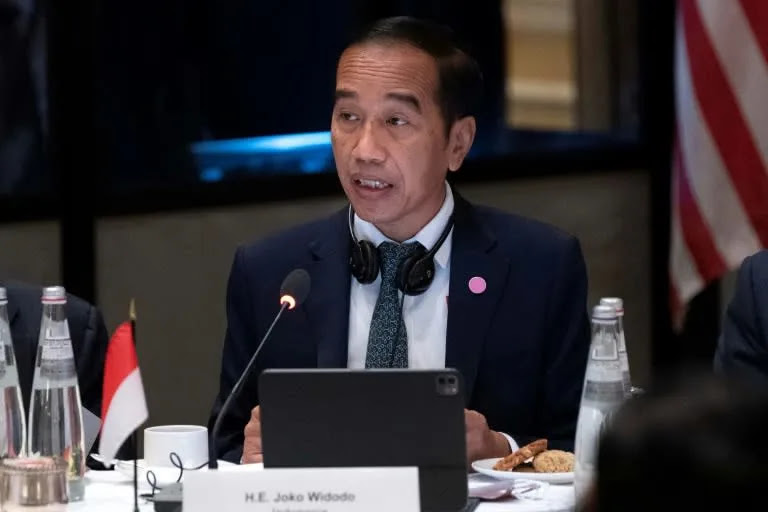
Indonesia executes six drug convicts, five of them foreigners

Indonesia executes six drug convicts, five of them foreigners
Widodo has pledged to bring reform to Indonesia

Ban appeals to Indonesia to stop death row executions

Ban appeals to Indonesia to stop death row executions
United Nations Secretary General Ban Ki-moon has pleaded to Indonesia to stop the execution of prisoners on death row for drug crimes. AFP PHOTO

Pope: 'Death penalty represents failure' – no 'humane' way to kill a person

Pope: 'Death penalty represents failure' – no 'humane' way to kill a person
The pope wrote that the principle of legitimate personal defense isn’t adequate justification to execute someone. Photograph: Zuma/Rex

Obama becomes first president to visit US prison (US Justice Systems / Human Rights)

Obama becomes first president to visit US prison   (US Justice Systems / Human Rights)
US President Barack Obama speaks as he tours the El Reno Federal Correctional Institution in El Reno, Oklahoma, July 16, 2015 (AFP Photo/Saul Loeb)

US Death Penalty (Justice Systems / Human Rights)

US Death Penalty (Justice Systems / Human Rights)
Woman who spent 23 years on US death row cleared (Photo: dpa)


.

.
"The Recalibration of Awareness – Apr 20/21, 2012 (Kryon channeled by Lee Carroll) (Subjects: Old Energy, Recalibration Lectures, God / Creator, Religions/Spiritual systems (Catholic Church, Priests/Nun’s, Worship, John Paul Pope, Women in the Church otherwise church will go, Current Pope won’t do it), Middle East, Jews, Governments will change (Internet, Media, Democracies, Dictators, North Korea, Nations voted at once), Integrity (Businesses, Tobacco Companies, Bankers/ Financial Institutes, Pharmaceutical company to collapse), Illuminati (Started in Greece, with Shipping, Financial markets, Stock markets, Pharmaceutical money (fund to build Africa, to develop)), Shift of Human Consciousness, (Old) Souls, Women, Masters to/already come back, Global Unity.... etc.) - (Text version)

… The Shift in Human Nature

You're starting to see integrity change. Awareness recalibrates integrity, and the Human Being who would sit there and take advantage of another Human Being in an old energy would never do it in a new energy. The reason? It will become intuitive, so this is a shift in Human Nature as well, for in the past you have assumed that people take advantage of people first and integrity comes later. That's just ordinary Human nature.

In the past, Human nature expressed within governments worked like this: If you were stronger than the other one, you simply conquered them. If you were strong, it was an invitation to conquer. If you were weak, it was an invitation to be conquered. No one even thought about it. It was the way of things. The bigger you could have your armies, the better they would do when you sent them out to conquer. That's not how you think today. Did you notice?

Any country that thinks this way today will not survive, for humanity has discovered that the world goes far better by putting things together instead of tearing them apart. The new energy puts the weak and strong together in ways that make sense and that have integrity. Take a look at what happened to some of the businesses in this great land (USA). Up to 30 years ago, when you started realizing some of them didn't have integrity, you eliminated them. What happened to the tobacco companies when you realized they were knowingly addicting your children? Today, they still sell their products to less-aware countries, but that will also change.

What did you do a few years ago when you realized that your bankers were actually selling you homes that they knew you couldn't pay for later? They were walking away, smiling greedily, not thinking about the heartbreak that was to follow when a life's dream would be lost. Dear American, you are in a recession. However, this is like when you prune a tree and cut back the branches. When the tree grows back, you've got control and the branches will grow bigger and stronger than they were before, without the greed factor. Then, if you don't like the way it grows back, you'll prune it again! I tell you this because awareness is now in control of big money. It's right before your eyes, what you're doing. But fear often rules. …
Showing posts with label War Crimes. Show all posts

Monday, June 27, 2022

Indonesian president to meet Zelensky and Putin to urge peace talks

Yahoo – AFP, 26 June 2022 


Indonesian President and G20 chairman Joko Widodo set off on Sunday to Europe where he said he plans to visit Russia and Ukraine and meet with the countries' leaders to urge peace talks. 

Widodo departed for Germany to attend as a guest for the G7 summit from June 26 to 27, and he will then go to the Ukraine capital Kyiv to meet President Volodymyr Zelensky. 

"The mission is to ask... President Zelensky to open a dialogue forum for peace, to build peace because the war has to be stopped," he told a press conference in Jakarta. 

The two leaders will also discuss the food supply chain "that needs to be reactivated" soon, Widodo said. From Kyiv, Widodo is scheduled to visit Moscow and meet with Russia's Vladimir Putin. 

The visit to Moscow is planned for June 30, Indonesian authorities said earlier. 

"With the same mission, I will ask President Putin to open a dialogue and to immediately have a ceasefire and to stop the war," he said. Earlier in April Widodo announced he had called Zelensky and invited him to join world leaders at G20 Summit in Bali in November 2022 as a guest. 

Indonesia holds the rotating presidency of the G20 this year and has been pressured by Western countries, led by the United States, to exclude Russia from the meeting. 

Widodo, however, did not rescind the invitation to Russia and said that Putin has expressed his intention to attend the November summit. 

Indonesia, like most major emerging economies, has tried to maintain a neutral position and has called for a peaceful resolution to the months-long conflict. 

Widodo refused to send weapons to Ukraine in response to a request from Zelensky, instead offering humanitarian aid. 

After concluding the European visit, Widodo will head to the United Arab Emirates before returning to Indonesia.

Saturday, April 9, 2022

Pink Floyd release first new song since 1994 for Ukraine

Yahoo – AFP, April 7, 2022 

David Gilmour: 'We, like so many, have been feeling the fury and the frustration of this vile
act of an independent, peaceful democratic country being invaded and having its people
murdered by one of the world's major powers' (AFP/JOHN D MCHUGH) (JOHN D MCHUGH)

Pink Floyd have written their first new song in almost 30 years to support Ukrainians, the band announced on Thursday. 

"Hey, Hey, Rise-Up!" will be released on Friday, and be used to raise funds for humanitarian causes linked to the war. 

It samples Andriy Khlyvnyuk, from one of Ukraine's biggest bands BoomBox, singing in Sofiyskaya Square in Kyiv in a clip that went viral. 

Khlyvnyukh abandoned a world tour to return to Ukraine and help defend his country. 

"We, like so many, have been feeling the fury and the frustration of this vile act of an independent, peaceful democratic country being invaded and having its people murdered by one of the world's major powers," Pink Floyd said on their official Twitter feed. 

In a press release, band leader David Gilmour said he had been moved by Khlyvnyuk's video: "It was a powerful moment that made me want to put it to music." 

He was able to speak with Khlyvnyuk from his hospital bed in Kyiv, where the singer was recovering after being hit by shrapnel in a mortar attack, the record company said. 

"I played him a little bit of the song down the phone line and he gave me his blessing. We both hope to do something together in person in the future," Gilmour said. 

The image accompanying the song is of a sunflower, and was inspired by a viral video showing a Ukrainian woman insulting two armed Russian soldiers. 

In it, she tells the soldiers: "Take these seeds and put them in your pockets. That way sunflowers will grow when you all rest here." 

It is the first original music from Pink Floyd since 1994's "The Division Bell". 

Gilmour tweeted his opposition to the war soon after Russia's invasion, saying: "Putin must go". 

The band has also pulled their music from Russian and Belarusian streaming sites in protest at the invasion.


Thursday, March 12, 2020

Building an equal partnership of mutual respect

The Jakarta Post, Retno LP Marsudi, Foreign Minister of Indonesia, Jakarta,March 11, 2020
President Joko Widodo (right) accompanied by First Lady Iriana Joko Widodo (second left)
and Dutch King Willem Alexander (second right) accompanied by Queen Maxima planting
trees during a state visit to Bogor Palace, West Java, Tuesday (10/3/2020). (Antara/
Sigid Kurniawan)

“The ongoing global economic and geopolitical volatility will not keep Indonesia and the Netherlands from advancing their long-standing cooperation” — that may be the right tone to begin the narrative on the state visit of King Willem-Alexander and Queen Maxima to Indonesia.

On Tuesday, President Joko “Jokowi” Widodo greeted the Dutch king and queen at Bogor Palace in West Java.

The visit sends the clear message that the two countries aspire to advance their ties going forward. It will surely create a new momentum for the Indonesian-Dutch partnership. The visit also instils not only increased confidence of Dutch investment in Indonesia but also strategic trust in the long run.

The visit produces numerous concrete deliverables in various sectors at the government-to-government as well as the business-to-business level. These include eight government initiatives in important sectors such as sustainable palm oil production, cooperation on infectious diseases control, waste management, the circular economy, water management, aviation cooperation, capacity-building of healthcare professionals, as well as women, peace and security.

On the business side, the king’s 190-strong business delegation has met with hundreds of Indonesian business counterparts and concluded investment and business deals amounting to US$1 billion. These include agreements on dairy products, oil and gas, agriculture, infrastructure and renewable energy.

However, these achievements did not come overnight. In fact, in the last seven decades, both sides have taken significant steps to strengthen bilateral ties.

I was the Indonesian ambassador in The Hague in 2013, when Indonesia and the Netherlands signed a joint declaration on a comprehensive partnership that laid out the modalities for concrete cooperation. This was an important building block to mature our bilateral cooperation into what we have today and what we will harvest tomorrow.

After more than 70 years, it is undeniable that the bond between the two countries has had its share of challenges. While we cannot deny the past of Indonesia-Netherlands relations, we can choose to fully capitalize on the potential of future cooperation for the benefit of both nations.

Read also: A time to remember

Therefore, the goal for our shared future must be clear, which is pursuing a forward-looking partnership that really benefits both countries and peoples.

There are three things that the two countries should advance together to attain common goals for a solid and mutually beneficial partnership.

First and fundamentally, both countries must remain committed to the common values of mutual respect and principles of sovereignty and territorial integrity.

Second, the Indonesian-Dutch partnership must produce long-term and concrete economic benefits for our two peoples.

The Netherlands is and should continue to be Indonesia’s strategic partner for trade and investment. In 2019, the Netherlands was Indonesia’s largest investment partner in the European region, the second-largest trading partner and the fourth-largest tourism partner.

Our political solidarity in furthering the common cause of sustainability is also strong. In promoting sustainable palm oil in Europe, for instance, it is evident that we can rely on the Netherlands as our friend. Last year, together with my colleague, Sigrid Kaag, the Dutch minister for foreign trade and cooperation development, we signed a memorandum of understanding (MoU) on joint production of sustainable palm oil in New York, the United States. King Willem-Alexander’s current visit has also brought an impetus toward the progression of sustainable production of palm oil through the conclusion of a technical arrangement that will focus on capacity-building for Indonesian smallholder farmers.

This is a good reflection of how trust is an important pillar of bilateral cooperation, as also exemplified through the Netherlands’ support in the establishment of the Indonesia-European Union Voluntary Partnership Agreement on Forest Law Enforcement, Governance and Trade in 2016.

Third, Indonesia and the Netherlands must continue to promote the universal common values of multilateralism, diplomacy and democracy, promoting habits of dialogue and peaceful dispute settlement to tackle shared global challenges amid rising tensions, intolerance and unilateralism.

Peacekeeping and counterterrorism are among our signature areas of collaboration on the world stage.

Indonesia and the Netherlands were among the core countries facilitating and supporting the Untied Nations' secretary-general’s Action for Peacekeeping (A4P) initiative to rally member states and other crucial stakeholders to fulfil their obligation in strengthening UN peacekeeping operations.

Both nations also need to stand shoulder to shoulder in the global fight against terrorism and violent extremism.

Deepening the promotion of democracy, pluralism and tolerance are other important areas of cooperation to further develop. The Bali Democracy Forum could become the platform to jointly advance these shared values.

Women, peace and security shall be another hallmark of our bilateral cooperation. The partnership aspires to deepen the capacity of women to promote peace and security, in line with the formation of the ASEAN Women Mediators Network and the Afghanistan-Indonesia Women Network last March.


In conclusion, another historical step was taken with the king of the Netherlands’ visit to Indonesia, in the very year when Indonesia celebrates its 75th year of independence.

The history binding our two countries together is not an easy one. This dark period should not be repeated in the future.

King Alexander stated that “today, we warmly congratulate the people of Indonesia as you celebrate 75 years of independence. The past cannot be erased and will have to be acknowledged by each generation in turn.” King Alexander also expressed his regret and apologized for excessive violence on the part of the Dutch in those years.

Let us together build a better and stronger relationship, one that is based on mutual respect and mutual interests.

Disclaimer: The opinions expressed in this article are those of the author and do not reflect the official stance of The Jakarta Post.

King Willem-Alexander and Indonesian president Joko Widodo. Photo: AP Photo/
Achmad Ibrahim, Pool 

Related Articles:


From left, Dutch Queen Máxima Zorreguieta Cerruti, Dutch King Willem-Alexander, 
President Joko Widodo and Education and Culture Minister Nadiem Makarim observe 
Prince Diponegoro's golden kris at the Bogor Palace in Bogor, West Java, on Tuesday. 
(Antara Photo/Sigid Kurniawan)

Tuesday, March 10, 2020

Dutch King Returns Prince Diponegoro's Golden Kris to Jokowi

Jakarta Globe, 10 March 2020

From left, Dutch Queen Máxima Zorreguieta Cerruti, Dutch King Willem-Alexander, 
President Joko Widodo and Education and Culture Minister Nadiem Makarim observe 
Prince Diponegoro's golden kris at the Bogor Palace in Bogor, West Java, on Tuesday. 
(Antara Photo/Sigid Kurniawan)

Jakarta. After nearly two centuries, a golden kris belonging to Indonesia's national hero Prince Diponegoro was returned by the Dutch King Willem-Alexander, here on a three-day state visit with Queen Máxima and a 130-strong delegation, to President Joko "Jokowi" Widodo at the Bogor Palace on Tuesday.

The golden kris was placed in a glass box not far from the podium where President Jokowi and King Willem-Alexander held a joint press statement.

Education and Culture Minister Nadiem Makarim was seen explaining how the golden kris came into Dutch hands to the President and the King.

The Dutch government had returned several of Prince Diponegoro's belongings in 1968, but the golden kris was not included. 

The kris was reportedly lost but was later found at the Volkenkunde Museum in Leiden.

A team of Dutch and Indonesian researchers has confirmed the authenticity of the golden kris.

Prince Diponegoro was a Javanese royal, the eldest son of Sultan Hamengkubuwono III of Yogyakarta, who led a crusade against Dutch colonial rule in the 1825-1830 Java War.

The war, in which 200,000 people died including 8,000 Dutch, ended with the prince's capture on March 28, 1830.

His famous golden kris was seized by the Dutch government during his famous capture when he was tricked into a fake negotiation – the subject of one of Indonesian painter Raden Saleh's most well-known paintings.

Colonel Jan-Baptist Cleerens gave Prince Diponegoro's golden kris as a gift to King Willem I in 1831.

Apart from returning the heirloom to Indonesia, the Dutch royal visit is intended to increase bilateral cooperation between Indonesia and the Netherlands.

"This is an excellent opportunity to work together for a future relationship between Indonesia and the Netherlands," King Willem-Alexander said.


Dutch monarch offers apology for past ‘excessive violence’

The Jakarta Post, Marchio Irfan Gorbiano, March 10, 2020

Dutch King Willem-Alexander (second right) and Queen Maxima (right) return after
laying a wreath during their visit to the Heroes Cemetery in Jakarta on March 10.
King Willem-Alexander and Queen Maxima of the Netherlands are on a five-day
visit to Indonesia, a former Dutch colony. ( AFP/BAY ISMOYO)

Dutch King Willem-Alexander has offered an apology over "excessive violence" suffered by Indonesians during the early years of Indonesian independence, acknowledging the period as a "painful separation".

The statement was conveyed by the king after he and Queen Maxima were hosted by President Joko "Jokowi" Widodo in an official ceremony at the Bogor Palace in West Java on Tuesday.

"In line with earlier statements by my government, I would like to express my regret and apologies for the excessive violence on the part of the Dutch in those years," Willem said during a joint press statement on Tuesday.

"And I do so in the full realization that the pain and sorrow of the families affected continue to be felt today."

Willem's statement reversed previous Dutch monarchs’ stance of refusing to apologize for the nation’s past war crimes in the country. During the last state visit by a Dutch monarch in 1995, Queen Beatrix was prevented by then-prime minister Wim Kok from offering an apology, saying the Netherlands was not ready.

Indonesia declared independence on Aug. 17, 1945, but the Dutch only recognized its sovereignty on Dec. 27, 1949.

The Dutch government had apologized several times for its colonial troops’ war crimes conducted between 1945 and 1949 in Indonesia.

In 2013, then-Dutch ambassador to Indonesia Tjeerd de Zwaan addressed an apology to 10 widows of men who were summarily executed in a series of mass killings in South Sulawesi between December 1946 and February 1947 during military operations by Dutch troops under Raymond Pierre Paul Westerling.

The king’s four-day state visit kicked off on Tuesday. It went ahead despite the recent announcement of 19 confirmed COVID-19 cases in Indonesia.

The Dutch king also expressed his desire to see a stronger tie between Indonesia and the Netherlands.

"Indonesia has a long tradition of religious tolerance and can play a constructive part in this respect. It's important to continue working together to foster peace, justice and the protection of minorities based on respect for sovereignty and territorial integrity," King Willem-Alexander said.

"And we are keen to work together with you toward this end."

Speaking before Willem, Jokowi emphasized the need for the two countries to forge ahead in a relationship of mutual respect.

"Of course, we cannot erase the history, but we can learn from the past. It serves as a lesson for our commitment to grow a relationship that is equal and with mutual respect and mutually-beneficial," the President said.

Wednesday, December 12, 2018

US returns war trophy bells to Philippines

Yahoo – AFP, Ayee Macaraig, December 11, 2018

The bells will be sent back later this week to the church in the central town of
Balangiga where they were looted by US soldiers avenging a surprise attack that
killed 48 of their comrades on September 28, 1901 (AFP Photo/TED ALJIBE)

Manila (AFP) - Church bells seized from the Philippines by US troops as war trophies over a century ago were returned on Tuesday, in a bid to turn the page on a difficult chapter between the historical allies.

Giving back the three so-called Balangiga bells meets a decades-old demand from the former US colony at a time when the two nations' ties have been rattled by President Rodrigo Duterte's pivot to China.

"Returning these bells is the right thing to do," US Ambassador Sung Kim said at a sober handover ceremony on a Manila airfield, where a cheer went up when the bells were pulled from wooden crates.

"It is my great honour to be here at the closing of a painful chapter in our history," he told the crowd that included people who had lobbied for years to bring the bells home.

Residents from Balangiga town pose for photos next to one of the three 
Balangiga church bells shortly after it arrived (AFP Photo/TED ALJIBE)

The bells will be sent back later this week to the church in the central town of Balangiga where they were looted by US soldiers avenging a surprise attack that killed 48 of their comrades on September 28, 1901.

In reprisal, the US commander Jacob Smith ordered the surrounding island of Samar be turned into a "howling wilderness", resulting in the slaughter of thousands of Filipinos and Balangiga's razing.

The return of the bronze bells has been divisive with some US veterans and lawmakers, who see them as a tribute to fallen American troops, while the Philippines hails them as a symbol of its struggle for independence.

Two of the bells had been on display in the US state of Wyoming and the other in South Korea until being restored and flown to a Manila air base Tuesday aboard an American military cargo plane.

The bells were flown to a Manila Tuesday aboard an American military cargo
plane (AFP Photo/TED ALJIBE)

'Ring again after 117 years'

"It is time for healing. It is time for closure. It is a time to look ahead as two nations should with shared history and as allies," Philippine secretary of defence Delfin Lorenzana said.

"After 117 years the sound of the bells will once again ring," he added.

Manila's push for the bells' repatriation began in the 1990s and has had backing from Philippine presidents as well as from the Catholic Church and historians, but also supporters in the US.

Duterte, 73, bluntly called on Washington in a 2017 speech -- where Kim was in the audience -- "Give us back those Balangiga bells. They are not yours."

Within months of winning the presidency in mid-2016 he signalled his intention to split with the Philippines' former colonial master and end a standoff with Beijing over the disputed South China Sea.

Philippine's Ambassador to the US Jose Romualdez visited the bells at a 
Wyoming air base with US Defense Secretary James Mattis earlier this year, 
after the US announced they would be returned (AFP Photo/Braydon Williams)

The president did not attend Tuesday's handover, but is due to speak at a ceremony Saturday in Balangiga when the bells -– which weigh a combined 408 kilograms (900 pounds) -– will be given back to the church.

Salvador Panelo, the president's spokesman, claimed a lot of the credit for Duterte, pointing to his "strong political will". However, experts said the process had been complicated.

"No single president can claim credit to it," Francis Gealogo, history professor at the Ateneo de Manila University, told AFP. "The credit should be given to the Filipino people who campaigned vigorously and actively."

A key factor was also major American veterans' associations, including the largest group Veterans of Foreign Wars, dropping their opposition to the bells being given back.


Tuesday, December 12, 2017

US man on the run after escaping notorious Bali prison

Yahoo – AFP, December 11, 2017

The pair made a break from the Indonesian resort island's main prison by cutting a
hole in the roof with a hacksaw, authorities said. It was not clear how they obtained
the tool (AFP Photo/SONNY TUMBELAKA)

Denpasar (Indonesia) (AFP) - A US man convicted on drugs charges escaped Bali's notorious Kerobokan jail in an early Monday morning jailbreak with another American prisoner who was caught almost immediately, an official said.

The pair made a break from the Indonesian resort island's main prison by cutting a hole in the roof with a hacksaw, authorities said. It was not clear how they obtained the tool.

Police are now scouring the palm-fringed island and handing out pictures of escapee Chrishan Beasley, a 32-year-old arrested in August for carrying five grams of hashish.

Foreigners are regularly arrested for drugs offences on Bali.

Beasley was awaiting a sentencing in his case. It was not immediately clear how much jail time he was facing, but Indonesia has some of the world's toughest drugs laws, with the death penalty available in some trafficking cases.

Beasley's accomplice in the escape, convicted thief Paul Anthony Hoffman, 57, was apprehended before he could make good on the escape.

"Paul was immediately recaptured by the locals who saw him trying to escape while Chrishan, who climbed up before him, managed to run away," Kerobokan chief warden Tonny Nainggolan told AFP.

Hoffman is serving a 20-month sentence for robbing a number of convenience stores at knifepoint.

Kerobokan houses some of the country's most notorious and high-profile inmates, including members of the so-called Bali Nine which plotted to bring heroin into Australia via Bali. Two members of the group have been executed.

Jailbreaks are common in Indonesia, where inmates are often held in unsanitary conditions at overcrowded and poorly guarded prisons.

In May, more than 200 inmates staged a mass breakout from an overcrowded prison on Sumatra island, while last year a convicted child murderer escaped from jail by putting on a woman's Muslim veil, make-up and sunglasses and walking out past unsuspecting guards.

Saturday, April 1, 2017

Children of Indonesian men executed by Dutch demand damages

DutchNews, March 31, 2017

More than 500 children of men executed in Indonesia during the independence war of 1946 to 1949 are preparing damages claims against the Dutch state, the AD said on Friday. 

Lawyer Liesbeth Zegveld has sent a list of 520 names to the defence and foreign affairs ministries, urging the state to settle their claims out of court, the paper said. 

She wants the government to agree to give the children damages the same rights as the widows of the men killed. They are able to make an uncontested claim for damages, outside the courts. 

The state, however, has said it wants to wait until the outcome of a test case brought by the children of men executed in southern Sulawesi. A lower court ruled in 2015 that they are entitled to compensation like their mothers. 

The Dutch military interventions in Indonesia, or Dutch Indies as it was known then, followed the proclamation of the independent Republic of Indonesia in 1945 and lasted until the country formally gained independence in 1949 after a bloody struggle. 

At the end of 2011, the Netherlands finally formally apologised for the massacre of hundreds of men and boys in the Javanese village of Rawagede in 1947. 

Last year, the Dutch government agreed to set up a major inquiry into the structural use of violence in Indonesia.

Related Article:


Saturday, December 3, 2016

Dutch cabinet agrees to fund research into violence in Indonesia

DutchNews, December 2, 2016

The Dutch government has agreed to finance a major investigation into the structural use of violence during the end of Dutch rule in its former colonies in Indonesia. 

Ministers agreed on Friday to fund the project after new research indicated that extreme violence, including torture and executions, were normal during the colonial wars, which ran from 1945 to 1949. 

In a statement, the cabinet said it realises that the research could ‘cause pain to soldiers who served in Indonesia’. 

However, it is important that the research takes into account the ‘difficult circumstances most veterans operated in, the violence on the Indonesia side…. and the responsibilities of the political, administrative and military leadership.’ 

During the battle for independence, some 100,000 Indonesians and almost 5,000 Dutch nationals died. According to the Telegraaf, the ruling VVD only agreed to back the research if violence by both the Dutch and the Indonesians came under the spotlight. 

Report

‘Dutch soldiers left a trail of burning kampongs and piles of bodies throughout the Indonesian archipelago,’ Swiss-Dutch historian Rémy Limpach said in his report, which was published in September. 

Until now, the official line had been that there were only isolated incidents of excessive violence.

‘The Netherlands has always had difficulty with this dark side of its own history,’ Socialist MP Harry van Bommel told the Volkskrant on Friday. ‘But I think this research is the start of a road towards recognition. It is primarily about political responsibility.’ 

Bloody struggle 

The Dutch military interventions in Indonesia, or Dutch Indies as it was known then, followed the proclamation of the independent Republic of Indonesia in 1945 and lasted until the country formally gained independence in 1949 after a bloody struggle. 

At the end of 2011, the Netherlands finally formally apologised for the massacre of hundreds of men and boys in the Javanese village of Rawagede in 1947. 

The Netherlands has also been ordered in court to pay compensation in connection with a bloodbath in southern Sulawesi. 

The research will be carried out by three Dutch institutes who submitted a specific research proposal in 2012, but failed to secure funding, the Telegraaf said. 

Friday, November 18, 2016

Indonesia says not to blame for missing WWII shipwrecks

Yahoo – AFP, Dessy Sagita, November 17, 2016

The Dutch and Indonesian naval commanders laid a wreath during a 2014 ceremony
 to commemorate the 1150 sailors who died in the Battle of the Java Sea in
1942 (AFP Photo)

Jakarta (AFP) - Indonesia refused to take the blame Thursday for the disappearance of at least six British and Dutch World War II shipwrecks -- considered war graves -- that investigators believe could have been salvaged for scrap.

Former colonial ruler The Netherlands has launched a probe into how three Dutch navy ships seemingly vanished from the bed of the Java Sea, while Britain has urged Indonesia to investigate what has happened to three of its vessels.

It is believed the military wrecks -- lost in 1942 during the Battle of the Java Sea -- were removed by illegal scavengers looking for scrap metal, an effort that could have taken years.

More than 900 Dutch and 250 Indo-Dutch sailors died during the battle in which the Allied navies suffered a disastrous defeat by the Imperial Japanese Navy.

Indonesian authorities have sought to distance themselves from the mystery, saying they could not be expected to protect the sites without assistance.

"The Dutch government cannot blame the Indonesian government because they never asked us to protect those ships," said Bambang Budi Utomo, head of the National Archeological Centre under the Ministry of Education and Culture.

"As there was no agreement or announcement, when the ships go missing, it is not our responsibility."

Amateur divers in 2002 discovered the long-lost wrecks of three Dutch ships, 60 years after they sank while in action against Japanese forces.

But an international expedition that sailed to the wreck site ahead of next year's 75th anniversary of the battle was shocked to discover the wrecks had vanished.

Britain expressed its distress at the disappearance of its own warships and asked Indonesia to "take appropriate action" to protect the sites from further disturbance.

But Utomo said Indonesia did not have the resources to maintain a constant patrol over its vast archipelago, a hotspot for other criminal enterprises like illegal fishing and people smuggling.

Row over naval war graves (AFP Photo)

'Looters are fearless'

Treasure hunters and scrap collectors are lured to Indonesia's relic-rich seas, experts say, where countless vessels have gone to a watery grave over centuries of trade, colonial conquest and war.

"Looting is really huge, not only on these World War II shipwrecks, but also on ancient shipwrecks," said Veronique Degroot, a Jakarta-based archaeologist.

The prize find for scavengers targeting the warships would be the huge bronze propellers used to power these juggernauts -- a far more lucrative find than iron or other scrap, according to Utomo.

"The looting must have been going on for years for such a huge ship to disappear," he said.

"Looters are fearless," he added, saying that divers risked death and injury sucking air through tubes to retrieve valuable scrap and antiquities, taking the wreck apart piece by piece.

While some larger, commercial operations use cranes and platforms to wrench heavy loads from the seabed, smaller ventures keep a low profile as they ship metal to scrapyards along Indonesia's thousands of kilometres of coastline.

Australia has been working closely with Indonesia to protect HMAS Perth -- which sunk off Java in World War II, claiming hundreds of lives -- after discovering in 2013 that the warship was being plundered for brass.

A spokesman for the Indonesian navy said the missing ships should not have been disturbed as they were war graves.

"However, the Indonesian navy cannot monitor all areas all the time," spokesman Gig Jonias Mozes Sipasulta told AFP.

"If they ask why the ships are missing, I'm going to ask them back, why didn't they guard the ships? They should have been more proactive."

Naval warships and war graves are protected under international law that makes the desecration of such shipwrecks illegal.


The HNLMS Kortenaer in the 1930s

Related Articles:


Thursday, January 28, 2016

Court says Dutch state must compensate woman for rape 67 years ago Crime

DutchNews, January 27, 2016

Photo: Depositphotos.com
The Dutch state has been ordered to pay compensation to an Indonesian woman who was raped by several Dutch soldiers in 1949, when Indonesia was still under Dutch rule.

The woman, who was 18 at the time, will receive €7,500 in what is thought to be the first successful compensation claim for a war crime other than execution.

The court in The Hague said there was sufficient proof that the woman had been raped by several soldiers at gunpoint in the run up to independence. 

In addition, the court said the state cannot appeal against the ruling on the basis that it is too old, even though the rapes took place almost 70 years ago. 

Other rulings

Last year, judges in The Hague said the Netherlands must pay compensation to the children and widows of men executed in South Sulawesi without trial by Dutch soldiers in 1946 and 1947. The claims are still being looked into. 

The Dutch military interventions in Indonesia, or Dutch Indies as it was known then, followed the proclamation of the independent Republic of Indonesia in 1945 and lasted until the country formally gained independence in 1949 after a bloody struggle. 

Thousands of Indonesian independence fighters were executed by the Dutch. At the end of 2011, the Netherlands finally formally apologised for the massacre of hundreds of men and boys in the Javanese village of Rawagede in 1947. Those widows, too, have been given compensation.