Indonesia executes six drug convicts, five of them foreigners

Indonesia executes six drug convicts, five of them foreigners
Widodo has pledged to bring reform to Indonesia

Ban appeals to Indonesia to stop death row executions

Ban appeals to Indonesia to stop death row executions
United Nations Secretary General Ban Ki-moon has pleaded to Indonesia to stop the execution of prisoners on death row for drug crimes. AFP PHOTO

Pope: 'Death penalty represents failure' – no 'humane' way to kill a person

Pope: 'Death penalty represents failure' – no 'humane' way to kill a person
The pope wrote that the principle of legitimate personal defense isn’t adequate justification to execute someone. Photograph: Zuma/Rex

Obama becomes first president to visit US prison (US Justice Systems / Human Rights)

Obama becomes first president to visit US prison   (US Justice Systems / Human Rights)
US President Barack Obama speaks as he tours the El Reno Federal Correctional Institution in El Reno, Oklahoma, July 16, 2015 (AFP Photo/Saul Loeb)

US Death Penalty (Justice Systems / Human Rights)

US Death Penalty (Justice Systems / Human Rights)
Woman who spent 23 years on US death row cleared (Photo: dpa)


.

.
"The Recalibration of Awareness – Apr 20/21, 2012 (Kryon channeled by Lee Carroll) (Subjects: Old Energy, Recalibration Lectures, God / Creator, Religions/Spiritual systems (Catholic Church, Priests/Nun’s, Worship, John Paul Pope, Women in the Church otherwise church will go, Current Pope won’t do it), Middle East, Jews, Governments will change (Internet, Media, Democracies, Dictators, North Korea, Nations voted at once), Integrity (Businesses, Tobacco Companies, Bankers/ Financial Institutes, Pharmaceutical company to collapse), Illuminati (Started in Greece, with Shipping, Financial markets, Stock markets, Pharmaceutical money (fund to build Africa, to develop)), Shift of Human Consciousness, (Old) Souls, Women, Masters to/already come back, Global Unity.... etc.) - (Text version)

… The Shift in Human Nature

You're starting to see integrity change. Awareness recalibrates integrity, and the Human Being who would sit there and take advantage of another Human Being in an old energy would never do it in a new energy. The reason? It will become intuitive, so this is a shift in Human Nature as well, for in the past you have assumed that people take advantage of people first and integrity comes later. That's just ordinary Human nature.

In the past, Human nature expressed within governments worked like this: If you were stronger than the other one, you simply conquered them. If you were strong, it was an invitation to conquer. If you were weak, it was an invitation to be conquered. No one even thought about it. It was the way of things. The bigger you could have your armies, the better they would do when you sent them out to conquer. That's not how you think today. Did you notice?

Any country that thinks this way today will not survive, for humanity has discovered that the world goes far better by putting things together instead of tearing them apart. The new energy puts the weak and strong together in ways that make sense and that have integrity. Take a look at what happened to some of the businesses in this great land (USA). Up to 30 years ago, when you started realizing some of them didn't have integrity, you eliminated them. What happened to the tobacco companies when you realized they were knowingly addicting your children? Today, they still sell their products to less-aware countries, but that will also change.

What did you do a few years ago when you realized that your bankers were actually selling you homes that they knew you couldn't pay for later? They were walking away, smiling greedily, not thinking about the heartbreak that was to follow when a life's dream would be lost. Dear American, you are in a recession. However, this is like when you prune a tree and cut back the branches. When the tree grows back, you've got control and the branches will grow bigger and stronger than they were before, without the greed factor. Then, if you don't like the way it grows back, you'll prune it again! I tell you this because awareness is now in control of big money. It's right before your eyes, what you're doing. But fear often rules. …
Showing posts with label Taiwan. Show all posts

Tuesday, December 31, 2019

Asia's first LGBT-focused streaming service tackles taboos

Yahoo – AFP, Catherine Lai, December 30, 2019

GagaOOLala brings more than 1,000 feature films, shorts, web series, and
documentaries to people across Asia, where censorship and traditional attitudes
mean there has been little in the way of gay content in the mainstream
media (AFP Photo/Roslan RAHMAN)

Singapore (AFP) - A rom-com about a lesbian flight attendant and a romance in a gay spa are among the shows featured on Asia's first LGBT-focused streaming service, which is pushing boundaries in an often highly conservative region.

GagaOOLala brings more than 1,000 feature films, shorts, web series, and documentaries to people across Asia, where censorship and traditional attitudes mean there has been little in the way of gay content in the mainstream media.

After launching in 2017 in Taiwan, a beacon for gay rights since becoming the first place in Asia to legalise same-sex marriage, it has expanded to 21 territories including several that still criminalise homosexuality.

"One of the main impetuses for me to create GagaOOlala, (is) to kind of dispel a lot of the myths and misconceptions that a lot of people might have about LGBT people," said Jay Lin, a prominent LGBT rights activist in Taiwan who founded the platform.

"We're not all living really tragic lives -- we're entrepreneurs, we're fathers," the 46-year-old, who is raising twin boys with his partner in Taipei, told AFP.

With about 280,000 members, made up mainly of gay people but also including a significant number of straight women, its success comes as some progress is made on LGBT rights in parts of the region.

As well as Taiwan's move to legalise same-sex unions in May, India's Supreme Court last year struck down a colonial-era ban on gay sex.

Dire rights situation

But the gay rights situation remains dire in other countries where the platform operates -- making its presence in those markets all the more important, supporters say.

Gay sex is still banned in Singapore as it is in Malaysia, where in the past year women and men have been caned under Islamic laws for having same-sex relations.

The tiny, oil-rich sultanate of Brunei introduced death by stoning for gay sex as part of a harsh new sharia penal code earlier this year –- but later rolled it back following a storm of criticism.

Censorship also persists in some countries, with Malaysia's film board this year cutting gay sex scenes from "Rocketman", the movie-musical based on the life of British singer Elton John.

The platform -- which is planning a global launch next year -- has not run into any regulatory hurdles so far, according to Lin, but he acknowledged the need to tread carefully in more conservative places.

The service often relies on closed chat groups, social media and LGBT influencers for promotion instead of advertising openly.

Lin's team started by building up GagaOOlala's library with Western content, but has since branched out, making an effort to find content from across Asia.

Earlier this year GOL Studios, a sister platform, was launched to help LGBT filmmakers find talent and funding, as well as distribute and market their work.

Homegrown content

The platform ramped up its production of original content this year, making its first Thai film, its first lesbian feature film in Japan and a Germany-Spain co-production.

"As we have developed..., we have realised that actually a lot of Asians also want to see Asian faces, and watch Asian stories and watch films take place in places or cities that they're familiar with," said Lin.

For streamers focusing on niche areas like GagaOOLala, original shows are key to building their brands.

Lin said interest in the platform jumped after the recent release of the "Handsome Stewardess", a series about a Taiwanese, tomboyish lesbian who takes a job as a flight attendant to pursue her new love interest to Singapore.

"The Teacher", another original about a gay educator who is in love with an HIV-positive married man, also proved a hit, bagging best supporting actress at the Golden Horse awards, dubbed the Chinese-language "Oscars".

GagaOOlala is not alone in relying on original content to draw in viewers and boost its profile.

Bryan Seah, head of original productions at Southeast Asia-focused streamer Hooq, said people felt "pride" at seeing local performers on screen.

Viewers were sending a message that "I want to see my favourite Indonesian actor, I want to see my favourite Filipino director, fronting something that has the scale and ambition to match the best Korean content", he said.

Wednesday, May 22, 2019

Hong Kong transport authorities approve LGBT ad after backlash

Yahoo – AFP, May 21, 2019

Campaigners have criticised Hong Kong for lagging behind on equality issues
(AFP Photo/Yan ZHAO)

A Cathay Pacific advert featuring two men holding hands can now be displayed across Hong Kong's transport network, after its reported ban sparked a public outcry.

Hong Kong newspaper South China Morning Post reported Monday that the city's airport and MTR train operator had barred the gay-friendly ad from its crowded terminals, citing sources.

The news emerged just after Taiwan's parliament legalised same-sex marriage last week in a landmark first for Asia, placing the island at the vanguard of the region's burgeoning gay rights movement.

By contrast, campaigners have criticised semi-autonomous Hong Kong for lagging behind on equality issues.

Neither Cathay Pacific nor the transport authorities directly confirmed or denied the ban which triggered a massive backlash.

LGBT group Big Love Alliance launched a campaign on Monday encouraging Hong Kongers to share on social media photos of themselves holding hands with their same-sex partners or friends at the airport or the MTR.

As public pressure mounted, airport authorities said on Tuesday the advert now had their full blessing.

The ad is deemed "not in infringement of the Airport Authority's established guidelines on advertisements displayed in the terminal", a spokesperson said in a statement.

JCDecaux, an agency that handles advertising bookings for the MTR Corporation, also appeared to have reversed course.

"We have advised... that the design can be posted at MTR stations," a JCDecaux spokeswoman in Hong Kong told AFP.

Ray Chan, Hong Kong's first openly gay lawmaker, welcomed the move saying public and media pressure have made transport officials and their advertising agencies "right their wrong".

The city airport is operated by a Hong Kong government body, while the MTR Corporation is majority-owned by the government.

Hong Kong does not recognise same-sex marriage or civil unions and only decriminalised homosexuality in 1991.

But a British lesbian won the right to live and work in Hong Kong with her partner in a landmark ruling last year hailed by rights groups.

A separate case has been lodged by two Hong Kong men directly challenging the same-sex marriage ban as unconstitutional.

Related Articles:

Taiwan parliament to vote on Asia's first gay marriage bill

Yahoo – AFP, May 16, 2019

Taiwan's top court has ruled that not allowing same-sex couples to marry
violates the constitution (AFP Photo/Chris STOWERS)

Taiwan will decide whether to pass Asia's first gay marriage law on Friday as conservative lawmakers launch a last-ditch attempt to scupper the bill despite a court ruling ordering same-sex marital equality.

Protesters on both sides of the debate will gather outside Taipei's parliament for what looks set to be a mammoth legislative debate over an issue that has bitterly divided the island.

Parliament is up against a ticking clock.

Taiwan's top court has ruled that not allowing same-sex couples to marry violates the constitution. Judges gave the government two years to make necessary changes by May 24, 2019 or see marriage equality enacted automatically.

With that deadline fast approaching, three bills have been tabled for Friday -- which also happens to be the International Day Against Homophobia, Transphobia and Biphobia.

The most progressive is the government's bill, the only one to use the word "marriage" and offer limited adoption rights.

Opponents warn that "forcefully" passing a gay marriage law will intensify 
tensions (AFP Photo/Daniel Shih)

It is backed -- begrudgingly -- by gay rights groups who see it as the closest thing to full equality with heterosexual couples, despite its limitations.

Opponents have tabled two other versions which avoid the word marriage, offering something closer to same-sex unions with no adoption rights.

Conservative and religious groups have been buoyed by a series of referendum wins in November, in which voters comprehensively rejected defining marriage as anything other than a union between a man and a woman.

President Tsai Ing-wen has said the government's bill respects both the court judgement and the referendum.

"I hope everybody can be considerate and tolerate different opinions to show Taiwan is a mature civil society that is capable of handling a divisive issue," she said on Tuesday.

Tsai's ruling Democratic Progressive Party (DPP) holds the majority in parliament, occupying 68 out of 113 seats.

Taiwan's LGBT community has been left in limbo 
the last two years (AFP Photo/SAM YEH)

But there is no guarantee her own lawmakers will vote for the more progressive bill, especially as many fear being punished by conservative voters at the ballot box in January.

One of the rival bills was proposed by a DPP lawmaker.

Taiwan's LGBT community has been left in limbo the last two years, with many couples planning weddings ahead of the May 24th deadline but unsure of what marriage equality will look like.

"We will have a clear answer this week about how this country will treat gay couples in the future," said Jennifer Lu, a spokeswoman for Marriage Equality Coalition Taiwan.

"The cabinet's bill is already a discounted version but it covers the most for now. The other bills are not only unconstitutional but discriminatory."

Opponents warn that "forcefully" passing a gay marriage law will intensify tensions.

"The cabinet's bill ignores the referendum results and that is unacceptable," said Lai Shyh-bao of the opposition Kuomintang party, who proposed one of the bills backed by conservatives.

Related Article:


Monday, August 31, 2015

Higher wages in store for foreign caregivers in Taiwan

Want China Times, CNA 2015-08-30

Foreign caregivers at a park in Taipei, March 30. (Photo/Fang Chun-che)

Foreign caregivers planning to work in Taiwan will receive a monthly wage of NT$17,000 (US$525) beginning on Sept. 1, the country's labor minister Chen Hsiung-wen announced on Friday.

That represents an increase of NT$1,160 (US$35), or 7.32%, from the current monthly wage of NT$15,840 (US$490), which has been the fixed rate for the past 18 years.

In contrast to the minimum monthly wage of NT$20,008 (US$617.34) for workers in Taiwan, which has increased 26% during the period, Chen said the 7.32% raise was reasonable.

Foreign nationals working as domestic caregivers in Taiwan are not covered under Taiwan's Labor Standards Act and therefore not entitled to the statutory minimum wage.

The higher monthly wage will only be applied, however, to new applicants from Indonesia, the Philippines, Thailand and Vietnam, and not to those already working in Taiwan.

With the monthly pay for migrant domestic helpers in Hong Kong and Macau at NT$16,530 (US$510), Taiwan hopes that the wage increase can attract quality domestic helpers to work in the country, Chen said, after a meeting with officials from the four Southeast Asian countries earlier in the day.

Indonesia and the Philippines, the two countries that provide the most migrant domestic helpers in Taiwan, have pressed Taiwan for months to increase the wages for their workers to NT$17,500 (US$540) per month, and have been holding back new workers from employers unwilling to pay that amount.

It was not immediately clear if the new wage settled the differences between Taiwan and the two countries.

But Agusdin Subiantoro, deputy director of Indonesia's National Agency for the Placement and Protection of Indonesian Migrant Workers, told CNA on Thursday that Indonesia and Taiwan had reached the agreement to increase migrant caregivers' pay to NT$17,000 (US$525) after rounds of negotiations.

Groups of manpower brokers called for the ministry on Friday afternoon to require incoming migrant workers to have HIV/AIDS testing and pregnancy tests done.

But the Labor Ministry said that considering international human rights conventions and workplace gender equality, those tests should not be requirements for those workers.

Related Article:


Tuesday, June 16, 2015

The Unbearable Irreversibility of the Death Penalty

A global trend away from the use of the death penalty for drug-related offenses means countries that do carry out executions are on the extreme fringe, a minority on the world stage

Supporters of Australians on death row in Indonesia Andrew Chan and Myuran
 Sukumaran light candles during a vigil at Martin Place in Sydney on April 28,
2015. The two were executed by firing squad hours later. (AFP Photo/Saeed Khan)

Kuala Lumpur. Chen Chin-Hsien walked up on stage and introduced himself before the audience: a civil court judge in Taiwan for the past four and a half years, and before that serving on the bench in juvenile and criminal courts.

“Twenty-one years ago,” he declared, “I believed firmly in retribution and the death penalty.”

But everything changed when, during a public discussion on judicial issues several years ago, a young woman asked him, “What if some day one of the defendants you have sentenced to death is found to be wrongfully convicted? What would you do?”

It was the first time anyone had brought up the possibility to him, Chen went on in his speech in Kuala Lumpur last week.

“I looked at her for a long time and I couldn’t answer her. Eventually I said, ‘I don’t really know. Maybe quit my job.’”

It was a possibility that, mercifully, Chen never had to face. One of the rare cases he heard in which the death penalty was prescribed involved a mentally ill young man on trial for slitting a child’s throat in an arcade.

Given the defendant’s mental condition, the panel of three judges, Chen among them, chose not to hand down the death penalty — and immediately drew condemnation from the press and society.

“This was no surprise. But the surprising thing was that we were also attacked so hard by our fellow judges. No judge supported our verdict. There are not many judges in Taiwan brave enough to resist such pressure,” Chen said.

He acknowledged the long tradition of martial justice in Chinese society, but argued that in the modern age, the death penalty is primitive and cruel.

Tide is turning

Chen was speaking at a congress hosted last week by the organization Together Against the Death Penalty/Ensemble Contre la Peine de Mort (ECPM) and the Anti-Death Penalty Asian Network (ADPAN). The ECPM has organized similar congresses on the abolition of the death penalty, but the Kuala Lumpur event was the first to be held in Asia, and served to highlight the use of the death penalty in the region, mostly for drug-related offenses.

Indonesia was, until 2012, among a growing number of countries exercising a de factor moratorium on the use of the death penalty. All that changed this year with the execution of 14 people, 12 of them foreigners, for drug-related offenses, drawing widespread criticism and riling diplomatic ties.

But the more than 300 delegates at the ECPM congress also heard about how the problem was not limited just to Indonesia: Singapore maintains a mandatory death sentence for drug-trafficking.

Malaysia also prescribes death for trafficking, but the tide is turning in that country, says Steven Thiru, the president of the Malaysian Bar Association.

The association has repeatedly passed resolutions at its annual meetings calling for the abolition of the death penalty, and while the government has never acquiesced, the public is increasingly in support of ending capital punishment. An opinion poll conducted in 2013 by the bar association and the Death Penalty Project, a leading human rights organization based in the Britain, found that the majority of the Malaysian public surveyed did not support the mandatory death penalty for drug trafficking, murder or firearm offenses.

Thiru said there were no more barriers to abolishing the death penalty in the country. “It is up to the government and the legislators to drive the conversation forward. If they lead, the public will follow,” he said.

Debunking the myth

In the wider context, the position maintained by law enforcement in Indonesia, Singapore and Malaysia is increasingly a marginal one. Six Asian countries — Nepal, Bhutan, Philippines, Cambodia, Timor Leste and Mongolia — have already abolished the death penalty from their statutes.

Brunei, Myanmar and South Korea are abolitionists in practice, meaning they still retain the death penalty in their legislation but have not carried out any executions for some time.

Only 25 countries in Southeast Asia, the Pacific islands and the Middle East routinely carry out executions, said Raphaël Chenuil Hazan, the executive director of the ECPM.

“This trend debunks the myth that abolishing the death sentence is a Western value,” Hazan said.

Britain-based Harm Reduction International goes deeper in its report “The Death Penalty for Drug Offences: Global Overview 2012.”

The report identifies 49 countries in the Asia and MENA (Middle East and North Africa) region as “retentionist,” or having the death penalty on their statutes; of these, only 13 carry out executions, and only five do so regularly.

Of the 92 retentionist countries and territories worldwide, a third prescribe the death penalty for drug-related offenses; only one in seven actively execute drug offenders, and only one in 18 do so with any regularity or in any great number.

That means that countries that do carry out death sentences are on the extreme fringe, a minority on the global stage.

Avoiding the real issues

Rick Lines, the executive director of HRI, said the decision to carry out death sentences was not a cultural, social or regional trend, but instead a mere political choice, which is what he saw happen in Indonesia, which went from two executions in the last five years to 13 in the last five months.

The fact that most of those executed were foreigners played to the narrative of drugs as a foreign threat, which Lines said was merely a way for the authorities to avoid dealing with developing health or harm reduction policies and therapies to treat people living with drug abuse domestically.

Julian McMahon, a lawyer for the late Andrew Chan and Myuran Sukumaran, the two Australians executed in Indonesia on April 29, refuted the Indonesian government’s insistence that the death penalty served as an effective deterrent against the drug trade.

“The drug kingpins move drugs by the tons. It’s laughable to think that by executing these two boys, it will deter consumption or distribution of drugs in Indonesia. Nobody is talking about the distribution or the making of drugs already happening inside Indonesia,” he said.

McMahon, who usually avoids giving out personal stories to the media because they tend to divert attention from the actual legal work being done by his office, made a rare exception at the congress in Kuala Lumpur.

“When I first met those boys in 2006, they were ordinary punk criminals,” he said.

“But they became poster boys for what the prison reform system could be. They turned the prison around into a safe learning space.”

He also shared his story of spending time with Mary Jane Veloso, a Filipina drug mule who was also slated to be executed with the others, and her two sons, all of them believing that it was the end.

“She held her two boys, thinking it would be for the last time. She sang to them, the boys sang to me, I gave them chocolate,” McMahon said.

When the shots rang out on the Central Java prison island of Nusakambangan, the grief of the Veloso family was immense. They were convinced she had been shot, only to be notified later that she had been granted a last-minute reprieve.

“And to think she’s going to face all of this again is just inhumane,” McMahon said.

He said what upset him the most about the Indonesian government’s approach to the issue was that there was no pretense whatsoever that President Joko Widodo had read the pleas for clemency: It was simply decided that 64 people must die, even though many of them, Chan and Sukumaran among them, still had appeals pending.

The Australians’ appeal hearing was scheduled for May 12; they were shot dead less than two weeks before their court date.

“There is no country in the world that deployed more energy, money and diplomats to get their citizens out of death row than Indonesia. And they do so in the most praiseworthy way,” McMahon said.

“So imagine my disappointment when all my legal efforts were met with the simple argument of trying to interfere with the sovereignty of another country.”

For the lawyer, the bitter experience of the Chan and Sukumaran case is the exact scenario that Chen, the Taiwanese judge, has always dreaded.

“Criminal judgment is not just about retribution, but also about a settlement between society and the defendant. In the rehabilitation process, society can embrace this defendant, or the defendant can embrace society again,” Chen said.

Monday, April 13, 2015

39 Bali-based fraud suspects repatriated to Taiwan

Want China Times, CNA and Staff Reporter 2015-04-13

The 39 suspects escorted by police at Taiwan Taoyuan International
Airport, April 12. (Photo/Chen Chi-chuan)

Police have arrested 39 suspects as part of a crackdown jointly launched by authorities in Taiwan, mainland China and Indonesia on a cross-border fraud ring based on the island of Bali.

These suspects, including five Chinese nationals, were sent to Taiwan aboard two flights late Sunday, according to the Criminal Investigation Division of the Taipei City Police Department.

Police in the three countries have uncovered a ring of Taiwanese con men who allegedly pretended to be from the Chinese government and a Chinese bank and asked victims to remit money to certain bank accounts under the pretext that their credit card information was stolen and they have to transfer funds to these accounts to help with the investigation.

With the joint efforts of police in the three countries, it was found that the fraud ring was composed of 39 people and led by a man surnamed Huang in New Taipei who was born in 1990.

To avoid being found out, Huang set up computers outside of Bali and has prepared guidelines for helping ring members to practice defrauding skills.

Some of the ring members disguised themselves as employees of the Industrial and Commercial Bank of China and Chinese public security officers, Taipei police said.

Initial investigation found that the ring was composed of 34 Taiwanese nationals and five Chinese nationals. Police have seized cellphones, notebook computers, USB flash drives and "operating guidelines" edited by Huang.

Saturday, March 7, 2015

New Taipei mayor praises Singapore as a tourist destination

Want China Times, CNA 2015-03-07

Eric Chu promotes tourism in New Taipei City during his visit to
Singapore, Mar. 3. (Photo/CNA)

Singapore is a great country despite its size, and Taiwan has much to learn from the city state in terms of tourism, said New Taipei mayor Eric Chu upon his arrival there Friday to promote tourism in his city.

Singapore is one of the best tourist attractions in the world, including its success in drawing high-end shoppers and international business travelers, said Chu, who also chairs the ruling Kuomintang.

Two-way travel has increased in recent years, with about 400,000 Singaporeans traveling to Taiwan last year, up from 194,000 in 2009.

The number of Taiwanese tourists to the city-state has risen to nearly 300,000 annually over the past two years from 137,000 in 2009, Chu added.

To draw travelers to New Taipei, a competition kicked off in Singapore on Friday to select a tourism promoter.

The winner will be rewarded a cash prize of 5,000 Singaporean dollars (US$3,670) and be treated to a two-week stay in New Taipei, during which the winner is required to post messages and photos on his or her trip on social media sites.

The mayor is also scheduled to attend the NATAS Travel fair, which began Friday and will run through Sunday.

Chu was accompanied by Chang Kuo-wei, chairman of Taiwanese airline EVA Air, which will increase flights to the city state to accommodate the growing two-way travel.

The airline said it will increase the number of flights to Singapore to 10 per week from the current seven, starting June 21, and to 11 starting July 1.

The carrier will transport passengers in its popular Hello Kitty planes on three of the flights, according to the airline.

Monday, August 25, 2014

Popular Taipei temple goes green, bans burning of incense

Want China Times, CNA 2014-08-25

People worship in Xing Tian Temple, Taipei, Aug. 24. (Photo/Chao Shuang-chieh)

Xing Tian Temple, a popular worship site in Taipei, announced Sunday that from Aug. 26, it will remove its big incense burner and offering tables to save resources and help protect the environment.

The decision was made in line with rapid changes in the environment and the increasingly serious global warming — trends that temple managers said remind them of the need to make better use of resources and treat all beings with kindness and compassion.

Instead of offering cakes, fruit and flowers and burning incense, the temple suggested that believers show their respect to the deities by simply clapping their hands and praying sincerely.

When lining up for the shoujing (a kind of exorcism) ritual, believers are advised not to chat, eat or use cell phones but rather to pray in a devout manner.

Xing Tian Temple, also known locally as Enzugong, promotes public good through charitable work and seeks to enlighten people's hearts, enhance spirituality and create a harmonious society.

To achieve those goals, the temple works to promote the concept of true faith, foster self-examination and respect for the deities, and devote itself to enlightening believers.

Xing Tian Temple also provides religious services such as exorcism rituals, services of prayers for peace and explaining divination results.

Monday, July 7, 2014

Taiwan promotes indigenous culture in China

Want China Times, Chen Chia-lun and Staff Reporter 2014-07-07

Indigenous people perform during a Harvest Festival in Kaohsiung.
(Photo/Liu Yo-ting)

Taiwan's Council of Indigenous People (CIP) has urged Chinese travel agencies to clearly distinguish between tourist performances done by indigenous people and their private lives so that their privacy will not be invaded, reports our sister newspaper China Times.

Members of the CIP made the appeal to travel agencies in Beijing during a trip in China to promote travel in Taiwan.

Chen Cheng-chia, a CIP deputy minister, said that in the past Chinese tourists would only attend indigenous performances in Taiwan's major cities instead of visiting the source of their culture. Chen said there are 16 indigenous tribes in Taiwan, and their culture is the gem of cross-strait tourism. Traditional aboriginal ceremonies attract large amounts of visitors each year.

Chang Chen-yue, an indigenous Taiwanese rock musician, recently wrote on his Facebook page, "If you respect indigenous people, don't believe in governmental promotions. The Harvest Festivals are very important parts of our tradition. How could it become a tourist event?"

A member of the CIP delegation to Beijing said people need not worry too much about what Chang said, because aboriginal performers do make a difference between what is performance, and what is the real ceremony that they organize to thank divinities for their harvest. According to that member, the 12 tourist villages are experienced in what they are doing, and tourists are not likely to disturb much of their private lives.

Friday, June 27, 2014

Hla'alua, Kanakanavu indigenous groups recognized in Taiwan

Want China Times, CNA and Staff Reporter 2014-06-27

Jiang Yi-huah, back center, with members of the newly recognized Hla'alua
and Kanakanavu tribes, June 26. (Photo/CNA)

Taiwan's Cabinet on Thursday approved the official recognition of the Hla'alua and Kanakanavu as Taiwan's 15th and 16th indigenous people groups, Premier Jiang Yi-huah announced in Taipei.

During a ceremony featuring performances from the two tribes from the southern city of Kaohsiung, Jiang extended his congratulations for their recognition as distinct groups.

The Hla'alua and Kanakanavu were previously grouped with the larger Tsou tribe native to southern and central Taiwan but have their own languages, social organization, religious practices and customs.

The two groups, which have about 400 and 550 members, respectively, filed an application to be recognized by the Council of Indigenous Peoples in 2012.

The Cabinet approved the proposals earlier Thursday, citing the spirit of cultural diversity and the principle of respecting each indigenous group's will to independent identification, Jiang said.

The premier noted that other indigenous groups are seeking similar recognition, pledging that the Executive Yuan will evaluate their applications based on the same principles.

Taiwan's indigenous tribes have lived on the island since as long as 15,000 years before Han settlers from China arrived in the 17th century.

The 14 other indigenous groups currently recognized by the central government are the Amis, Atayal, Bunun, Kavalan, Paiwan, Puyuma, Rukai, Saisiat, Sakizaya, Seediq, Thao, Truku, Tsou and Yami.

Related Article:

Zhang Zhijun, chief of Chinese mainland's  Taiwan affairs, talks with
people from Atayal tribe in Taiwan (China Xinhua News)

Thursday, June 26, 2014

Progress with be made at cross-strait leaders meeting: experts

Want China Times, Lan Hsiao-wei and Staff Reporter 2014-06-26

Zhang Zhijun, left, shakes hands with Wang Yu-chi after arriving
in Taiwan on a four-day tour, June 26. (Photo/Yao Chih-ping)

The upcoming meeting between Taiwan's Mainland Affairs Council (MAC) chief Wang Yu-chi and China's Taiwan Affairs Office head Zhang Zhijun is poised to enhance both countries' mutual trust, and is an opportunity for the two sides to recognize each other's sovereignty, reports our Chinese-language sister paper China Times.

Zhang, China's top cross-strait negotiator, arrived in Taiwan on June 25, and will meet with his Taiwanese counterpart Wang during his unprecedented four-day trip, as well as New Taipei city mayor Eric Chu, a member of the ruling KMT, and Kaohsiung mayor Chen Chu, a member of the opposition Democratic Progressive Party (DPP).

Zhang Nienchi, an academic of Shanghai Institute for East Asian Studies, said that Wang and Zhang will establish an even better basis to solve political problems between the two sides. They will also pay more attention to the use of the "Republic of China (ROC)" to refer to Taiwan, Zhang said. He added that the TAO head is the first Chinese politican to ever urge Beijing to give importance to the appellation of "Republic of China."

"Most people who fuss about the status of 'a citizen of the Republic of China' hope to have some respect before China annexes Taiwan; and that if China does not recognize the ROC, it would be like a decapitated human body, because the remains without the head would be useless. The people with such ideas might not be supporting Taiwan's independence," said Zhang Nienchi.

Zhang said he believes that issues related with the ROC's legitimacy will be harder to avoid in the future, and the upcoming meeting between the two top negotiators will force China to face the reality on Taiwan's status.

Meanwhile, Yang Lixian, a deputy secretary-general of the Beijing-based National Society of Taiwan Studies, said that Taiwan's political status is not something that either the Communist Party of China, the KMT or the DPP can clearly define; this is also what causes the lack of mutual trust across the Taiwan Strait. Without such mutual trust, it would be impossible to have any kind of military mutual trust or a peace treaty.

Yang said Beijing feels uncomfortable with the "equal political entity" concept that the KMT government proposed in 1991 because it failed to depict China the way it was pictured in the international world.

Yang said it is normal and obvious that Taiwanese people decide on their own fate, but the differences in both countries' ideology, political system and power are too big as to make Taiwanese people fear about China. "The fairest way would be to decide that neither Taipei nor Beijing should have the right to change the situation in each other's respective country," said Yang.

Zhang Zhijun, chief of Chinese mainland's  Taiwan affairs, talks with
people from Atayal tribe in Taiwan (China Xinhua News)

Related Articles:


Monday, April 14, 2014

Taiwanese Tourists Hurt in Japan Deer Rampage

Jakarta Globe - AFP, Apr 14, 2014

A sika deer window-shops on the Japanese island of Miyajima.
(JG Photo/Wikimedia Commons)

Tokyo. Visitors to one of usually-safe Japan’s most celebrated spots are being warned to be on the lookout, after two Taiwanese tourists were injured in a rampage by a wild deer.

The two, both 54-year-old women, took a tumble Sunday morning after being startled by the creature near the railway station in Nikko, an area known for its historic temples, a police spokesman said Monday.

The animal charged towards the pair before bolting into a nearby shop, where it smashed dozens of bottles and then ran off into nearby woods, the spokesman said.

“The tourist season will be in full swing soon,” he said. “We wanted to get the word out and tell people what happened.”

Nikko, alongside the capital Tokyo and the ancient city of Kyoto, is one of the most popular destinations for foreign tourists in Japan, a country where violent crime is rare and few visitors ever report falling victim to any kind of attack.

Agence France-Presse

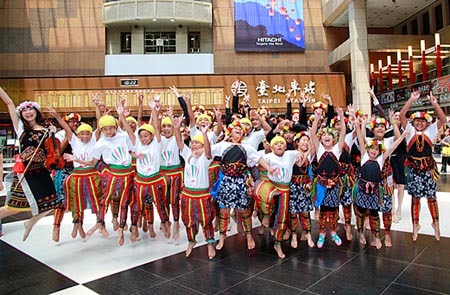
Indigenous children surprise travelers to Taiwan with flash mob

Want China Times, CNA 2014-04-14

Flash mob performers pose for photos at Taipei Main Station. (Photo/Hotel Royal)

A flash mob organized by members of one of Taiwan's indigenous tribes surprised travelers at Taipei Railway Station on Sunday with traditional songs and dances and the traditional costumes they wore.

Many spectators were touched by the angel-like voices of the members of the flash mob, all Puyuma children.

"They made me tear up within five seconds after they started," one passenger at the station told reporters from Public Television Service.

Asked about what they sang, a member of the flash mob said the songs extolled the beauty of their land in Taitung County in southeastern Taiwan and the return of brave Puyuma warriors from battles they won.

The performance was in fact part of a charity program initiated by the Hotel Royal Chihpen in Taitung to help indigenous children residing in remote mountainous parts of the county live their dreams.

Most members of the flash mob, comprised of a dancing troupe and a choir, had never been outside Taitung due to their secluded living environment, the organizer of the show said.

With assistance from the Taitung County Tourism Bureau and Uni Air, the indigenous children took their first-ever flight to Taipei to show urban dwellers in Taipei the beauty of Taitung through song and dance, the organizer said.

The Puyama, one of 14 indigenous tribes in Taiwan, reside mainly in Taitung County.

Monday, October 21, 2013

Thousands in Kaohsiung catch last-minute Rubber Duck fever

Want China TimesCNA 2013-10-20

People flock to Kaohsiung Harbor for a last glimpse of the Rubber Duck, Oct. 19.
(Photo/Hsieh Ming-tso)

Thousands of admirers flocked to Kaohsiung Harbor on Saturday for a last glimpse of the city's world-famous Rubber Duck inflatable sculpture, which will conclude its appearance in the southern Taiwan city on Sunday.

The city's Glory Harbor was packed with buses from early Saturday morning bringing tourists to admire and pose for pictures with the floating art, which has drawn 3.5 million spectators since being put on display a month ago, according to the Kaohsiung City government.

Designed by Dutch artist Florentijn Hofman, the installation was expected to attract some 200,000 spectators on Saturday, officials said.

A closing ceremony for Hofman's duck campaign in Kaohsiung will be held at 4pm on Sunday, and the city has encouraged the duck's fans to dress in yellow to bid it farewell.

The 18-meter-tall, 1,000-kilogram yellow duck will then be deflated and stored, perhaps for another occasion in the future, but Rubber Duck fever will continue in Taiwan, with Taoyuan county to display its own version of the Rubber Duck at a festival between Oct. 26 and Nov. 10.

Related Articles: