Indonesia executes six drug convicts, five of them foreigners

Indonesia executes six drug convicts, five of them foreigners
Widodo has pledged to bring reform to Indonesia

Ban appeals to Indonesia to stop death row executions

Ban appeals to Indonesia to stop death row executions
United Nations Secretary General Ban Ki-moon has pleaded to Indonesia to stop the execution of prisoners on death row for drug crimes. AFP PHOTO

Pope: 'Death penalty represents failure' – no 'humane' way to kill a person

Pope: 'Death penalty represents failure' – no 'humane' way to kill a person
The pope wrote that the principle of legitimate personal defense isn’t adequate justification to execute someone. Photograph: Zuma/Rex

Obama becomes first president to visit US prison (US Justice Systems / Human Rights)

Obama becomes first president to visit US prison   (US Justice Systems / Human Rights)
US President Barack Obama speaks as he tours the El Reno Federal Correctional Institution in El Reno, Oklahoma, July 16, 2015 (AFP Photo/Saul Loeb)

US Death Penalty (Justice Systems / Human Rights)

US Death Penalty (Justice Systems / Human Rights)
Woman who spent 23 years on US death row cleared (Photo: dpa)


.

.
"The Recalibration of Awareness – Apr 20/21, 2012 (Kryon channeled by Lee Carroll) (Subjects: Old Energy, Recalibration Lectures, God / Creator, Religions/Spiritual systems (Catholic Church, Priests/Nun’s, Worship, John Paul Pope, Women in the Church otherwise church will go, Current Pope won’t do it), Middle East, Jews, Governments will change (Internet, Media, Democracies, Dictators, North Korea, Nations voted at once), Integrity (Businesses, Tobacco Companies, Bankers/ Financial Institutes, Pharmaceutical company to collapse), Illuminati (Started in Greece, with Shipping, Financial markets, Stock markets, Pharmaceutical money (fund to build Africa, to develop)), Shift of Human Consciousness, (Old) Souls, Women, Masters to/already come back, Global Unity.... etc.) - (Text version)

… The Shift in Human Nature

You're starting to see integrity change. Awareness recalibrates integrity, and the Human Being who would sit there and take advantage of another Human Being in an old energy would never do it in a new energy. The reason? It will become intuitive, so this is a shift in Human Nature as well, for in the past you have assumed that people take advantage of people first and integrity comes later. That's just ordinary Human nature.

In the past, Human nature expressed within governments worked like this: If you were stronger than the other one, you simply conquered them. If you were strong, it was an invitation to conquer. If you were weak, it was an invitation to be conquered. No one even thought about it. It was the way of things. The bigger you could have your armies, the better they would do when you sent them out to conquer. That's not how you think today. Did you notice?

Any country that thinks this way today will not survive, for humanity has discovered that the world goes far better by putting things together instead of tearing them apart. The new energy puts the weak and strong together in ways that make sense and that have integrity. Take a look at what happened to some of the businesses in this great land (USA). Up to 30 years ago, when you started realizing some of them didn't have integrity, you eliminated them. What happened to the tobacco companies when you realized they were knowingly addicting your children? Today, they still sell their products to less-aware countries, but that will also change.

What did you do a few years ago when you realized that your bankers were actually selling you homes that they knew you couldn't pay for later? They were walking away, smiling greedily, not thinking about the heartbreak that was to follow when a life's dream would be lost. Dear American, you are in a recession. However, this is like when you prune a tree and cut back the branches. When the tree grows back, you've got control and the branches will grow bigger and stronger than they were before, without the greed factor. Then, if you don't like the way it grows back, you'll prune it again! I tell you this because awareness is now in control of big money. It's right before your eyes, what you're doing. But fear often rules. …
Showing posts with label Iran. Show all posts

Monday, May 2, 2016

Iran's new parliament has more women than clerics

Yahoo – AFP, May 1, 2016

After the second round of elections in Iran a record 17 women will become
 lawmakers in the 290-seat parliament -- one more than the number of clerics,
which has hit an all time low (AFP Photo/Atta Kenare)

Tehran (AFP) - Iran's new parliament will have more women than clerics when its members are sworn in this month, a first in the Islamic republic and a sign of the country's evolving politics.

Official results Saturday showed that reformist and moderate politicians allied with President Hassan Rouhani won a big victory in second round parliamentary elections.

Iran parliament after the first round
election results (AFP Photo)
The outcome saw them outnumber their conservative rivals -- many hardliners lost seats -- for the first time since 2004 and capped a remarkable comeback for reformists after years of isolation.

After the second round of elections a record 17 women will become lawmakers in the 290-seat parliament -- one more than the number of clerics, which has hit an all time low.

In the first parliament that followed the Islamic revolution in 1979 there were 164 clerics elected.

Some of the country's most prominent politicians are clerics and have previously been lawmakers including Rouhani who was an MP between 1980 and 2000.

Two earlier presidents, Ayatollah Akbar Hashemi Rafsanjani and Mohammad Khatami, are also past members of parliament.

However clerical numbers have steadily fallen since 1980 with 153 elected in the second parliament, 85 in the third, 67 in the fourth and 52 in the fifth.

The outgoing legislature had only 27 men of the cloth. Of the 16 who will enter parliament next month 13 have conservative political leanings and three are reformists.

Although the 17 women, nearly all reformists, elected represent only nine percent of the total it is a high for the Islamic republic and almost double the nine conservative women in the outgoing chamber. The previous high for female MPs was 14.

Results show there will be 133 reformists in the new parliament, 13 shy of a majority but more than the conservatives' 125 MPs. The remaining seats went to independents and minorities.

The second ballot on Friday was needed because no candidate won the minimum 25 percent required during the first round of voting on February 26.

Related Articles:


“… With free choice, the percentage of DNA efficiently started to go down as humanity grew. As soon as the DNA started to lose percentage, the gender balance was dysfunctional. If you want to have a test of any society, anywhere on the planet, and you want to know the DNA percentage number [consciousness quota] as a society, there's an easy test: How do they perceive and treat their women? The higher the DNA functionality, the more the feminine divine is honored. This is the test! Different cultures create different DNA consciousness, even at the same time on the planet. So you can have a culture on Earth at 25 percent and one at 37 - and if you did, they would indeed clash. …”

“… You're at 35. There's an equality here, you're starting to see the dark and light, and it's changing everything. You take a look at history and you've come a long way, but it took a long time to get here. Dear ones, we've seen this process before and the snowball is rolling. There isn't anything in the way that's going to stop it. In the path of this snowball of higher consciousness are all kinds of things that will be run over and perish. Part of this is what you call "the establishment". Watch for some very big established things to fall over! The snowball will simply knock them down. …”

Sunday, January 17, 2016

'Implementation Day' for Iran nuclear deal as prisoners freed

Yahoo – AFP, Simon Sturdee with Arthur MacMillan in Tehran, January 16, 2016

Iranian Foreign Minister Mohammad Javad Zarif (L) and EU foreign policy chief
 Federica Mogherini hold a joint press conference during the E3/EU+3 and Iran talks
 at the International Atomic Energy Agency headquarters in Vienna on January 16,
2016 (AFP Photo/Joe Klamar)

Vienna (AFP) - The historic nuclear accord between Iran and major powers entered into force Saturday as the UN confirmed that Tehran has shrunk its atomic programme and as painful sanctions were lifted on the Islamic republic.

The International Atomic Energy Agency said its "inspectors on the ground verified that Iran has carried out all measures" agreed under the July 14 agreement.

EU foreign policy chief Federica Mogherini, representing the six powers, said that as a result "multilateral and national economic and financial sanctions related to Iran's nuclear programme are lifted".

US Secretary of State John Kerry 
holds a press conference in Vienna 
on January 16, 2016 (AFP Photo/
Joe Klamar)
"All sides remain firmly convinced that this historic deal is both strong and fair, and that it meets the requirements of all," Mogherini said in Vienna in a joint statement with Iranian Foreign Minister Mohammad Javad Zarif.

"This achievement clearly demonstrates that with political will, perseverance, and through multilateral diplomacy, we can solve the most difficult issues and find practical solutions that are effectively implemented," they said.

The so-called "Implementation Day" for the accord also followed news of a prisoner swap between Iran and the United States in another sign of thawing relations between the two foes since the July 14 agreement.

The steps taken by Iran, combined with ultra-close IAEA inspections, extend to at least a year -- from a few months previously -- how long Iran would need to make one nuclear bomb's worth of fissile material.

They include slashing by two-thirds its uranium centrifuges, reducing its stockpile of uranium -- enough before the deal for several bombs -- and removing the core of the Arak reactor which could have given Iran weapons-grade plutonium.

Iran has always denied wanting nuclear weapons, saying its activities are exclusively for peaceful purposes such as power generation.

In what was hailed as a momentous diplomatic breakthrough, the Vienna agreement was nailed down after two years of rollercoaster negotiations following the June 2013 election of Iranian President Hassan Rouhani.

The highly complex deal drew a line under a standoff dating back to 2002 marked by failed diplomatic initiatives, ever-tighter sanctions, defiant nuclear expansion by Iran and threats of military action.

In addition it put Iran and the United States on the road to better relations some 35 years after the Islamic revolution that toppled the US-backed shah, and at a particularly explosive time in the Middle East.

The four Iranian-American detainees to be freed by Iran included Washington Post correspondent Jason Rezaian and Saeed Abedini, a pastor from Idaho, a senior US official said Saturday.


The others were Amir Hekmati and Nosratollah Khosravi-Roodsari, Washington said. A fifth American, identified as Matthew Trevitick, was also to be released as part of a different process.

In exchange Washington said it had granted clemency to seven Iranians, six of whom were dual US-Iranian citizens, and dropped charges against 14 more.

Daggers drawn

The agreement, heralded as US President Barack Obama's biggest major foreign policy triumph, has by no means been universally cheered, however.

Obama's Republican opponents charge that it fails to do enough to ensure Iran will never get the bomb, a complaint shared by Israel, Iran's arch foe widely assumed to have nuclear weapons itself.

Sunni Saudi Arabia, Iran's other great regional rival, is also alarmed at the prospect of warmer US-Iran ties and of predominantly Shiite Iran, newly flush with oil revenues, increasing its influence.

Already Saudi Arabia and Iran, fighting a proxy war in Yemen and key players in the Syrian conflict, are at daggers drawn following Saudi Arabia's execution of a Shiite cleric in early January and the subsequent ransacking of the Saudi embassy in Tehran.

Iran's imminent return to the oil market has also contributed to the sharp slide in the price of crude to 12-year lows of under $30 per barrel this week, putting Saudi Arabia's public finances under strain.

The lifting of sanctions on Iran is "going to put 500,000 barrels per day more on the market", said James Williams of WTRG Economics. Some analysts believe $20 oil is on the horizon.

Bumpy road

The deal has more than a decade to run, which is likely to be a bumpy road, experts say, not least if more hardline governments take power in Tehran or Washington.


Related Articles:

Iran, major powers trumpet historic nuclear deal

Obama credits 'diplomacy' for effective nuclear deal with Iran
Iran's Rouhani says nuclear deal to bring peace
US to pay Iran $1.7 bn in debt and interest: Kerry

US Secretary of State John Kerry speaks to journalists about his negotiations
 with Iran upon his arrival from Vienna at Joint Base Andrews on January 17,
2016 (AFP Photo/Kevin Lamarque)

Sunday, October 4, 2015

First Iran hajj dead flown home nine days after stampede

Yahoo – AFP, Arthur Macmillan, 3 Oct 2015

The Iranian honour guard carries the caskets of Iranian pilgrims, killed in a stampede
 at the annual hajj, during a repatriation ceremony on their arrival on October 3,
2015 in Tehran (AFP Photo/Atta Kenare)

Tehran (AFP) - The first bodies of Iranians killed in a stampede at the hajj arrived home from Saudi Arabia Saturday after a controversial nine-day delay and questions over the final death toll.

President Hassan Rouhani and other top officials laid white flowers on coffins at a sombre ceremony in Tehran for the 104 pilgrims -- among 464 Iranians declared dead in the September 24 crush.

Iran has accused Saudi Arabia of incompetence in its handling of safety at the hajj, further souring relations already strained by the civil war in Syria and conflict in Yemen.

Iranian officials pray over the caskets 
of Iranian pilgrims killed in the hajj 
stampede as the bodies arrived in Tehran
 on October 3, 2015 (AFP Photo/Atta 
Kenare)
"If it were proved that some (authorities) were guilty in this accident, we will not forgive," Rouhani said as the bodies emerged in red caskets from a cargo plane at Mehrabad Airport in Tehran.

The president was accompanied by the heads of Iran's judiciary and parliament as well as the chief of staff of supreme leader Ayatollah Ali Khamenei's office.

"Our language in this accident was one of brotherhood and respect and the language of diplomacy was used when necessary," Rouhani said. "If needed, the language of authority will also be used."

Iran has been deeply critical of the slow pace at which the Saudi authorities have identified the dead.

More bodies were expected to be flown home later on Saturday but Iran's health minister said not all of the Iranian dead had yet been found and many were thought to be lying unidentified in sealed containers.

"We hope with Saudi cooperation, we can find the bodies of these victims which might be among the corpses from other countries," Hassan Hashemi told the official IRNA news agency.

Iranian families face a further delay in receiving their loved ones for burial as DNA testing has been deemed necessary.

"The ID tags on the coffins do not match the victims' identities and the existing lists in Mehrabad Airport," the ISNA news agency cited an unnamed official as saying.

Memorial ceremonies on Sunday

The tragedy will be marked with memorial ceremonies in Tehran and in provincial capitals on Sunday.

Iranian President Hassan Rouhani (C) 
attended a repatriation ceremony for the
 pilgrims who were among at least 464 
Iranians killed in the hajj stampede on 
September 24, 2015 (AFP Photo/
Atta Kenare)
Khamenei, Iran's supreme guide, demanded on Wednesday that Saudi Arabia apologise to the bereaved and to the world's Muslims

"The slightest disrespect towards tens of thousands of Iranian pilgrims in Mecca and Medina and not fulfilling their obligation to transfer holy bodies will have Iran's tough and fierce reaction," he said.

Rouhani called for a fact-finding commission into the disaster as all Islamic countries deserved to know the cause.

Saudi authorities have yet to provide a breakdown of the nationalities of the 769 pilgrims they say died, but many countries have provided their own individual tolls.

Tallies of the dead from foreign officials and media from 24 countries put the dead at 1,036, well in excess of the Saudi figure.

With many more pilgrims still listed as missing, Iranian officials say the real death toll is between 2,000 and 4,000, and many of the dead have yet to be identified.

It took a week before Iran was able to confirm 464 of its nationals had died as officials spent days scouring Saudi hospitals for the missing without success.

It is the highest confirmed death toll among foreign nationalities by far. Egypt has 126 dead and 110 missing, and Indonesia has 91 dead.

While Iran has been vocal, official reaction elsewhere in the Muslim world has been more restrained, although survivors and bereaved families have criticised safety measures in place at the hajj.

Sunday, September 6, 2015

Iran photographer to share prize money with Syria refugees

Yahoo – AFP, 5 Sep 2015

Iranian photographer Newsha Tavakolian poses for a picture in a park in Tehran,
June 26, 2011 (AFP Photo)

Tehran (AFP) - Iranian photographer Newsha Tavakolian has said she will donate part of a 100,000-euro ($112,000) Dutch award to charity, including Syrian and Iraqi refugees.

"It is hard for me to enjoy this prize as much as I would like to, seeing the region where I work and live in flames and tens of thousands seeking refuge in faraway lands," Tavakolian said on her Facebook page.

The 34-year-old self-taught photographer considered as one of the first professional female photojournalists in Iran, said she would be donating 15,000 to an organisation helping Syrian and Iraqi refugees.

"I have worked in both their countries and want to give back to all the kindness Iraqi's and Syrians always welcomed me with, despite the dire circumstances they live in," she said.

The Amsterdam-based Prince Claus Fund dedicated to culture and development said on its website Thursday that it had awarded its Principal 2015 prize to Tavakolian.

"Newsha Tavakolian is a self-taught photographer who combines photojournalism and art to offer new insights into the lived experience of people in Iran and the wider Middle East region," it said.

"One of the first professional female photojournalists in Iran, her work ranges from bold reportage of political events to sensitive portraits and evocative series on subjects such as the insecurity of middle-class youth, female Kurdish fighters or the impact of sanctions on individual lives.

"The aesthetic and intellectual qualities of Tavakolian's stills, videos, installations and photobooks question stereotypes and inspire young photographers across the Middle East," said the Prince Claus Fund.

During a recent trip in the Middle East, Tavakolian took pictures to illustrate the struggles of Kurdish women fighting the jihadist Islamic State group in northern Iraq.

Tavakolian said 13,000 euros of her prize money would be given to Sheed Award, an independent documentary photography award in Iran.

Another 10,000 euros will go to Mahak Foundation, an Iranian charity supporting children with cancer, and 7,000 euros to local organisations supporting and protecting animals.

Tavakolian's pictures have been published by Time magazine, the National Geographic and Magnum Photos.

In 2014, Tavakolian returned a 50,000-euro prize from the Carmignac Gestion photojournalism award citing a dispute with the French foundation over her right to artistic freedom.

She later changed her mind following negotiations with the jury.

The Prince Claus awards are given to individuals, groups and organisations based mainly in Africa, Asia, Latin America and the Caribbean.


Tuesday, May 5, 2015

Iran's Rouhani says not for police to enforce Islam

Yahoo – AFP, 4 May 2015

President of Iran Hassan Rouhani is distancing himself from efforts to 
involve religion in law enforcement (AFP Photo/Don Emmert)

Tehran (AFP) - Iran's President Hassan Rouhani said Monday it was not up to the country's police to deliver Islamic guidance, distancing himself from efforts to involve law enforcement in religion.

Rouhani, a relative moderate, last week faced criticism from the Islamic republic's clerical establishment and conservative lawmakers for insisting the police had no role to play in religion.

But in a speech to teachers on Monday he took up the issue again, saying it was for officers to carry "handcuffs and pistols", not to act like clergy.

"If we tell them you are the seminary and you can also interpret Islam, there would be chaos," he said.

"All teachers in schools, universities and of course in the seminaries whose mission is to better understand and express religion" have a responsibility to "teach, spread and explain Islam," he said.

"But you can't just tell anyone... (to) interpret" Islam, he added.

Rouhani last year spoke out about draft legislation that would have given more power to police and volunteer militias to enforce women's compulsory wearing of the veil.

"We should not be overly focused on one issue, such as bad hijab, to prevent vice," he said, in reference to women deemed not properly veiled.

The proposed law was later ruled unconstitutional.

And last month he told law enforcement commanders that "police should only enforce the law", drawing a rebuke from the country's powerful religious establishment.

Ayatollah Mohammad Yazdi, the head of Iran's highest clerical body, the Assembly of Experts, said the government is "bound to implement the laws of Islam, and cannot say no to Islam."

Conservative lawmakers also wrote a letter protesting Rouhani's remarks, saying it was up to the government "to defend Islam in any meeting".

Rouhani was elected in 2013 to replace the more conservative Mahmoud Ahmadinejad and has faced resistance from hardliners on a range of issues, including efforts to reach a deal with world powers on Tehran's contested nuclear programme.

Saturday, April 25, 2015

Iran President : Islam, Christianity And Judaism No Different

Jakarta Globe, aacc2015.id, Apr 23, 2015


AACC2015, Jakarta – President of the Islamic Republic of Iran Hassan Rouhani said, respect for different religions, ethnicities and races is the foundation for overcoming terrorism. Concrete action must be taken by religious leaders to prevent terrorism and achieve tolerance.

“In preventing terrorism, there is no difference between Islam, Christianity, Judaism, Buddhism nor Africa, Asia and Europe. Religion must not become a political instrument, especially Islam, which brings a message of peace for the world,” said Hassan firmly in the first plenary of the 60th Anniversary AAC at Jakarta Convention Centre (JCC), Wednesday (22/4).

He asserted the need for prompt identification of the causes of youths to join terrorist groups. “The problems of culture and economy that may lead to radical views must be identified,” he said.

He added, the problem of social justice should be a main consideration in order that terrorist groups not be allowed to expand their influence. “Financial, political and intelligence support for terrorist groups must be stopped,” he said.
Hassan labelled armed conflict in Syria and Yemen a common consideration. History shows that military intervention has not been an effective solution to crises experienced by these countries. Conflict resolution or settlement should be conducted through dialogue.

Besides this, Hassan affirmed that the Ten Principles of Bandung, which were first declared 60 years ago, had been an inspiration for Iran in fighting against arrogance. “Economic sanctions toward Iran for its nuclear programme has been a demonstration of hostility and an example of dangerous steps,” he said.

The Iranian people were inspired by the first AAC in Bandung in 1955 and by the values of Islam to keep promoting cooperation towards peace. The Ten Principles of Bandung, said Hassan, should be translated into concrete action, thus it will manifest success for the New Asian African Strategic Partnership. “All Asian and African nations should strengthen the spirit of association in facing the rapidly changing world,” he said.

(Photo: Antara, Editor: Gusti Andry, Translator: Donum Theo)

Related Articles:

"The Recalibration of Awareness – Apr 20/21, 2012 (Kryon channeled by Lee Carroll) (Subjects: Old Energy, Recalibration LecturesGod / CreatorReligions/Spiritual systems  (Catholic Church, Priests/Nun’s, Worship, John Paul Pope, Women in the Church otherwise church will go, Current Pope won’t do it),  Middle East, Jews, Governments will change (Internet, Media, Democracies, Dictators, North Korea, Nations voted at once), Integrity (Businesses, Tobacco Companies, Bankers/ Financial Institutes, Pharmaceutical company to collapse),  Illuminati (Started in Greece, with Shipping, Financial markets, Stock markets, Pharmaceutical money (fund to build Africa, to develop)), Shift of Human Consciousness, (Old) Souls, Women, Masters to/already come back, Global Unity.... etc.) (Text version)

“.   New Tolerance

Look for a softening of finger pointing and an awakening of new tolerance. There will remain many systems for different cultures, as traditions and history are important to sustaining the integrity of culture. So there are many in the Middle East who would follow the prophet and they will continue, but with an increase of awareness. It will be the increase of awareness of what the prophet really wanted all along - unity and tolerance. The angel in the cave instructed him to "unify the tribes and give them the God of Israel." You're going to start seeing a softening of intolerance and the beginning of a new way of being.

Eventually, this will create an acknowledgement that says, "You may not believe the way we believe, but we honor you and your God. We honor our prophet and we will love you according to his teachings. We don't have to agree in order to love." How would you like that? The earth is not going to turn into one belief system. It never will, for Humans don't do that. There must be variety, and there must be the beauty of cultural differences. But the systems will slowly update themselves with increased awareness of the truth of a new kind of balance. So that's the first thing. Watch for these changes, dear ones. ...."

Tuesday, April 14, 2015

Palestine and Permanent Seats on Asia-Africa Agenda

Of 109 invitations sent out for the 60th anniversary of the Asian-African Conference, only 57 countries have RSVP’ed

Jakarta Globe, Erwida Maulia, Apr 14, 2015

A declaration on Palestinian statehood is among three documents expected to be
 signed by heads of state or government at the end of the Asian-African
conference. (Reuters Photo/Beawiharta)

Jakarta. Observers have high hopes that the upcoming 60th anniversary commemorations of the Asian-African Conference in Jakarta and Bandung can produce significant outcomes — ranging from a concrete road map for an independent Palestine, to a higher geopolitical stature for countries from the two continents.

Teuku Rezasyah, the executive director of the Indonesian Center for Democracy, Diplomacy and Defense, said on Monday that he believed the high-profile commemoration would be more than just a series of ceremonies.

“It will have substance. If Palestine is indeed on the agenda, the commemoration will be substantial, because Palestine is the only participant from the 1955 Asian-African Conference that has still not yet gained independence,” said Rezasyah, who is also an international relations lecturer at Padjajaran University in Bandung, where the historic conference was held in 1955.

A declaration on Palestinian statehood is among three documents expected to be signed by heads of state or government at the end of the 60th anniversary commemoration of the conference, which kicks off this Sunday in Jakarta with a meeting of senior officials from participating countries.

The Asian-African Summit, which will feature heads of state and government, is scheduled for April 22-23 at the Jakarta Convention Center, while a ceremony to commemorate the 1955 conference will take place in Bandung the following day, and will include a walk by the leaders down Jalan Asia Afrika in the West Java capital, retracing a similar procession by the leaders of 60 years ago.

The anniversary conference is also expected to conclude with two other declarations: the Bandung Message and the Declaration of Reinvigorating the New Asian-African Strategic Partnership. Both are expected to redefine and bolster the relationships and partnerships between Asian and African nations.

Indonesian Foreign Minister Retno L.P. Marsudi said in Jakarta last week that the three documents had been intensively discussed by AAC representatives in New York.

“The deliberations in New York are 70 percent complete. The target is [that by the time of the summit] in Jakarta they will be 80 percent complete, and then they will be discussed at the head-of-state level,” Retno said as quoted by CNN Indonesia.

Rezasyah said that although the pro-Palestinian independence cause kept failing at larger international forums, including the United Nations, he believed the meetings in Jakarta and Bandung next week would reinvigorate the cause.

“The Asian-African Summit gives the participants more liberty [to openly express their support for Palestine]. The five countries that hold veto power [in the UN Security Council] won’t be in attendance, except for China. And China will definitely support [Palestinian independence],” he said.

Rezasyah also said he expected the conference to conclude with strong calls for changes or additions to the permanent membership of the UN Security Council, held by the United States, China, Russia, France and Britain.

“Those five countries do not equally represent global citizens by population, geography or politics,” Rezasyah said. “The [conference] should conclude with proposals for new permanent members of the UN Security Council.”

He said Indonesia could make a strong case for a permanent seat on council, representing Southeast Asia; Australia could represent the Australasian region; and either Egypt or Algeria could represent the Middle East and Africa.

“The proposals can be included in a joint communique that will be read out on the last day [of the conference],” Rezasyah said.

Hikmahanto Juwana, a professor of international law at the University of Indonesia, said conference participants should stick to three key issues if they wanted the event to carry any weight internationally.

“First, they should discuss how Asian and African nations should bring color to the existing universal values,” he said.

“The so-called universal values we’ve had this whole time are influenced exclusively by European states or other nations that carry European traditions, such as the United States. In the past, there were attempts to promote Asian values, but they didn’t work. We can try now with Asian and African values.”

Second, Hikmahanto said, Asian and African nations must proclaim their rejection of developed nations’ intervention through economic dependency.

“Many Asian and African states are bound by dependency in the economic sector. [Developed nations] intervene with other countries’ sovereignty — including Indonesia’s — through loans or grants,” he said.

“This isn’t forced intervention, but intervention caused by dependency. This issue must be addressed.”

Third, the Asian and African leaders must discuss how to tackle crises currently afflicting their parts of the world, such as the militant uprisings of Boko Haram in West Africa and Al Shabaab in East Africa, Hikmahanto said.

Rezasyah said this was an important point, given past experiences that showed how intervention by the United States and Europe in conflicts in Iraq and Afghanistan had left behind destruction in those two nations and destabilized the Middle East.

Hikmahanto expressed doubt, though, that the conference would carry any weight if the number of heads of state or government confirmed to attend remained as low as reported.

Retno said last Friday said only around 25 foreign leaders had confirmed their attendance. The number of countries sending a delegation currently stands at 57, out of the 109 invited.

Among those confirmed to attend are Chinese President Xi Jinping and Japanese Prime Minister Shinzo Abe.

Abe said at a meeting in Tokyo on Monday that Japan would use the conference to make further contributions to the development of Asia and Africa, according to the Japan Times.

The newspaper also said Abe would deliver a speech on April 22, which, coming on the 70th anniversary of the end of World War II, is expected to convey Japan’s remorse over its actions in the war and explain the country’s postwar path as a pacifist nation.

Xi’s attendance, meanwhile, is meant to show that the Chinese government intends to contribute directly to maintaining the spirit of the 10-point “declaration on promotion of world peace and cooperation” produced at the end of the 1955 conference, according to Xie Feng, the Chinese ambassador to Indonesia.

“China and Indonesia are friends. Moreover, the Bandung Spirit can bring a new chapter in Asia and Africa’s relations,” Xie was quoted as saying in Jakarta last week by the official website of the AAC Commemorations 2015.

Indonesian Foreign Ministry spokesman Arrmanatha Nasir said 18 foreign leaders were seeking bilateral meetings with President Joko Widodo on the sidelines of the event, including Xi, Abe and leaders from Myanmar, Iran, Palestine, Vietnam, Jordan, Nepal, Zimbabwe and Mozambique.

The 60th anniversary commemoration of the Bandung conference will also feature a host of other events on the sidelines, including the Asian-African Business Summit in Jakarta, as well as a “smart city” summit, a student conference, and a carnival, all in Bandung.

Nearly 10,000 police personnel will be dispatched to provide security during the series of events.
Related Articles:


Monday, April 6, 2015

Pope hails Iran accord, urges end to 'absurd violence' in Easter message

Yahoo – AFP, Jean-Louis De La Vaissiere, 5 April 2015

Pope Francis speaks from the central loggia of St Peters' basilica during the
 "Urbi et Orbi" blessing for Rome and the world following the Easter Mass in the
Vatican on April 5, 2015 (AFP Photo/Filippo Monteforte)

Vatican City (AFP) - Pope Francis appealed Sunday for an end to "absurd violence" in hotspots around the world and said the international community must not stand by in the face of the "immense humanitarian tragedy" in Syria and Iraq.

In his traditional Easter message, the 78-year-old pontiff said he was praying for those killed in armed conflict, including the students massacred by Somali gunmen at a university in Kenya.

Tens of thousands of pilgrims huddled under a sea of umbrellas in a rain-soaked St Peter's Square to hear the pope deliver his "Urbi et Orbi" (To the City and World) blessing, broadcast live to dozens of countries.

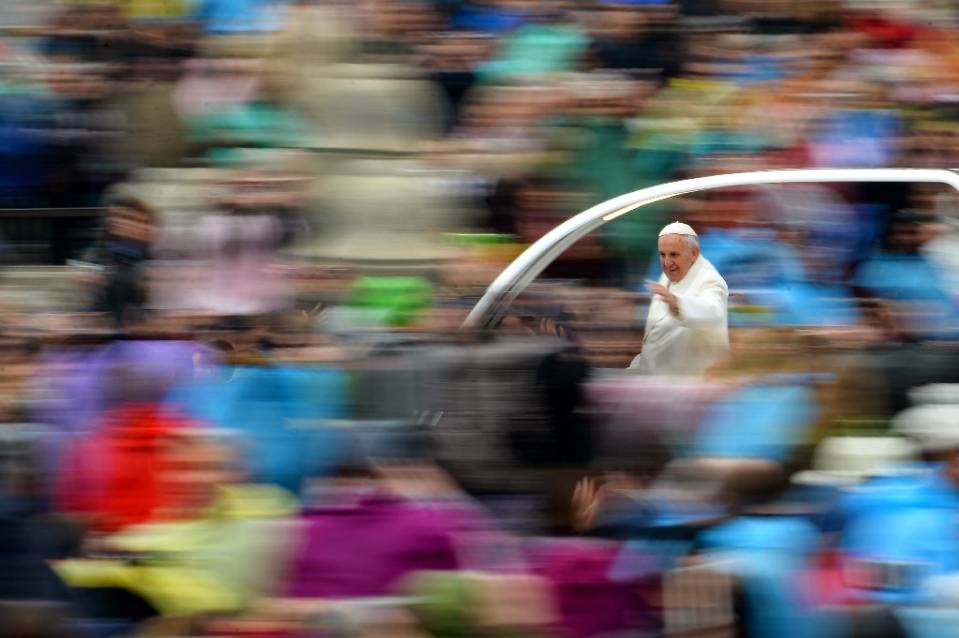
Pope Francis greets the crowd from the
 popemobile after the Easter Mass at
 St Peter's square in the Vatican on
April 5, 2015 (AFP Photo/Gabriel Bouys)
In his third Easter message since his election as pope in 2013, the head of the world's 1.2 billion Catholics prayed "for peace, above all, for Syria and Iraq, that the roar of arms may cease".

He called on the international community to "not stand by before the immense humanitarian tragedy unfolding in these countries and the drama of the numerous refugees" created by the two conflicts.

He also prayed for the victims of Thursday's attack in Kenya that left 148 people dead, with survivors sayng the militants spared Muslim students but taunted Christian and Jewish students before killing them.

"I think in particular of the young people who were killed last Thursday at Garissa University College in Kenya," he said.

Earlier Francis greeted pilgrims personally as he rode through the flower-bedecked square aboard his open Popemobile after presiding over Easter mass.

The most important and joyous moment of the Catholic calendar, Easter celebrates the day when Christians believe Jesus rose from the dead.

Pope Francis greets the crowd from 
the popemobile after the Easter Mass 
at the Vatican on April 5, 2015 (AFP
Photo/Filippo Monteforte)
Speaking from the balcony of St Peter's Basilica, Francis also said the framework nuclear accord reached Thursday between Iran and six major world powers inspired hope for "a definitive step toward a more secure and fraternal world".

The Argentine pope pleaded for "absurd bloodshed and all barbarous acts of violence" in Libya to be halted, and voiced his "desire for peace, for the good of the entire people" in war-battered Yemen and Ukraine.

Without referring to a particular hotspot, Francis said: "Those who bear within them God's power, his love and his justice, do not need to employ violence."

Be 'respectful, ready to help'

He prayed for "all who have been kidnapped, and for those forced to abandon their homes and their dear ones" in armed conflict and attacks by extremists in Nigeria and South Sudan as well as parts of Sudan and the Democratic Republic of Congo.

In addition, he urged "peace and freedom for the many men and women subject to old and new forms of enslavement on the part of criminal individuals and groups (and) for the victims of drug dealers... And we ask peace for this world subjected to arms dealers."

Pope Francis greets the crowd from
 the popemobile after the Easter Mass
 at the Vatican on April 5, 2015 (AFP
Photo/Filippo Monteforte)
Francis also sounded his trademark appeal to the rich and powerful to care for the world's poor and downtrodden, saying: "The world proposes that we put ourselves forward at all costs, that we compete."

Instead, Christians should "seek to live in service to one another, not to be arrogant, but rather respectful and ready to help," he said.

Sunday's Easter observances capped a long and demanding Holy Week that left Francis at times appearing tired.

On Friday he presided over the traditional Via Crucis (Way of the Cross) procession at Rome's Colosseum evoking the last hours of Jesus's life.

The day before Francis celebrated two masses -- one for priests, and the other at Rome's Rebibbia prison, where he washed the feet of 10 inmates symbolically evoking Christ's humility -- a theme he took up again on Sunday.

"To enter into the mystery, we need to 'bend down', to abase ourselves," Francis said.

Related Article:


Saturday, July 12, 2014

SBY Speaks Out Against Israeli Air Strikes

Jakarta Globe, Ezra Sihite & Vita A.D. Busyra, Jul 12, 2014

A boy holds a toy gun — as he poses during a rally against Israeli attacks on
the Palestinian territories — in Jakarta on July 11, 2014. (EPA Photo/Mast Irham)

Jakarta. President Susilo Bambang Yudhoyono on Friday strongly condemned the air strikes launched by the Israeli military in the Gaza Strip that have killed nearly 100 people since Tuesday.

Yudhoyono said at a cabinet meeting at the State Palace in Jakarta that he would call Iranian President Hassan Rouhani later on Friday to discuss what move the countries under the Non-Aligned Movement (NAM) planned to take in response to the ongoing violence that has claimed mostly civilian lives.

“I will be communicating with the Iranian president in his capacity as the chairman of the NAM to discuss what the NAM countries can do to stop the violence,” Yudhoyono said.

He called the Israeli military’s action “too much,” and said that Indonesia would also call on the United Nations and the Organization of Islamic Cooperation to stop the air strikes.

“Besides condemning the overwhelmingly excessive military action, Indonesia has already made a diplomatic approach with the UN, the OIC and the NAM countries. The goal is to halt Israeli’s military actions,” he said.

A cease-fire is strongly urged and must be enforced under the UN’s supervision, the president said. He gave assurances that there would not be any retaliation by the Palestinian side if the Israelis ended the air strikes, which were launched in response to the firing of rockets into Israel by Hamas militants.

Yudhoyono said he and Rouhani would also discuss the provision of aid and other relief supplies for the Palestinians.

Din Syamsuddin, the Indonesian chairman of the Palestine Friendship Initiative (PPIP) and head of Muhammadiyah, Indonesia’s second-biggest Islamic organization, also condemned the Israeli Defense Forces for what he called “attacks on innocent Palestinian people” in Gaza.

He encouraged people to donate money for aid for the Palestinians.

The Medical Emergency Rescue Committee (MER-C), an Indonesian humanitarian group, previously built a hospital in Gaza, but Din said it lacked equipment and facilities to help treat the injured.

“The MUI [Indonesian Council of Ulema] and the PPIP are also calling on people during this holy month of Ramadan to give alms to help resolve the problem of the Palestinians so that the hospital can start running,” he said on Thursday in Jakarta.

Din previously said he hoped to raise up to Rp 6 billion ($516,000) to be sent to the Palestinian people.

He said the PPIP had initially planned a charity concert for Aug. 15, to feature Indonesian and Palestinian musicians, but had to put the plan on hold for now.

Din urged international organizations, such as the UN and the OIC to take concrete steps to stop the air strikes.

“There have been many resolutions from the UN, but they were either not enforced or ignored. So we will keep urging the UN to take immediate action,” he said.

“The OIC has to undertake concrete measures, including providing humanitarian help to the people of Gaza and Palestine who have been suffering from the attacks,” Din said.

Teuku Rezasyah, the executive director of the Indonesian Center for Democracy, a Jakarta-based think tank, noted that many past attempts to sanction Israel at the UN had been vetoed by its close ally, the United States, and called for a fundamental change in the structure of the UN Security Council to better reflect the contemporary global balance of power.

“The structure needs to be revised so that a more democratic decision can be produced to force Israel to halt its attacks,” Rezasyah said on Friday.

“So far it’s always been under the US’s command. Russia always tries to defend itself. It’s a complicated story in there,” he said, emphasizing that Israel always managed to come away untouched by sanctions over its actions because of the way the UNSC veto power worked.

Rezasyah said the UN should be restructured to enable other countries, such as Indonesia, Japan, Germany and Brazil, to as much of a say as the five permanent members of the UNSC, especially on matters of humanitarian urgency.

He added that another factor that rendered Indonesia unable to do more to help Palestine was its refusal to recognize the state of Israel, saying its decision not to have diplomatic ties with Tel Aviv had put it in a dilemma and would leave it incapable of being a fair mediator unless it could make its voice heard by Israel.

“Ideally we should establish a diplomatic approach with Israel in order to discuss this sensitive issue. But if Indonesia wants to be heard by Israel, it needs to be a prominent voice of Asean, the OIC and the NAM,” Rezasyah said.

Andreas Harsono, an Indonesia researcher at Human Rights Watch, said that despite the high number of victims from the Israeli military actions, Palestine deserved as much of the blame as Israel for the escalating violence.

“Under the international law, both countries attacked civilians, their homes, hospitals and schools. Innocent people risked being attacked and that violates the law already,” he said of Hamas’s rocket strikes into Israeli settlements.

He was quick to add, however, that this did not justify the Israeli’s own strikes in residential areas of Gaza.

He also said that major Middle Eastern powers such as Saudi Arabia, Egypt and Turkey were in alignment with the US, making it difficult to reach any kind of satisfactory outcome at the UN.

Reuters cited Palestinian officials as saying that 11 civilians were killed n Friday in the fourth day of Israeli air strikes on the Gaza Strip, raising the death toll in the coastal enclave to at least 96, most of them civilians.