Indonesia executes six drug convicts, five of them foreigners

Indonesia executes six drug convicts, five of them foreigners
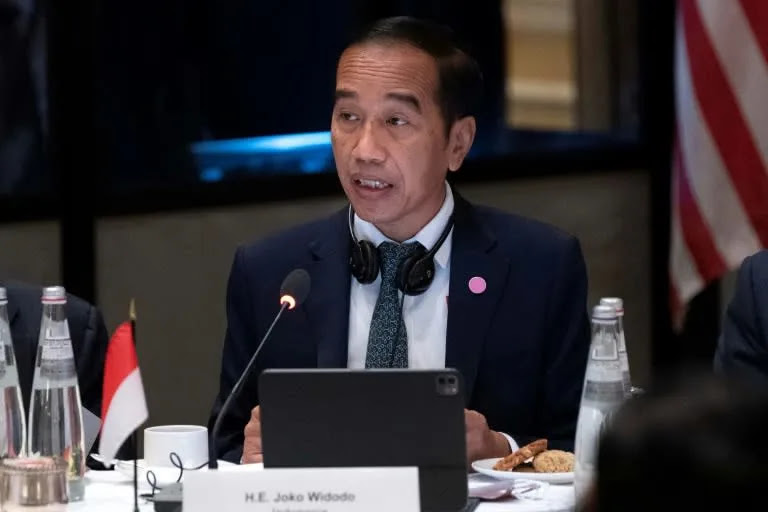
Widodo has pledged to bring reform to Indonesia

Ban appeals to Indonesia to stop death row executions

Ban appeals to Indonesia to stop death row executions
United Nations Secretary General Ban Ki-moon has pleaded to Indonesia to stop the execution of prisoners on death row for drug crimes. AFP PHOTO

Pope: 'Death penalty represents failure' – no 'humane' way to kill a person

Pope: 'Death penalty represents failure' – no 'humane' way to kill a person
The pope wrote that the principle of legitimate personal defense isn’t adequate justification to execute someone. Photograph: Zuma/Rex

Obama becomes first president to visit US prison (US Justice Systems / Human Rights)

Obama becomes first president to visit US prison   (US Justice Systems / Human Rights)
US President Barack Obama speaks as he tours the El Reno Federal Correctional Institution in El Reno, Oklahoma, July 16, 2015 (AFP Photo/Saul Loeb)

US Death Penalty (Justice Systems / Human Rights)

US Death Penalty (Justice Systems / Human Rights)
Woman who spent 23 years on US death row cleared (Photo: dpa)


.

.
"The Recalibration of Awareness – Apr 20/21, 2012 (Kryon channeled by Lee Carroll) (Subjects: Old Energy, Recalibration Lectures, God / Creator, Religions/Spiritual systems (Catholic Church, Priests/Nun’s, Worship, John Paul Pope, Women in the Church otherwise church will go, Current Pope won’t do it), Middle East, Jews, Governments will change (Internet, Media, Democracies, Dictators, North Korea, Nations voted at once), Integrity (Businesses, Tobacco Companies, Bankers/ Financial Institutes, Pharmaceutical company to collapse), Illuminati (Started in Greece, with Shipping, Financial markets, Stock markets, Pharmaceutical money (fund to build Africa, to develop)), Shift of Human Consciousness, (Old) Souls, Women, Masters to/already come back, Global Unity.... etc.) - (Text version)

… The Shift in Human Nature

You're starting to see integrity change. Awareness recalibrates integrity, and the Human Being who would sit there and take advantage of another Human Being in an old energy would never do it in a new energy. The reason? It will become intuitive, so this is a shift in Human Nature as well, for in the past you have assumed that people take advantage of people first and integrity comes later. That's just ordinary Human nature.

In the past, Human nature expressed within governments worked like this: If you were stronger than the other one, you simply conquered them. If you were strong, it was an invitation to conquer. If you were weak, it was an invitation to be conquered. No one even thought about it. It was the way of things. The bigger you could have your armies, the better they would do when you sent them out to conquer. That's not how you think today. Did you notice?

Any country that thinks this way today will not survive, for humanity has discovered that the world goes far better by putting things together instead of tearing them apart. The new energy puts the weak and strong together in ways that make sense and that have integrity. Take a look at what happened to some of the businesses in this great land (USA). Up to 30 years ago, when you started realizing some of them didn't have integrity, you eliminated them. What happened to the tobacco companies when you realized they were knowingly addicting your children? Today, they still sell their products to less-aware countries, but that will also change.

What did you do a few years ago when you realized that your bankers were actually selling you homes that they knew you couldn't pay for later? They were walking away, smiling greedily, not thinking about the heartbreak that was to follow when a life's dream would be lost. Dear American, you are in a recession. However, this is like when you prune a tree and cut back the branches. When the tree grows back, you've got control and the branches will grow bigger and stronger than they were before, without the greed factor. Then, if you don't like the way it grows back, you'll prune it again! I tell you this because awareness is now in control of big money. It's right before your eyes, what you're doing. But fear often rules. …
Showing posts with label EU. Show all posts

Monday, June 27, 2022

Indonesian president to meet Zelensky and Putin to urge peace talks

Yahoo – AFP, 26 June 2022 


Indonesian President and G20 chairman Joko Widodo set off on Sunday to Europe where he said he plans to visit Russia and Ukraine and meet with the countries' leaders to urge peace talks. 

Widodo departed for Germany to attend as a guest for the G7 summit from June 26 to 27, and he will then go to the Ukraine capital Kyiv to meet President Volodymyr Zelensky. 

"The mission is to ask... President Zelensky to open a dialogue forum for peace, to build peace because the war has to be stopped," he told a press conference in Jakarta. 

The two leaders will also discuss the food supply chain "that needs to be reactivated" soon, Widodo said. From Kyiv, Widodo is scheduled to visit Moscow and meet with Russia's Vladimir Putin. 

The visit to Moscow is planned for June 30, Indonesian authorities said earlier. 

"With the same mission, I will ask President Putin to open a dialogue and to immediately have a ceasefire and to stop the war," he said. Earlier in April Widodo announced he had called Zelensky and invited him to join world leaders at G20 Summit in Bali in November 2022 as a guest. 

Indonesia holds the rotating presidency of the G20 this year and has been pressured by Western countries, led by the United States, to exclude Russia from the meeting. 

Widodo, however, did not rescind the invitation to Russia and said that Putin has expressed his intention to attend the November summit. 

Indonesia, like most major emerging economies, has tried to maintain a neutral position and has called for a peaceful resolution to the months-long conflict. 

Widodo refused to send weapons to Ukraine in response to a request from Zelensky, instead offering humanitarian aid. 

After concluding the European visit, Widodo will head to the United Arab Emirates before returning to Indonesia.

Tuesday, January 23, 2018

Foreign tourist numbers to the Netherlands hit 17.6 million

DutchNews, January 22, 2018


The number of foreign tourists visiting the Netherlands reached a new record last year, soaring 11% to hit 17.6 million, the national tourism and convention board NBTC reported on Monday

Tourists spent a total of €12.9bn during their stay, the figures show. 

Most foreign visitors – 42% – came from Germany and Belgium. German tourists numbered more than five million and the NBTC said it is clear that the German economy is improving because of the increase in short breaks. 

More than 2.2 million Belgians visited the Netherlands last year while Britain was in third place with nearly 2.2 million visitors. The NBTC expects visitor number to top 18.5 million in 2018, a rise of 5% on last year. 

The popularity of the Netherlands, especially for weekend breaks, has led the NBTC to develop a new strategy to try to better spread tourists across the country. 

‘We need to invest more in accessibility, new and more varied experiences, and appropriate places to stay,’ director Jos Vranken said. ‘On Wednesday we will urge MPs to focus on the need to strengthen and speed up the implementation of the HollandCity strategy.’ 

The HollandCity strategy involves promoting the Netherlands as a single metropolis with lots of districts, such as Lake District Friesland and Design District Eindhoven.

Related Article:


Sunday, January 21, 2018

Europe brings on charm and blue skies to lure Chinese tourists

Yahoo – AFP, Céline CORNU, 20 January 2018

Europe brings on charm and blue skies to lure Chinese tourists

Venice (AFP) - Chinese tourists are big spenders and with the numbers visiting Europe set to soar by nearly 70 percent over the next five years, the countries of the Old Continent are rolling out the red carpet to make the guests feel welcome.

A total 12.4 million Chinese, mostly in guided tour groups, came to Europe in 2017, according to the European Travel Comission. And the Chinese Tourism Academy (CTA) is expecting the number to reach 20.8 million by 2022.

"A few years ago, the Chinese came to Europe solely to do some shopping. Now, they're increasingly keen to get know the culture and the countryside," CTA president Dai Bin told AFP, speaking in Venice, at the launch of the year of tourism between the EU and China.

Festivals, cooking courses... "they want to have personal experiences and visit areas where they don't see any other Chinese," said ETC's executive director, Eduardo Santander.

"They like the cuisine, the music, the blue skies... most of them come from the coast, where pollution is extremely high," Santander said.

And some were surprised that they can "breathe without coughing," he added.

China is the world's biggest market for foreign tourism -- with 129 million Chinese holidaymakers travelling abroad, they account for one fifth of the total number of tourists globally.

And they spend more than twice the amount that, say, US tourists do -- $261 billion in 2016 compared with $123 billion.

Hot water and credit cards

Small gestures can go a long way towards making Chinese tourists feel more at ease in Europe, said Jacopo Sertoli, head of Welcome Chinese, a body that awards certificates to tourism companies catering for Chinese customers.

"You can make them very happy by offering them a glass of hot water," he said, noting most Chinese families drink water at that temperature rather than cold.

Chinese language television stations and good wifi in hotel rooms are a good idea while payment methods favoured by the Chinese, such as UnionPay, the only credit card issuer in China, WeChatPay or Alipay are a must.

CTA chief Dai Bin said Europe should reduce the red tape for its Chinese visitors.

"We hope Europe will make is easier for Chinese to get a visa," he said.

"In a number of eastern European countries, for example, it's easy. But it's very difficult in others. And when Chinese tourists visit Europe, they want to visit several countries, not just one," Dai Bin said.

By reciprocation, China would become "more flexible when granting visas and Europeans can stay in Beijing or Shanghai for 144 hours -- or six days -- without a visa," he promised.

According to ETC data, France is the number one desired destination in Europe for Chinese tourists, with 61 percent of visitors hoping to go there, followed by Germany with 37 percent and Italy with 28 percent.

Nevertheless, that picture has started to change in recent years, and travel to eastern Europe is booming, not least because of the easier allocation of visas and the increased availability of cheap flights. The string of terrorist attacks in France and Germany in recent years is also a factor.

In 2016, the number of Chinese tourists visiting Serbia, for example, rose by 173 percent, and numbers were up by nearly 90 percent in Montenegro.

But while "the Chinese are very alert to questions of security, they tend to forget more easily than other tourists," Santander said.

Popular for perceivedly having deep pockets -- a result of the Chinese tradition of giving presents -- Chinese visitors haven't always enjoyed a reputation for their savoir-vivre.

But that's an image which China is itself keen to remedy, with "some tourist agencies offering lessons to customers before they go to Europe," said CTA president Dai Bin.


Tuesday, January 16, 2018

Spain expected to replace US as 2nd tourism destination

Yahoo – AFP, 15 January 2018

Catalonia has remained a tourism magnet despite a terror attack in August
and a political crisis over independence

Spain is expected to replace the United States as the world's second tourism destination while France has retained the top spot, the UN World Tourism Organization said Monday.

"It is expected" that Spain will take the second position with some 82 million visitors last year, UNWTO chief Zurab Pololikashvili told reporters, adding however that definitive figures would be published in the spring.

He did not give any details about the United States, nor did he explain why Spain took the second spot despite a terror attack in August and a highly mediatised independence crisis in tourism magnet Catalonia.

John Kester, head of tourism trends at the UN agency, added that "everything indicates" that France would retain its top spot in 2017 -- a good year for the industry as the number of global tourists leapt seven percent on 2016, the biggest increase in seven years.

Europe was the star of the show as it attracted a large number of visitors, up eight percent from the previous year, lured in particular by the Mediterranean's sea and sun.

This contrasts sharply with 2016 figures that saw security fears hit visitor arrivals in Europe.

"We do see that demand for European destinations has been very strong," said Kester.

"We also see important recovery in France," he added, without giving further details about a country that was hard hit by extremist attacks.

Spain also suffered a deadly jihadist attack in August in Catalonia, the same region whose leaders tried unsuccessfully to break away from Spain, triggering a major crisis that shook Europe.

And while the political crisis sparked a drop in visitor numbers to the northeastern region, it does not appear to have dented overall tourist figures for Spain in 2017.

In 2016, Spain welcomed 75.3 million visitors, just behind the United States with 75.6 million, while France -- despite its own terror woes -- easily remained the world leader with 82.6 million visitors, according to the UNWTO.


Sunday, June 18, 2017

Taboo-breaking liberal mosque opens in Berlin

Yahoo – AFP, Yannick PASQUET, June 17, 2017

Lawyer and women's rights activist Seyran Ates opened the
Ibn-Rushd-Goethe-Mosque with words of welcome before Christian and
Jewish guests and a large media contingent (AFP Photo/John MACDOUGALL)

Berlin (AFP) - With a mission to spread a liberal form of Islam, a mosque where men and women pray side by side has opened its doors in Berlin, complete with female imams.

The Arabic phrase "Allahu Akbar" ('God is greatest') resonated through the crowded Ibn-Rushd-Goethe-Mosque Friday as US-Malaysian Ani Zonneveld, one of the world's few female imams, launched the call to prayer.

Then one of the founders of the new place of worship, lawyer and women's rights activist Seyran Ates, opened the event with words of welcome before Christian and Jewish guests and a large media contingent.

"We want to send a signal against Islamic terror and the misuse of our religion," said Turkish-born Ates, 54, dressed in a long white robe. "We want to practise our religion together."

Ates -- no stranger to breaking taboos, having called for a "sexual revolution" in the Muslim world -- vowed she would not allow ultra-conservatives "to rob me of my right to be Muslim".

Kneeling on green carpets, the faithful -- men and women, side by side -- bowed to Mecca for the traditional prayer as the imam spoke in German.

Some of the women wore veils or head coverings, others did not.

'Depoliticise' Islam

The new mosque, the 88th in the German capital, is located in a rented room on the third floor of the Protestant Johanniskirche (St. John's Church) building.

Founded by Seyran Ates, the mosque aims to establish a humanistic, 
secular and liberal reading of Islam (AFP Photo/John MACDOUGALL)

All Muslims -- Sunni or Shia, Alawite or Sufi -- are welcome in the mosque named after one of Germany's greatest writers, Johann Wolfgang von Goethe, and 12th century Islamic scholar Ibn Rushd, also known as Averroes.

The seven founding members said they want to open their prayer hall to all groups, including gays and lesbians.

"This mosque allows Muslims to define themselves in a new way," said co-founder and German Islam scholar Abdel-Hakim Ourghi.

He added that "we will try to depoliticise Islam", as the religion was being torn by rival political movements. "Because religion is a private matter."

Police stood guard outside the entrance of the building.

The founders said they had not received any threats or insults, but that they fully expected not everyone would be happy.

Time for change

Germany, with some four million Muslims, has been the target of jihadist attacks, the deadliest last December when a truck tore through a Berlin Christmas market crowd killing 12 people.

Seyran Ates -- who has campaigned against forced marriages,
domestic violence and so-called "honour killings" among Muslim
migrants -- said the project was eight years in the making (AFP
Photo/John MACDOUGALL)

The arrival of more than one million refugees, most from mainly Muslim countries, since 2015 has worsened the fears of some Germans.

Ates -- who has campaigned against forced marriages, domestic violence and so-called "honour killings" among Muslim migrants -- said the project was eight years in the making.

"Many left along the way," she said. "They told us it was dangerous, that they were afraid."

Elham Manea, a Swiss political scientist of Yemeni background, said the time had come for change, with other so-called liberal mosques having also opened in the United States, Britain and Switzerland.

The Berlin mosque, financed by private donations, is located in the Berlin district of Moabit, which has a large immigrant population.

It was in this neighbourhood that Tunisian Anis Amri, the Christmas market attacker, frequented a radical mosque that has since been closed.

Pakistani human rights activist Mukhtar Mai (C) receives a standing ovation
as she takes the stage following performance of the opera 'Thumbprint', at
the Roy and Edna Disney/Calarts Theater (REDCAT) in Los Angeles, on
June 16, 2017 (AFP Photo/Robyn Beck)

Related Articles:


Yassmine el Ksaihi poses in the prayer hall of the Polder Mosque in Amsterdam, 
Netherlands, Tuesday, March 2, 2010. Uniquely in the Netherlands, men and 
women pray together in her mosque, albeit segregated, with the women praying
 in the back of the prayer hall. Devotions and sermons are conducted mostly in
 Dutch rather than Arabic. And non-Muslims are welcome. Across Europe Muslims
 are seeking a formula that lets them be an inseparable part of their country while
 maintaining their loyalty to their faith and origin. (AP Photo/ Evert Elzinga)

Tuesday, September 27, 2016

EU launches debit cards for refugees in Turkey

Yahoo – AFP, September 26, 2016

European Commissioner for Humanitarian Aid and Crisis Management Christos
 Stylianides (L) delivers a speech next to Turkey’s EU Minister Omer Celik (R)
during a joint press conference following their meeting on September 26, 2016
(AFP Photo/Adem Altan)

Ankara (AFP) - The European Union on Monday launched a scheme worth almost 350 million euros providing mainly Syrian refugees in Turkey with pre-paid debit cards, the biggest project yet under a landmark deal between the bloc and Ankara.

EU Humanitarian Aid Commissioner Christos Stylianides, in Ankara for the start of the programme, said the debit cards will help give vulnerable refugees a "sense of normality" in their lives.

The refugees will be able to use the cards in shops or institutions to pay for food, education, housing and clothing or also to withdraw cash from ATMs.

Each card will be automatically topped up with 100 Turkish lira ($33.50) a month, giving people the chance to choose their own purchases.

Stylianides said the programme was an "unprecedented response" to an "unprecedented crisis".

"This (scheme) is, in our humanitarian field, a game-changer in the delivery of humanitarian aid. Refugees can choose what they spend money on."

Turkey is home to some three million refugees, most of them Syrian. The vast majority live in cities without direct support from non-governmental organisations and aid groups.

Supported with 348 million euros ($392 million) from Brussels and its member states, the scheme will be rolled out by Turkish Red Crescent and the UN World Food Programme supported by the Turkish authorities.

Applications will start in October for the scheme. Families who have children going to school will receive more cash. All refugees registered in Turkey, including Iraqis, are eligible to apply.

Stylianides suggested that the programme would also benefit Turks.

"The money will be spent in local shops, boosting local businesses and encouraging social cohesion between citizens and refugees."

The project is part of a six billion euro ($6.75 billion) deal struck in March between Brussels and Ankara to curb the migrant influx into Europe, which saw more than a million arrive in the EU last year.

There have been fears the deal could collapse with President Recep Tayyip Erdogan complaining that the promised money was not handed directly to Turkey.

In exchange for cutting the flow, Brussels also offered Turkey visa liberalisation for its citizens to visit EU countries in the Schengen area as well as accelerated membership talks.

But Ankara has threatened to withdraw from the agreement if Europe does not allow visa-free travel for Turks by next month, though the numbers coming to Europe have dropped significantly since March.

Saturday, April 23, 2016

European Council President Praises Indonesia’s Democracy and Religious Tolerance

Jakarta Globe, Eko Prasetyo, April 22, 2016

President Joko Widodo meets with European Council President Donald Tusk
in Brussels, Thursday (21/04). (State Palace Press Photo/Laily)

Jakarta. President Joko Widodo met with European Council President Donald Tusk at the Europa building, seat of the European Council, in Brussels, an official statement said on Thursday (21/04).

In the meeting, Joko said Indonesia is a "living laboratory" where Islam, democracy and religious tolerance exist side by side.

Tusk in response praised the way Indonesia has been fostering democracy, human rights and religious tolerance, often under difficult circumstances, and said the council will continue its interfaith exchange program with Indonesia.

The European Council also said it will look at the proposal for a visa waiver program for Indonesian citizens, as soon as the security situation in Europe improves.

The Indonesian president had earlier met with European Parliament President Martin Schulz, and conducted a bilateral meeting with European Commission President Jean-Claude Junker.

Wednesday, April 20, 2016

Merkel Praises Indonesia's Development in Meeting Focused on Education

Jakarta Globe, Eko Prasetyo, April 19, 2016

President Joko Widodo in a discussion with German Chancellor Angela Merkel in
Bundeskanzleramt, Berlin, Germany, Monday (18/04). (State Palace Press Photo/Laily)

Jakarta. German Chancellor Angela Merkel praised Indonesia’s developments and achievements while meeting with President Joko Widodo in Bundeskanzleramt, Berlin, on Monday (18/04).

“It is a challenging duty for a country to develop itself, especially for Indonesia with 250 million citizens and 17,000 islands. I am amazed by Indonesia’s achievements. Surely, we can discuss many issues together,” Merkel said in an official statement.

Prior to the visit, Joko said the two will focus on efforts to increase and strengthen partnerships in vocational education in a number of sectors.

“Indonesia wants Germany to assist vocational education, especially those related to industry, such as power plants, textile, maritime and others,” Joko said.

Both leaders agreed in their meeting to follow up the vocational partnership commitment in a technical meeting in May.

Both countries agreed to complete the "scooping papers," which will accelerate the establishment of a Comprehensive Economic Partnership Agreement.

The meeting touched on terrorism and the place of soft and hard power in eradicating the threat, as well as a proposal to establish a Steering Committee to oversee the application of 2012 Indonesia-Germany Comprehensive Partnership.

Germany is Indonesia's top European trading partner and its seventh largest investor.

Friday, March 25, 2016

Pope Francis washes the feet of refugees

In a sign of "humility and service," the Argentine pontiff has washed the feet of refugees from various religious backgrounds. One of the asylum seekers said he felt "more important than Obama."

Deutsche Welle, 24 March 2016


Pope Francis washed the feet of 11 Muslim, Orthodox, Hindu and Catholic refugees and one aid worker at a shelter for asylum seekers as part of traditional rituals held on the Thursday before most Christians celebrate Easter on Sunday.

The "washing of the feet" ritual represents a "gesture of humility and service" that reflects the moment Jesus washed his disciples' feet in chapter 13 of the Gospel of John, according to the Vatican.

"All of us together - Muslims, Hindus, Catholics, Copts, Evangelicals - but brothers, children of the same God, who want to live in peace, integrated," the pope said in unscripted comments, according to Reuters news agency.

"Three days ago, there was a gesture of war, of destruction, in a city of Europe by people who don't want to live in peace," he said, referring to attacks in Brussels that left more than 30 people dead. "Behind that gesture, there were arms manufacturers, arms traffickers, who want blood, not peace, who want war, not brotherhood."

The pope, who has championed refugees' rights in Europe at a moment of growing anti-migrant populism, has called on European leaders to do more for refugees and migrants, many of whom are fleeing war in the Middle East, Asia and Africa.


"Washing the feet of the refugees, Pope Francis demands respect for each one of them," wrote Archbishop Rino Fisichella earlier this week.

'More important than Obama'

Angelo Chiorazzo, who founded the charity running the shelter outside of Rome, told Vatican Radio that the asylum seekers were looking forward to the ceremony.

"One of the boys [at the shelter], a Muslim from Mali, told me: 'I really feel more important than [US President Barack] Obama. That the pope, the most important in the world - the best man in the world - will wash my feet," said Chiorazzo.

After the ceremony, the pontiff individually greeted many of the nearly 900 asylum seekers residing at the shelter.


Related Articles:


"The Recalibration of Awareness – Apr 20/21, 2012 (Kryon channeled by Lee Carroll) (Subjects: Old Energy, Recalibration LecturesGod / CreatorReligions/Spiritual systems  (Catholic Church, Priests/Nun’s, Worship, John Paul Pope, Women in the Church otherwise church will go, Current Pope won’t do it),  Middle East, Jews, Governments will change (Internet, Media, Democracies, Dictators, North Korea, Nations voted at once), Integrity (Businesses, Tobacco Companies, Bankers/ Financial Institutes, Pharmaceutical company to collapse),  Illuminati (Started in Greece, with Shipping, Financial markets, Stock markets, Pharmaceutical money (fund to build Africa, to develop)), Shift of Human Consciousness, (Old) Souls, Women, Masters to/already come back, Global Unity.... etc.) (Text version)

“.   New Tolerance

Look for a softening of finger pointing and an awakening of new tolerance. There will remain many systems for different cultures, as traditions and history are important to sustaining the integrity of culture. So there are many in the Middle East who would follow the prophet and they will continue, but with an increase of awareness. It will be the increase of awareness of what the prophet really wanted all along - unity and tolerance. The angel in the cave instructed him to "unify the tribes and give them the God of Israel." You're going to start seeing a softening of intolerance and the beginning of a new way of being.

Eventually, this will create an acknowledgement that says, "You may not believe the way we believe, but we honor you and your God. We honor our prophet and we will love you according to his teachings. We don't have to agree in order to love." How would you like that? The earth is not going to turn into one belief system. It never will, for Humans don't do that. There must be variety, and there must be the beauty of cultural differences. But the systems will slowly update themselves with increased awareness of the truth of a new kind of balance. So that's the first thing. Watch for these changes, dear ones. ...."

Sunday, January 17, 2016

'Implementation Day' for Iran nuclear deal as prisoners freed

Yahoo – AFP, Simon Sturdee with Arthur MacMillan in Tehran, January 16, 2016

Iranian Foreign Minister Mohammad Javad Zarif (L) and EU foreign policy chief
 Federica Mogherini hold a joint press conference during the E3/EU+3 and Iran talks
 at the International Atomic Energy Agency headquarters in Vienna on January 16,
2016 (AFP Photo/Joe Klamar)

Vienna (AFP) - The historic nuclear accord between Iran and major powers entered into force Saturday as the UN confirmed that Tehran has shrunk its atomic programme and as painful sanctions were lifted on the Islamic republic.

The International Atomic Energy Agency said its "inspectors on the ground verified that Iran has carried out all measures" agreed under the July 14 agreement.

EU foreign policy chief Federica Mogherini, representing the six powers, said that as a result "multilateral and national economic and financial sanctions related to Iran's nuclear programme are lifted".

US Secretary of State John Kerry 
holds a press conference in Vienna 
on January 16, 2016 (AFP Photo/
Joe Klamar)
"All sides remain firmly convinced that this historic deal is both strong and fair, and that it meets the requirements of all," Mogherini said in Vienna in a joint statement with Iranian Foreign Minister Mohammad Javad Zarif.

"This achievement clearly demonstrates that with political will, perseverance, and through multilateral diplomacy, we can solve the most difficult issues and find practical solutions that are effectively implemented," they said.

The so-called "Implementation Day" for the accord also followed news of a prisoner swap between Iran and the United States in another sign of thawing relations between the two foes since the July 14 agreement.

The steps taken by Iran, combined with ultra-close IAEA inspections, extend to at least a year -- from a few months previously -- how long Iran would need to make one nuclear bomb's worth of fissile material.

They include slashing by two-thirds its uranium centrifuges, reducing its stockpile of uranium -- enough before the deal for several bombs -- and removing the core of the Arak reactor which could have given Iran weapons-grade plutonium.

Iran has always denied wanting nuclear weapons, saying its activities are exclusively for peaceful purposes such as power generation.

In what was hailed as a momentous diplomatic breakthrough, the Vienna agreement was nailed down after two years of rollercoaster negotiations following the June 2013 election of Iranian President Hassan Rouhani.

The highly complex deal drew a line under a standoff dating back to 2002 marked by failed diplomatic initiatives, ever-tighter sanctions, defiant nuclear expansion by Iran and threats of military action.

In addition it put Iran and the United States on the road to better relations some 35 years after the Islamic revolution that toppled the US-backed shah, and at a particularly explosive time in the Middle East.

The four Iranian-American detainees to be freed by Iran included Washington Post correspondent Jason Rezaian and Saeed Abedini, a pastor from Idaho, a senior US official said Saturday.


The others were Amir Hekmati and Nosratollah Khosravi-Roodsari, Washington said. A fifth American, identified as Matthew Trevitick, was also to be released as part of a different process.

In exchange Washington said it had granted clemency to seven Iranians, six of whom were dual US-Iranian citizens, and dropped charges against 14 more.

Daggers drawn

The agreement, heralded as US President Barack Obama's biggest major foreign policy triumph, has by no means been universally cheered, however.

Obama's Republican opponents charge that it fails to do enough to ensure Iran will never get the bomb, a complaint shared by Israel, Iran's arch foe widely assumed to have nuclear weapons itself.

Sunni Saudi Arabia, Iran's other great regional rival, is also alarmed at the prospect of warmer US-Iran ties and of predominantly Shiite Iran, newly flush with oil revenues, increasing its influence.

Already Saudi Arabia and Iran, fighting a proxy war in Yemen and key players in the Syrian conflict, are at daggers drawn following Saudi Arabia's execution of a Shiite cleric in early January and the subsequent ransacking of the Saudi embassy in Tehran.

Iran's imminent return to the oil market has also contributed to the sharp slide in the price of crude to 12-year lows of under $30 per barrel this week, putting Saudi Arabia's public finances under strain.

The lifting of sanctions on Iran is "going to put 500,000 barrels per day more on the market", said James Williams of WTRG Economics. Some analysts believe $20 oil is on the horizon.

Bumpy road

The deal has more than a decade to run, which is likely to be a bumpy road, experts say, not least if more hardline governments take power in Tehran or Washington.


Related Articles:

Iran, major powers trumpet historic nuclear deal

Obama credits 'diplomacy' for effective nuclear deal with Iran
Iran's Rouhani says nuclear deal to bring peace
US to pay Iran $1.7 bn in debt and interest: Kerry

US Secretary of State John Kerry speaks to journalists about his negotiations
 with Iran upon his arrival from Vienna at Joint Base Andrews on January 17,
2016 (AFP Photo/Kevin Lamarque)

Monday, October 19, 2015

Germany ready to support Turkey's EU accession process, says Merkel

Chancellor Merkel has said Germany will support Turkey's EU membership bid, during a visit aimed at securing Ankara's help in stemming a migrant influx to Europe. Turkish PM Davutoglu hailed Europe's "better approach."

Deutsche Welle, 18 Oct 2015

Merkel and Davutoglu shake hands at a joint-press conference

Germany is ready to accelerate Turkey's EU accession process, said German Chancellor Angela Merkel on Sunday at a joint press conference with Turkish Prime Minister Ahmet Davutoglu.

Merkel spoke of organizing the accesion process "more dynamically."

"Germany is ready this year to open Chapter 17, and make preparations for (Chapters) 23 and 24. We can talk about the details," she said.


Merkel's statement comes as she visits Turkish leaders on Sunday in a bid to secure Ankara's support in stemming the current migrant influx into the EU.

'Better approach'

Davutoglu hailed the EU's latest moves to foster collaboration between Brussels and Ankara as a "better approach."

"Unfortunately Turkey was left alone by the international community in terms of burden sharing. We are very pleased there is a better approach now. The issue of sharing going forward is very important," Davutoglu said.

The Turkish premier also praised Merkel for "not turning a blind eye" to the crisis.

However, Davutoglu noted that "significant new waves of migration" were likely to occur if a political solution to the Syrian conflict does not emerge.

Turkey has taken in more than two million Syrian refugees since a civil war erupted there in 2011, according to UN figures.

Thousands of refugees have crossed the Aegean Sea to enter EU member
state Greece from Turkey

Whole package?

According to officials, the EU offered Ankara an aid package of at least 3 billion euros ($3.4 billion) along with an easing EU visa restrictions for Turkish citizens, which Merkel and Davutoglu discussed.

The German chancellor later met with Turkish President Recep Tayyip Erdogan, who said he asked Merkel to support Turkey's EU membership bid. Erdogan added that he also asked France, Britain and Spain for support.

The EU is struggling to cope with the current influx of asylum seekers, with more than half a million migrants having crossed into the 28-nation bloc in 2015, the International Organization for Migration (IOM) reported in September.

ls/tj (Reuters, AFP, dpa)


Related Articles: