Indonesia executes six drug convicts, five of them foreigners

Indonesia executes six drug convicts, five of them foreigners
Widodo has pledged to bring reform to Indonesia

Ban appeals to Indonesia to stop death row executions

Ban appeals to Indonesia to stop death row executions
United Nations Secretary General Ban Ki-moon has pleaded to Indonesia to stop the execution of prisoners on death row for drug crimes. AFP PHOTO

Pope: 'Death penalty represents failure' – no 'humane' way to kill a person

Pope: 'Death penalty represents failure' – no 'humane' way to kill a person
The pope wrote that the principle of legitimate personal defense isn’t adequate justification to execute someone. Photograph: Zuma/Rex

Obama becomes first president to visit US prison (US Justice Systems / Human Rights)

Obama becomes first president to visit US prison   (US Justice Systems / Human Rights)
US President Barack Obama speaks as he tours the El Reno Federal Correctional Institution in El Reno, Oklahoma, July 16, 2015 (AFP Photo/Saul Loeb)

US Death Penalty (Justice Systems / Human Rights)

US Death Penalty (Justice Systems / Human Rights)
Woman who spent 23 years on US death row cleared (Photo: dpa)


.

.
"The Recalibration of Awareness – Apr 20/21, 2012 (Kryon channeled by Lee Carroll) (Subjects: Old Energy, Recalibration Lectures, God / Creator, Religions/Spiritual systems (Catholic Church, Priests/Nun’s, Worship, John Paul Pope, Women in the Church otherwise church will go, Current Pope won’t do it), Middle East, Jews, Governments will change (Internet, Media, Democracies, Dictators, North Korea, Nations voted at once), Integrity (Businesses, Tobacco Companies, Bankers/ Financial Institutes, Pharmaceutical company to collapse), Illuminati (Started in Greece, with Shipping, Financial markets, Stock markets, Pharmaceutical money (fund to build Africa, to develop)), Shift of Human Consciousness, (Old) Souls, Women, Masters to/already come back, Global Unity.... etc.) - (Text version)

… The Shift in Human Nature

You're starting to see integrity change. Awareness recalibrates integrity, and the Human Being who would sit there and take advantage of another Human Being in an old energy would never do it in a new energy. The reason? It will become intuitive, so this is a shift in Human Nature as well, for in the past you have assumed that people take advantage of people first and integrity comes later. That's just ordinary Human nature.

In the past, Human nature expressed within governments worked like this: If you were stronger than the other one, you simply conquered them. If you were strong, it was an invitation to conquer. If you were weak, it was an invitation to be conquered. No one even thought about it. It was the way of things. The bigger you could have your armies, the better they would do when you sent them out to conquer. That's not how you think today. Did you notice?

Any country that thinks this way today will not survive, for humanity has discovered that the world goes far better by putting things together instead of tearing them apart. The new energy puts the weak and strong together in ways that make sense and that have integrity. Take a look at what happened to some of the businesses in this great land (USA). Up to 30 years ago, when you started realizing some of them didn't have integrity, you eliminated them. What happened to the tobacco companies when you realized they were knowingly addicting your children? Today, they still sell their products to less-aware countries, but that will also change.

What did you do a few years ago when you realized that your bankers were actually selling you homes that they knew you couldn't pay for later? They were walking away, smiling greedily, not thinking about the heartbreak that was to follow when a life's dream would be lost. Dear American, you are in a recession. However, this is like when you prune a tree and cut back the branches. When the tree grows back, you've got control and the branches will grow bigger and stronger than they were before, without the greed factor. Then, if you don't like the way it grows back, you'll prune it again! I tell you this because awareness is now in control of big money. It's right before your eyes, what you're doing. But fear often rules. …
Showing posts with label Turkey. Show all posts

Friday, January 13, 2017

'This time is different': Istanbul tourism reels after attacks

Yahoo – AFP, Fulya Ozerkan, January 12, 2017

The number of foreign tourists visiting Istanbul,dropped to 9.2 million in 2016,
a 26-percent decline on the previous year (AFP Photo/Ozan Kose)

Istanbul (AFP) - Yavuz Indere has worked as a hotel receptionist in Istanbul for nearly half a century, witnessing coups, unrest and economic crises.

But as a string of terror attacks erodes the backbone of Turkey's key tourism sector, Indere admits he has never seen anything like this in the city.

"I've been doing this job for 45 years, obviously I've had tough years, but this time it was different," he told AFP at his tiny hotel in the historic Sultanahmet area, the scene of a deadly attack on January 12 last year that rocked the tourism industry.

Exactly a year on from the bombing blamed on Islamic State (IS) jihadists which killed 12 German tourists in the heart of the city, many hotels are suffering, and some have closed their doors for good.

"The heart of the problem is that terrorist attacks do not stop. People who go to visit a country want a guarantee ... I understand them, it is a human reflex," Indere said.

That attack was followed by a slew of strikes blamed on IS and Kurdish militants that killed hundreds in Turkey in 2016, capped by the gunning down of 39 revellers at Istanbul's glamourous Reina nightclub by a suspected jihadist on New Year's night.

'Lost my dear travellers'

There were no official ceremonies to mark the Sultanahmet bombing and the anniversary was barely mentioned on Turkish television.

But Sibel Satiroglu, the tourist guide who was with the Germans that day, laid single red carnations on each spot where a body had fallen in a lonely and personal act of remembrance.

"It is a year today since I lost my dear people and travellers. Faced with their pain, in their absence, I pay my respects," she told AFP

"I curse those who have done this, planned this, produced this. Those I lost, I love them all, I love them and they will always live with me," she said as she sobbed with grief.

The number of foreign tourists visiting Istanbul, with its historic mosques and Ottoman palaces, dropped to 9.2 million in 2016, a 26-percent decline on the previous year, tourism ministry statistics show.

Istanbul: a year of attacks (AFP Photo)

Tourists can still be spotted on Sultanahmet -- home to sights including the Blue Mosque and Hagia Sofia -- but there is no sign of the crowds that once thronged the area and souvenir sellers look forlornly at their stalls.

The Sultanahmet attack was followed by another one on the busy Istiklal shopping street last March, which left three Israelis and an Iranian dead.

A gun and bomb attack on the city's Ataturk airport in June slaughtered 47 people, including 19 foreigners.

Then on July 15, a failed coup attempt left dozens dead in Istanbul alone while a December double bombing near the Besiktas football stadium claimed by Kurdish militants killed 46 people.

"The airport was attacked, Sultanahmet was attacked, then Taksim was attacked, and finally the Reina (nightclub), which for me is an attack on the heart of tourism," said Cetin Gurcun, secretary general of the Association of Turkish Travel Agencies (TURSAB).

The country as a whole has paid a steep price: while 42 million people visited Turkey in 2015, some 12 million fewer travelled there in 2016, Gurcun said.

"In foreign currency terms, revenues amounted to 31.6 billion dollars in 2015, and we had a fall of almost 10 billion dollars in 2016," he added.

In 2015 tourism accounted for 4.4 percent of Turkey's gross domestic product (GDP), according to the latest figures available.

'Can't let terrorists win'

Adding to the tensions, the search continues for an IS-claimed jihadist who rampaged through the Reina nightclub in the early hours of 2017, shooting revellers, including Arab and European tourists, before escaping.

"It does worry me but you know, if you do not come, then you let the terrorists win," said John Plas, a tourist from the Netherlands.

Security measures have been heightened in the wake of the attacks, with heavily armed police patrolling streets.

Tourist guide Umran Aslan said it helped make her feel safer: "They're trying to protect us. I feel better when I see police everywhere".

But she admitted it was unlikely to reassure tourists. "it's so sad, because I love my job".

Tuesday, September 27, 2016

EU launches debit cards for refugees in Turkey

Yahoo – AFP, September 26, 2016

European Commissioner for Humanitarian Aid and Crisis Management Christos
 Stylianides (L) delivers a speech next to Turkey’s EU Minister Omer Celik (R)
during a joint press conference following their meeting on September 26, 2016
(AFP Photo/Adem Altan)

Ankara (AFP) - The European Union on Monday launched a scheme worth almost 350 million euros providing mainly Syrian refugees in Turkey with pre-paid debit cards, the biggest project yet under a landmark deal between the bloc and Ankara.

EU Humanitarian Aid Commissioner Christos Stylianides, in Ankara for the start of the programme, said the debit cards will help give vulnerable refugees a "sense of normality" in their lives.

The refugees will be able to use the cards in shops or institutions to pay for food, education, housing and clothing or also to withdraw cash from ATMs.

Each card will be automatically topped up with 100 Turkish lira ($33.50) a month, giving people the chance to choose their own purchases.

Stylianides said the programme was an "unprecedented response" to an "unprecedented crisis".

"This (scheme) is, in our humanitarian field, a game-changer in the delivery of humanitarian aid. Refugees can choose what they spend money on."

Turkey is home to some three million refugees, most of them Syrian. The vast majority live in cities without direct support from non-governmental organisations and aid groups.

Supported with 348 million euros ($392 million) from Brussels and its member states, the scheme will be rolled out by Turkish Red Crescent and the UN World Food Programme supported by the Turkish authorities.

Applications will start in October for the scheme. Families who have children going to school will receive more cash. All refugees registered in Turkey, including Iraqis, are eligible to apply.

Stylianides suggested that the programme would also benefit Turks.

"The money will be spent in local shops, boosting local businesses and encouraging social cohesion between citizens and refugees."

The project is part of a six billion euro ($6.75 billion) deal struck in March between Brussels and Ankara to curb the migrant influx into Europe, which saw more than a million arrive in the EU last year.

There have been fears the deal could collapse with President Recep Tayyip Erdogan complaining that the promised money was not handed directly to Turkey.

In exchange for cutting the flow, Brussels also offered Turkey visa liberalisation for its citizens to visit EU countries in the Schengen area as well as accelerated membership talks.

But Ankara has threatened to withdraw from the agreement if Europe does not allow visa-free travel for Turks by next month, though the numbers coming to Europe have dropped significantly since March.

Wednesday, December 9, 2015

Tourism chief tells Russians no need for beach holidays

Yahoo – AFP, December 7, 2015

Foreign tourists enjoy the sunny weather at the beach of the Egyptian Red Sea
resort town of Sharm el-Sheikh (AFP Photo/Mohammed Abed)

Moscow (AFP) - Russia's tourism chief got himself into hot water on Monday by claiming there is no need for Russians to go abroad on beach holidays, after Moscow severed air ties with Egypt and warned against travel to Turkey.

In an interview with government newspaper Rossiiskaya Gazeta, the head of Russia's tourism agency Oleg Safonov said that "the need for beaches and the sea is very much a stereotype of recent years, which we already accept as our own opinion."

"Our forefathers, even the wealthy, did not go en masse to foreign seas," he said.

Safonov -- who last year declared he owned two houses on the Seychelles -- was responding to a question from an interviewer who said many Russians felt they had been "deprived of the opportunity to have a real holiday in warm parts."

Officials led by President Vladimir Putin have warned Russians against travelling to Turkey and insisted the country was no safer than Egypt, where a Russian charter plane flying from the resort city of Sharm El-Sheikh to Saint Petersburg was downed by a bomb in October, killing all 224 people on board.

Safonov's front-page interview was clearly intended to promote Russia's domestic tourist industry but misfired.

His comments irritated many, particularly as his opponents pointed out he last year declared ownership of property in the tropics.

On Monday, the word "Seychelles" in Russian became one of the top Twitter trends, and even state news agency RIA Novosti came up with an ironic headline: "A villa in the Seychelles didn't stop tourism chief Safonov from loving his motherland."

Crimean vacations

Safonov recommended that holidaymakers head to Russian-annexed peninsula of Crimea instead of going abroad, suggesting it should develop "all-inclusive" tourism.

"It would be right if a significant part of the money Russian tourists spend on holiday stayed in Russia and worked to benefit our economy and not that of another country," he said.

A tourist poses on a camel at the beach in the Egyptian Red Sea resort 
of Sharm el-Sheikh on November 3, 2015 (AFP Photo/STR)

But the temperatures there are hardly tropical, at 14 degrees Celsius in the resort city of Yalta on Monday afternoon.

Safronov's comments also remind Russians of the decades under Soviet rule when only a small elite was allowed by the authorities to travel outside the Soviet bloc.

"Yes, they think we are idiots," anti-corruption campaigner Lyubov Sobol wrote on Facebook, slamming Safonov for his "hypocrisy."

"From his house in the Seychelles, Safonov advises Russians to holiday at home," opposition politician Alexei Navalny wrote on his blog.

Safonov, a former banker and stockbroker, responded to the furore by saying that he had sold his Seychelles property.

He said his words had been misinterpreted and that he has "great respect for seaside holidays" but was "against any form of absolutism."

Russia's health authorities meanwhile also warned Russians of the dangers of sunnier climes.

"Of course I advise you to holiday in Russia," said Russia's chief sanitary doctor, Anna Popova, in comments carried by Interfax news agency over the weekend.

"It's better not to overstress the body with temperature and climate changes."

Saturday, December 5, 2015

Indonesian Cultural House Opens in Turkey

Jakarta Globe, December 04, 2015

The opening event of Indonesian Cultural House in Ankara, Turkey.
(Photo courtesy of Indonesian Embassy in Turkey)

Jakarta. In an effort to promote Indonesian culture in foreign countries, the Indonesian Embassy in Ankara and the Ministry of Education and Culture officially opened the Indonesian Cultural House, or Rumah Budaya Indonesia, in the Turkish capital last week.

According to the center's official website, the venue will function as a "public space for cultural diplomacy ... to introduce the art and culture of Indonesia to the world in order to improve the country's image and appreciation as well as forge a cultural relationship between the international public and Indonesia."

Known as Endonezya Kultur Evi in Turkey, the cultural house was crowded with guests, from Turkish government officials to fans of Indonesian culture, during the opening event, as reported by Beritasatu.com.

Indonesian dance maestro, Didik Nini Thowok, charmed the audience with his performance of Topeng Dwimuka Jepindo and Lengger Banyumas dances.

From West Sumatra's Tari Piring to Aceh's Saman, a variety of other Indonesian dances were also performed during the event by Indonesian students in Turkey. This was accompanied with a showcase of Turkish traditional dances called Seymenler and Karadenis.

According to Wardana, the Indonesian ambassador to Turkey, the cultural house will be a center to introduce Indonesian culture and provide information to Turkish people.

Various programs will take place at the cultural house in the future, including dance and angklung lessons, Indonesian language courses for Turkish citizens and an array of events to promote Indonesian culture in Turkish cities.

Previously, the Indonesian Cultural House initiative has been launched in nine other countries, including Australia, Japan, the Netherlands, and the United States.

Monday, October 19, 2015

Germany ready to support Turkey's EU accession process, says Merkel

Chancellor Merkel has said Germany will support Turkey's EU membership bid, during a visit aimed at securing Ankara's help in stemming a migrant influx to Europe. Turkish PM Davutoglu hailed Europe's "better approach."

Deutsche Welle, 18 Oct 2015

Merkel and Davutoglu shake hands at a joint-press conference

Germany is ready to accelerate Turkey's EU accession process, said German Chancellor Angela Merkel on Sunday at a joint press conference with Turkish Prime Minister Ahmet Davutoglu.

Merkel spoke of organizing the accesion process "more dynamically."

"Germany is ready this year to open Chapter 17, and make preparations for (Chapters) 23 and 24. We can talk about the details," she said.


Merkel's statement comes as she visits Turkish leaders on Sunday in a bid to secure Ankara's support in stemming the current migrant influx into the EU.

'Better approach'

Davutoglu hailed the EU's latest moves to foster collaboration between Brussels and Ankara as a "better approach."

"Unfortunately Turkey was left alone by the international community in terms of burden sharing. We are very pleased there is a better approach now. The issue of sharing going forward is very important," Davutoglu said.

The Turkish premier also praised Merkel for "not turning a blind eye" to the crisis.

However, Davutoglu noted that "significant new waves of migration" were likely to occur if a political solution to the Syrian conflict does not emerge.

Turkey has taken in more than two million Syrian refugees since a civil war erupted there in 2011, according to UN figures.

Thousands of refugees have crossed the Aegean Sea to enter EU member
state Greece from Turkey

Whole package?

According to officials, the EU offered Ankara an aid package of at least 3 billion euros ($3.4 billion) along with an easing EU visa restrictions for Turkish citizens, which Merkel and Davutoglu discussed.

The German chancellor later met with Turkish President Recep Tayyip Erdogan, who said he asked Merkel to support Turkey's EU membership bid. Erdogan added that he also asked France, Britain and Spain for support.

The EU is struggling to cope with the current influx of asylum seekers, with more than half a million migrants having crossed into the 28-nation bloc in 2015, the International Organization for Migration (IOM) reported in September.

ls/tj (Reuters, AFP, dpa)


Related Articles:

Sunday, March 15, 2015

Indonesia, Turkey to Cooperate in Battle Against Extremism

Jakarta Globe, Mar 15, 2015

The ISIS logo is displayed on a wall in Grogol, Central Java. (JG Photo/Ali Lutfi)

Jakarta. Indonesia and Turkey have agreed to work closely to eradicate religious extremism, just two days after government officials confirmed that up to 32 Indonesians had been detained in Turkey or gone missing and were suspected of trying to cross into Syria to join Islamic State (IS) militants.

The two countries discussed the issue on the sidelines of the United Nations World Conference on Disaster Risk Reduction on Saturday, state-run news agency Antara reported.

Vice President Jusuf Kalla, who is representing Indonesia at the summit, met with Turkish officials where they discussed security operations, the exchange of information and how to deal with refugees that were displaced by IS in Syria and Iraq.

“Radicalism must be overcome together,” Kalla told Antara.

Foreign Minister Retno Marsudi said this week that 16 Indonesians, most of them women and children, had been arrested by Turkish authorities.

Sixteen other Indonesian citizens who went missing from a tour group last week had yet to be located, though Turkish authorities are yet to confirm if they were still in Turkey or had crossed into Syria.

National Police deputy chief Comr. Gen. Badrodin Haiti said the 32 Indonesians were suspected of trying to join the Islamic State.

Indonesia’s Anti-Terrorism Agency has estimated that more than 500 Indonesian jihadist have joined IS.

Sunday, September 14, 2014

Four Turks Arrested in Poso Over Islamic State Link

Jakarta Globe – AFP, Sep 14, 2014

The ISIS logo is displayed on a wall in Grogol, Central Java. (JG Photo/Ali Lutfi)

Jakarta. Indonesia’s anti-terrorism police have arrested four Turks suspected of being linked to the Islamic State jihadist group, a spokesman said on Sunday.

The elite Detachment 88 police squad arrested the men, along with three Indonesians, after tailing their car on Saturday in central Sulawesi district of Poso, a known hotbed for militant activity, Boy Rafli Amar told AFP.

“They are Turkish,” Amar said, confirming the arrest and adding that the men were being investigated for their connection to the dreaded Islamist group.

“We suspect they are linked and are investigating further,” he said.

Indonesia is home to the world’s biggest Muslim population of about 225 million and has long struggled with terrorism. But a successful clampdown in recent years has seen the end of major deadly attacks.

Jakarta has estimated that dozens of Indonesians have travelled to Syria and Iraq to fight and President Susilo Bambang Yudhoyono said he was concerned about their return, adding that he had tasked agencies to oppose the spread of extremist ideology in the sprawling nation.

Ronny Sompie, another police spokesman said two of the Indonesians arrested Saturday had fetched the foreigners “believed to be from an international terror group” from Makassar airport in South Sulawesi.

“The four foreigners managed to flee to the mountains” before their capture, he said.

Agence France-Presse

Thursday, July 31, 2014

Turkish women defy deputy PM with laughter

Bülent Arinç said women should not laugh in public, prompting backlash and highlighting state of women's rights in Turkey

The Guardian, Constanze Letsch in Istanbul, Wednesday 30 July 2014

Bülent Arinç, Turkey's deputy prime minister. Photograph: Adem
Altan/AFP/Getty Images

Twitter in Turkey broke into a collective grin on Wednesday as hundreds of women posted pictures of themselves laughing.

They weren't just happy. They were smiling in defiance of the deputy prime minister, Bülent Arinç, who in a speech to mark Eid al-Fitr on Monday said women should not laugh in public.

"Chastity is so important. It's not just a word, it's an ornament [for women]," Arinç told a crowd celebrating the end of Ramadan in the city of Bursa in an address that decried "moral corruption" in Turkey. "A woman should be chaste. She should know the difference between public and private. She should not laugh in public."

On Wednesday thousands of women posted pictures of themselves laughing out loud, with the hashtags #direnkahkaha (resist laughter) and #direnkadin (resist woman) trending on Twitter.

Turkish men also took to social media to express their solidarity. "The men of a country in which women are not allowed to laugh are cowards", tweeted one user.

Ekmeleddin Ihsanoglu, the main opposition presidential candidate running against current prime minister Recep Tayyip Erdogan in next Sunday's elections, joined a chorus of male voices criticising Bülent Arinç's comment, tweeting: "More than anything else, our country needs women to smile and to hear everybody's laughter."

Other opposition figures pointed out that Arinç's comments highlighted the dismal state of women's rights in Turkey. Calling on people to protest against massive violence towards women at a demonstration next week, Melda Onur, an Istanbul MP for the main opposition Republican People's party, wrote on Twitter: "We would have left Arinç to his fantasies and wouldn't even have laughed about it, but while so many murders are being committed he makes [women] a target by stressing the need for chastity."

A 2009 report commissioned by the Prime Ministry Directorate on the Status of Women found that more than 40% of Turkey's female population have suffered domestic violence. More than 120 have been killed since the beginning of this year alone, mostly by their partners or other family members.

Mehtap Dogan of the Socialist Feminist Collective – who was among the women who posted pictures of herself laughing – said that Arinç's statements were not an isolated incident of misogyny.

"His words perfectly illustrate his and the [ruling] AK party's attitude towards women," she said. "In their eyes, women should not have any rights, they treat us like a separate species."

It was certainly not the first time the government of Erdogan – infamous for his admission that he did not believe in equality between men and women – has provoked outrage with discriminatory remarks.

Dogan added: "Using moralism to hide behind, they defend violence, rape, and sexism."

In 2012, when the government tried to massively curb the right to abortion, Ankara mayor Melih Gökcek said on public television: "Why should the child die if the mother is raped? The mother should die instead."

When women in an Anatolian town approached the visiting forestry minister in 2009, asking for work, he replied: "Isn't your housework enough?"

Asked by journalists to comment on the social media backlash, Arinç said his comment had been taken "out of context".

"From one and a half hours of my speech, some only heard what I said about women laughing in the street. What a disgusting, ugly and unfounded fabrication."

But he also said "I stand by my words", in reference to his wider speech, which he described as an effort to shine a light on the "degeneration in society". In an attempt to distance himself from his earlier statement, he said someone who would want to ban women from laughing in public "would have to be an idiot".

He also accused "certain stars" of "fake laughter": "These are all artificial laughs. In reality laughter brings relief and makes people happy. I think we are in need of that everywhere, but your laughs are fake. You all had your moments of fame, but when that eluded you tried to attract attention with alcohol and such fake laughter."

Arinç went on to slam women who "despite being married with kids go on vacation with their boyfriends" and those who "never miss the chance to wrap themselves around a dancing pole".

Turkish media has speculated that the latter comment was directed at Asena Erkin, wife of the Turkish Fenerbahçe footballer Caner Erkin, who had recently shared an Instagram picture of herself dancing around a pole with the comment: "When I see a dancing pole, I never miss the chance [to use it]."

He did not have to wait long for a renewed wave of mockery on social media. "There are politicians who imagine Turkey to be one big open-air orgy", Turgay Ogur tweeted. "But I swear, my neighbourhood Atasehir is quite an orderly place."

But for Mehtap Dogan, Bülent Arinç's statements this week were not simply a laughing matter: "The AKP government denies women their rights. They are sexist. We were not surprised by what was said this week, but we are really angry."

Related Articles:


Sunday, April 20, 2014

Historic mass in Turkish-held north Cyprus 'like a miracle'

Yahoo – AFP, Tom Little, 19 April 2014

A Greek Cypriot priest (L) and a Turkish Cypriot Imam walk next to each other
 during a Good Friday mass in the St George Exorinos church in Famagusta
on April 18, 2014 (AFP Photo/Achilleas Zavallis)

Famagusta (Cyprus) (AFP) - With a nighttime procession lit by the glimmer of devotional candles and the flash of smartphone cameras, a church in Turkish-held northern Cyprus hosted its first Easter mass in nearly 60 years.

Hundreds of Greek Cypriots crossed the Green Line to attend the ceremony at Famagusta's church of St George Exorinos, in the part of the Mediterranean island occupied by Turkish forces since 1974.

Bishop Vassilis, wearing robes embroidered with gold and white and accompanied by a top Muslim cleric from the Turkish Cypriot community, led a tearful ceremony around the gardens of the 14th century church in Famagusta's mediaeval walled city.

Greek Cypriots attend a Good Friday
 mass in the St George Exorinos church
 in Famagusta on April 18, 2014 (AFP
Photo/Achielleas Zavallis)
Crowds of worshippers who had crossed for the historic service pressed around as the bishop delivered a mass urging reconciliation on the divided island.

Good Friday is one of the holiest dates in the Orthodox calendar, but for Pavlos Iacovou, who helped organise the service, the fact that the mass was taking place in the Turkish-held side of the island made the day "like a miracle".

He fled his hometown as an 18-year-old in 1974, when Turkey seized Cyprus’s northern third in response to an Athens-engineered coup aimed at uniting the island with Greece.

"We didn’t believe it would take 40 years to return. We thought it was only for a few days, and then we would be able to go home," he said wistfully, remembering the bustling town of his childhood, where his family owned a seafront hotel.

The Famagusta of Iacovou’s remembering is an idyllic place, where Turkish and Greek Cypriots coexisted peacefully, but it was intercommunal troubles before the island gained independence from Britain in 1960 that ended religious services at St George Exorinos 58 years ago.

Many of the Greek Cypriots who attended had fled the town in 1974, but despite the painful memories a jovial atmosphere settled on the church ahead of the service.

Orthodox priests milled around as smartly dressed families set out chairs in the gardens, enjoying the sunshine.

Throughout the afternoon hundreds of worshippers queued patiently to enter the tiny church to light candles and hear the liturgy.

One of the volunteers helping to marshal the crowds in the gardens estimated that 2,000 to 3,000 people had attended the service throughout the afternoon.

'An island for everyone'

Resting under the shade of a tree in the gardens as the service was relayed to those outside by loudspeaker, Constantinos Lordos, 74, a former Greek Cypriot MP, remembered coming to the church as a boy.

“This is a very touching ceremony for me. My mother used to bring me here for various ceremonies, especially for the Easter services,” he said.

He too was forced to leave his hometown, but he said he bore no bitterness. "I feel that the island belongs to all of us, it doesn't belong to anyone in particular,” he said, smiling.

The worshippers crowded onto pews in the dimly lit church were joined by a clutch of Turkish and Greek Cypriot politicians, as well as several foreign dignitaries, including the US ambassador and a representative of the UN.

Greek Cypriots light candles before the
 start of a Good Friday mass in the 
St George Exorinos church in Famagusta
 on April 18, 2014 (AFP Photo/Achilleas
Zavallis)
Among those inside the church were the mayor-in-exile of Famagusta Alexis Galanos and his Turkish Cypriot counterpart Oktay Kayalp, who worked together to set up the mass.

"Without exaggerating the importance, I think this is one step ahead" towards a solution to the division of Cyprus, Gallanos said.

Events where Greek and Turkish Cypriots can meet are a message to negotiators in the island’s UN-brokered peace talks that relaunched in February, Kayalp said.

For some marking Good Friday at St George’s, a solution cannot come quickly enough, as the desire to return to their hometown has not faded over the years.

Nicolas Nicolaou, a 50-year-old businessman, was 10 when he and his family escaped Famagusta, and he had brought his own two young children to see the place where he still feels deeply rooted.

"It is like a dream for us, and we hope that one day we will be back here."

Related Articles:


Tuesday, December 24, 2013

Cashing in on Christmas without Christianity

Deutsche Welle, 24 December 2013

Even predominantly Hindu and Muslim countries deck the halls and department store windows during the traditional Christian holiday. For retailers, especially, this makes the season's profits all the more merry.

Students in China parade, dressed as Santa Claus

Bratwurst sizzles as the spicy aroma of mulled wine wafts between the vendors' wooden stalls. Santa parts the crowd, dispersing candy to a swarm of children. He's come a long way from the North Pole to face the blazing Indian sun, but he couldn't pass up the German Christmas market in Delhi - even if the country is overwhelmingly Hindu.

Move over, baby Jesus. For many non-Christian countries like India and China, Christmas has become a seasonal necessity, spiking retail sales, spreading secular cheer and prompting festive store-window displays intent on luring big spenders.

But back to the Christmas market. The Indo-German Chamber of commerce has been sponsoring the event in Delhi for 16 years now. Here, religion takes a back seat.

The Christmas market in Delhi was such
 a success that Mumbai launched its own
version
"It is a totally commercial event meaning to promote Indo-German trade and culture in the joyful setting of a Christmas market, which is so famous in Germany," said Navina Choudhury, project director of the event where Indian and German vendors peddle their wares. "It's popular for everybody who's fun-loving and wants to buy Christmas goodies or just do shopping in a fun atmosphere."

Aside from the social aspect, Choudhury says it's a platform for businesses to garner recognition. Big German corporations like Audi, for example, help sponsor the event.

"A lot of companies get good branding and exposure in this format," she said, adding that the event tends to draw 10,000 - 12,000 visitors annually. Beyond the Christmas market, however, Choudhury said the holiday cheer extends into Delhi's public sphere. "Hotels, markets, everything gets decorated in a Christmas fashion. Nobody would do without it."

Deck the New Year's tree?

Against the soundscape of minaret calls in Istanbul, Christmas decorations dangle from the streetlamps. Department stores tout trimmed trees. But don't go calling them Christmas trees. In Turkey these pines are marketed as "New Year's Trees."

Christmas decorations dangle from street lamps on Istanbul's shopping
street Istikal Caddesi

Even if it's not exactly called Christmas, Muslim-majority Turkey also profits from the holiday spirit. Fancy hotels, retail chains and fancy restaurants deck the halls.

Pelin Cakar heads the upscale "Luca" restaurant in Istanbul's classy Bebek district. Christmas trees - or New Year's trees, rather, dot the dining room. A string of lights lines the outdoor terrace.

"For us, they aren't decorations for Christmas, but rather, for the New Year," Cakar said. "We decorate because it's a festive month, and because the decoration fits accordingly."

Despite the alluring decorations, Cakar says that cashing in on the holidays isn't her priority. "For us the financial aspect isn't our foremost focus, the social aspect is. But of course, the decoration is beautiful and inviting for the guests. We also have a lot of international guests who like it."

Santa speaks Chinese, too

Across the globe in China, pine trees are illuminated and red-suited Santas pose for portraits. "With more and more Western influence in Chinese cities, Christmas as an event, much more commercial than religious, has become common in China," said Shanghai-based media producer Jose Qian.

Although rural communities may be exempt, big cities like Shanghai and Beijing go all out.

"Christmas trees and similar decorations appear in most office buildings and shopping malls. Merry Christmas signs and Santa Claus costumes are popular in many commercial venues," Qian said, adding that classic Christmas carols can often be heard in public."

Since Christmas falls near the traditional Chinese New Year between January and February, the Christmas season gives retailers a reason to launch major sales already in December. Qian said most sales are in the clothing and dining sector.

"The sales season lasts for one and half months, during which time shopping volume goes up," Qian said. "All kinds of promotions are organized and retailers obviously benefit from this."

According to Professor Kent Deng of the London School of Economics, the Christmas boom provides a lifeline to some Chinese manufacturers.

"From the producers' point of view, a lot of small and medium companies depend on Christmas for their livelihood," Deng said. In addition to producers of trinkets, the manufacturers of gadgets or popular tech gifts also pin their success on the commercialization of holidays.

Shopping malls erect massive trees, speckled with colorful baubles. Santa enthusiasts can even get their photo taken with jolly old Saint Nick. Even if the public isn't entirely clear on who the potbellied fellow is, they know that he helps make wishes come true.

"This comes from Hollywood movies," Deng said. "Here, Santa speaks Chinese, of course. But if someone looked at the photo, you wouldn't recognize that this is a non-Christian country."

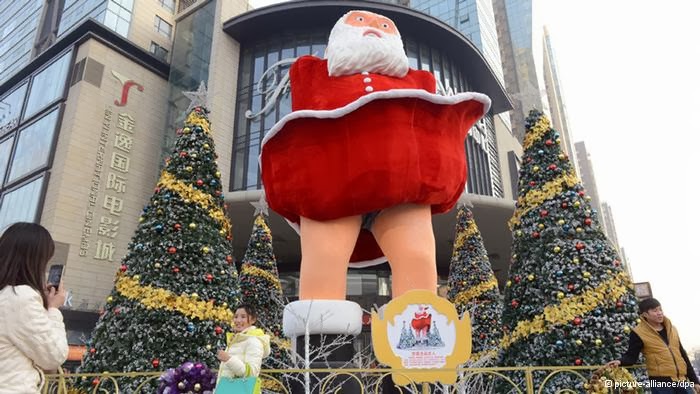
Santa poses Marilyn Monroe-style in Taiyuan, Shanxi province of China

In China, Christmas is celebrated not necessarily by giving gifts, says the economist, but rather, by splurging on a good meal. And this is where French, Italian and German restaurants profit. Deng says Western restaurants are some of the greatest financial beneficiaries of the Christmas season in China.

"The Chinese have a very strange reinterpretation of the Christmas celebration," Deng said. "You must go to a posh restaurant and have some foreign wine and some fine food. You are for that day, a European person." He laughs, adding, "You can appreciate they have such a romantic view about Christmas. You spend all your disposable income. You eat the best food of the year."

Multi-purpose merry wishes

And the interpretation of the Western holiday doesn't end there. "As a social norm, Chinese do send Christmas cards that say 'Merry Christmas,'" Deng said, estimating that about 100 million families will be sending cards this year. "This is a social formality. Often they link this to the New Year since it's only five days apart, so they'll copy the European style."

European or not. Christian or not, back in India, Navina Choudhury says religion isn't necessary to appreciate the holiday.

"I'm not a Christian, but my daughter has always had a Christmas tree. Santa brings gifts. It is a very important festival in India, even for non-Christians. We all celebrate it."

With additional reporting by Senada Sokullu in Istanbul.

Related Article: