Indonesia executes six drug convicts, five of them foreigners

Indonesia executes six drug convicts, five of them foreigners
Widodo has pledged to bring reform to Indonesia

Ban appeals to Indonesia to stop death row executions

Ban appeals to Indonesia to stop death row executions
United Nations Secretary General Ban Ki-moon has pleaded to Indonesia to stop the execution of prisoners on death row for drug crimes. AFP PHOTO

Pope: 'Death penalty represents failure' – no 'humane' way to kill a person

Pope: 'Death penalty represents failure' – no 'humane' way to kill a person
The pope wrote that the principle of legitimate personal defense isn’t adequate justification to execute someone. Photograph: Zuma/Rex

Obama becomes first president to visit US prison (US Justice Systems / Human Rights)

Obama becomes first president to visit US prison   (US Justice Systems / Human Rights)
US President Barack Obama speaks as he tours the El Reno Federal Correctional Institution in El Reno, Oklahoma, July 16, 2015 (AFP Photo/Saul Loeb)

US Death Penalty (Justice Systems / Human Rights)

US Death Penalty (Justice Systems / Human Rights)
Woman who spent 23 years on US death row cleared (Photo: dpa)


.

.
"The Recalibration of Awareness – Apr 20/21, 2012 (Kryon channeled by Lee Carroll) (Subjects: Old Energy, Recalibration Lectures, God / Creator, Religions/Spiritual systems (Catholic Church, Priests/Nun’s, Worship, John Paul Pope, Women in the Church otherwise church will go, Current Pope won’t do it), Middle East, Jews, Governments will change (Internet, Media, Democracies, Dictators, North Korea, Nations voted at once), Integrity (Businesses, Tobacco Companies, Bankers/ Financial Institutes, Pharmaceutical company to collapse), Illuminati (Started in Greece, with Shipping, Financial markets, Stock markets, Pharmaceutical money (fund to build Africa, to develop)), Shift of Human Consciousness, (Old) Souls, Women, Masters to/already come back, Global Unity.... etc.) - (Text version)

… The Shift in Human Nature

You're starting to see integrity change. Awareness recalibrates integrity, and the Human Being who would sit there and take advantage of another Human Being in an old energy would never do it in a new energy. The reason? It will become intuitive, so this is a shift in Human Nature as well, for in the past you have assumed that people take advantage of people first and integrity comes later. That's just ordinary Human nature.

In the past, Human nature expressed within governments worked like this: If you were stronger than the other one, you simply conquered them. If you were strong, it was an invitation to conquer. If you were weak, it was an invitation to be conquered. No one even thought about it. It was the way of things. The bigger you could have your armies, the better they would do when you sent them out to conquer. That's not how you think today. Did you notice?

Any country that thinks this way today will not survive, for humanity has discovered that the world goes far better by putting things together instead of tearing them apart. The new energy puts the weak and strong together in ways that make sense and that have integrity. Take a look at what happened to some of the businesses in this great land (USA). Up to 30 years ago, when you started realizing some of them didn't have integrity, you eliminated them. What happened to the tobacco companies when you realized they were knowingly addicting your children? Today, they still sell their products to less-aware countries, but that will also change.

What did you do a few years ago when you realized that your bankers were actually selling you homes that they knew you couldn't pay for later? They were walking away, smiling greedily, not thinking about the heartbreak that was to follow when a life's dream would be lost. Dear American, you are in a recession. However, this is like when you prune a tree and cut back the branches. When the tree grows back, you've got control and the branches will grow bigger and stronger than they were before, without the greed factor. Then, if you don't like the way it grows back, you'll prune it again! I tell you this because awareness is now in control of big money. It's right before your eyes, what you're doing. But fear often rules. …
Showing posts with label Health. Show all posts

Wednesday, December 30, 2020

Chinese citizen journalist jailed for Wuhan virus reporting

Yahoo – AFP, 28 December 2020 

Authoroties said former Chinese lawyer and citizen journalist
Zhang Zhan had spread "False remarks" online.

A Chinese citizen journalist was jailed for four years Monday for her reporting from Wuhan as the Covid-19 outbreak began, her lawyer said, almost a year after details of an "unknown viral pneumonia" surfaced in the central China city. 

Zhang Zhan, a former lawyer who arrived at court in a wheelchair, was sentenced at a brief hearing in a Shanghai court for allegedly "picking quarrels and provoking trouble" during her reporting in the chaotic initial stages of the outbreak. 

Her live reports and essays were shared on social media platforms in February, grabbing the attention of authorities, who have punished eight virus whistleblowers so far as they curb criticism of the government's response to the outbreak. 

Beijing has congratulated itself for "extraordinary" success in controlling the virus inside its borders, with an economy on the rebound while much of the rest of the world stutters through painful lockdowns and surging caseloads a year on from the start of the pandemic in Wuhan. 

Controlling the information flow during an unprecedented global health crisis has been pivotal in allowing China's communist authorities to reframe the narrative in their favour, with President Xi Jinping being garlanded for his leadership by the country's ruling party. 

But that has come at a serious cost to anyone who has picked holes in the official storyline. 

The court said Zhang Zhan had spread "false remarks" online, according to one of her lawyers Zhang Keke, but the prosecution did not fully divulge its evidence in court. 

"We had no way of understanding what exactly Zhang Zhan was accused of doing," he added, describing it as "a speedy, rushed hearing." 

In return the defendant "didn't respond [to questions]... She refused to answer when the judge asked her to confirm her identity." 

The defendant's mother sobbed loudly as the verdict was read out, Ren Quanniu, another member of Zhang's defence team, told reporters who were barred from entering the court. 

Concerns are mounting over the health of 37-year-old Zhang, who began a hunger strike in June and has been force-fed via a nasal tube. 

Her legal team said her health was in decline and she suffered from headaches, dizziness and stomach pain, and that she had appeared in court in a wheelchair. 

"She said when I visited her (last week): 'If they give me a heavy sentence then I will refuse food until the very end.'... She thinks she will die in prison," Ren said before the trial. 

"It's an extreme method of protesting against this society and this environment." 

China's communist authorities have a history of putting dissidents on trial in opaque courts between Christmas and New Year in an effort to minimise Western scrutiny. 

Example made

The sentencing comes just weeks before an international team of World Health Organization experts is expected to arrive in China to investigate the origins of Covid-19. 

Zhang was critical of the early response in Wuhan, writing in a February essay that the government "didn't give people enough information, then simply locked down the city". 

"This is a great violation of human rights," she wrote. 

Rights groups and embassies have also drawn attention to her case, although diplomats from several countries were denied requests to monitor the hearing. 

"Zhang Zhan's case raises serious concerns about media freedom in China," the British embassy in Beijing said, urging "China to release all those detained for their reporting." 

Authorities "want to use her case as an example to scare off other dissidents from raising questions about the pandemic situation in Wuhan earlier this year", added Leo Lan, research and advocacy consultant at the Chinese Human Rights Defenders NGO. 

A United Nations official following the trial also expressed "deep concern" about the verdict. 

"We raised her case with the authorities throughout 2020 as an example of the excessive clampdown on freedom of expression linked to #COVID19 & continue to call for her release," the office of the UN High Commissioner for Human Rights Michelle Bachelet said in a tweet. 

Zhang is the first of a group of four citizen journalists detained by authorities after reporting from Wuhan to face trial. 

Previous attempts by AFP to contact the other three -- Chen Qiushi, Fang Bin and Li Zehua -- were unsuccessful. 

Related Article:

(>13.46 Min - Reference to the Global Coronavirus crisis)

Monday, December 7, 2020

Indonesia minister arrested over pandemic aid corruption

Yahoo –AFP, December 6, 2020

Two Indonesian ministers have been arrested in recent weeks over
corruption allegations


Indonesia's social affairs minister was arrested Sunday for allegedly taking $1.2 million in bribes linked to food aid for those hit by the coronavirus pandemic.
 

Juliari Batubara was named as a suspect after Indonesian anti-corruption agents seized suitcases, backpacks and envelopes stuffed with cash equivalent to $1.2 million in a sting operation on Saturday. 

He turned himself in on Sunday at the anti-corruption agency's headquarters, becoming the second minister in President Joko Widodo's government to be arrested over alleged graft in recent weeks. 

"That's the people's money... it's aid urgently needed to help during Covid-19 and for the national economic recovery," Widodo said after Batubara's arrest, vowing he would not protect any corrupt officials. 

Indonesia's economy -- Southeast Asia's biggest -- has been hit hard by the pandemic, and the government has rolled out aid programmes such as food packages to help those in need. 

Batubara has been accused of involvement in a bribery scheme linked to one such aid project. 

Officials have alleged that he received more than $1 million from two contractors that were appointed to supply basic food packages for people affected by the pandemic. 

For each package, Batubara would receive 10,000 rupiah, or $0.71, officials alleged. 

If found guilty, he could face up to 20 years in prison and a fine of one billion rupiah ($70,000).

Wednesday, August 5, 2020

Aboriginal group blocks access to Australia's Uluru over virus fears

France24 – AFP , 4 August 2020

Tourists gather to watch the sunset at Uluru in 2019 Saeed KHAN AFP/File

Sydney (AFP) - Indigenous residents forced the closure of Australia's famed Uluru national park Tuesday, after blocking tourists from accessing the sacred site amid fears over the spread of coronavirus.

About 30 members of the local community physically blocked dozens of tourists arriving from virus-hit eastern Australia from accessing the park entrance, said Glenn Irvine, manager of Mutitjulu Community Aboriginal Corporation, which handles local community issues.

Locals said they were blindsided by the arrival of 43 tourists on a flight from Brisbane, Queensland and decided to take action.

"We were of the understanding that the flight was cancelled," Irvine told AFP.

"We asked for the national park to be closed," he added. When that did not happen, "members of the community gathered at the park gate".

After crisis talks with local authorities Tuesday, the park remained closed.

Uluru-Kata Tjuta National Park said in a statement: "We have the utmost respect for Uluru-Kata Tjuta's traditional owners and are continuing to work in good faith with them and all other parties to keep Mutitjulu residents safe."

More than 395,000 people visited the park in the 12 months to June 2019, according to Parks Australia.

Irvine said there was now tacit agreement that the tourists -- who remained nearby -- would be tested for the virus and no more groups would come from COVID-19 "hotspots".

Queensland has recorded just over 1,000 cases of the virus since the pandemic began and new cases have been relatively rare.

But even in areas where tourism is a mainstay of the local economy, many Aboriginal groups are fearful that any outbreak could badly hit remote Outback communities.

Travel to the Northern Territory, including Uluru -- once known as Ayer's Rock -- has been severely restricted since the pandemic began.

Those measures were recently eased, but visitors from Australia's COVID-19 hotpots are still required to quarantine for 14 days.

Brisbane is currently included on that list.

Overseas travellers remain banned from entering Australia except for some very closely prescribed cases.

Australia recorded 453 new cases Tuesday, taking the total to 18,728 with 10,787 recoveries. The death toll is now 232, after 11 more fatalities.

Sunday, March 15, 2020

Indonesian transportation minister tests positive for COVID-19

The Jakarta Post, March 14, 2020

Transportation Minister Budi Karya Sumadi (center) walks at Kertajati International
Airport in Majalengka, West Java, on March 1. The minister tested positive of
COVID-19, State Secretary Pratikno announced on Saturday evening. (Antara/
Dedhez Anggara)

Transportation Minister Budi Karya Sumadi has tested positive for COVID-19.

State Secretary Pratikno announced on Saturday evening that Budi was identified as Case 76 in a previous Health Ministry announcement and was being treated at the Gatot Subroto Army Hospital.

He declined to say when Budi had been admitted to the hospital or when he had likely been infected.

Budi reportedly attended a Cabinet meeting on Wednesday.

Pratikno said President Joko “Jokowi” Widodo had appointed Coordinating Maritime Affairs and Investment Minister Luhut Pandjaitan as ad interim transportation minister.

Gatot Subroto Army Hospital doctors said Budi’s condition was improving.

Thursday, February 13, 2020

Bat for sale at Indonesia's wildlife market despite virus warning

Yahoo – AFP, February 12, 2020

Scientists are debating how the novel coronavirus, which has killed more than
1,100 people in China and spread to dozens of countries around the world,
was transmitted to humans (AFP Photo/Ronny Adolof Buol)

Bats, rats and snakes are still being sold at an Indonesian market known for its wildlife offerings, despite a government request to take them off the menu over fears of a link to the deadly coronavirus.

Vendors at the Tomohon Extreme Meat market on Sulawesi island say business is booming and curious tourists keep arriving to check out exotic fare that enrages animal rights activists.

But scientists are debating how the new virus, which has killed more than 1,100 people in China and spread to dozens of countries around the world, was transmitted to humans.

A wildlife market in Wuhan, the epicentre of the virus, is thought to be ground zero and there is suspicion it could have originated in bats.

The possible link wasn't on many radar screens at the Indonesian market, however.

Vendors at the Tomohon Extreme Meat market on Sulawesi island say
business is booming (AFP Photo/Ronny Adolof Buol)

Its grubby stalls feature a dizzying array of animals including giant snakes, rats impaled on sticks and charred dogs with their hair seared off by blowtorches -- a gory scene described by some critics as "like walking through hell".

Bat seller Stenly Timbuleng says he's still moving his fare for as much as 60,000 rupiah ($4.40) a kilogram to buyers in the area, where bats are a speciality in local cuisine.

"I'm selling between 40 and 60 kilograms every day," the 45-year-old told AFP.

"The virus hasn't affected sales. My customers still keep coming."

Restaurateur Lince Rengkuan -- who serves bats including their heads and wings stewed in coconut milk and spices -- says the secret is preparation.

"If you don't cook the bat well then of course it can be dangerous," she said.

Stalls at the Tomohon Extreme Meat market on Sulawesi island feature
a dizzying array of animals (AFP Photo/Ronny Adolof Buol)

"We cook it thoroughly and so far the number of customers hasn't gone down at all."

This despite a request from the local government and the health agency to take bats and other wildlife out of circulation -- a call that has been all but ignored.

"We're also urging people not to consume meat from animals suspected to be carriers of a fatal disease," said Ruddy Lengkong, head of the area's government trade and industry agency.

Indonesia has not yet reported a confirmed case of the virus.

In the capital Jakarta, vendors selling skinned snakes and cobra blood on a recent Saturday night didn't have any trouble finding takers.

"It's good for you, sir," said one vendor of his slithering fare.

"Cures and prevents all diseases."

Tuesday, February 4, 2020

Indonesians protest use of island for virus quarantine

Yahoo – AFP, February 3, 2020

Health officials disinfect the evacuees from Wuhan, who will be quarantined on
the island of Natuna for two weeks (AFP Photo/HANDOUT)

Hundreds of residents of a remote Indonesian island protested Monday at the government's decision to use it to quarantine evacuees from the Chinese city at the epicentre of the coronavirus outbreak.

Indonesia has evacuated 237 citizens and one foreign national, married to an Indonesian, from Wuhan.

The evacuees, mostly students, landed Sunday and will be quarantined for 14 days on Natuna island, which lies between Borneo and Peninsular Malaysia.

"The government's decision to quarantine Indonesians who returned from China has made people feel uneasy, so we strongly reject it," Fadillah, one of the protesters who like many Indonesians goes with one name, told AFP.

The protesters, wearing green surgical masks, demonstrated in front of the local parliament building, demanding the local authorities relocate the evacuation centre away from a residential area.

"Whatever the reason and the explanation, we don't believe it. We believe this virus is very dangerous for people in Natuna," Fadillah said.

In response to the growing protest on the island, President Joko Widodo said the returnees had to be quarantined to ensure they were in good health before they can return home.

"Those people are healthy, however several stages are needed in health protocol before they can be returned to their family," Widodo said.

Following the evacuees' arrival on Natuna, the local government has shut down schools for two weeks and urged students to limit outdoor activities.

The coronavirus epidemic has infected more than 17,000 people across China and reached 24 nations, although Indonesia has not reported any confirmed cases so far.

Saturday, November 23, 2019

Foot fetish: Nibbles a specialty at Indonesian restaurant

Yahoo – AFP, November 22, 2019

Indonesian diners have lunch while fish nibble dead skin from their feet at a
restaurant at Wedomartani village in Yogyakarta (AFP Photo/OKA HAMIED)

Yogyakarta (Indonesia) (AFP) - As he scarfed down a traditional Indonesian meal, Adi Karyanov got himself the two-in-one special at a new restaurant offering pedicures by fish.

The tables and chairs at Soto Cokro Kembang in Indonesia's cultural capital Yogyakarta sit in ankle-deep water, home to thousands of little fish that nibble dead skin off the feet of diners.

"I felt the fish biting my feet -- it was ticklish but nice," Karyanov said.

"They make it fun to eat here. It's kind of unique."

Many spas across southeast Asia have for years touted a fishy pedicure as an unproven but novel way of treating various skin conditions.

But restaurant owner Imam Nur, who opened in June, has gone a step further by offering it alongside his traditional Javanese "sole food".

Nur credits his father for coming up with the idea for the open-air restaurant, which has some 7,000 Red Nile Tilapia swimming around its patrons.

A diner wades through a fish pond to her table to have a 
lunch while fish nibble at her feet at a restaurant in Indonesia
(AFP Photo/OKA HAMIED)

"We initially opened this restaurant just for locals living nearby," he said.

"But what's happening now is beyond what we had initially planned. It's become like culinary tourism. Many people are coming here from different cities."

Pressing fish into service to remove dead skin is not without controversy.

Some cities in North America and Europe have banned it over concerns about bacterial outbreaks, while People for the Ethical Treatment of Animals (PETA) has warned over both the health risks and possible cruelty to animals.

Still, visitors like Anna Widia were keen to give the fish treatment a whirl.

"I've never seen any place like this," she said.

"And it's big enough to bring the whole family."

Wednesday, September 25, 2019

Indonesian forest fires putting 10 million children at risk: UN

Yahoo – AFP, September 24, 2019

Indonesian children get a dose of oxygen from a Red Cross volunteer. UNICEF says
the forest fires are puttling nearly 10 million children at risk from the toxic air (AFP
Photo/Tri Iswanto)

Jakarta (AFP) - Indonesian forest fires are putting nearly 10 million children at risk from air pollution, the United Nations warned Tuesday, as scientists said the blazes were releasing vast amounts of greenhouse gases.

The fires have been spewing toxic haze over Southeast Asia in recent weeks, closing schools and airports, with people rushing to buy face masks and seek medical treatment for respiratory ailments.

Jakarta has deployed tens of thousands of personnel and water-bombing aircraft to tackle the slash-and-burn blazes set to clear agricultural land. The fires are an annual problem but this year are the worst since 2015 due to dry weather.

Almost 10 million people under 18 -- about a quarter below five -- live in the areas worst affected by fires on Indonesia's Sumatra island and the country's part of Borneo island, the UN children's agency UNICEF said.

Small children are especially vulnerable due to undeveloped immune systems while babies born to mothers exposed to pollution during pregnancy may have low birth weights and be delivered early, they said.

Thousands of schools have been closed across Indonesia due to poor 
air quality (AFP Photo/CHAIDEER MAHYUDDIN)

"Poor air quality is a severe and growing challenge for Indonesia," said Debora Comini from UNICEF.

"Every year, millions of children are breathing toxic air that threatens their health and causes them to miss school -- resulting in lifelong physical and cognitive damage."

Thousands of schools have been closed across Indonesia due to poor air quality, with millions of youngsters missing classes.

Schools were forced to shut across Malaysia last week as dense smog from its neighbour clouded the skies, while Singapore was also shrouded in haze during the weekend's Formula One motor race.

Air quality had however improved in Malaysia and Singapore Tuesday, and the skies were clearer.

There have been a series of wildfire outbreaks worldwide, from the Amazon to Australia, and scientists are increasingly worried about their impact on global warming.

From the start of August to September 18, the fires emitted about 360 
megatonnes of carbon dioxide (AFP Photo/Wahyudi)

The Copernicus Atmosphere Monitoring Service, part of the EU's Earth observation programme, said this year's Indonesian fires were releasing almost as much carbon dioxide into the atmosphere as blazes in 2015, the worst for two decades.

From the start of August to September 18, the fires emitted about 360 megatonnes of the greenhouse gas, compared to 400 megatonnes over the same period four years ago, the service said.

One megatonne is equivalent to one million tonnes.

At the peak of the 2015 crisis, the fires were emitting more greenhouse gases into the atmosphere each day than all US economic activity, according to environmental watchdog the World Resources Institute.

Tuesday, March 26, 2019

No quiet rules at Indonesia's flyover library

Yahoo – AFP, Harry PEARL, 25 March 2019

Despite its unlikely location, the Taman Baca Masyarakat Kolong open-air reading
 park has been a hit due to a shortage of public libraries where kids from this
area can read books outside school

Singing and laughter briefly drown out the roar of cars under a Jakarta flyover, where an unlikely library for kids is thriving despite choking fumes -- and opposition from menacing gangsters.

There's no quiet rule at this open-air reading park wedged between two lanes of traffic just outside Indonesia's capital, a city of some 30 million that is notorious for having some of the world's worst traffic jams.

Despite its unlikely location, the Taman Baca Masyarakat Kolong has been a hit. A shortage of public libraries means it's one of the few places where kids from this area can read books outside school.

"We wanted to bring books closer to the community," Devina Febrianti, a library coordinator, told AFP as car horns blared accompanied by choking exhaust fumes.

Several years ago, the flyover in suburb Ciputat, part of Jakarta's greater metropolitan area, was strewn with rubbish and roamed by intimidating street thugs, Febrianti said.

But armed with books and paint, local organisations set about transforming its down-and-out reputation.

Artists painted murals on the walls, installed planter boxes and a futsal pitch, and a library with several dozen books was built on site.

Still, it wasn't met with universal acclaim when it opened for business in 2016.

"In the beginning not everyone was supportive when we came with books because there were already other residents here," Febrianti said.

"We asked for forgiveness first from the gangsters who were here and then the 'angkot' drivers," she added, referring to cheap and ubiquitous minivans that provide public transport.

Winning over parents afraid that their children would be kidnapped or hit by a car was no mean feat, either.

'Smell, rubbish, loud noises'

But eventually, parents -- and even the street gangs -- warmed to the idea.

Today, it's not uncommon to see up to 70 kids attending after-school sessions, where they read stories with teachers, get help with homework, or sing and dance on concrete covered with green Astroturf.

Bookshelves are stuffed with hand-me-down kids books and some other less likely titles such as "Accounting" and "Glossary of Marketing Terms".

Emilia Clara, an 11-year-old student, said she liked reading stories, especially fairytales, with friends.

"It makes me happy and it's exciting," she told AFP in a brief interview, before rushing back to join the other kids.

And it has won over parents like Salmih Usia, a 41-year-old mother of two.

"This is a great place for learning, creating and playing," she said.

Free reading gardens, known as Taman Bacaan, have existed in various forms across Indonesia for several decades.

They're often run by NGOs or volunteer associations funded by public and private sector contributions.

Some 80 reading parks have been established this part of the sprawling capital, although there is only one located right below a flyover, Febrianti said.

In Hong Kong, a small outdoor library that doubled as a children's playground was set up under a flyover in the bustling city as part of research into how to better use community spaces, according to a report in the South China Morning Post last year.

Back in Indonesia, library volunteers admit the street-side location poses some potential health problems because of the fumes from traffic and the subsequent impact on air quality.

"But so far there haven't been any complaints about the smell, rubbish or loud noises," Febrianti said, adding: "We use a sound system, which is quite helpful for us to overcome the (noise) problem."


Friday, December 21, 2018

Indonesian third-grader's 'school crawl' becomes sensation

Yahoo – AFP, December 20, 2018

Mukhlis Abdul Holik's heartwarming story has become a sensation across
Indonesia (AFP Photo/CANTIGIE NUR FERDINAND)

Sukabumi (Indonesia) (AFP) - Indonesian third-grader Mukhlis Abdul Holik begins the long haul to school with a knapsack strapped to his back and hands stuffed into a pair of sandals -- to guard against road burn.

It is no ordinary trip for the eight-year-old. He has severely deformed feet and legs so tiny that he only reaches up to his classmates' waists when standing.

With his mom in tow, the gap-toothed pupil crawls from his West Java village across rocky paths and an old wooden bridge that he navigates on his hands alone, as his sneakers dangle in the air.

Holik crawls from his West Java village across rocky paths and an old wooden 
bridge that he navigates on his hands alone, as his sneakers dangle in the air 
(AFP Photo/CANTIGIE NUR FERDINAND)

Holik's heartwarming story has become a sensation across the country of 260 million, and earned him a meeting with Indonesian president Joko Widodo, after media covered his trip to school and back -- a distance of nearly six kilometres.

"The road is steep but he crawls every day," said Holik's mother Pipin, who like many Indonesians goes by one name.

"If we've got money, then he can take a motorcycle taxi but if things are tight, he's got to crawl. He never complains.... rain or shine, he always goes to school."

Holik declared himself "very happy" after meeting Indonesian President 
Joko Widodo (AFP Photo/CANTIGIE NUR FERDINAND)

Holik met the country's leader on December 3 -- the UN's International Day of Persons with Disabilities.

"I asked Abdul when we met if he wanted anything from me," Widodo said in a statement.

"I thought he'd want me to give him a present. But he didn't want anything. He just said he wanted to go to university."

The pupil declared himself "very happy" for meeting his idol Widodo, who got a full report on Holik's ambitious future plans.

"I want to be a firefighter, a doctor and an astronaut," he told AFP.

Wednesday, October 18, 2017

Despite the clear seas and white sandy beaches of Raja Ampat, Indonesia, the islands' children face the gloomy reality of poor education

Sunday, January 29, 2017

Hoping for a fresh sea breeze aboard a cruise ship? Better hold your nose!

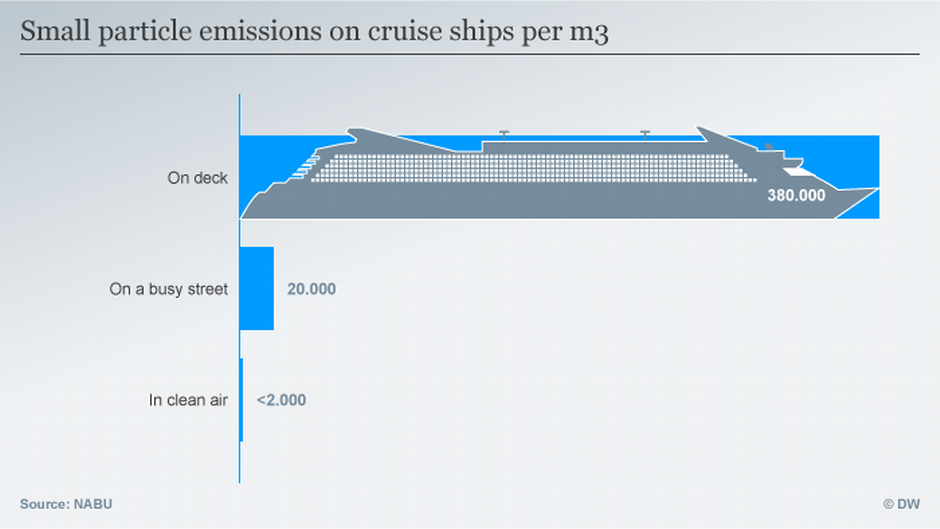
French TV journalists have secretly measured the air quality on a cruise ship. The results are devastating: The air is significantly worse polluted than it would be in thick urban traffic.


Deutsche Welle, 26 January 2017

Cruises are increasingly popular among today's tourists. They offer relaxation with 24-hour service for stressed out office workers.

Forget about searching for the perfect, pristine beach - which most people will never find, anyhow. Instead, just go to the pool on the upper deck, enjoy some tasty drinks and take in breathtaking views of the ocean from high above. For people who need less contemplation, cruises offer theater and show performances, generous meals, bars and shopping opportunities.

That doesn't mean you're in for a boring vacation: Adventure comes as part of the risk free deal. Even frail seniors can now feel like mystic characters such as Long John Silver from Treasure Island or real explorers like Roald Amundsen - be it by cruising the romantic Carribean, visiting savage South Sea islands or admiring polar bears on impenetrable arctic shores. Finally you can do something for your health by going to the ship's gym and getting a good work out.

Tourists want to enjoy themselves - and the fresh sea breeze.

But you better think twice about taking a deep breath. The German Environmental Association "Naturschutzbund Deutschland"(NABU) now warns that it is more likely you inhale polluted air than a fresh breeze. NABU says that it cannot recommend any of the large European cruise ships.

"Pamphlets lead you to believe that there are blue skies and white ships - a dream-like setting," Daniel Rieger, who is in charge of transportation policies at NABU, said. "The truth is that clouds of black soot are emitted from the funnels."

Measuring results are worse than expected

Recent measurements of actual air quality onboard a cruise ship seem to support NABU's view. French TV journalists from broadcaster France 3 conducted covert measurements while on a cruise. They boarded a ship in Marseille for a cruise of the Mediterranean.

Results show that "the shipping companies are exposing their travelers to high concentrations of harmful substances," NABU managing director Leif Miller concluded.

Even environmentalists were surprised by the high concentrations that the journalists detected. Right after leaving Marseille, air pollution was roughly 200 times that of a heavily trafficked urban street.

Besides fine dust and soot, the combustion of marine diesel fuel and heavy oil also set free other harmful substances such as nitrogen oxides and heavy metals.


Former captain and ship broker Helge Grammerstorf, who is the German national director of the Cruise Lines International Association CLIA, defends his industry. He told the daily "Hamburger Abendblatt:" "We don't know these measurements. The claim is completely unsubstantiated."

Grammerstorf argues that the measurements were taken only selectively and that one would need to run a more systematic test to collect data over a longer time period.

Hardly noticeable for passengers

"The passengers can only smell or see the particles before they get mixed up with the ambient air," NABU spokesman Rieger said after the France 3 test results were published.

He argued that it wouldn't take the shipping companies much to change the pollution and to increase comfort. "Even switching from marine diesel fuel or heavy oil to regular road diesel fuel would make a big difference," he said.

In addition, it wouldn't be too hard to install effective exhaust cleaning systems, according to NABU. Such systems have long existed with established standards for trucks and trains.
"The question is whether the industry deliberately looks the other way," Dietmar Oellinger - NABU's transport expert - said.

He suggested that the tests taken by the French journalists were merely an example and could possibly be representative for the entire cruise ship industry.

"The reality is black soot from the chimneys," NABU environmentalists say.

"We should ask how much more proof the industry needs before they finally take action," Oellinger said.

Some cruise lines have pledged to install particle filters, but so far, there are none in use.

Covert measuring only in the harbor

Previously, NABU has only had the opportunity to measure harmful ultra fine dust particles in the air around cruise ships in harbors. They have done so in Hamburg, Venice and the north-eastern German city of Rostock-Warnemünde. The ship owners did not allow the environment agency to take measurements on board, Daniel Rieger said.

The results were devastating nonetheless: In all cases the ships were burning off heavy oil. Four of five ships were not equipped with any exhaust gas cleaning or they were only fulfilling the lowest legal standard for northern Europe - a system that only reduces sulfur oxide emissions.

Technical solutions to reduce particle and nitrogen oxide emissions have long been on the market, though. Therefore, NABU argues, not implementing them is largely due to greed. It would cost money to install the system and furthermore require the companies to use more expensive types of fuel.

Almost as dangerous as asbestos

The German Lung Foundation already recommended several years ago that people with chronic respiratory diseases only stay on certain parts of the deck when on a cruise ship and thus avoide breathing in the ship's exhaust.

The World Health Organization (WHO) has concluded that diesel exhaust is just as carcinogenic as asbestos. The ultrafine particles, which are smaller than 0.1 micrometer can get into the smallest pulmonary alveoli and from there into the blood stream and other organs.

NABU manager Leif Miller argues it's cynical that the cruise ship companies "pay huge sums to improve entertainment and gastronomical services on board, but save as much as they can when it comes to environmental protection."

Meanwhile, in Germany the cruise ship industry is getting ready for the next season: In Warnemünde, Hamburg and Kiel alone, more than two million passengers are expected to board the giants of the seas in 2017.

Related Articles: