Indonesia executes six drug convicts, five of them foreigners

Indonesia executes six drug convicts, five of them foreigners
Widodo has pledged to bring reform to Indonesia

Ban appeals to Indonesia to stop death row executions

Ban appeals to Indonesia to stop death row executions
United Nations Secretary General Ban Ki-moon has pleaded to Indonesia to stop the execution of prisoners on death row for drug crimes. AFP PHOTO

Pope: 'Death penalty represents failure' – no 'humane' way to kill a person

Pope: 'Death penalty represents failure' – no 'humane' way to kill a person
The pope wrote that the principle of legitimate personal defense isn’t adequate justification to execute someone. Photograph: Zuma/Rex

Obama becomes first president to visit US prison (US Justice Systems / Human Rights)

Obama becomes first president to visit US prison   (US Justice Systems / Human Rights)
US President Barack Obama speaks as he tours the El Reno Federal Correctional Institution in El Reno, Oklahoma, July 16, 2015 (AFP Photo/Saul Loeb)

US Death Penalty (Justice Systems / Human Rights)

US Death Penalty (Justice Systems / Human Rights)
Woman who spent 23 years on US death row cleared (Photo: dpa)


.

.
"The Recalibration of Awareness – Apr 20/21, 2012 (Kryon channeled by Lee Carroll) (Subjects: Old Energy, Recalibration Lectures, God / Creator, Religions/Spiritual systems (Catholic Church, Priests/Nun’s, Worship, John Paul Pope, Women in the Church otherwise church will go, Current Pope won’t do it), Middle East, Jews, Governments will change (Internet, Media, Democracies, Dictators, North Korea, Nations voted at once), Integrity (Businesses, Tobacco Companies, Bankers/ Financial Institutes, Pharmaceutical company to collapse), Illuminati (Started in Greece, with Shipping, Financial markets, Stock markets, Pharmaceutical money (fund to build Africa, to develop)), Shift of Human Consciousness, (Old) Souls, Women, Masters to/already come back, Global Unity.... etc.) - (Text version)

… The Shift in Human Nature

You're starting to see integrity change. Awareness recalibrates integrity, and the Human Being who would sit there and take advantage of another Human Being in an old energy would never do it in a new energy. The reason? It will become intuitive, so this is a shift in Human Nature as well, for in the past you have assumed that people take advantage of people first and integrity comes later. That's just ordinary Human nature.

In the past, Human nature expressed within governments worked like this: If you were stronger than the other one, you simply conquered them. If you were strong, it was an invitation to conquer. If you were weak, it was an invitation to be conquered. No one even thought about it. It was the way of things. The bigger you could have your armies, the better they would do when you sent them out to conquer. That's not how you think today. Did you notice?

Any country that thinks this way today will not survive, for humanity has discovered that the world goes far better by putting things together instead of tearing them apart. The new energy puts the weak and strong together in ways that make sense and that have integrity. Take a look at what happened to some of the businesses in this great land (USA). Up to 30 years ago, when you started realizing some of them didn't have integrity, you eliminated them. What happened to the tobacco companies when you realized they were knowingly addicting your children? Today, they still sell their products to less-aware countries, but that will also change.

What did you do a few years ago when you realized that your bankers were actually selling you homes that they knew you couldn't pay for later? They were walking away, smiling greedily, not thinking about the heartbreak that was to follow when a life's dream would be lost. Dear American, you are in a recession. However, this is like when you prune a tree and cut back the branches. When the tree grows back, you've got control and the branches will grow bigger and stronger than they were before, without the greed factor. Then, if you don't like the way it grows back, you'll prune it again! I tell you this because awareness is now in control of big money. It's right before your eyes, what you're doing. But fear often rules. …
Showing posts with label Waste Management. Show all posts

Friday, February 22, 2019

Indonesians clean up the beach one sandal at a time

Yahoo – AFP, February 21, 2019

The yearly campaign kicked into action after rubbish was getting trapped in the
fishing nets of locals (AFP Photo/PERDIANSYAH)

Hundreds of people sifted through a vast wasteland of rubbish strewn across a beach in Indonesia on Thursday, underscoring the Southeast Asian archipelago's mammoth marine waste problem

Some 200 students, military personnel and locals scoured a beach on the southern tip of Sumatra island, picking up rubbish as they waded through heaps of plastic, discarded flip flops and other debris.

In just over three hours, the group collected an eye-watering 30 tonnes of rubbish from the coast in Lampung province.

The yearly campaign first kicked into action in 2010 after huge amounts of rubbish were getting trapped in the fishing nets of locals who made their living off the sea.

Most of the detritus had flowed in from the provincial capital.

Other rubbish clearing campaigns have popped up across Indonesia, the world's second biggest contributor to marine debris after China.

In holiday hotspot Bali, the problem has become so bad that officials declared a "garbage emergency" two years ago after a stretch of coast was swamped with rubbish.

Last year, a sperm whale was found dead in a marine park off Sulawesi island with 115 plastic cups and 25 plastic bags in its stomach.

The archipelago of some 17,000 islands has pledged to reduce marine plastic waste by 70 percent by 2025.


Thursday, April 12, 2018

Trouble in Paradise: Tourism surge lashes Southeast Asia's beaches

Yahoo – AFP, Lillian SUWANRUMPHA with Joe FREEMAN in Bangkok and AFP bureaus,  April 11, 2018

Thailand received 35 million tourists last year, of whom nearly 10 million hailed
from China, according to official data (AFP Photo/Lillian SUWANRUMPHA)

Hordes of tourists clamber across the white sand with selfie sticks as Thai park rangers wade into turquoise waters to direct boats charging into the cliff-ringed cove.

Made famous by the 2000 movie "The Beach" starring Leonardo DiCaprio, Maya Bay on the western Thai island of Koh Phi Phi Ley is now a case study in the ruinous costs of runaway tourism, swamped by up to 4,000 daily visitors.

"There is too many people here, it's bad," lamented Saad Lazrak, a 61-year-old from Morocco, as crowds around him swallowed the stretch of sand encircled by an amphitheatre of limestone cliffs.

Across the region, Southeast Asia's once-pristine beaches are reeling from decades of unchecked tourism as governments scramble to confront trash-filled waters and environmental degradation without puncturing a key economic driver.

Thailand's Maya Bay will be off limits for four months from June to September, officials announced last month, in a bid to save its ravaged coral reefs.

In the Philippines, President Rodrigo Duterte ordered this month the Boracay beach resort closed to tourists for up to six months from April 26, describing the destination as a "cesspool" tainted by sewage dumped directly into the sea.

Indonesian officials, meanwhile, declared a "garbage emergency" last year swamping a six-kilometre stretch of coast along the island of Bali.

The island's grim coastal pollution was highlighted in March by British diver Rich Horner's viral video of swimming through a sea of trash swirling off shore.

"Plastic bags, more plastic bags, plastic, plastic, so much plastic!" Horner said in a Facebook post that has been viewed more than a million times.

Thailand's Maya Bay will be off limits for four months from June to September 
in a bid to save its ravaged coral reefs (AFP Photo/Lillian SUWANRUMPHA)

Breathing space

Conservationists and governments are worried about the health of coral reefs, which are in a dire state globally due to climate change and rising sea temperatures.

When exposed to warmer waters, they shed the algae that dazzle the eye and are vital to marine eco-systems, leaving the corals diseased or bone-white in a process called bleaching.

Environmental stress, including pollution, human contact and exposure to plastics that comes with mass tourism are also major threats to reefs that are part of the draw for snorkellers and scuba-divers.

"Tourism has a series of detrimental effects on coral health," said Eike Schoenig, a Thailand-based marine biologist at the Center for Oceanic Research and Education.

Countries in Southeast Asia are looking to stem the threats without cutting off the cash flow of a regional tourism boom, led by China, the top source market for travellers to the region.

Thailand received 35 million tourists last year, of whom nearly 10 million hailed from China, according to official data.

But what is good for business can be bad for beaches.

Songtam Suksawang, Thailand's National Park Office Director, told AFP he personally inspected the beach at Maya Bay and said it "must definitely be (temporarily) closed" in order to rehabilitate it.

He said authorities are discussing new rules once the shut-down is lifted, such as restrictions on the number of daily visitors, better regulation of boats and a higher entrance fee.

Made famous by the 2000 movie 'The Beach' starring Leonardo DiCaprio, Maya Bay
 on the western Thai island of Koh Phi Phi Ley is now a case study in the ruinous 
costs of runaway tourism (AFP Photo/Lillian SUWANRUMPHA)

Tourism costs

Thailand is also conducting studies on six other marine parks, while the Philippines is weighing action on other top destinations buckling under mass tourism.

But governments are wary of curtailing an industry that creates jobs and buoys economies.

Spending on travel and tourism contributed nearly $136 billion to the region's GDP in 2017, a figure forecast to rise to $144 billion this year, according to the World Travel & Tourism Council.

The cost of the closures is already being felt in the Philippines, where hundreds of Boracay hotels and tour companies are facing steep losses from cancelled rooms, flights and other bookings.

But some countries are not taking such dramatic steps.

In Indonesia, the tourism ministry said there were no plans to close Bali or any other holiday destination in the archipelago, although it acknowledged that pockets of the tropical paradise were under strain from heavy tourism.

"Shut down Bali? I don't think we will need to do that yet," said ministry spokesman Guntur Sakti. "Bali is the centre of Indonesian tourism."

In fact, Indonesia has identified 10 other destinations where it is trying to boost visitors and replicate Bali's success, including neighbouring island Lombok and Lake Toba in Sumatra.

Experts are also sceptical that short shut-downs will have lasting effects.

Fire dancers perform for tourists on the southern Thai island of Koh Phi Phi, which
is swamped by up to 4,000 daily visitors (AFP Photo/Lillian SUWANRUMPHA)

"Bottom line is that temporarily closing the beach is probably not the optimal solution to these problems. It only take a day for a bunch of incompetent snorkellers to trash a small reef," said Andrew Baird from the ARC Centre of Excellence for Coral Reef Studies in Australia.

In Thailand, the government hopes to draw people to lesser known beaches.

"We are working very hard to spread people out, not to go to one condensed area," said Thon Thamrongnawasawat, a marine expert working with the parks and tourism authorities.

Travellers to Maya Bay might like the idea.

"It's very touristy. There wasn't a patch of sand that didn't have people laying down on it, taking photos," Oliver Black, a 22-year-old tourist, said of his afternoon at the destination.

As for his thoughts on the looming closure?

"It would not really upset me if I wasn't able to go to (back to) Maya beach," he told AFP.
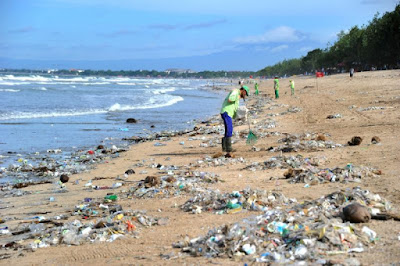
The Indonesian holiday island has become an embarrassing poster child for the
country's trash problem (AFP Photo/SONNY TUMBELAKA)

Sunday, March 11, 2018

Dutch packaging industry has two years to solve plastic bottle problem

DutchNews, March 10, 2018


The Dutch government has given the packaging industry until 2021 to boost the recycling of small plastic bottles or face the introduction of a deposit system. 

‘Litter is bad for the environment and the public mood,’ junior environment minister Stientje van Veldhoven said in a briefing for MPs about the plans. ‘We’ve all seen the pictures, the roadside full of litter, the Bali beach covered in bottles, animals full of plastic in the oceans. It has to stop.’ 

The industry must ensure 90% of throwaway plastic bottles are recycled and that the number of plastic bottles in litter is cut by 70% to 90% to avoid the introduction of deposits of 10 to 15 cents on plastic bottles. 

The results of the industry’s efforts will be assessed in autumn 2020. If the target has not been met, deposits will be introduced on small bottles from January 1, 2021, the minister said. 

Almost 200 Dutch local authorities and other organisations have now signed up to a campaign aimed at bringing in deposits on cans and small plastic bottles. 

The Statiegeldalliantie was launched in November with 21 organisations, including the North Sea foundation and aims to persuade Dutch and Belgian governments to widen the use of deposits. 

In 2015, the Dutch government tore up an agreement with the packaging industry to end the current system of deposits on plastic bottles. The industry argued there would be major cost advantages if deposits were scrapped but the cost savings, in a report commissioned by the industry, were later shown to be exaggerated.

The Indonesian holiday island has become an embarrassing poster child for the
country's trash problem (AFP Photo/SONNY TUMBELAKA)

Related Article:


Friday, December 29, 2017

Bali declares 'garbage emergency' amid sea of waste

Yahoo – AFP, Bagus SARAGIH, December 28, 2017

The Indonesian holiday island has become an embarrassing poster child for the
country's trash problem (AFP Photo/SONNY TUMBELAKA)

Kuta (Indonesia) (AFP) - Bali's palm-fringed Kuta beach has long been a favourite with tourists seeking sun and surf, but nowadays its golden shoreline is disappearing under a mountain of garbage.

Plastic straws and food packaging are strewn between sunbathers, while surfers bobbing behind the waves dodge waste flushed out from rivers or brought in by swirling currents.

"When I want to swim, it is not really nice. I see a lot of garbage here every day, every time," Austrian traveler Vanessa Moonshine explains.

"It's always coming from the ocean. It's really horrible," she adds.

Often dubbed a paradise on earth, the Indonesian holiday island has become an embarrassing poster child for the country's trash problem.

The archipelago of more than 17,000 islands is the world's second biggest contributor to marine debris after China, and a colossal 1.29 million metric tons is estimated to be produced annually by Indonesia.

The waves of plastic flooding into rivers and oceans have been causing problems for years -- clogging waterways in cities, increasing the risk of floods, and injuring or killing marine animals who ingest or become trapped by plastic packaging.

Officials in Bali have declared a "garbage emergency" across a stretch of coast that 
includes Jimbaran, Kuta and Seminyak beaches (AFP Photo/SONNY TUMBELAKA)

The problem has grown so bad that officials in Bali last month declared a "garbage emergency" across a six-kilometre (3.7-mile) stretch of coast that included popular beaches Jimbaran, Kuta and Seminyak.

Officials deployed 700 cleaners and 35 trucks to remove roughly 100 tons of debris each day to a nearby landfill.

"People with green uniform were collecting the garbage to move it away but the next day I saw the same situation," said German Claus Dignas, who claimed he saw more garbage with each visit to the island.

"No one wants to sit on nice beach chairs and facing all this rubbish," he added.

Bali's rubbish problem is at its worst during the annual monsoon season, when strong winds push marine flotsam onto the beach and swollen rivers wash rubbish from riverbanks to the coast, according to Putu Eka Merthawan from the local environment agency.

"This garbage does not come from people living in Kuta and nearby areas," he told AFP.

"It would be suicidal if Kuta people were doing it."

War on waste

Some 72 kilometres from Kuta, Mount Agung has been threatening to erupt for two months, prompting tourists to cancel visits and displacing tens of thousands of villagers living within a 10 kilometre-radius of the volcano's crater.

Indonesia is the world's second biggest contributor to marine debris after 
China (AFP Photo/SONNY TUMBELAKA)

But the island's waste problem is no less of a threat, said I Gede Hendrawan, an environmental oceanography researcher from Bali's Udayana University.

"Garbage is aesthetically disturbing to tourists, but plastic waste issue is way more serious," he told AFP.

"Microplastics can contaminate fish which, if eaten by humans, could cause health problems including cancer."

Indonesia is one of nearly 40 countries that are part of UN Environment's Clean Seas campaign, which aims to halt the tide of plastic trash polluting the oceans.

As part of its commitment, the government has pledged to reduce marine plastic waste by 70 percent by 2025.

It plans to boost recycling services, curb the use of plastic bags, launch cleanup campaigns and raise public awareness.

Still, the scale of the problem facing Indonesia is huge, due to its population of more than 250 million and poor waste processing infrastructure.

Hendrawan, who says both locals and tourists are responsible for the island's rubbish problem, urged authorities to invest more resources to tackle the problem.

"The Bali government should spare more budget to raise people's awareness to take care of local rivers, not to dump waste," he said.

"The central government should boost the campaign to reduce use of plastic packaging and ban free plastic bags at convenient stores."


Saturday, March 21, 2015

In Bali’s Demon Parade, Plastic

Jakarta Globe, Nadia Bintoro, Mar 20, 2015

The artist Made Bayak wants to raise awareness about the unsustainable
 use of plastic in Bali, through his project to build an ogoh-ogoh for Nyepi
the traditional way. (JG Photos/Nadia Bintoro)

As Hindus in Bali prepare to mark the sacred day of Nyepi, or the Day of Silence,  that falls this Saturday, myriad spooky-looking monster effigies, known as ogoh-ogoh, have begun popping up in  villages across the island.

Nyepi marks the start of the New Year in the Balinese Saka calendar, and as such is the most important religious celebration for the island’s Balinese faithful. The celebrations leading up to the day begin with the purification ceremony of Melasti, which takes place three to four days before in a temple by the sea, culminating on the eve of Nyepi with the burning of the ogoh-ogoh.

A representation of evil spirits, ogoh-ogoh are larger-than-life effigies of demons, symbolizing negative elements or malevolent spirits. During the Bhuta Yajna ritual, on the night before Nyepi, the ogoh-ogoh are paraded around each village and then set alight, in a symbolic act of vanquishing all negative elements and restoring the balance between the gods, mankind and nature.

It represents a total cleansing before welcoming Nyepi, a day reserved for self-reflection, when all activities that may hinder such purpose are prohibited. As such, there is no lighting of fires, no working, no entertainment activities and no traveling during Nyepi, with Bali’s airport shut down for the day.

In the past, ogoh-ogoh were made from bamboo and paper. In recent years, though, the artisans who make them have increasingly turned to the more pliable medium of Styrofoam — a choice of convenience, but one that goes against the meaning of Nyepi as a day for getting back in balance with nature.

Local artist Made Bayak is leading a small revolution to take the ogoh-ogoh back to its environmentally conscious roots. He does this by constructing his ogoh-ogoh from plastic waste, to symbolize the true evils that have engulfed the resort island in recent years.

An artist-cum-environmental activist, Bayak hails from Banjar Sakih ward in Gianyar district, and studied at the Indonesia Institute of Arts in Denpasar.

In his third year there he began experimenting with art using plastic as his medium. He went on to exhibit the resulting works in a show titled “Plastiliticum,” an indictment of the “age of plastic” in which he says mankind has mired itself.

“I believe that after the megalithic and paleolithic, mankind is entering the new era of Plastiliticum,” Bayak says.

“If we continue consuming plastics like we do, archaeologists in the future will only dig up plastic as the remnants of our civilization.”

Bayak’s “Plastiliticum” expanded over the years and is now a project titled “Plasticology,” which the artist has been working on for the past five years.

The project has yielded numerous works of art, from paintings to statues, that employ plastic waste and other castoffs that Bayak collected himself from landfills.

To mark Nyepi this year, Bayak is challenging himself to extend the “Plasticology” theme by incorporating an important cultural celebration into his art to create an even bigger momentum in his push for greater awareness.

 “Creating this ogoh-ogoh along the youngsters in my village is my way of campaigning against the trend of making ogoh-ogoh using Styrofoam,” he says.

“It is also a way of educating the youngsters on the dangers of Styrofoam, which releases a toxic smoke when it burns. Even during the sculpting process, the fine Syrofoam grains can be very dangerous if inhaled by the artists.”

Through his ogoh-ogoh, Bayak is also declaring war on the culture of instant gratification that pervades life in Bali in the contemporary age.

“It seems everybody in Bali nowadays is so caught up with the instant lifestyle. They want everything to come quick and easy, and forget about the real essence of the making of ogoh-ogoh,” he says.

“Ogoh-ogoh is essentially a symbol of Bhutakala or the bad traits that people possess. During the Tawur Kesanga ceremony on the night before Nyepi, when people burn the ogoh-ogoh, there’s a term, ‘nyomia,’ which is about turning the traits of Bhutakala into God’s traits.

“So it’s about salvation and how to make something that’s bad good again. This is what I want to achieve with the use of plastic waste in making this ogoh-ogoh. It’s recycling through culture, as I believe Styrofoam and plastic are just another form of the evil Bhutakala.”

With the help of his four nephews and local youths, Bayak is rushing to finish his ogoh-ogoh before Nyepi. The frame is constructed out of bamboo, the body will be padded out with papier-mache using old newspapers, while plastic waste will be used for the outer embellishments and for adding color.

“The challenge was to find the right plastic rubbish to create the artistic coloring that I envision for the surface. I had to visit a lot of landfills in Bali to dig up these treasures,” Bayak says.

He says he hopes this practice of re-using plastic waste will catch on among the people who turn out to watch the ogoh-ogoh parade and the subsequent burning tonight.

Bayak also continues to hold regular exhibitions of plastic-waste art, as well as workshops for local schools and communities, where he teaches children how to make dolls and paintings using plastic waste.

 “These projects are all still self-financed, but I believe art is a useful and effective method to raise awareness of this issue, especially among the kids. It’s important to plant the seeds of reuse and recycle in these little minds,” Bayak says.