Indonesia executes six drug convicts, five of them foreigners

Indonesia executes six drug convicts, five of them foreigners
Widodo has pledged to bring reform to Indonesia

Ban appeals to Indonesia to stop death row executions

Ban appeals to Indonesia to stop death row executions
United Nations Secretary General Ban Ki-moon has pleaded to Indonesia to stop the execution of prisoners on death row for drug crimes. AFP PHOTO

Pope: 'Death penalty represents failure' – no 'humane' way to kill a person

Pope: 'Death penalty represents failure' – no 'humane' way to kill a person
The pope wrote that the principle of legitimate personal defense isn’t adequate justification to execute someone. Photograph: Zuma/Rex

Obama becomes first president to visit US prison (US Justice Systems / Human Rights)

Obama becomes first president to visit US prison   (US Justice Systems / Human Rights)
US President Barack Obama speaks as he tours the El Reno Federal Correctional Institution in El Reno, Oklahoma, July 16, 2015 (AFP Photo/Saul Loeb)

US Death Penalty (Justice Systems / Human Rights)

US Death Penalty (Justice Systems / Human Rights)
Woman who spent 23 years on US death row cleared (Photo: dpa)


.

.
"The Recalibration of Awareness – Apr 20/21, 2012 (Kryon channeled by Lee Carroll) (Subjects: Old Energy, Recalibration Lectures, God / Creator, Religions/Spiritual systems (Catholic Church, Priests/Nun’s, Worship, John Paul Pope, Women in the Church otherwise church will go, Current Pope won’t do it), Middle East, Jews, Governments will change (Internet, Media, Democracies, Dictators, North Korea, Nations voted at once), Integrity (Businesses, Tobacco Companies, Bankers/ Financial Institutes, Pharmaceutical company to collapse), Illuminati (Started in Greece, with Shipping, Financial markets, Stock markets, Pharmaceutical money (fund to build Africa, to develop)), Shift of Human Consciousness, (Old) Souls, Women, Masters to/already come back, Global Unity.... etc.) - (Text version)

… The Shift in Human Nature

You're starting to see integrity change. Awareness recalibrates integrity, and the Human Being who would sit there and take advantage of another Human Being in an old energy would never do it in a new energy. The reason? It will become intuitive, so this is a shift in Human Nature as well, for in the past you have assumed that people take advantage of people first and integrity comes later. That's just ordinary Human nature.

In the past, Human nature expressed within governments worked like this: If you were stronger than the other one, you simply conquered them. If you were strong, it was an invitation to conquer. If you were weak, it was an invitation to be conquered. No one even thought about it. It was the way of things. The bigger you could have your armies, the better they would do when you sent them out to conquer. That's not how you think today. Did you notice?

Any country that thinks this way today will not survive, for humanity has discovered that the world goes far better by putting things together instead of tearing them apart. The new energy puts the weak and strong together in ways that make sense and that have integrity. Take a look at what happened to some of the businesses in this great land (USA). Up to 30 years ago, when you started realizing some of them didn't have integrity, you eliminated them. What happened to the tobacco companies when you realized they were knowingly addicting your children? Today, they still sell their products to less-aware countries, but that will also change.

What did you do a few years ago when you realized that your bankers were actually selling you homes that they knew you couldn't pay for later? They were walking away, smiling greedily, not thinking about the heartbreak that was to follow when a life's dream would be lost. Dear American, you are in a recession. However, this is like when you prune a tree and cut back the branches. When the tree grows back, you've got control and the branches will grow bigger and stronger than they were before, without the greed factor. Then, if you don't like the way it grows back, you'll prune it again! I tell you this because awareness is now in control of big money. It's right before your eyes, what you're doing. But fear often rules. …
Showing posts with label Marina. Show all posts

Sunday, January 29, 2017

Hoping for a fresh sea breeze aboard a cruise ship? Better hold your nose!

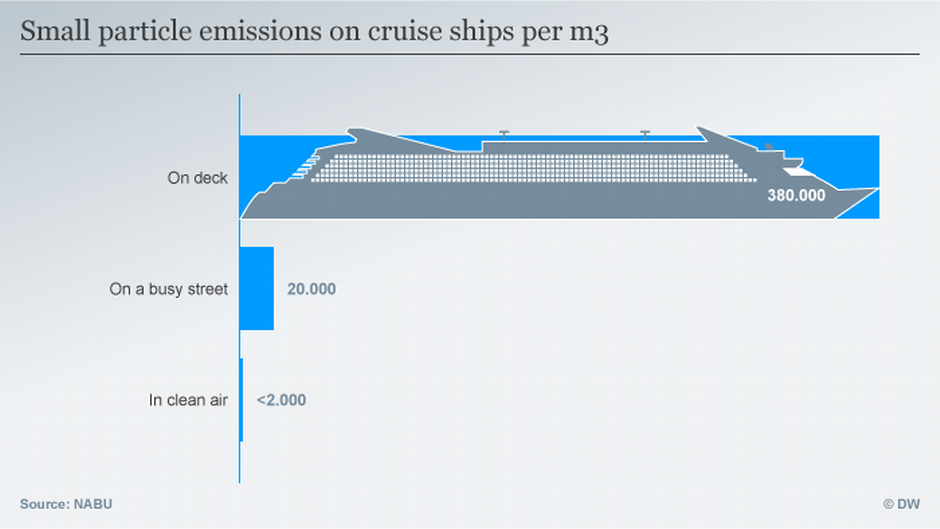
French TV journalists have secretly measured the air quality on a cruise ship. The results are devastating: The air is significantly worse polluted than it would be in thick urban traffic.


Deutsche Welle, 26 January 2017

Cruises are increasingly popular among today's tourists. They offer relaxation with 24-hour service for stressed out office workers.

Forget about searching for the perfect, pristine beach - which most people will never find, anyhow. Instead, just go to the pool on the upper deck, enjoy some tasty drinks and take in breathtaking views of the ocean from high above. For people who need less contemplation, cruises offer theater and show performances, generous meals, bars and shopping opportunities.

That doesn't mean you're in for a boring vacation: Adventure comes as part of the risk free deal. Even frail seniors can now feel like mystic characters such as Long John Silver from Treasure Island or real explorers like Roald Amundsen - be it by cruising the romantic Carribean, visiting savage South Sea islands or admiring polar bears on impenetrable arctic shores. Finally you can do something for your health by going to the ship's gym and getting a good work out.

Tourists want to enjoy themselves - and the fresh sea breeze.

But you better think twice about taking a deep breath. The German Environmental Association "Naturschutzbund Deutschland"(NABU) now warns that it is more likely you inhale polluted air than a fresh breeze. NABU says that it cannot recommend any of the large European cruise ships.

"Pamphlets lead you to believe that there are blue skies and white ships - a dream-like setting," Daniel Rieger, who is in charge of transportation policies at NABU, said. "The truth is that clouds of black soot are emitted from the funnels."

Measuring results are worse than expected

Recent measurements of actual air quality onboard a cruise ship seem to support NABU's view. French TV journalists from broadcaster France 3 conducted covert measurements while on a cruise. They boarded a ship in Marseille for a cruise of the Mediterranean.

Results show that "the shipping companies are exposing their travelers to high concentrations of harmful substances," NABU managing director Leif Miller concluded.

Even environmentalists were surprised by the high concentrations that the journalists detected. Right after leaving Marseille, air pollution was roughly 200 times that of a heavily trafficked urban street.

Besides fine dust and soot, the combustion of marine diesel fuel and heavy oil also set free other harmful substances such as nitrogen oxides and heavy metals.

Former captain and ship broker Helge Grammerstorf, who is the German national director of the Cruise Lines International Association CLIA, defends his industry. He told the daily "Hamburger Abendblatt:" "We don't know these measurements. The claim is completely unsubstantiated."

Grammerstorf argues that the measurements were taken only selectively and that one would need to run a more systematic test to collect data over a longer time period.

Hardly noticeable for passengers

"The passengers can only smell or see the particles before they get mixed up with the ambient air," NABU spokesman Rieger said after the France 3 test results were published.

He argued that it wouldn't take the shipping companies much to change the pollution and to increase comfort. "Even switching from marine diesel fuel or heavy oil to regular road diesel fuel would make a big difference," he said.

In addition, it wouldn't be too hard to install effective exhaust cleaning systems, according to NABU. Such systems have long existed with established standards for trucks and trains.
"The question is whether the industry deliberately looks the other way," Dietmar Oellinger - NABU's transport expert - said.

He suggested that the tests taken by the French journalists were merely an example and could possibly be representative for the entire cruise ship industry.

"The reality is black soot from the chimneys," NABU environmentalists say.

"We should ask how much more proof the industry needs before they finally take action," Oellinger said.

Some cruise lines have pledged to install particle filters, but so far, there are none in use.

Covert measuring only in the harbor

Previously, NABU has only had the opportunity to measure harmful ultra fine dust particles in the air around cruise ships in harbors. They have done so in Hamburg, Venice and the north-eastern German city of Rostock-Warnemünde. The ship owners did not allow the environment agency to take measurements on board, Daniel Rieger said.

The results were devastating nonetheless: In all cases the ships were burning off heavy oil. Four of five ships were not equipped with any exhaust gas cleaning or they were only fulfilling the lowest legal standard for northern Europe - a system that only reduces sulfur oxide emissions.

Technical solutions to reduce particle and nitrogen oxide emissions have long been on the market, though. Therefore, NABU argues, not implementing them is largely due to greed. It would cost money to install the system and furthermore require the companies to use more expensive types of fuel.

Almost as dangerous as asbestos

The German Lung Foundation already recommended several years ago that people with chronic respiratory diseases only stay on certain parts of the deck when on a cruise ship and thus avoide breathing in the ship's exhaust.

The World Health Organization (WHO) has concluded that diesel exhaust is just as carcinogenic as asbestos. The ultrafine particles, which are smaller than 0.1 micrometer can get into the smallest pulmonary alveoli and from there into the blood stream and other organs.

NABU manager Leif Miller argues it's cynical that the cruise ship companies "pay huge sums to improve entertainment and gastronomical services on board, but save as much as they can when it comes to environmental protection."

Meanwhile, in Germany the cruise ship industry is getting ready for the next season: In Warnemünde, Hamburg and Kiel alone, more than two million passengers are expected to board the giants of the seas in 2017.

Related Articles:


Wednesday, February 4, 2015

Four Countries Reportedly Set to Join List of Visa-Free Travel to Indonesia

Jakarta Globe, Feb 04, 2015

A manta ray swims in the waters of Raja Ampat in eastern Indonesia's remote
Papua province. (AFP Photo)

Jakarta. Indonesia plans to offer visa-free travel to visitors from China, Japan, Russia and South Korea as a tactic to boost tourist numbers, a report said on Wednesday.

Indroyono Soesilo, the coordinating minister for maritime affairs, told Tempo. co that the four countries would join the existing 19 nations whose citizens can enter Indonesia without a visa.

Indonesia recorded 8.8 million foreign tourists in 2013, a 10 percent rise on the 8 million visitors in 2012.

In 2013 there were 747,921 tourists from China, or 8.5 percent of the total.

Indonesia’s neighbors have proved a more attractive place to visit over the years, due to better marketing and infrastructure and fewer visa restrictions. Malaysia recorded 25 million foreign tourists last year, helped in part by offering visa-free travel for 90 days to citizens of many countries.

Indroyono is also keen to provide incentives for foreign cruise vessels to dock in Indonesia. Seven new docks are in the works, the minister said.

“For example, we will give foreign cruises and yachts permission to park at the dock for 6 months,” Indroyono said.

Tuesday, September 1, 2009

Businessman to develop Islamic resorts

Indra Harsaputra and Achmad Faisal, The Jakarta Post, Surabaya | Tue, 09/01/2009 5:45 PM

A Sumenep legislative council member confirmed reports that two islands off Madura had been sold to a businessman who intends to develop them into resorts.

Councilor Badrul Aini said Tuesday that businessman Zainal Seniya bought the islands and had leased them to Canadian and Singaporean investors.

“Both Sitabok and Seradeng islands will be developed into maritime resorts equaling Bunaken [North Sulawesi],” Badrul said.

Local cleric Dailami Abu Hurairah, who is close to the businessman, said the two islands would be Islamic resorts and target Middle East tourists.

“We have been involved in the project and will help operate the maritime resorts, which will follow an Islamic concept,” Dailami said.

He said many Middle East tourists felt uncomfortable with major tourist destinations like Bali, which do not promote Islamic values.

Deputy Sumenep Regent Mochammad Dahlan said the two islands belonged to the state and had not been sold to anyone.

Friday, August 28, 2009

Sail Bunaken - What a Spectacle!

Sailworld.com

What a spectacle, but no photos yet! An amazing 163 yachts took part in the 'Sail Bunaken 2009' festivities, which celebrated the Republic of Indonesian independence 64th anniversary last weekend in Manado, North Sulawesi province of Indonesia.

In the Sail Bunaken, the yacht rally was participated in by 25 countries and manned by 510 crew members, who sailed in a circuituous route through the islands of Indonesia, visiting 18 ports on the way. Not even any amateur photos have arrived fill the gap!

There were two routes for the Sail Bunaken participants namely from Darwin, Australia, which started on July 18 and went through Saumlaki, Maluku province to Manado

The second route, planned for yachts based in South East Asia, started at Kinabalu (Malaysia) on August 3, 2009 and passed through Tarakan, East Kalimantan (Indonesia), arrivomg in Bitung, North Sulawesi on August 12 to join Sail Bunaken.

The peak event of Sail Bunaken 2009 was the fleet review and sailpast which took place in Teluk Manado on August 19. On the day 31 warships, 3 tall ships, 42 yachts, 15 government boats and 40 fishing boat took part. Included in the sailpast were warships Indonesia, Bangladesh, China, Philippines, England, Germany, Cambodia, Pakistan, Papua New Guinea, Peru, New Zealand, Singapore, Thailand, Vietnam, Myanmar, Saudi Arabia, Iran, Egypt, United Arab Emirates, Greece, Libya, South Africa, Morocco, Kuwait, Oman, Algeria and Syria.

Seminars held in conjuction with the celebration on the subject of illegal fishing were attended by 16 Navy chiefs of staffs from 16 countries, including representatives of international and multilateral institutions.

During the festival, there were also staged musical performances, fireworks displays, industrial and maritime tourism exhibitions, culture and food festivals, an undersea photo competition, a flower festival and a city parade.

The event was jointly organized by the Ministry of Maritime Affairs and Fisheries, Ministry of Culture and Tourism, Ministry of Communications and Information Technology, Ministry of Transportation, the Navy and the North Sulawesi provincial government.

It is Indonesia's attempt to promote Manado as an alternative destination to Bali, and would have provided an amazing spectacle for the participating yachts, many of whom are involved in circumnavigations. The event coincided nicely with the normal seasonal departure of yachts from Darwin in July, headed to Asia and the Indian Ocean.

by Sail-World Cruising 10:09 PM Thu 27 Aug 2009 GMT


Wednesday, March 18, 2009

City welcomes 900 cruise ship tourists for a day

The Jakarta Post, Wed, 03/18/2009 2:34 PM

JAKARTA: The Costa Allegra cruise ship was docked at Tanjung Priok seaport in North Jakarta recently, carrying 900 tourists from Europe and Asia, an official said Tuesday.

The tourists were welcomed by by Betawi Dancers and as well as a Welcome Dance by children from Delima Studio, in Tebet, South Jakarta.

About 400 of the tourists got off the ship to tour the capital, riding 16 buses to the National Monument in Central Jakarta, the Indonesian Miniature Park (TMII) in East Jakarta, the Old Town area in North and West Jakarta and several shopping centers. They were accompanied by 20 guides.

"I hope the tourists get a positive impression of Jakarta and return here," Arie Budhiman, head of the city's tourism agency said, as quoted by beritajakarta.com.

Friday, March 13, 2009

Florida Offered Lombok Tour Package

Friday, 13 March, 2009 | 12:58 WIB 

TEMPO Interactive, Mataram: Leaders of the Association of Indonesia Tours and Travel (ASITA) in West Nusa Tenggara (NTB) plans to offer a tour package to cruise providers at the Seatrade Cruise Shipping Convention in Miami, Florida, USA, March 16-19. 

A cruise only visits Lombok once a year with 1,200 foreign tourists. After this convention, it is expected to visit Lombok 5-6 times a year. 

“We have to be proactive or Lombok will be forgotten,” ASITA's head, Awanadhi Aswinabawa told Tempo, Friday (13/3), who leads NTB delegation in the convention. 

He said that cruises visit Benoa in Bali and Komodo island in East Nusa Tenggara more than Lombok. Komodo island is included as one of the wonderful world heritages. Most cruises end up in Malaysia or Singapore. 

Seatreade Cruise Shipping Convention is the biggest shipping convention in the world. Shipping providers, operators, associations, services, from around the world attend the convention. 

SUPRIYANTHO KHAFID

Wednesday, February 11, 2009

The Rhapsody Docks in Lombok

Wednesday, 11 February, 2009 | 18:44 WIB 

TEMPO Interactive, Mataram:Around 1.200 international tourists sailing on the cruise ship Rhapsody of The Seas will dock in Lombok next Tuesday. They will have a day visit to the handicraft center in Rungkang Jangkuk, Senggigi, and the Putri Mandalika site. 


This will be their first stop in Indonesia before going on to the Komodo Island in East Nusa Tenggara (NTT) and Semarang in Central Java. "This can raise the image of Lombok after the recent security issues and the economic crisis," said West Nusa Tenggara (NTB) Culture and Tourism Office chief, Lalu Gita Ariyadi, meeting with NTB governor Muhammad Zainul Madjdi yesterday. 

SUPRIYANTHO KHAFID

Thursday, January 22, 2009

Benoa all set to welcome cruise ships this year

Wasti Atmodjo, THE JAKARTA POST, DENPASAR | Thu, 01/22/2009 1:49 PM  

Now in the last stages of construction, the Benoa port upgrade, to support turn-around services for cruise ships that meet international standards, should be ready to berth ships soon, state-owned PT Pelabuhan Indonesia (Pelindo) III said. 

"If all parties *including local tourism businesses* are in agreement, we can begin receiving cruise ships into Benoa port this year," 

Pelindo III general manager Bambang Priyanto said after a meeting Monday with Bali's provincial legislative council (DPRD) and the city administration. 

Benoa port has been upgrading its infrastructure since late 2007 to expand its services beyond its longtime role as a cargo and refueling port. 

The government has reportedly been trying to outfit the port with hotels, landscaped gardens, trade centers and other upscale passenger-port facilities. 

The development plans behind Benoa's expansion, which included setting aside two hectares of land at the port, have not been fi nalized. But Pelindo III is apparently not waiting for these facilities to be fully operational before scheduling cruise ships to stay overnight. 

The port's current size - 3.6 kilometers in length and 150 meters in width - should allow ships under 200 meters long to stop over. Only two such cruise ships can berth at a time. 

"Even with this limited capability, we can still make sure the users will be satisfi ed," Bambang said. 

He said starting up the facility would enhance Bali's popularity as a tourist spot, citing the island's strategic location as a bridge between the continent of Asia and Australia. 

The distance between Benoa and Singapore is 1,488 kilometers, from Benoa to Darwin, 1,550. 

"Our position smack dab in the middle makes it one of the best stopoff choices for cruise ships passing through the region," Bambang said.

Related Articles:

BOOK TODAY AND RECEIVE $1,000 OFF + FREE HOTEL NIGHT AT THE RITZ CARLTON SINGAPORE! SEE PROGRAM RATES FOR DETAILS.

Indonesia Aboard the Orion (Pdf)


Bali to finish construction of special tourist port in 2009

Benoa ferry port receives award


Wednesday, November 14, 2007

Bali to build new cruise ship port

Wasti Atmodjo, The Jakarta Post, Denpasar

The Bali provincial administration plans to build a special port for cruise ships at Labuan Amuk in Karangasem in a bid to help boost tourism on the resort island, an official says.

Putu Ardana, head of the Bali Transportation Office, said the infrastructure costs for the port project would be covered by funds from the state budget amounting to Rp 130 billion (US$14,400).

The project is expected to be completed in 2009, he said, adding the port would be designed to accommodate large-scale single or double-deck cruise ships measuring 360 meters by 50 meters.

"The completion and operation of the port will constitute the first cruise ship port in Indonesia," said Karangasem's transportation office head, Nengah Parwata.

The first stage of the project is currently underway, he said.

Putu said Labuan Amuk was considered to be the best location for the construction of the new port as it was near a deep sea lane.

Ardana compared it with Benoa harbor, another alternative location.

"In Benoa, the water is too shallow and it would be too difficult to dredge. In Labuan Amuk, there is no need to dredge," he added.

He added the infrastructure currently being built included office buildings, a berth, terminal, health and security posts, immigration office and other supporting facilities.

According to Karangasem Tourism Office data, a number of cruise ships frequently made stops at Padang Bai Port, near Labuan Amuk Port, en route to Lembar Port in Lombok.

One such cruise ship is the Costa Marina, which berthed there on Feb. 4 and 5, 2007, transporting about 772 passengers.

Next month, a cruise ship with as many as 2,000 passengers and another with 684 passengers is expected to berth there, while next year three other cruise ships - the Amsterdam, Black Watch and Silver Whisperalso plan to berth in Bali.

Parwata said cruise ship passengers were usually senior citizens. Using small boats they land at Karangasem for one or two days.

"Some of them visit Karangasem and surrounding areas, including Besakih, Candidasa and others. Several others go to Ubud or Kuta," he said.

Parwata said in order to support the port project, the Karangasem regency administration had cleared a 1.5-hectare plot of land. The surrounding areas, which consisted mostly of agricultural land, had also been blocked to prevent any alterations, he said.

Compensation was still being negotiated, he added.

The Bali Tourism Alliance has hailed the project.

"We support it because it will diversify our tourist arrivals," said the alliance's coordinator Gusti Kade Sutawa. He urged the provincial administration to carefully prepare its spatial planning to avoid unexpected impacts.

Kade Sutawa also proposed the preparation of professional human resources to help introduce Bali to the passengers.

"Local people will be appropriate in these positions as they know a lot about Bali."

Parwata added the many cruise ships that berth in Padang Bai or Benoa usually did so to refuel or get supplies. With the operation of the new port, the cruise ships would be able to drop off and pick up passengers from Bali. Travel agents would be able to arrange travel arrangements from the port as well, he said.

Up until now, passengers wishing to enjoy the beauty of the eastern parts of Indonesia have been forced to board cruise ships in other countries, like Singapore.

"With the operation of the port, tourists can fly to Bali and enjoy Balinese culture before boarding the cruise ships or vice versa," Parwata said.

With the completion of the port project, Bali will be able to obtain additional income. The use of transportation services and accommodation will surely increase too, he said.

From Bali the cruise ships could go eastward, for example to Lombok, Fores, Alor, Sulawesi and Papua, Parwata said, adding the port would also benefit these other regions.

Monday, November 5, 2007

Australian investors interested in building retirement village in Bali

Brisbane (ANTARA News) - Some Australian investors are interested in doing business in Indonesia`s popular island resort of Bali where they can build an international hospital, a retirement village for Australian pensioners, and a luxurious cruiser pier, an Indonesian diplomat has said.

Some Australian investors hoped that they needed some 25 hectares of land on which to realize their project, Minister Counselor at the Indonesian Consulate General Jahar Gustom said here Sunday.

According to Gultom, the investors of the retirement village were still negotiating their plan with the Karangasem district administration.

"Many Australian investors are waiting for an opportunity to do business in Bali, but they had problems in obtaining land," he said.

The Australian entrepreneurs` hope grew after the Indonesian Consulate General held an annual Indonesian festival starting in 2005, he said. Bilateral trade between Indonesia and the Australian

State of Victoria also increased following the annual Indonesian trade exhibitions.

The bilateral trade value was recorded at 1.47 billion Australian dollars in 2006, an increase from 1.22 billion Australian dollars in 2005.

The Indonesian Consulate General in Melbourne is scheduled to hold a similar festival on November 9-11, focusing on Sulawesi potentials. The exhibitions which were held in 2005 and 2006 focused on Bali and Sumatra potentials respectively.

Provinces outside Sulawesi like Yogyakarta, Bali, West Sumatra, North Sumatra, West Java, DKI Jakarta, Central Kalimantan, Gorontalo, West Sulawesi, North Sulawesi, Southeast Sulawesi, South Sulawesi, and Central Sulawesi will also participated in the trade festival.

Bank Indonesia, state banks like BRI and BNI as well as flag-carrier Garuda Indonesia will support the exhibition.

Thursday, October 25, 2007

Sunda Kelapa: The no-frills favorite

The Jakarta Post, Jakarta

It was not yet noon, but the Friday morning heat was such that a group of men had tied shirts around their heads in addition to their caps to protect them from sunburn.

Covered in white dust, the men loaded sacks of cement from a cargo truck into a traditional schooner.

This activity -- a daily routine at the port -- attracted Yannick and Mona, a French couple, strolling along the dock which has a capacity to accommodate 70 schooners.

Photographing and discussing the work, they were also impressed with the long line of vessels with uniquely pointed prows and colorful decorations mooring at Sunda Kelapa Port in North Jakarta.

Sunda Kelapa is the city's most historical port, renowned for phinisi schooners, the traditional vessels of the Bugis people of Sulawesi, still used to deliver goods around the archipelago.

An Australian couple, Pat and Jenny, who had been in the country for one week, were also fascinated by the boats.

"We have wooden boats back in Australia, but they're not like these ones," Pat said.

The phinisi ships at Sunda Kelapa are wooden vessels around 40 meters long and 15 meters wide, with two main masts with seven sails each. The boats have diesel engines they can use alternately with the sails. They can carry up to 950 tons of cargo, which varies from cement and timber, to electronic devices and appliances.

The schooners transport goods across the archipelago, but mainly to Batam island or Pontianak in Kalimantan.

The journey takes up to three full days. Some may return laden with timber from Kalimantan but most return empty to Sunda Kelapa to reload.

John (not his real name), a British man, who for 13 years has been coming to Jakarta for business, said he finds the harbor unique.

"This place offers something very traditional and very Indonesian. The boats are remarkable. You can't find them anywhere else in the world," he said.

Sunda Kelapa's history dates back to the 12th century, when it was the most important harbor of the Pajajaran Kingdom (the area now known as West Java), with trading ships from China, southern India, Japan and the Middle East.

In the 15th century it became the source of a conflict. The port was conquered by Fatahillah on June 22, 1527, marking the birth of Jakarta.

Tanjung Priok, a far more modern harbor not far from Sunda Kelapa, was constructed by the Dutch in 1873 and became one of the most prominent seaports in the country, but Sunda Kelapa maintains activity.

For something different, tourists can take a boat ride across the Dutch-made canal.

Despite being popular among foreign visitors, Sunda Kelapa is not a favorite tourist destination for locals, who prefer modern entertainment centers and shopping malls.

While the area does not see many local tourists, Basri, a 50-year-old Buginese man who takes people across the harbor in his small boat every day, said over the Idul Fitri holidays more visitors had come.

"During the holidays I made more money," he said.

Basri, usually charges locals between Rp 6,000 and Rp 10,000 (US$1), and foreigners Rp 25,000 to Rp 30,000 a trip.

As part of Jakarta's old city, the harbor attracts both locals and foreigners with its schooners, but lacks tourism infrastructure.

Attended parking is available for cars but not for motorcycles.

Tourists are permitted onto schooners to get a look at the old sturdy wooden decks or a feel for the seafaring atmosphere, but first must climb a one-meter high concrete dock curb before reaching the ship.

Sunda Kelapa may serve as a loading and storage facility, but it is not tourist friendly.

Except for warehouses and a stock piling area there's not much more for tourists to see on the dock, which is poorly maintained and partly flooded with seawater.

There are no proper restaurants at Sunda Kelapa either, only street vendors selling cigarettes, peanuts and drinks.

Toilets, another vital facility, are nowhere to be found.

The poor condition of the harbor is a concern for some tourists, like John, even though he enjoys Sunda Kelapa's uniqueness.

"It's just too bad. It has so much potential. There is so much that could be done to the place."

Tuesday, June 26, 2007

Number of foreign tourist arrivals in 2009 projected at 10 million

Jakarta (ANTARA News) - The Culture and Tourism Ministry has projected the number of foreign tourists visiting the country in 2009 at 10 million, a ministry spokesman said here Monday.

"The country will earn US$10 billion in foreign exchange in 2009 with the arrival of 10 million foreign tourists. This tourism growth will create job opportunities for 12.5 million people," Culture and Tourism Minister Jero Wacik said in a statement read by his ministry`s marketing director general, Thamrin B Bachri, at a tourism workshop.

The ministry was also expecting the number of domestic tourists to grow by 1.4 percent annually so that in 2009 their number would reach 218.8 million who would spend some Rp105.9 trillion.

Minister Wacik also foresaw constant development in tourism destinations, marine tourism, cultural tourism and related services in the country.

The ministry would thus step up its efforts to market and develop tourism destinations until 2009 through its Bali Recovery Program, Yogya Recovery Program, Online Marketing and Marketing Representatives.

Meanwhile, in order to help make a planned Visit Indonesia Year (VIY) 2008 program a success, the ministry would promote Indonesian tourism in China, India and the Middle East; step up cooperation with Singapore, Malaysia and Thailand; implement visa integration and increase flight frequencies.

The ministry would also open regional tourism representative offices in Singapore, Frankfurt, China, UAE, Japan, South Korea, India and Australia as well as launch golf, spa, diving, caving and wedding and ecotourism programs.

Friday, June 22, 2007

Authentic souvernirs wanting at Jakarta tourist attractions

The Jakarta Post, Jakarta

Jakarta may be a city where you can find most things. But when it comes to souvenirs to remind you of your stay, things can get exceptionally difficult.

In the capital cities of neighboring countries, tourism operators and businesspeople have long sold souvenirs such as fridge magnets depicting Kuala Lumpur's Petronas Tower, Manila's shell handicrafts or the Ho Chi Minh mausoleum.

Back home, the souvenir stalls at Jakarta's tourists spots offer little more than poor-quality T-shirts, paper or plastic fans bearing pictures of Nickelodeon cartoon characters and souvenirs from other provinces.

T-shirts decorated with a picture of a bajaj and the word "Batavia" can be bought for Rp 15,000 (about US$1.80) at garment wholesale markets like Pasar Pagi, Mangga Dua.

"Most people who buy these T-shirts are people from outside the city or those who want to make a donation," a trader said.

Poor quality material and unattractive designs have turned off many people, who see even the modest Rp 15,000 price tag as asking too much.

At the National Monument (Monas) -- a well recognized symbol of Jakarta that attracts foreign and local tourists -- many vendors sell souvenirs that have little or nothing to do with the capital at all.

Most vendors at the monument ground, instead, offer wooden statues of Lombok and Asmat.

"I don't think Jakarta really has something interesting that can be made into souvenirs. Besides, souvenir makers here seem not to be interested in making authentic souvenirs of Jakarta," said Ujang, one of the souvenir vendors.

Like most vendors at Monas, Ujang sells the wooden statues, which are supplied weekly by artisans based in Cileunyi, Bandung.

Ben Sukma, President of the Association of Indonesian Tour and Travel Agencies, said Jakarta had no natural attractions to offer.

"Unlike Bogor or other cities that have natural recreational sites, Jakarta can only count on man-made resorts, and that's what metropolitan cities usually count on," he said.

He added that governments and the private sector had to take leading roles in building tourist attractions.

According to the Central Statistics Agency (BPS), the number of foreign tourists arriving in Jakarta in January 2007 was 92,117, while in December 2006 the number was 104,608. In April it reached 104,081, just 0.05 percent lower than March's figure of 104,133.

Sapta Nirwanda, the secretary general of the Ministry of Culture and Tourism, said low demand for authentic Jakarta souvenirs meant few businesses were willing to produce them.

Sapta said the ministry had yet to take up the lack of Jakarta-specific souvenirs as an issue because vendors selling souvenirs from outside Jakarta were helping tourism in other provinces.

"It's fine as long as they're still selling souvenirs from other provinces," he said.

Meanwhile, the city's tourism agency has blamed the private sector for not seriously promoting places of interest in Jakarta.

"People may know that Jakarta has Ragunan zoo and Ancol recreation park. But actually we also have other good places for having fun," said Eko Guruh, a Jakarta Tourism Agency spokesman.

But he said a lack of interest from the private sector to come up with investment had hampered tourism development in Jakarta.

Eko said that, for example, car or noodle factories in the capital could make great tourist attractions.

"We could take elementary school students on city tours to those factories and show them how to make noodles or cars," Eko said. "They can have fun while gaining more knowledge."

The Dutch architecture of Jakarta's Old Town and the fish markets in Angke, North Jakarta, could also be interesting to visitors, he said.

Sunday, May 20, 2007

Ecotourism in 'Lord Jim' country

The Jakarta Post

Duncan Graham, Contributor, Palangkaraya, Central Kalimantan

There's a lot of curiosity and much activity among the mud and mangroves at a Kahayan River inlet in Palangkaraya, the capital of Central Kalimantan.

Six carpenters are building cabins atop a stripped-down, 20-meter former cargo boat bought by two foreigners with a dream. They want to introduce serious ecotourism to the huge but almost empty province -- and by doing so save the forests and the Dayak who depend on them.

The inlet, with two primitive hand-cranked steel cable winches, is a local bush version of a dry dock though heavy rains have flooded the site.

That hasn't deterred the workers who are racing to get the craft looking presentable for the May 23 celebrations of Central Kalimantan's 50th anniversary (see sidebar).

When the cheering has faded and the bunting been pulled down the engine will be installed, heaved in by muscle power, for this open-air boatyard has few facilities. Then the fittings will be finessed to ensure they're of a standard to meet the needs of international clients.

The Dayak Hope will be a floating boutique hotel with five double cabins. It will be capable of sailing into the upper reaches of the province (known locally as Kalteng), giving ecotourists the chance to see distant Dayak villages, wild (not rehabilitated) orangutans scrambling through the treetops and tropical flora and fauna.

For businesswomen Lorna Dowson-Collins and Gaye Thavisin this is a major undertaking. They plan to put the Indonesian part of Borneo on the world map of discerning tourists looking for experiences they can't get in Amsterdam or Adelaide.

The couple have already sunk more than US$60,000 (Rp 550 million) of their own money into the plan, which includes development of a river port in Palangkaraya, more floating hotels and extensive marketing overseas.

"Gaye and I have gone beyond just ooh-ing and aah-ing and thinking how great it would be to open up the Kalimantan environment to others," Lorna said.

"We're now up to our necks in a venture that's driven by our vision to protect Kalteng's unique forests and create new sources of income for the local jungle-dwelling communities."

Up to their necks? An outside observer might think this a defective metaphor. Add the crocodiles of business envy, the leaches of bureaucratic interference, the everyday hazards of remote-area life made doubly difficult in the tropics, and the fickleness of the tourist industry -- and you can see that on the Richter risk scale this show is quaking.

Lose one visitor into the swirling brown crocodilian waters or have a hard encounter with a hornbill and the word will move at warp-speed through the Internet.

Fun in frontierland? Sure -- but only if it comes with air-conditioning and cell phone access.

Boat-based tourism

This is "Lord Jim" country, the land made famous in Joseph Conrad's classic. In the story, a disgraced young seaman shrinks from society to live with the Dayak. He helps better their lives but is killed after making a second error of judgment. (Read the book if you want to know the first.)

Fortunately, neither Lorna nor Gaye are dewy-eyed business maidens. Both have sweated long enough in Indonesia to know that foreigners giving birth to a new idea won't have an easy labor, whatever soothing sounds are made by politicians who say overseas money's welcome, but won't ease the traumas of investment.

Lorna grew up in Jakarta where her father was a doctor at the British Embassy until he was kicked out of the country. Before that happened the family went sailing most weekends through the Thousand Islands just offshore from the capital -- an experience that helped develop Lorna's love of adventure.

Dad was expelled allegedly for treating Indonesians and referring patients to Singapore surgeons rather than the locals. Whatever the reason it gave young Lorna insights into the way things are sometimes done in the Republic.

She went on to study anthropology and work in the UK on international development programs, but was soon back in the archipelago.

In Indonesia she's been a consultant with the Australian aid agency AusAID in Aceh, and with a non-government organization (NGO) in Kalimantan on training projects and developing business enterprises.

Gaye is an Australian who formerly managed the Kalimantan Meeting Center (KMC), a three-star hotel and restaurant at Rungun Sari, about 36 kilometers northwest of Palangkaraya. She now runs a foreign investment company, PT Kalimantan Tourism Development.

Both are members of the Subud community, a spiritual movement started in Java early last century. They live at Rungun Sari where a magnificent meeting hall has been built and is available to all faiths.

"My river journeys whilst working for the NGO took me to the heart of the local people's lives and their rapidly depleting forests," Lorna said.

"Rivers are still the main transport system linking remote villages, a fascinating but uncomfortable affair. This led me to think: What could be better than a boat hotel with comfortable cabins and a restaurant viewing deck to enjoy the passing, peaceful days of village and jungle life?"

Indeed. Great idea but nothing stands in isolation. The current investment buzzword is "infrastructure" meaning roads, ports, airports, hotels and other public facilities have to be fixed first.

Sustainability

There aren't too many roads in Kalteng -- the biggest province in Borneo at 154,000 square kilometers. However, by Indonesian standards the main links are in reasonable condition.

Borneo isn't jam-packed Java: There are only 10 million in the whole Indonesian section of the island, with maybe less than 250,000 in Palangkaraya.

The locust swarms of Hondas and Yamahas have yet to plague the highways and the air is breathable outside the smoke season when farmers set fire to the forests in defiance of edicts from Jakarta.

There's no international airport so connections -- frequently late -- have to be made through Jakarta or Surabaya. Foreigners remain a rarity -- only 2,000 visited last year -- and not all Palangkaraya hotels are either comfortable or welcoming to outsiders.

The plan is to run Dayak Hope from the river close to the KMC hotel while port facilities in Palangkaraya are upgraded. Then, if all goes well, boats two and three will be built. These will probably be custom-built rather than converted.

The original budget of Rp 280 million for the boat alone has already doubled. Other investors have come to the rescue so the project is still afloat and heading for commercial operation in September -- with a plan to break even by the second year.

Mike Johnson, a marine environmental anthropologist from East Java, has been hired to advise on the work, though the design came from a French marine architect.

Johnson reckons the cost of building a floating hotel from the keel up will be little more than buying and reshaping an old boat -- and a lot easier.

The proposed tariff is Rp 4.3 million per person for a three-day, all-found river trip. The partners reckon this will attract a market between backpackers who'll rough it anywhere, and the top-end tourists who want five star toilets.

Lorna put together a business plan entered it in an international competition and won a useful Rp 74 million for her proposal. Through this she met Dutch travel agents interested in supplying management skills, clients and maybe investment.

"Our first planned tours will be along the Katingan River into the newly established Sebangau National Park, one of the last surviving peat swamp forests in Kalimantan and home to the largest known remaining orangutan populations in the world," she said.

"Unfortunately, illegal logging and forest fires continue to threaten the survival of the park.

"Our overall aim is to promote ecotourism in Kalteng as a viable way of protecting the forest and promoting the welfare of local communities through creating an effective strategy for economic growth.

"We'll provide 25 per cent of our boat tour profits to finance village ecotourism and conservation programs using microfinance loans to establish home-stays and train guides.

"The communities depend on the natural resources for their livelihoods. When use is sustainable the balance in the ecosystem is maintained. But where income is low the local people are forced to exploit.

"Poverty is a large threat to biodiversity. To conserve nature it's important to deal with poverty alleviation.

"We believe that our boat will be the vehicle to develop a social enterprise that can make a real difference."

Thursday, May 3, 2007

Emaar to set up $600m project in Indonesia

MENAFN - 01/05/2007

(MENAFN) Emaar Properties, one of the world's largest real estate firms, is planning to build a $600 million mixed-use project in Indonesia's Central Lombok Island on an area of more than 1,200 hectares, Gulf News reported.

The project will include seven-kilometer natural waterfront which will support a marina, residential clusters and resorts managed by five-star hospitality chains, as well as a golf course and retail facilities.

It is worth mentioning that Emaar currently has an overseas development portfolio of over $60 billion and a significant presence in the emerging markets in Middle East and North Africa, India, the US and Europe.