Indonesia executes six drug convicts, five of them foreigners

Indonesia executes six drug convicts, five of them foreigners
Widodo has pledged to bring reform to Indonesia

Ban appeals to Indonesia to stop death row executions

Ban appeals to Indonesia to stop death row executions
United Nations Secretary General Ban Ki-moon has pleaded to Indonesia to stop the execution of prisoners on death row for drug crimes. AFP PHOTO

Pope: 'Death penalty represents failure' – no 'humane' way to kill a person

Pope: 'Death penalty represents failure' – no 'humane' way to kill a person
The pope wrote that the principle of legitimate personal defense isn’t adequate justification to execute someone. Photograph: Zuma/Rex

Obama becomes first president to visit US prison (US Justice Systems / Human Rights)

Obama becomes first president to visit US prison   (US Justice Systems / Human Rights)
US President Barack Obama speaks as he tours the El Reno Federal Correctional Institution in El Reno, Oklahoma, July 16, 2015 (AFP Photo/Saul Loeb)

US Death Penalty (Justice Systems / Human Rights)

US Death Penalty (Justice Systems / Human Rights)
Woman who spent 23 years on US death row cleared (Photo: dpa)


.

.
"The Recalibration of Awareness – Apr 20/21, 2012 (Kryon channeled by Lee Carroll) (Subjects: Old Energy, Recalibration Lectures, God / Creator, Religions/Spiritual systems (Catholic Church, Priests/Nun’s, Worship, John Paul Pope, Women in the Church otherwise church will go, Current Pope won’t do it), Middle East, Jews, Governments will change (Internet, Media, Democracies, Dictators, North Korea, Nations voted at once), Integrity (Businesses, Tobacco Companies, Bankers/ Financial Institutes, Pharmaceutical company to collapse), Illuminati (Started in Greece, with Shipping, Financial markets, Stock markets, Pharmaceutical money (fund to build Africa, to develop)), Shift of Human Consciousness, (Old) Souls, Women, Masters to/already come back, Global Unity.... etc.) - (Text version)

… The Shift in Human Nature

You're starting to see integrity change. Awareness recalibrates integrity, and the Human Being who would sit there and take advantage of another Human Being in an old energy would never do it in a new energy. The reason? It will become intuitive, so this is a shift in Human Nature as well, for in the past you have assumed that people take advantage of people first and integrity comes later. That's just ordinary Human nature.

In the past, Human nature expressed within governments worked like this: If you were stronger than the other one, you simply conquered them. If you were strong, it was an invitation to conquer. If you were weak, it was an invitation to be conquered. No one even thought about it. It was the way of things. The bigger you could have your armies, the better they would do when you sent them out to conquer. That's not how you think today. Did you notice?

Any country that thinks this way today will not survive, for humanity has discovered that the world goes far better by putting things together instead of tearing them apart. The new energy puts the weak and strong together in ways that make sense and that have integrity. Take a look at what happened to some of the businesses in this great land (USA). Up to 30 years ago, when you started realizing some of them didn't have integrity, you eliminated them. What happened to the tobacco companies when you realized they were knowingly addicting your children? Today, they still sell their products to less-aware countries, but that will also change.

What did you do a few years ago when you realized that your bankers were actually selling you homes that they knew you couldn't pay for later? They were walking away, smiling greedily, not thinking about the heartbreak that was to follow when a life's dream would be lost. Dear American, you are in a recession. However, this is like when you prune a tree and cut back the branches. When the tree grows back, you've got control and the branches will grow bigger and stronger than they were before, without the greed factor. Then, if you don't like the way it grows back, you'll prune it again! I tell you this because awareness is now in control of big money. It's right before your eyes, what you're doing. But fear often rules. …

Saturday, March 15, 2014

Israel MPs pass law to conscript ultra-Orthodox Jews

Google – AFP, 12 March 2014

Ultra-Orthodox Jews hold a mass prayer vigil in Jerusalem on March 2, 2014
 in protest at plans to conscript young ultra-Orthodox men for Israeli military or
civilian service (AFP/File, David Buimovitch)

Jerusalem — Israeli MPs on Wednesday voted through a law which will compel ultra-Orthodox Jews to either serve in the military or perform national civilian service.

The bill was voted through by 65 to 1 in a poll broadcast on Israel's parliamentary television channel.

The lone dissenting vote was cast by an MP from the far-right Jewish Home who broke coalition discipline to oppose the law. Opposition parties within the 120-seat parliament had earlier announced they would not participate in the vote.

The cabinet last year agreed to end a practice under which tens of thousands of ultra-Orthodox were exempted from military service if they were in full-time study at a Jewish seminary, or yeshiva.

The new legislation stipulates that ultra-Orthodox men must either join the army or perform civilian service, in a law which will go into force in 2017.

The law also includes a clause stipulating sanctions against draft dodgers -- including imprisonment -- in a move which has enraged the ultra-Orthodox leadership who said it would be tantamount to jailing people for practising their faith.

Military service is compulsory in Israel, with men serving three years and women two.

Earlier this month, more than 300,000 ultra-Orthodox took to the streets of Jerusalem in a mass prayer vigil to protest against the impending legislation.

The new law is seen by many Israelis as amending the historic injustice of an exemption handed to the ultra-Orthodox in 1948, when Israel was created. At that time they were a small segment of society.

Because of their high birth rate, the ultra-Orthodox community has since swelled to make up roughly 10 percent of the country's population of just over eight million, and continues to be the fastest-growing sector in Israel.


The ultra-Orthodox make up 10 percent of Israel’s population of 7.5 million
,but are increasing rapidly amid a growing backlash to the privileges and subsidies
long granted to the ultra-religious. (Rina Castelnuovo for The New York Times)

Related Articles:


Thursday, March 13, 2014

Australians, Canadians held for stripping at Machu Picchu

Google – AFP, 13 March 2014

Police detained four male tourists, two Australians and two Canadians, for 
several hours after filming and taking nude photos at Peru's famed Machu
Picchu, local authorities said (AFP/File, Cris Bouroncle)

Lima — Police detained four male tourists, two Australians and two Canadians, for several hours after filming and taking nude photos at Peru's famed Machu Picchu, local authorities said.

The culture ministry has put up signs at the world-famous Inca site warning that people taking their clothes off there is a "crime against culture" and would lead to immediate expulsion from the area.

The latest incidents came after Peru vowed to step up surveillance at its famous historical sites to counter a growing trend of tourists taking nude photos, including at Machu Picchu, and then posting them online.

The Australians, 22 and 24, used a camcorder and the Canadians, both 20, used an iPhone, police at a local police station told AFP.

It was not immediately clear if the four men acted together, separately or individually.

Machu Picchu, an Inca citadel from the 1400s, is a UNESCO World Heritage Site.

Tuesday, March 11, 2014

Jakarta Is Going Back to Its Roots With Old Town Fiesta

Jakarta Globe, Sylviana Hamdani, Mar 11, 2014

This weekend sees Jakarta’s historic Kota Tua play host to Fiesta Fatahillah.
(AFP Photo/Romeo Gacad)

Jakarta. Indonesia’s capital may be one of the liveliest cities of Southeast Asia, yet when it comes to having fun and stepping out of the house for the day, the city has very little to offer other than shopping malls and restaurants. This weekend, however, Jakartans are encouraged to visit the Old Town or Kota Tua to enjoy Fiesta Fatahillah, a vibrant art, culture, and culinary festival running from Thursday through Sunday. The first event of its kind, it will also mark the start of ambitious plans made by Jakarta’s provincial government to revamp the city’s historical Old Town.

History

“At last, everything falls into place,” said Arie Budhiman, head of Jakarta’s tourism and culture office. “After decades of planning, we’re now going to revitalize the heart of the city, the Kota Tua section.”

Kota Tua, which encompasses about 1.3 square kilometers across parts of North and West Jakarta, was the onset of the sprawling metropolis that Jakarta is now. It was in this area that Jan Pieterszoon Coen, governor general of the Dutch East Indies, established the headquarters of the Dutch East India Company (VOC) in the early 1600s.

Thanks to the Sunda Kelapa Harbor, which was the biggest in Southeast Asia at that time, trade and business activities in Batavia (Jakarta’s old name) grew rapidly and this part of the town soon became a very busy. Sailors and traders from many different parts of the world lived in this part of the town.

At the end of the 17th century, malaria, dysentery and cholera plagues hit the area, killing hundreds of people. Survivors evacuated and abandoned all forts, offices, mansions and warehouses in Kota Tua. Thus, the area became dingy, run-down and finally neglected.

In 1972, Jakarta’s visionary governor, Ali Sadikin, established Kota Tua as a cultural and heritage center and started an ambitious plan to renovate and restore its old buildings.

“But somehow, the plan was never executed,” Jakarta’s senior historian, Martono Yuwono said.

All of Ali Sadikin successors expressed intentions to breathe life back into the site, yet their plans also fell through.

“But this is now the era of Jakarta Baru [New Jakarta] under Pak Jokowi [Governor Joko Widodo] and Ahok [Deputy Governor Basuki Tjahaja Purnama],” Arie said. “They both have great concerns about this heritage area and are truly committed to seeing it revitalized.”

Under Jokowi and Ahok’s care, the provincial government founded the Jakarta Endowment for Arts and Heritage (Jeforah) a non-profit consortium, which consists of two government-owned companies, nine private companies, artists, architects, historians and many other experts, in early 2014.

The group’s members came together out of concern for the Old Town, vowing to carry out a revitalization project.

Meanwhile, the city also established the Jakarta Old Town Revitalization Corporation (Jotrc) to carry out the ambitious plans under Jeforah’s guidance and supervision.

A large number of stakeholders have invested their time, effort, and funds into the undertaking.

“The government owns just 4 percent of the buildings in the Kota Tua area,” said Lin Che Wei, chairman of Jotrc.

“About 40 percent are owned by private companies and the rest of its buildings are personally owned.”

With the consortium, Lin hopes to encourage all stakeholders in Kota Tua to work together in renovating and revitalizing the area.

The Fiesta Fatahillah festival is the group’s first endeavor toward reanimating Jakarta’s beloved historical site.

The four-day festival, opened by governor Joko Widodo, launched ambitious plans
 to revitalize an area steeped in history but suffering from decades of neglect.
(AFP Photo/Romeo Gacad)

Fiesta Fatahillah

The festival will be opened by the Jakarta Governor in Taman Fatahillah (Fatahillah Park), in front of the Jakarta History Museum on Thursday at 6 p.m.

The opening ceremony will be followed by a video-mapping presentation by Sembilan Matahari, a creative studio based in Bandung, offering a visual concept of the new Kota Tua upon the project’s completion. The studio presented a similar video in the exact same spot on the exact same day four years ago.

“I believe it’s no coincidence,” said Adi Panuntun, founder and creative head of Sembilan Matahari. “When the provincial government asked us to present another video-mapping on the exact same day and location, it means that the universe supports this project.”

Adi refused to divulge details of the video, only adding: “The video depicts water as a source of inspiration for revitalizing the Old Town.”

The four-day festival will also feature 55 vendors of the best local cuisines in Jakarta, all of which were selected by food critic and writer Laksmi Pamuntjak.

“We treat food as art in this festival,” Lin Che Wei said. “Everything is carefully curated by experts.”

In addition, contemporary creations by 47 renowned Indonesian artists will be displayed in Galleria Fatahillah, a new art space on the second floor of the Fatahillah Post Office.

Senior art collectors Dr. Oei Hong Djien and Heri Pemad Art Management selected the pieces showcased in the exhibition, including an installation called “Taxi Lover” by Angki Purbandono and a sculpture by Dolorosa Sinaga. Bandung-based visual artist Tisna Sanjaya will present a performance art action painting during the opening night by using asphalt, mud and paints on a large canvas.

The exhibit will run through Sept. 13 to “give maximum exposure to these artists and boost their careers,” Oei said.

Despite the festivities, Jeforah members realize much still needs to be done.

“We don’t aim to wow the public with a series of spectacular events in the festival,” said senior poet, writer and social activist, Goenawan Mohamad, who chairs the consortium’s advisory board. “We realize that we still have a long way to go [in revitalizing the Old Town]. We just want to let the people know that something positive is being done.”
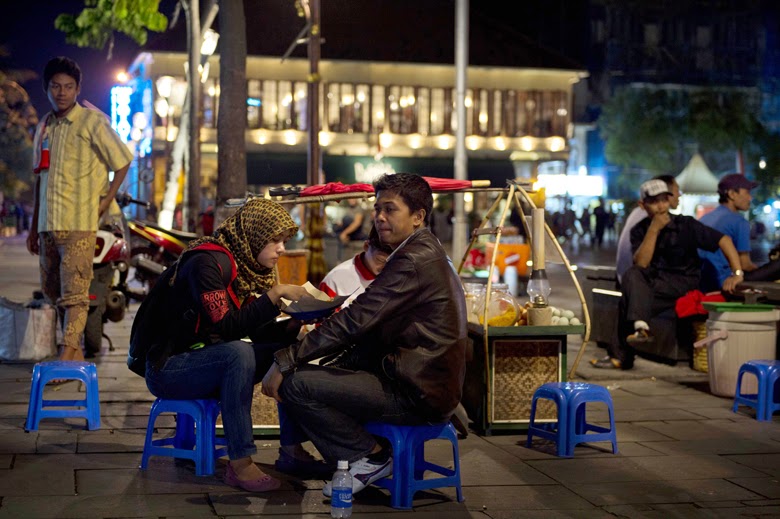
Pedestrians enjoy street food in Jakarta’s Kota Tua. (AFP Photo/Romeo Gacad)

Revitalization plan

The Fiesta Fatahillah will also mark the opening of a Visitor’s Center on the ground floor of the Fatahillah Post Office.

“The visitor’s center will provide anyone who is interested with detailed information regarding the project,” Lin Che Wei said.

A very important part of the revitalization plan is to convert the Kota Tua area into a special trade and business center.

“Economic activities are needed to sustain this area,” Lin Che Wei said. “However, every utilization and development plan is subject to the approval of [Jeforah’s] advisory board.”

These activities will involve art and culture, education, lifestyle (food, fashion and entertainment), MICE (meeting, incentive, convention, exhibition), creative industries and finance.

“The advisory board guarantees there will be no gentrification and no change to the old buildings,” Goenawan said.

Instead, owners of Kota Tua’s colonial buildings will be encouraged to renovate.

“The provincial government will enact new regulations for building owners,” Arie of Jakarta Tourism said.

Under the new regulations, owners who neglect their property will be given a large penalty, while those who agree to renovate and maintain their structures will enjoy significant discounts on land and building taxes.

“Those who cannot afford to renovate their old buildings, may send their proposals to us,” Arie said.

“The governor has agreed to contribute a portion of Jakarta’s development budget to renovate some of these historical buildings.”

Jeforah and Jotrc aim to renovate 85 colonial structures in the area within the first five years of the project.

On the opening night of the festival, the Indonesia Port Corporation (Pelindo) will also sign an agreement with Jeforah and Jotrc to revitalize the 33-hectare area of the historic Sunda Kelapa Harbor.

“Everything is already on track,” Arie said. “With the right people on our team, I’m optimistic the plan will be executed properly.”

The government is also working on a traffic master plan to alleviate the heavy traffic jams in this area and planning to build more sidewalks for tourists.

“This is our starting point,” Lin Che Wei said. “With the commitment and participation of all stakeholders, I’m positive that Kota Tua can once again be a wonderful place to live, work and play.”

A revitalized Kota Tua can play an important role in promoting Jakarta as a destination offering more than just malls and traffic gridlock.

Fiesta Fatahillah
March 13 to 16
5 p.m. to 10.30 p.m.
Related Article:


Sukarno’s Daughter Given Rights to Biopic

Jakarta Globe, Lenny Tristia Tambun, Mar 11, 2014

A still from the official trailer of ‘Soekarno – Indonesia Merdeka.’
(YouTube Image)

Jakarta. The Central Jakarta Commercial Court has handed over the rights to a popular biopic about Indonesia’s founding president to his second daughter Rachmawati Sukarnoputri after a months-long legal dispute over the film’s content.

Based on the verdict, the court ruled that producer Raam Punjabi and director Hanung Bramantyo have violated the intellectual rights of the Sukarno family.

“The legal process has been going on for three months, and thank God, the judge has decided that the rights to ['Soekarno: Indonesia Merdeka'] are mine,” Rachmawati said at a press conference on Tuesday.

Rachmawati’s lawyer Leonard Simorangkir added that she will proceed to claim material compensation for the film, though the amount of money is still undecided.

“The movie made a profit,” Leonard said. “We want to claim the profit through legal means. It’s up to Ibu Rachmawati where she wants to give the money to.”

However, according to the lawsuit, Rachmawati only asked Raam Punjabi and Hanung Bramantyo to apologize and pay a symbolic sum of Rp 2 ($0.000176).

“In this lawsuit, its not the amount of money that Ibu Rachmawati concerned about,” Leonard said. “The important thing is that they feel guilty and pay the damages, even though it’s only Rp 2.”

Speaking on the topic of biopics, Rachmawati stressed that all filmmakers have the right to make films about important historical figures, as long as they obtain the consent of their descendants beforehand.

“In this case, we made an agreement that had to be obeyed by both parties,” she said. “It turned out that the party that partnered with me flouted the agreement and made the film different from the original script. It ruined Sukarno’s character.”

She said that she came up with the original idea for the movie and only hired Hanung to direct the movie on the recommendation of prominent Indonesian actress Widyawati.

“Hanung was merely a painter I asked to paint,” she said. “The plans and ideas were mine. I knew my father much better than he and Raam Punjabi did.”

Rachmawati had already filed a separate defamation lawsuit with the special crimes division of the Jakarta Police last year.

“I hope that they can be made suspects as soon as possible,” she said.

Monday, March 10, 2014

Thai police target 'passport ring' in vanished flight probe

Google – AFP, 9 March 2014

People stand beside the arrival board showing the missing Malaysia Airlines
 Boeing 777-200 plane (on top and in red) at Beijing Airport on March 8, 2014 
(AFP/File, Mark Ralston)

Bangkok — Thai police said Sunday they were investigating a "passport ring" as details emerged of bookings made in Thailand with stolen European passports for the vanished Malaysia Airlines flight.

Two European names -- Christian Kozel, an Austrian, and Luigi Maraldi of Italy -- were listed on the passenger manifest of the flight MH370, but neither man boarded the plane, officials said.
Both had their passports stolen in Thailand over the past two years.

Malaysia has launched a terror probe investigating the suspect passengers and the United States has sent in the FBI to assist.

Flight information seen by AFP shows that tickets were booked in Maraldi and Kozel's names on March 6, 2014, and issued in the Thai city of Pattaya, a popular beach resort south of the capital Bangkok.

The e-ticket numbers for their flights are consecutive and both were paid for in Thai baht.
Each ticket cost THB 20,215 (US$625).

Kozel was booked to travel from Kuala Lumpur to Beijing on the Malaysia Airlines Boeing 777, then on to Amsterdam and Frankfurt.

Maraldi was booked on the same flights until Amsterdam, where he was to continue to Copenhagen.

Interpol confirmed that "at least two passports" recorded in its Stolen and Lost Travel Documents (SLTD) database were used by passengers on board the flight, which was carrying 239 people.

"The Austrian and Italian passports were added to Interpol's SLTD database after their theft in Thailand in 2012 and 2013 respectively," it said in a statement.

A senior Thai police official told AFP that authorities were probing a passport racket on the resort island of Phuket, where Maraldi's passport was stolen.

"A police team combined with local police and immigration are working to track down a passport ring," southern police commander Panya Mamen said.

A district official in Phuket said that Maraldi had presented himself to police there on Sunday.

"An Italian tourist, Luigi Maraldi, has met southern police commander today in Phuket to say he was not on the plane and his passport had been stolen since last year," district police lieutenant colonel Akanit Danpitaksart told AFP.

He said they had no information on Kozel's passport but Austrian foreign ministry spokesman, Martin Weiss, said Sunday that it had been stolen on a flight from Phuket to Bangkok.

Related Articles:

Friday, March 7, 2014

Bali Deports Two Australian Journalists Covering Schapelle Corby Parole

Jakarta Globe, Made Arya Kencana, Mar 07, 2014

Australian and Indonesian journalists crowd around a police van carrying
 convicted Australian drug trafficker Schapelle Corby following her release from
 Kerobokan Prison in Denpasar, Bali on February 10, 2014. (Reuters Photo/
Jason Reed)

Denpasar. Two Australian journalists attempting to cover the story of freed drug mule Schapelle Corby were deported on Friday for alleged visa violations.

Daniel William Sutton, a reporter working for Australian TV network Channel 10, and Nathan Mark Ritcher, a freelance photographer, were arrested in Kuta district — close to where Schapelle is staying for her parole period.

“We will be deporting them both this afternoon,” Bali Justice and Human Rights office head Gusti Kompyang Adnyana said earlier on Friday.

Sutton and Ricther were making preparations to do a live report when the officers arrested them on Friday.

Adnyana said the two journalists violated Indonesian law by attempting to report using visas on arrival, which are intended for tourists.

“A visa on arrival is only meant for tourism purposes,” he said. “It cannot be used for journalism or any commercial activities.”

Sutton and Ritcher were detained for two days prior to their deportation.

Adnyana denied that his office was discriminating against Australians by deporting the journalists. He said other foreign journalists were allowed to stay and work because they didn’t violate Indonesia’s visa policy.

When asked why the immigration office did not arrest journalists from Channel Seven Australia who interviewed Corby’s sister, Mercedes, Adnyana said his office only managed to arrest two journalists so far.

Adnyana said the arrest should serve as a lesson for foreign journalists so they would not neglect the importance of possessing proper documentation.

“They must use a journalist visa that has been approved by the Ministry of Foreign Afairs and Ministry of Communication and Information,” he said.

Media coverage surrounding Schapelle Corby has become the source of controversy after the Indonesian government threatened to revoke her parole following her sister’s interview.

Mercedes apologized for the interview and said she did not mean to insult Indonesia with her statements.

Schapelle was released from Bali’s Kerobokan Prison on Feb. 10 after spending more than nine years behind bars for attempting to smuggle 4.1 kilograms of marijuana into Bali in her surf gear. She was sentenced to serve 20 years in 2005, but her term was reduced by annual sentence cuts and by a five-year presidential remission.

She must remain in Indonesia until 2017 as a requirement of her parole.

Related Article:


Wednesday, March 5, 2014

Indonesian clerics issue fatwa to protect wildlife

Google – AFP, 5 March 2014

Indonesian policemen show off the remains of preserved Sumatran tigers (L and R)
 and other animals after seizing them in Takengon Central Aceh, in Banda Aceh
on January 27, 2014 (AFP/File, Chaideer Mahyuddin)

Jakarta — Indonesia's top Islamic clerical body has issued a religious fatwa against the illegal hunting and trade in endangered animals in the country, which the WWF hailed on Wednesday as the world's first.

The fatwa by the Indonesian Ulema Council declares such activities "unethical, immoral and sinful", council official Asrorun Ni'am Sholeh told AFP.

"All activities resulting in wildlife extinction without justifiable religious grounds or legal provisions are haram (forbidden). These include illegal hunting and trading of endangered animals," said Sholeh, secretary of the council's commission on fatwas.

"Whoever takes away a life, kills a generation. This is not restricted to humans, but also includes God's other living creatures, especially if they die in vain."

The country of 250 million people is the world's most populous Muslim nation, but it remained unclear whether the fatwa would have any practical impact.

Indonesia's vast and unique array of wildlife is under increasing pressure from development, logging and agricultural expansion.

The government does not typically react to fatwas by implementing specific policy changes.

However, a Forestry Ministry official who asked to remain anonymous told AFP the ministry and the religious council would make a joint announcement regarding the fatwa on March 12, without elaborating on its content.

The WWF called the fatwa the first of its kind in the world, and said the use of religion for wildlife protection "is a positive step forward."

A baby pangolin is released into the wild by government wildlife and conservation
 officers in North Sumatra province on July 31, 2012 after Indonesian police
intercepted 85 endangered pangolins stuffed into sacks by smugglers (AFP/File)

"It provides a spiritual aspect and raises moral awareness which will help us in our work to protect and save the remaining wildlife in the country such as the critically endangered tigers and rhinos," WWF Indonesia communications director Nyoman Iswara Yoga said.

The fatwa was the result of months of dialogue between government officials, conservationists and other stakeholders, said Sholeh, the fatwa commission official.

Acknowledging it was not legally binding, Sholeh said in English: "It's a divine binding."

He said the fatwa was effective from January 22. It was only made public late Tuesday.

The fatwa urges the government to effectively monitor ecological protection, review permits issued to companies accused of harming the environment, and bring illegal loggers and wildlife traffickers to justice.

The clearing, often illegally, of Indonesia's once-rich forests for timber extraction or to make way for oil palm or other plantations poses a severe threat to critically endangered species such as the Sumatran tiger, orangutan, and Sumatran elephant.

Poachers also target wild elephants for their ivory tusks, for use in traditional Chinese medicines.

Under Indonesian law, trafficking in protected animals can result in a maximum of five years in jail and 100 million rupiah ($8,700) fine.

Saturday, March 1, 2014

FIFA authorises wearing of veils, turbans during matches

Google – AFP, 1 March 2014

Picture taken on November 30, 2006 shows Jordan midfielder Abeer Al Nahar
 at a training session at the Al-Arabi Football Stadium in Doha (AFP/File,
Toshifumi Kitamura)

Zurich — Football's world governing body FIFA on Saturday officially authorised the wearing of head covers for religious purposes during matches.

"It was decided that female players can cover their heads to play," said FIFA secretary general Jerome Valcke at a meeting of the International Football Association Board (IFAB), the sport's lawmakers, in Zurich.

That will allow female Muslim players who wear a veil in everyday life to cover their heads during matches, and Valcke added that male players will also be authorised to do so following a request from the Sikh community of Canada.

"It was decided that male players can play with head cover too," he said, although they will not be the same as those worn day-to-day.

"It will be a basic head cover and the colour should be the same as the team jersey."

The wearing of head covers had been banned until 2012, with FIFA saying that they posed too great a risk of injury to the head or neck.

However, the IFAB then allowed for them to be tested out over a two-year period following a request from the Asian Football Confederation (AFC), a trial which proved to be successful.


Iranian women footballers run with the national flag at a stadium in Amman on
 June 3, 2011 moments after they were barred from playing an Olympic qualifier
against Jordan for wearing the traditional Islamic headscarf (AFP)

Fifa allows Iran girl footballers to cover their heads

Iran agreed the girls could swap
their headscarves for caps

Mideast Peace Talks in Focus at Palestinian Development Meet

Jakarta Globe – AFP, March 1, 2014

Indonesian President Susilo Bambang Yudhoyono delivers a speech during
 the second Conference on Cooperation among East Asian Countries for Palestinian
Development (Ceapad) in Jakarta on March 1, 2014. (AFP Photo)

Jakarta. Representatives of 22 nations met in Jakarta on Saturday to discuss Palestinian development, with co-chairs Japan and Indonesia reiterating their support for a two-state solution.

The second Conference on Cooperation among East Asian Countries for Palestinian Development (Ceapad) is aimed at boosting infrastructure and supporting the private sector in the Palestinian Territories.

But a looming deadline for a full Middle East peace deal brokered by US Secretary of State John Kerry is expected to feature prominently in talks.

“We still believe that the two-state vision can be envisaged and realized. And here I must commend the… efforts of Mr John Kerry,” Palestinian prime minister Rami Hamdallah said during the conference’s opening.

Kerry, who coaxed the two sides back to the negotiating table in late July after a three-year hiatus, said Wednesday a full deal would likely slip past the April 29 deadline.

The document has not yet been made public, but Hamdallah said on Friday “all issues actually have been (put) on the table.”

The document is understood to include a non-binding proposal laying out guidelines for negotiating the central issues of the conflict, including such as borders, security, Jerusalem, the settlements and the right of return for Palestinian refugees.

Hamdallah expressed gratitude to donor nations, but said Israeli settlements were “severely” hampering development.

“Sixty-two percent of all our land is still controlled by the Israeli authorities. This impedes any access we have to natural resources, and severely restricts our development,” he said.

“The people of Palestine have been struggling to achieve this dream for more than five decades,” Indonesian President Susilo Bambang Yudhoyono said at the opening.

“Providing them with capacity-building program is critical.”

Yudhoyono said that Indonesia envisaged a Middle East “at peace with itself and the rest of the world” and that peace would also depend on a treaty on nuclear weapons and weapons of mass destruction.

Japanese Foreign Minister Fumio Kishida said that security in the Middle East was “by no means someone else’s problem in a distant region” for Asian nations.

“I firmly believe participating countries share the common determination to assist in a Palestinian state-building that promises to bring about regional peace and stability,” he said in Japanese, according to a statement.

“Such assistance will help achieve a ‘two-state solution’, which would see Palestine and Israel in peaceful coexistence and co-prosperity,” he said.

The Ceapad is jointly chaired by Indonesia, the Palestinian Authority and Japan.

Among attending nations are South Africa, Singapore, Australia, Brunei and Vietnam, while China’s special envoy on the Middle East issue Wu Sike attended.

The conference was initiated by Japan, a major donor to the Palestinian Territories, with the first event held in Tokyo last year.

The conferences are not designed to seek fresh aid pledges, officials said, although several countries have made pledges following last year’s meeting.

Agence France-Presse

Thursday, February 27, 2014

Indonesia's Batik Air to launch international service

Google – AFP, 27 February 2014

Two air hostesses stand next to a Boeing 737-900 plane of the new Indonesian
 airline Batik Air in Tangerang on the outskirts of Jakarta on April 25, 2013 (AFP,
Adek Berry)

Singapore — An airline owned by Indonesia's Lion Group announced Thursday it will launch international services with a flight from Jakarta to Singapore later this year.

Batik Air, which is part of the Lion Group that also owns Indonesian budget carrier Lion Air, will start the flights by November or December, said its chief executive Achmad Luthfie.

The airline, which operates as a full-service carrier with meals and drinks and offers business and economy class seating, began operations in May last year servicing domestic destinations in Indonesia.

"Our first international destination will be Singapore and we aim to have more than a daily service on the route," Luthfie said in a statement.

"We chose Singapore as our first international destination because we can see that demand continues to increase," he added.

Speaking at a news conference in Singapore, Luthfie said Batik Air plans to fly next from the Indonesian capital to Kuala Lumpur in Malaysia.

Luthfie said that eventually it is looking to fly to Southern China and Western Australia.

On the domestic front, the airline plans to more than double its network to 22 destinations including Palembang, Solo and Batam.

Luthfie said the carrier is currently filling 90 percent of seats.

Batik Air operates six Boeing 737-900ER aircrafts and is based in Jakarta's Soekarno-Hatta airport.

Six Airbus A320 aircraft and four Boeing 737-800 planes will be delivered by the end of this year, the airline said.

Indonesia, a sprawling archipelago of over 17,000 islands cutting across three time zones, relies heavily on air transport and is experiencing a sharp growth in its aviation sector, thanks to a rapidly rising middle class.

Indonesian Capital Seeks to Revive Crumbling Kota Tua

Jakarta Globe – AFP, Madura McCormack, February 26, 2014

A man sits near a neglected colonial building in Kota Tua, North Jakarta,
in this file photo. (JG Photo/Afriadi Hikmal)

Jakarta. Once resplendent facades sagging in the tropical heat and empty shells of colonial-era buildings are depressing signs that the old town of the Indonesian capital Jakarta, once considered the “Jewel of Asia,” has suffered decades of neglect.

Palm trees grow through crumbling windows in what was once the center of power for Indonesia’s Dutch colonial rulers, and many buildings that are still intact lie empty, stained grey by fumes from hordes of passing traffic.

But Jakarta’s popular governor Joko Widodo, who has energetically taken on the task of transforming one of the world’s most chaotic metropolises, has a new plan to overhaul the old town and attract more tourists.

“It has to be done, otherwise it is going to deteriorate,” said Goenawan Mohamad, a well-known Indonesian writer and member of the group set up to regenerate Kota Tua. “It’s about time.”

Nevertheless, there is much scepticism.

Other plans have failed and some fear that even if the latest makes progress, developers might transform the area into a “Disneyland” full of garish malls rather than a well-preserved heritage area.

Restoring colonial splendor

Kota Tua, in modern-day North Jakarta, was once a global trading center, where merchants would arrive to buy and sell goods from across the Indonesian archipelago, particularly spices sought after in Europe.

With its whitewashed buildings and cobbled streets, the area for centuries made up almost the whole of Jakarta, then known as Batavia, and was called the “Jewel of Asia” by European sailors arriving after long sea voyages.

Jakarta has expanded to become a city with a population of some 10 million, better known now for its traffic jams than historic buildings, and Kota Tua has fallen into disrepair, out of favor with the city’s well-heeled residents.

Some small sections have been preserved. Cobbled “Fatahillah” square, the heart of the old town and the most visited part, is in good condition and is packed out with vendors selling trinkets to the small number of passing tourists.

On the square, and also well-preserved, are the former city hall and a museum showcasing Indonesian puppets.

But outside this small area most of the buildings are in a state of serious decay.

Joko — who was elected last year — and his supporters hope their initiative might at last return some colonial splendor to Jakarta.

They believe their plan stands a better chance of success than previous ones as they have created an umbrella organisation with what they believe is the right mix of people to oversee the regeneration.

The consortium includes private firms, a former government minister and a heritage group.

Crucially they have the strong backing of the Jakarta authorities, who have pledged a 150 billion rupiah ($12.5 million) budget for the regeneration.

Previous attempts suffered either from a lack of coordination between numerous different players, or the opposite — just one group but a lack of resources, said Lin Che Wei, chairman of the consortium’s board of advisors.

There are signs that work is under way on some buildings in the area, and a visitor centre and exhibition space for contemporary art are due to open next month.

The consortium intends to renovate 85 historic buildings over five years, a program it says will create 11,400 jobs.

Disneyland fears

However, some have expressed fears over-enthusiastic development might destroy Kota Tua’s charms and transform it into an area full of ugly modern buildings and shopping malls.

“Kota Tua is a city, it’s not Disneyland,” said Ella Ubaidi, owner of a colonial-era building in the old town.

Her apprehensiveness stems from the profile of the consortiums’ board of trustees, some of whom are from large Indonesian property companies.

There is also a lack of enthusiasm among the public.

Some regard Kota Tua, a district built by colonizers, as a symbol of repressive rule, and there has been little interest among Jakarta’s citizens in maintaining it since the Dutch left Indonesia in the late 1940s.

Nevertheless, the plan’s backers are optimistic. They believe they can attract more tourists to Jakarta, which lags behind other Southeast Asian capitals in numbers of foreign visitors, as they restore Kota Tua to its former glory.

Agence France-Presse